CanadaBhagwan Swaminarayan & Akshar Purushottam
BAPS Shri Swaminarayan Mandir Toronto
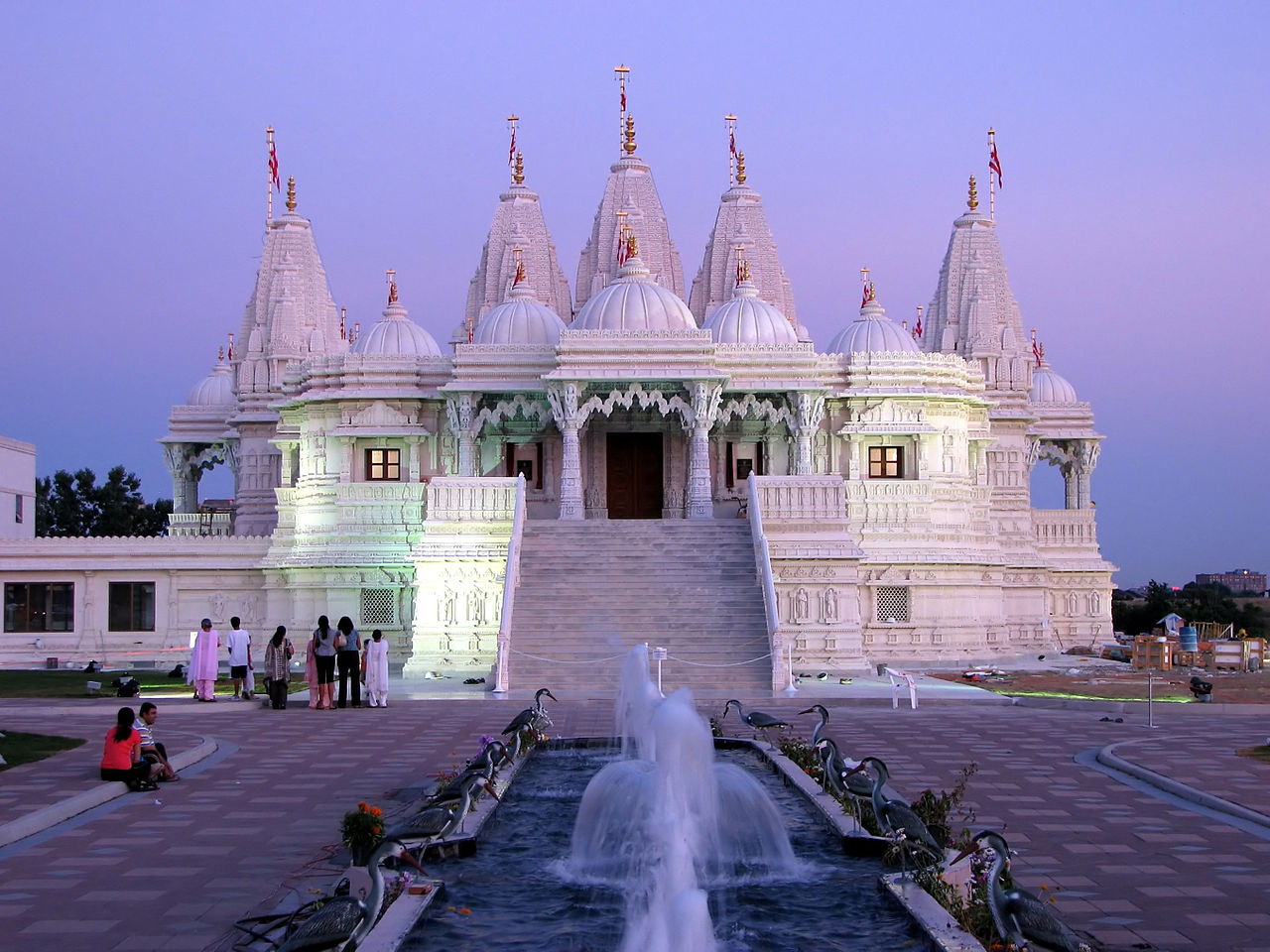
Explore BAPS Shri Swaminarayan Mandir in Toronto, Canada: hand-carved from 24,000+ pieces of Italian marble and Turkish limestone, featuring a Burmese teakwood Haveli and heritage museum.
Etobicoke, Toronto, Ontario, Canada Bhagwan Swaminarayan & Akshar Purushottam Built: 2007
Share
Overview
BAPS Shri Swaminarayan Mandir, located in Etobicoke in the Greater Toronto Area, is Canada's largest traditional hand-carved Hindu stone temple and one of the nation's most celebrated architectural achievements. Consecrated on July 22, 2007, by His Holiness Pramukh Swami Maharaj, the mandir was assembled without structural steel from over 24,000 pieces of hand-carved Italian Carrara marble, Turkish limestone, and Indian sandstone.
The complex encompasses the traditional stone mandir, an intricately carved Burmese teakwood Haveli (cultural centre), and the Canadian Museum of Cultural Heritage of Indo-Canadians, which chronicles the century-long journey and contributions of the Indo-Canadian community.
Quick Facts
Deity
Bhagwan Swaminarayan & Akshar Purushottam
Location
Etobicoke, Toronto, Ontario, Canada
Built
2007
Built By
BAPS Swaminarayan Sanstha / His Holiness Pramukh Swami Maharaj
Coordinates
43.74, -79.63
Timings
9:00 AM – 7:30 PM daily (Mandir open year-round)
Entry Fee
Free admission and parking; Heritage Exhibition has a modest ticket fee ($5 CAD)
History
The BAPS Swaminarayan community in Toronto held its first spiritual assemblies in devotee homes during the early 1970s. In 1974, Pramukh Swami Maharaj made his first pastoral visit to Toronto. In 1984, the congregation purchased an industrial building in Richmond Hill to serve as an interim mandir. By 1999, growing numbers inspired plans for a permanent traditional shikharbaddh stone temple on an 18-acre property on Claireville Drive in Etobicoke.
More than 1,800 artisan sculptors in Rajasthan, India, hand-chiselled raw blocks of stone, which were then numbered, shipped to Canada in 305 containers, and assembled like an immense 3D jigsaw puzzle by hundreds of dedicated volunteers. The grand opening in 2007 was attended by then-Canadian Prime Minister Stephen Harper and Ontario Premier Dalton McGuinty.
Architecture
The mandir adheres strictly to ancient Vastu Shastra principles. The building comprises 24,151 individual stone elements carved by hand. It features 5 intricately carved pinnacles (shikharas), 7 grand domes, 132 pillars, and 340 sculpted motifs of deities, celestial dancers, and peacocks. The interior is lined with immaculate white Carrara marble, maintaining a radiant luminosity under natural skylights.
Adjacent to the stone mandir is the sprawling wooden Haveli, fashioned from hand-carved Burmese teakwood and English oak, featuring traditional courtyards, arched balconies, and floral brackets depicting classical Gujarati woodwork.
Main Deity
Bhagwan Swaminarayan & Akshar Purushottam
Religious Significance
With over 820,000 Hindus residing in Canada (representing approximately 2.3% of the national population), the Toronto mandir serves as an architectural landmark of national pride and an active embassy of Indian spiritual values in North America. The temple has welcomed Canadian prime ministers, federal ministers, governors general, foreign dignitaries, and hundreds of thousands of schoolchildren on educational tours. Its 'Canadian Museum of Cultural Heritage of Indo-Canadians' serves as an authoritative public institution highlighting the historical ties between India and Canada.
Temple Legends
According to the Akshar Purushottam philosophy revealed by Bhagwan Swaminarayan (1781–1830), the mandir is an earthly abode of the Divine where sincere seekers achieve inner peace and realize God through darshan of the sanctified murtis and guidance of a living spiritual guru (the Gunatit Sadhu).
Festivals & Celebrations
Diwali and Annakut (New Year) are the temple's largest annual festivities, attracting tens of thousands of visitors who admire the spectacular display of more than 1,000 vegetarian dishes prepared and offered before the deities. Krishna Janmashtami, Ram Navami, Mahashivratri, and Swaminarayan Jayanti are marked with devotional music, classical dances, spiritual discourses, and outdoor fireworks displays.
Daily Rituals
The mandir conducts five daily aarti ceremonies: Mangala Aarti at 6:00 AM, Shangar Aarti at 7:30 AM, Rajbhog Aarti at 11:15 AM, Sandhya Aarti at 7:00 PM, and Shayan Aarti at 8:30 PM. The Nilkanth Varni Abhishek ritual allows visitors to personally pour sanctified water over the sacred bronze murti while offering personal prayers for global peace.
Visitor Information
Timings
9:00 AM – 7:30 PM daily (Mandir open year-round)
Entry Fee
Free admission and parking; Heritage Exhibition has a modest ticket fee ($5 CAD)
Dress Code
Modest dress required: tops must cover the shoulders, chest, and upper arms; bottoms must cover the knees and lower legs; wraps are provided at the welcome desk for visitors if needed; footwear must be deposited in the shoe room
Photography
Photography is permitted in the outdoor courtyards and gardens; photography and video recording are strictly prohibited inside the stone Mandir sanctuary and exhibition areas
Accessibility
Fully wheelchair accessible with elevators, ramps, accessible washrooms, and complimentary wheelchairs available at the entrance
Best Time to Visit
Mid-morning (10:30 AM to 12:00 PM) to experience the Rajbhog Aarti and natural light pouring through the marble domes; or during Diwali/Annakut in October/November for the Annakut display
How to Reach
Located at 61 Claireville Drive, Etobicoke, Toronto, Ontario (near the intersection of Highway 427 and Finch Avenue West). Just 10 minutes drive from Toronto Pearson International Airport (YYZ). Accessible via TTC bus route 36A or 927 from Humber College or Highway 407 subway station.
Nearby Attractions
Claireville Conservation Area (adjacent), Woodbine Racetrack and Casino (5 km south), Wet 'n' Wild Toronto water park (4 km west), Fantasy Fair at Woodbine Centre
Interesting Facts
- It is the largest traditional hand-carved Hindu stone mandir in Canada.
- Over 24,000 hand-carved stone pieces were assembled without a single steel rod or structural beam.
- Over 1,800 master artisans in India hand-carved the limestone and Italian marble components.
- Canadian Prime Minister Stephen Harper attended the grand consecration in July 2007.
- The adjoining Haveli features thousands of square feet of hand-carved Burmese teakwood.
Image Gallery
1 / 2
Canada's largest hand-carved stone temple, constructed from over 24,000 stone pieces
Frequently Asked Questions
Is BAPS Shri Swaminarayan Mandir Toronto open to non-Hindus?
Yes, the Mandir welcomes visitors of all faiths, backgrounds, and nationalities. Free self-guided tours and knowledgeable volunteer guides are available daily.
How long does a visit to BAPS Toronto typically take?
Most visitors spend between 1.5 to 2.5 hours exploring the stone mandir, viewing the teakwood Haveli, attending the aarti ceremony, and browsing the Canadian Museum of Cultural Heritage of Indo-Canadians.
Is there vegetarian food available on campus?
Yes, the Shayona snack shop and cafeteria on campus offers freshly made authentic Indian vegetarian savouries, sweets, snacks, and lunch meals.
Sources & References
- [1]BAPS Shri Swaminarayan Mandir Toronto Official Portal temple
- [2]City of Toronto Heritage Preservation Services government
- [3]Canadian Museum of Cultural Heritage of Indo-Canadiansacademic
— every record linked above was re-requested for this release, so the link still resolves and the publisher still serves the document. It is a link check, not a re-verification of every sentence on this page.
More Temples in Canada
Explore other Hindu temples in Canada.
