Somnath 1025–26: Raid, Return and the Jat Campaign
Mahmud of Ghazni's raid on Somnath, the costly march home, the reported Jat campaign of 1027 — and the two later reconstructions that turned an eleventh-century event into the story most people think they know.
Published
10 October 2026
Last reviewed
10 October 2026
Reading time
22 min read
Evidence base
Persian chronicles, inscriptions, colonial records
What this guide establishes
- Mahmud of Ghazni raided Somnath once, in the winter of 1025–26. He led roughly seventeen expeditions into India; the raid on the temple is one of them, not seventeen of them, and popular claims that he looted Somnath 11 or 12 times confuse separate campaigns with repeat assaults on the shrine.
- The return journey was the costly part of the campaign. The army reached Ghazni in April 1026, and the chronicles that report its arrival report a much smaller force than the one that left.
- In 1027 a separate punitive expedition was sent against Jat communities in the Sindh–Sindh Sagar region for harassing that return. No source consulted here reports a Ghaznavid defeat, and none names a Jat commander.
- The story as most people know it was assembled later — by colonial administrators in 1842, by nationalist politicians between 1947 and 1951, and by writers working from those two moments ever since.
A raid, a return journey, and a story that grew afterwards
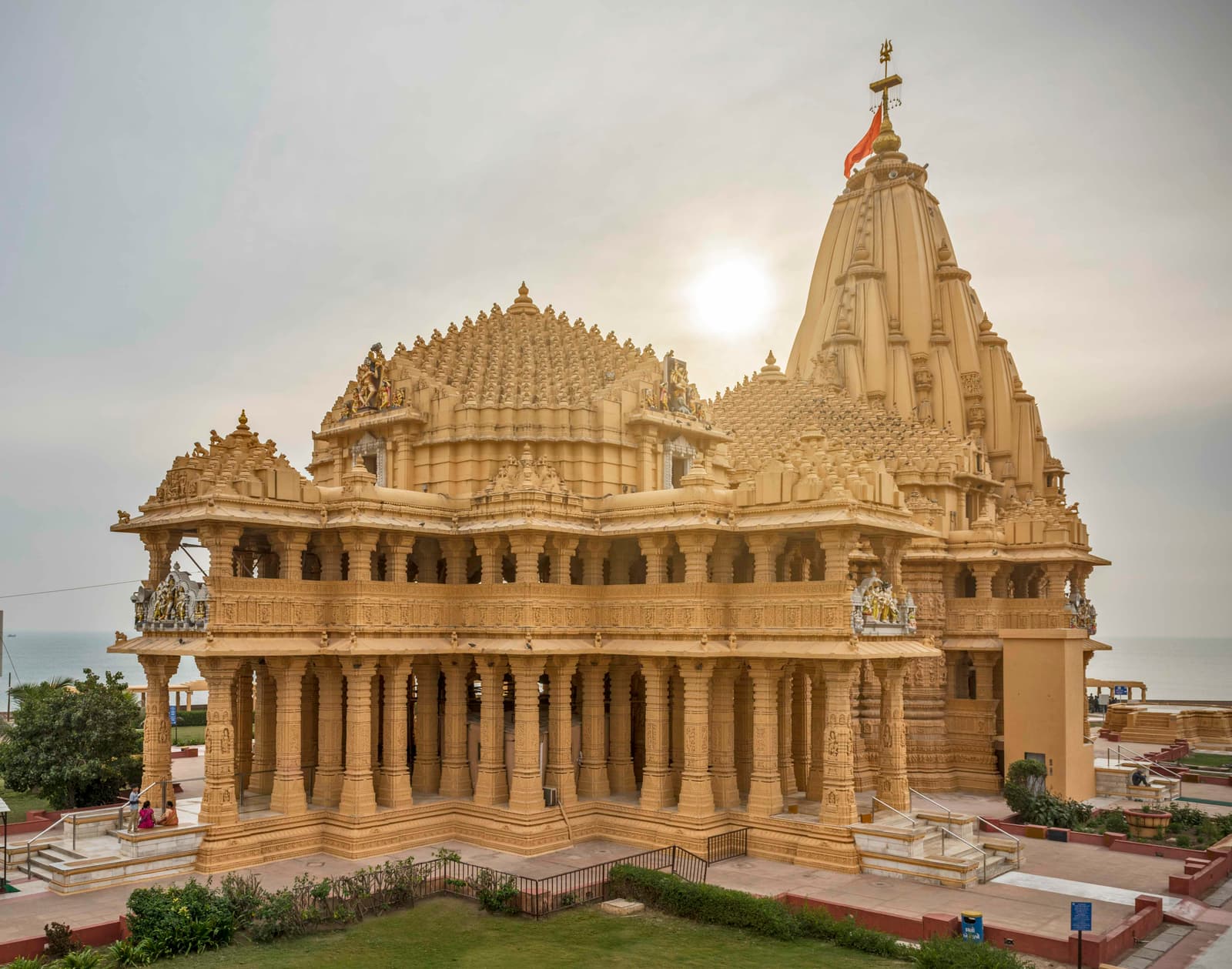
Somnath is a working temple on the Saurashtra coast and one of the twelve Jyotirlingas. It is also the site of the most frequently retold military episode in medieval Indian history. Two things tend to get merged whenever that episode is told: an eleventh-century raid on a temple, and the much larger narrative that has been built on top of it over the last two hundred years.
This page keeps the two apart. It follows the campaign of 1025–26 from the Ghaznavid departure to the return to Ghazni, then the separate expedition of 1027, and then — only after that — the nineteenth- and twentieth-century work that turned the raid into a symbol. Where a claim rests on a named chronicle, the chronicle is named. Where it rests on tradition, it is labelled as tradition. Where it cannot be supported at all, the page says so rather than repeating it because it is familiar.
That structure matters more here than on almost any other page on this site. The Somnath raid is one of the few medieval events in Indian history that most readers will arrive at already holding a version of — a number of campaigns, a number of destructions, a defeat on the return march. Almost all of those specifics are either wrong, unverifiable, or attached to a different event.
The raid, the return, and the expedition that followed
Sections 01 to 06 stay inside the eleventh-century record. What the chronicles say, what they do not say, and where the popular version departs from both.
What the sources actually say
Nearly everything known about the raid comes from writers working inside the Ghaznavid world or shortly after it. The contemporary and near-contemporary testimony is Arabic and Persian. Al-Biruni, who spent years in India and is the author of the Kitab fi tahqiq ma li'l-hind — commonly cited as Tahqiq-e-Hind — is the closest thing the event has to an eye-witness among surviving named authors. Later Persian histories carry the narrative forward, and later still, European historians of the eighteenth and nineteenth centuries translated and amplified it.
On the other side of the ledger there is a silence that is itself evidence. A. K. Majumdar's 1956 study of the Chaulukyas of Gujarat, quoted in Romila Thapar's work on the temple, puts it plainly: Hindu sources give no information about the raids of Sultan Mahmud, so what follows is based solely on the testimony of Muslim authors. Thapar's own point is not that the chronicles are false. It is that they were accepted as historically valid without much attention to their internal contradictions, largely because they happened to resemble what European historians of the period expected a history to look like.
The consequence is a lopsided record. The raid is extremely well documented for an eleventh-century event — far better than most battles of the period — and almost all of that documentation is celebratory, written for a court that had an interest in the size of the victory. Reading it responsibly means using the chronicles without treating their figures as measurements.
Dating the raid: 1024, 1025 or 1026
The army left Ghazni on 18 October 1025 according to the standard chronology drawn from Nazim's study of Mahmud. It rested at Multan, crossed the desert, took the fort of Ludrava near Jaisalmer, moved through the Jaisalmer country and Mallani, and reached Anhilwara — Patan — by the end of December. The siege of Somnath began on 6 January 1026 and the temple fell after three days.
So the year depends on which part of the campaign you are dating and which calendar you are using. Al-Biruni reports that Durlabha of Multan computed the year of the raid as Shaka 947, which Thapar renders as AD 1025–26 — the double-year form that most modern scholarship now uses. The year-by-year reading of the Persian chronicles places the attack itself in the winter of 1025–26. The recent academic literature on the temple's modern history, including Tommaso Bobbio's 2023 article in the Journal of the Royal Asiatic Society, refers to the invasion of AD 1026.
The date 1024, which still appears in Indian publications and on this site's own temple page, belongs to a different conversion of the Hijri dating, and the variation across the literature is real: datings ranging from January 1025 to January 1026 are in print. It is not a conspiracy and it is not evidence of anything except the persistence of an older convention. This page uses 1025–26 and flags the alternatives where they matter.
The march, the siege and what was taken
Bhima I of the Chaulukya dynasty, whose capital was at Anhilwara, withdrew to the fort of Kanthkot in Kutch rather than meet the Ghaznavid army in the field. A defence was assembled further south: roughly twenty thousand warriors under local chiefs at Modhera were defeated, and the garrison at the port held out for three days.
The temple fell on 8 January 1026. The accounts describe the treasury taken and the lingam broken, and they describe the two together. That pairing is the reason the raid has never separated cleanly into a financial act or a religious one — the sources present it as both, and a reader who insists on one reading over the other is choosing, not discovering.
The plunder figure usually quoted is twenty million dinars. Numbers of that order in a medieval chronicle are not measurements. They are the writer's way of saying that a great deal was taken, and they should be read that way. The same applies to the army strengths that circulate alongside them.
The army stayed eighteen days. Before leaving, Mahmud is reported to have instructed Bhima's brother that the temple should be rebuilt — an instruction that, if it happened as reported, tells you something about how the raid was understood at the time: as an extraction from a subject territory, not as the annihilation of a place that could never be used again.
The return journey: the part that cost the campaign
The march out of Gujarat is where this story usually gets compressed into a sentence, and it is the part that most needs the detail. The army did not simply go back the way it came. A force under a king the chronicles call "Param Dev" blocked the direct passage, which pushed the Ghaznavids through the Aravalli hills and the Rann of Kutch. From there the route ran by Kutch and Sindh — the so-called watery route — past Miyani, on to Kanthkot, and north to Mansura.
It was through the Sindh country and the Sindh Sagar doab that the harassment began in earnest. The chronicles describe repeated attacks on the marching column and its baggage. These were not pitched battles; they were the kind of pressure that a heavily loaded army moving through hostile ground is worst equipped to absorb, and the reported result is a very large attrition between the force that left Ghazni in October 1025 and the one that returned to it on 2 April 1026.
The figure attached to that return — that Mahmud arrived with only two thousand men — is the single most quoted number in this entire story and the single most unreliable. It appears in the gazetteer and school-text tradition as a fact. It is a chronicle figure, from a genre that routinely described returning armies as remnants, and it should be reported as reported rather than as counted. What it does establish, directionally, is not disputed: the return was expensive, and the Jat communities of the Sindh Sagar region were part of why.
The Jat campaign of 1027: what is actually reported
Mahmud did not leave the matter there. In 1027 he mounted a further expedition — usually described as punitive — against Jat communities in the Salt Range and the Sindh Sagar doab for the attacks on his army during the previous year's return. The standard treatment is the campaign described in W. Haig's Cambridge History of India and the volume of the History and Culture of the Indian People devoted to the struggle for empire, both of which draw on the Persian sources; Muhammad Nazim's study of Mahmud gives the campaign the same reading.
The military form of the expedition is distinctive and is the part the sources agree on most clearly. Mahmud went to Multan and built a flotilla — the sources give fourteen hundred boats, fitted with iron spikes at the prow and along the gunwales and manned by armed crews. The Jats, who had moved their families and goods to an island in the river, put a fleet of reed boats on the water against it. Some sources give the Jat fleet as eight thousand boats; that figure is generally treated in the literature as inflated, and it is safer to report the smaller number and name the larger one as a variant.
The engagement itself is described as a Ghaznavid victory, and 1027 marks Mahmud's last military expedition into India. He returned to Ghazni around the middle of that year and died three years later, in 1030. The temple at Somnath was rebuilt under the Chaulukya rulers in the twelfth century, and the shrine the visitor sees today dates from 1951.
What the Jat episode does and does not prove
This is the section that most versions of the story skip, and it is the reason the page exists. The reported facts are specific and modest: a regional population harassed a withdrawing army; a punitive expedition was sent the following year; that expedition is reported to have succeeded. Everything beyond that — the defeat of Mahmud, the permanent blocking of his return, a named commander, a battlefield, a decisive turning point — is not in the sources.
Three limits are worth stating outright. No source consulted for this page names a Jat commander. No source consulted for this page reports a Ghaznavid defeat in the 1027 campaign. And no source consulted for this page says the Jats prevented Mahmud from returning — the expedition of 1027 is itself the proof that the route was open enough for an army to use it twice.
None of that diminishes what the harassment achieved. Harassment of a withdrawing army is a real military act with real effects, and the Ghaznavid response — a purpose-built river fleet, deployed the following year — is itself the clearest available measure of how serious the threat was taken to be. The point is not that the Jats did nothing. The point is that the difference between that and the claim usually made online is the whole distance between a chronicle and a myth.
The evidence, claim by claim
Every claim commonly attached to this event, with what kind of support it actually has. This table is the reference point for Sections 11 and 12.
| Claim | Standing | What supports it |
|---|---|---|
| Mahmud raided the temple at Somnath and took its treasury | Established | Recorded in the Persian chronicles and accepted across the modern historiography; it is among the best-documented events of medieval Indian history. |
| The attack belongs to the winter of 1025–26 | Established | Supported by the march chronology — departure from Ghazni on 18 October 1025, siege from 6 January 1026 — and by Al-Biruni's report of Shaka 947, which Thapar renders as AD 1025–26. The year 1024 reflects a different conversion of the Hijri dates. |
| The treasury amounted to twenty million dinars, and the returning army numbered two thousand | Reported | Chronicle figures, from a genre that used round and inflated numbers as a rhetorical device. Reportable as what a named source says; not reportable as a measurement. |
| Jat communities attacked the army on its return through the Sindh Sagar doab | Reported | Reported by the Persian tradition and carried into the standard modern treatments, including Haig's Cambridge History of India and the History and Culture of the Indian People, Volume V. |
| A punitive expedition was sent against the Jats in 1027 and was a Ghaznavid success | Reported | The Battle of the Indus campaign: fourteen hundred boats built at Multan against a Jat reed-boat fleet. Described in the chronicles and in the standard nineteenth- and twentieth-century scholarship. |
| The Jats defeated Mahmud of Ghazni, or permanently stopped him returning | Disputed | Not found in any source consulted for this page. The 1027 expedition is itself evidence the route remained usable. This is a popular online claim, treated in Section 11. |
| A Jat commander led the defence, at a named battlefield | Disputed | No commander, battlefield or troop strength for the Jat side is named in the sources consulted. No such name should be asserted. |
| Mahmud attacked or looted Somnath multiple times (11, 12 or 17 times) | Disputed | Contradicted by every primary chronicle and modern monograph. Mahmud led roughly seventeen campaigns into northern India, but raided Somnath once (1025–26). Later destructions across subsequent centuries were carried out by entirely different dynasties; the 12-times claim confuses overall campaigns or later attacks with repeated Ghaznavid assaults. |
| Thapar reports that no Sanskrit or Prakrit inscription records the raid | Reported | Thapar's observation, carried into the modern literature: a 1038 CE Kadamba inscription from a king of Goa records a pilgrimage and is silent about the raid, and she reports that no inscription of either language refers to it. |
How the labels are applied
Established claims are supported by more than one kind of evidence or carry no significant dissent in the modern historiography. Reported claims rest on a named source and have no independent confirmation. Disputed claims circulate widely and are not found in the sources consulted here, or are contradicted by them. Nothing on this page is presented as established on the strength of a chronicle figure alone.
How the story was built
Sections 07 to 12 follow the two reconstructions — 1842 and 1947\u201351 — and then the online discourse that both of them fed.
Seventeen expeditions is not seventeen attacks on Somnath
Mahmud of Ghazni ruled from 998 to 1030 and campaigned into India repeatedly across a quarter of a century. The figure usually given for those campaigns is seventeen, and it is a real figure attached to a real body of military activity. What it does not describe is seventeen attacks on Somnath.
There was one raid on the temple, in 1025–26. The confusion enters from two directions. First, the count of the expeditions is not itself stable: the Somnath campaign is called Mahmud's fifteenth invasion in some accounts and the 1027 expedition against the Jats is called both his sixteenth and his seventeenth, depending on the source and on whether subsidiary raids are being counted separately. Second, the seventeenth-campaign figure travels through popular writing alongside the word Somnath often enough that the two become welded together.
The result is a multiplication error that the temple's own popular history tends to absorb. When a reader is told there were seventeen expeditions and then told about Somnath in the same breath, the natural inference is a repeated assault, and that inference then supports the further claim that the Jats had to intervene more than once. Neither follows from the record.
A parallel variation of this error claims that Mahmud looted Somnath 'twelve times' — or that Somnath was raided for an 11th or 12th time by Mahmud. This claim has no support in any primary chronicle or reliable scholarship. It stems from conflating three separate things: Mahmud's total Indian expedition tally (where Somnath is sometimes numbered as an 11th, 12th, or 15th expedition in older divergent lists), the traditional status of Somnath as the first of the twelve Jyotirlingas, and the multi-century sequence of subsequent destructions carried out by entirely different rulers (such as the Delhi Sultanate in 1299 and 1395, the Gujarat Sultanate under Mahmud Begada, and the Mughals under Aurangzeb). Mahmud himself attacked Somnath exactly once.
The silence of the inscriptions
If a large military event happened at a wealthy and well-connected temple on a busy trading coast in 1026, one might expect something in stone to remember it. Nothing has been found.
Thapar draws attention to a specific case: a Kadamba inscription of 1038 CE, from a king of Goa, recording a pilgrimage that makes no mention of Mahmud's raid. Her broader observation is that neither Sanskrit nor Prakrit inscriptions refer to the raid at all. This is a narrow claim about what the epigraphic record contains, and it is worth holding next to the much broader claim that the raid is absent from Indian memory. It is not absent from Indian memory. It is absent from Indian inscriptions, which is a different and more limited statement.
The silence has two competing readings and neither of them can currently be settled. One is that the raid, while real, did not produce the kind of commemorative inscription that would survive — temple patrons after 1026 had reasons to describe rebuilding rather than defeat. The other is the harder reading associated with the Thapar line of argument: that the weight later placed on the event has much more to do with what the chronicles were made to carry from the nineteenth century onwards than with what happened at the site in 1026. Both readings are compatible with the physical evidence. Neither is proved by it.
The gates of 1842: the first big reconstruction
During the first Anglo-Afghan war, in 1842, Lord Ellenborough instructed the British forces returning from Afghanistan to collect the gates said to hang at the tomb of Mahmud of Ghazni in Ghazni — gates which, the story went, had been taken from Somnath eight centuries earlier. He made the order public that November, in the document known as the Proclamation of the Gates.
General William Nott removed the gates from Ghazni in September 1842. A whole sepoy regiment, the 6th Jat Light Infantry, was detailed to carry them back to India, and the gates were paraded through the country on a ceremonial carriage as an intended restoration of a Hindu shrine by a Christian colonial power. The episode was debated in the House of Commons in 1843.
The gates were not sandalwood, as tradition held. They were deodar — a timber native to the region around Ghazni — and their carving was not Gujarati. On examination they were not accepted as authentic, and they were placed in the arsenal store-room of Agra Fort, where they remain. Neither Turko-Persian nor Indian sources mention any such gates having been taken from Somnath in 1026. Thapar's verdict is that if there were any gates at all, they might have been fort gates.
This is the moment at which the Somnath story acquires its modern shape. Bobbio's article traces it precisely: an episode from 1026 was turned, in 1842, into an instrument of colonial legitimacy, and the historiography that followed — James Mill's, Gibbon's before it — had already framed the penetration of Islam into India as a rising domination of which Somnath was the turning point. The myth was not invented in 1842. It was given a purpose.
1947–51: reconstruction and the national story
The temple at Somnath today was completed in 1951. Its reconstruction is the second of the two moments Bobbio studies, and it is the one in which the raid became inseparable from the question of what kind of state independent India would be.
The reconstruction committee was led by Vallabhbhai Patel, with K. M. Munshi among its most forceful advocates, and it was opposed at the time by Jawaharlal Nehru, who feared that Somnath would become the symbol of a sectarian reading of the nation, particularly in the wake of partition. Gandhi's assassination that same period changed the political weather around the project but not its completion. The shrine was consecrated on 11 May 1951 by President Rajendra Prasad.
Read with the 1842 episode beside it, the pattern is unmistakable: two different polities, separated by a century, using the same eleventh-century raid to make a claim about themselves. That is what makes this story unusual. Very few medieval events in India have been reconstructed so thoroughly, and so repeatedly, by people who were not there.
The retellings online today
Search for this subject in English today and three kinds of claim come back with predictable regularity: that Mahmud attacked seventeen times (or looted Somnath 11 or 12 times); that the Jats defeated him on the return; and that a named Indian king — Raja Bhoj and the folk hero Goga Ji both turn up — killed him or defeated him in single combat.
None of the three survives contact with the sources. The first is the multiplication error of Section 07. The second is the overreach of Section 06. The third has no basis in the chronicle record at all — Mahmud died at Ghazni in 1030, three years after the last Indian expedition, of causes unrelated to any Indian battlefield.
What those retellings are doing is not, mostly, lying. They are compressing. A raid on a beloved temple is a story people want to end in a victory, and a community that fought an invading army wants that fight remembered as decisive. Those are understandable impulses. They are also where the record stops.
The three discussion threads linked in the bibliography were checked during research and their URLs resolve, but their text is rendered by the browser after loading and could not be re-read by the research process. They are cited as examples of the discourse, not as evidence for any historical claim. A further two pages — a Quora thread on the "seventeen times" claim and a Jat community history page — returned HTTP 403 to automated access and so could not be verified at all; they are named here for completeness and are not relied on anywhere in this page.
Online discussion threads consulted
- r/IndianHistory — discussion thread on the scale of the sack (verified reachable) — Content rendered client-side; could not be re-read during research.
- r/IndianHistory — thread on the Muslim invasions of India (verified reachable) — Content rendered client-side; could not be re-read during research.
- r/UNITEDJATFRONT — the 1027 Jat campaign as discussed in community forums (verified reachable) — Content rendered client-side; cited as an example of popular retelling, not as evidence.
- Quora — was Mahmud of Ghazni really defeated seventeen times? (HTTP 403) — Blocked to automated access. Not verified and not relied on; named for completeness.
- Jatland — Jat resistance to the Muslim invaders (HTTP 403) — Blocked to automated access. Not verified and not relied on; named for completeness.
How to read this story
Three labels are used consistently on this page and in the table above. Established means the claim is supported by more than one kind of evidence, or is accepted across the modern historiography without significant dissent. Reported means a named source says it and no independent confirmation exists — which is where most of the interesting detail of this story lives. Disputed means the claim circulates widely and is not found in the sources, or is contradicted by them.
Applying those labels changes very little about how the raid should be felt and changes a great deal about how it should be argued. A temple was attacked, a treasury was taken, a lingam was broken, and a community was enslaved or displaced on the return march. Those things are documented. So is the fact that the story built around them has been assembled, twice, by people with reasons to assemble it.
The temple is open to visitors every day, and the evening aarti at the seafront draws a large crowd. The site museum holds fragments recovered from the earlier phases during the excavations of the late 1940s. Reading the raid well and standing at the temple are not in tension; if anything, the second is clearer after the first.
Visit the site
Somnath stands at Prabhas Patan, a short drive from Veraval in Gir Somnath district. The temple is managed by the Shree Somnath Trust, and the site museum holds material recovered during the excavations of the late 1940s.
Method, and what was left out
Every historical statement on this page is traceable to one of the sources in the bibliography at the foot of the page, and the bibliography records what each source was used for. Where two sources disagree — over the count of the expeditions, over the size of the Jat fleet, over the year of the raid — both readings are given and the disagreement is named rather than resolved by fiat.
Several specific things were deliberately not written. No Jat commander is named, because none is named in the sources consulted. No battlefield for the Jat engagement is given, because none is given. No troop strength, casualty figure or dialogue is invented, and the medieval figures that do appear — twenty million dinars, fourteen hundred boats, eight thousand boats — are presented as what a source reports rather than what a survey measured.
Two sources that might otherwise have been cited could not be verified during research and are therefore excluded: a Quora thread and a community history page, both of which returned HTTP 403 to automated access. They are named in Section 11 so that the exclusion is visible, and they support nothing on this page.
Questions this guide answers
When did Mahmud of Ghazni raid Somnath?
The raid belongs to the winter of 1025–26 CE. Modern scholarship and the year-by-year reading of the Persian chronicles place the attack in the winter of 1025–26, which is why the event is usually written as "1025–26" rather than as a single year. Some Indian publications still give 1024: the variation comes from converting the Hijri dating, and dates from January 1025 to January 1026 are in print.
Where a source used here states a single year, the page names that source rather than silently harmonising it.
Did the Jats defeat Mahmud of Ghazni?
No source consulted for this page reports a defeat. What is reported is a punitive expedition, usually placed in 1027, sent against Jat communities in the Sindh–Salt Range region for harassing the army on its way home from Somnath. The account describes a river crossing and fighting, not a reversal of the campaign. Claims that the Jats "defeated" Mahmud or permanently blocked his return are popular retellings and are treated here as such.
How many times did Mahmud attack Somnath?
Once is the figure that stands up. Mahmud led roughly seventeen expeditions into India across a quarter of a century, and the raid on Somnath is one of them. Counting the seventeen campaigns as seventeen attacks on Somnath — or claiming that he looted Somnath for an 11th or 12th time — is a common error that confuses his overall Indian campaigns, the twelve Jyotirlingas, and destructions by later dynasties across subsequent centuries.
There is exactly one documented raid by Mahmud on the temple (winter 1025–26), followed by a separate expedition a year or so later.
Was the Somnath raid purely a religious act?
The chronicles report both plunder and desecration, and they report them together, which is why the two readings never separate cleanly. Somnath sat on an Indian Ocean trade coast and its treasury was famous. A raid that took the wealth and broke the lingam served financial and political purposes at the same time as it served a religious one. What can be said with confidence is what the chronicles describe, not what the raid "was really about".
What happened to the Somnath lingam?
The Persian accounts describe the destruction of the image and the removal of the treasury. Later Indian tradition treats the desecration of the lingam as the central wound of the event, and that is how the site has been narrated ever since. No surviving inscription from the raid itself has been found, so the detail rests on the written chronicles rather than on a stone record.
Are there Sanskrit inscriptions describing the raid?
None have been found. Romila Thapar's study of the site notes a 1038 CE Kadamba inscription of a king of Goa recording a pilgrimage that makes no mention of Mahmud's raid, and observes that no Sanskrit or Prakrit inscription refers to it. That silence does not deny the raid — it is simply what the epigraphic record does and does not contain, and it is one reason the written chronicles carry so much weight in this story.
Did Mahmud return to Somnath after the raid?
Not to Somnath. The chronicles place his last expedition in India in 1027, against the Jats, and he died in 1030. The temple was rebuilt under the Solanki rulers of Gujarat in the twelfth century. Later destructions are attributed to Khalji, Tughlaq and Mughal armies, and the present shrine was completed in 1951.
Where can I read the sources cited on this page?
The bibliography at the foot of the page lists every source with a link and a line explaining what each one supports, and the evidence table separates what is established, what is reported by named chronicles, and what is disputed or unsupported. Sources that could not be verified during research — for example pages behind bot-blocked logins — are named as such rather than cited as if they had been read.
Keep reading
Somnath Temple
Timings, architecture, the site museum and the visitor day at Prabhas Patan, including the documented destruction sequence.
Open the guide Research & GuidesThe 12 Jyotirlingas
The twelve shrines read through tradition, documented record and what a pilgrim finds today, with the textual variations kept visible.
Read the guide Research & GuidesBack to all research
Every long-form guide, from temple chronology to architectural classification.
All guidesReviewed 10 October 2026 against the Persian chronicle tradition as transmitted in the standard modern scholarship, Thapar's study of the temple, and the colonial record on the gates of 1842.
Where a figure comes from a chronicle rather than a survey, the text says so at the point it is used.
Corrections are welcome via the contact page; sources that could not be verified are named rather than cited.