The 12 Jyotirlingas: Shiva's Sacred Journey Across India
Twelve shrines, eight states, more than a thousand years of building and rebuilding — what the texts actually say, what the record supports, and what a pilgrim finds at each temple today.
Published
8 October 2026
Last reviewed
8 October 2026
Reading time
20 min read
Evidence base
Puranas, stotram, ASI, UNESCO
What this guide establishes
- The membership of the set — twelve shrines — is stable across the texts. The order of the names, their spellings and in places their geography are not.
- The Dvadasha Jyotirlinga Stotram is traditionally attributed to Adi Shankaracharya, but traditional attribution is not proof that he fixed a definitive list.
- Every shrine below separates three things: what the tradition tells, what the record supports, and what a visitor finds today.
- Two of the twelve — Srisailam and Deoghar — are counted as Jyotirlinga and Shakti Peetha at the same time, in the same precinct.
What a Jyotirlinga actually is
In Shaiva tradition a jyotirlinga is Shiva worshipped as light rather than as a form. The Sanskrit compound joins jyoti, radiance, with linga, sign or mark: the radiant sign of a god who has no shape of his own. A shrine that calls itself one of the twelve does not claim to hold a figure made by a sculptor. It claims that the lingam in its sanctum appeared on its own — svayambhu, self-manifested — at a moment when Shiva chose to show himself.
The story behind that claim is the Lingodbhava. Brahma and Vishnu argue over who is greater; Shiva appears as a pillar of light with no visible beginning or end, and sets them each a task. Vishnu concedes. Brahma, in most tellings, is found to have lied about reaching the top, and is cursed for it. The pillar of light remains the point of reference, and the twelve shrines are understood as places where that light entered the ground.
Read this way, the twelve are not twelve separate gods. They are one circuit, described from twelve directions, each with its own account of why Shiva appeared there — a demon defeated, a sage answered, a devotee rewarded, a river released. Pilgrimage to the set is treated as contact with the same presence twelve times over, which is why the numbering matters so little to worship and so much to lists.
How the list of twelve took shape
The enumeration is a text tradition. The Shiva Purana names the twelve, and the Dvadasha Jyotirlinga Stotram hymns them in verse; the hymn is traditionally attributed to Adi Shankaracharya, the eighth-century philosopher. That attribution is a traditional claim carried by the text itself. It is not evidence that he settled the geography of the twelve or fixed their order for everyone who came after.
The verse order does not match the numbering most printed lists use. The stotram runs Somnath, Mallikarjuna, Mahakaleshwar, Omkareshwar, Vaidyanath, Nagesh, Kedarnath, Trimbakeshwar, Rameshwar, Bhimashankar, Vishwanath and Grishneshwar. Common printed lists move Kedarnath to fifth, Bhimashankar to sixth and Vaidyanath to ninth. The set agrees; the sequence does not.
That is why no single Sanskrit enumeration is presented here as a universally definitive geographical order. This page follows the numbering used across this site's directory — the sequence familiar from most printed lists — and notes where the hymn differs. Where a shrine appears is a matter of geography and record. Where it appears in a list is a matter of which text you are holding.
The twelve, in the order used here
- 01 Somnath · Gujarat
- 02 Mallikarjuna · Andhra Pradesh
- 03 Mahakaleshwar · Madhya Pradesh
- 04 Omkareshwar · Madhya Pradesh
- 05 Kedarnath · Uttarakhand
- 06 Bhimashankar · Maharashtra
- 07 Kashi Vishwanath · Uttar Pradesh
- 08 Trimbakeshwar · Maharashtra
- 09 Baidyanath · Jharkhand
- 10 Nageshwar · Gujarat
- 11 Ramanathaswamy · Tamil Nadu
- 12 Grishneshwar · Maharashtra
Read the primary texts
- Dvadasha Jyotirliṅga Stotram, full Sanskrit text — The hymn itself, so the verse order quoted above can be checked line by line.
- Ellora Caves, UNESCO World Heritage List no. 243 — The inscription record for the monument a short walk from Grishneshwar.
- Shree Somnath Trust, official temple site — The trust that administers Somnath and publishes the account of its twentieth-century reconstruction.
Traditional identifications and textual variations
Lists of the twelve are firm about membership and less firm about names. The same shrine is written more than one way: Baidyanath at Deoghar is also Vaidyanath, which is how the stotram spells it, and Grishneshwar is also given as Ghushmeshwar. The stotram places the last shrine at Elapura — the older name of Verul, the village beside Ellora where the temple still stands, which is one case where the text and the ground agree exactly.
Geography is where the variation shows most. This site lists Nageshwar near Dwarka in Gujarat, as most lists do, while another tradition identifies the Puranic Nageshwar with Aundha Nagnath in Maharashtra. Different texts support the different readings and no inscription settles it, so both are named here rather than one being quietly dropped.
Two further variations belong to the tradition rather than to scholarship. At Omkareshwar the island shrine of Omkareshwar is paired with Mamleshwar across the river, and local practice treats the pair as the single Jyotirlinga of the site. At Srisailam and Deoghar the shrine is counted both a Jyotirlinga and a Shakti Peetha — two of the twelve carry that double status, which is why neither should be described as the only one that does.
None of this makes the list unreliable. It makes it a transmitted tradition with the usual features of transmitted traditions: stable core, variable edges, and a habit of carrying more than one account at once.
Reading the tradition alongside the record
Every shrine below is set out in three blocks, and the labels are used consistently so that the reader always knows which kind of statement is being made.
In the tradition is the story a community tells about a place — the legend that explains why Shiva appeared there. It is reported as belief, in the language of the text or the telling, and never offered as an event.
In the record is what can be tied to an inscription, a dated construction, a documented destruction, an administration or a published report. Where the record thins out, the block says so instead of filling the gap. Where two sources disagree, the disagreement is named.
At the temple today is current information: what the building looks like, what the routine of worship involves, what a visitor will physically encounter. This is the part that changes, and it is the part most likely to be out of date.
The distinction matters most at the two extremes. Kedarnath's association with Adi Shankaracharya is deeply held tradition with little direct documentation behind it, and is labelled as such here. Somnath's sequence of destructions and rebuildings, by contrast, is written in Persian chronicles, in excavated foundations and in the records of the trust that manages the site, and is presented as history.
The twelve, west to east
Each entry separates the story a community tells from the evidence that survives it, and from what is standing and working at the site now.
Somnath — Prabhas Patan, near Veraval
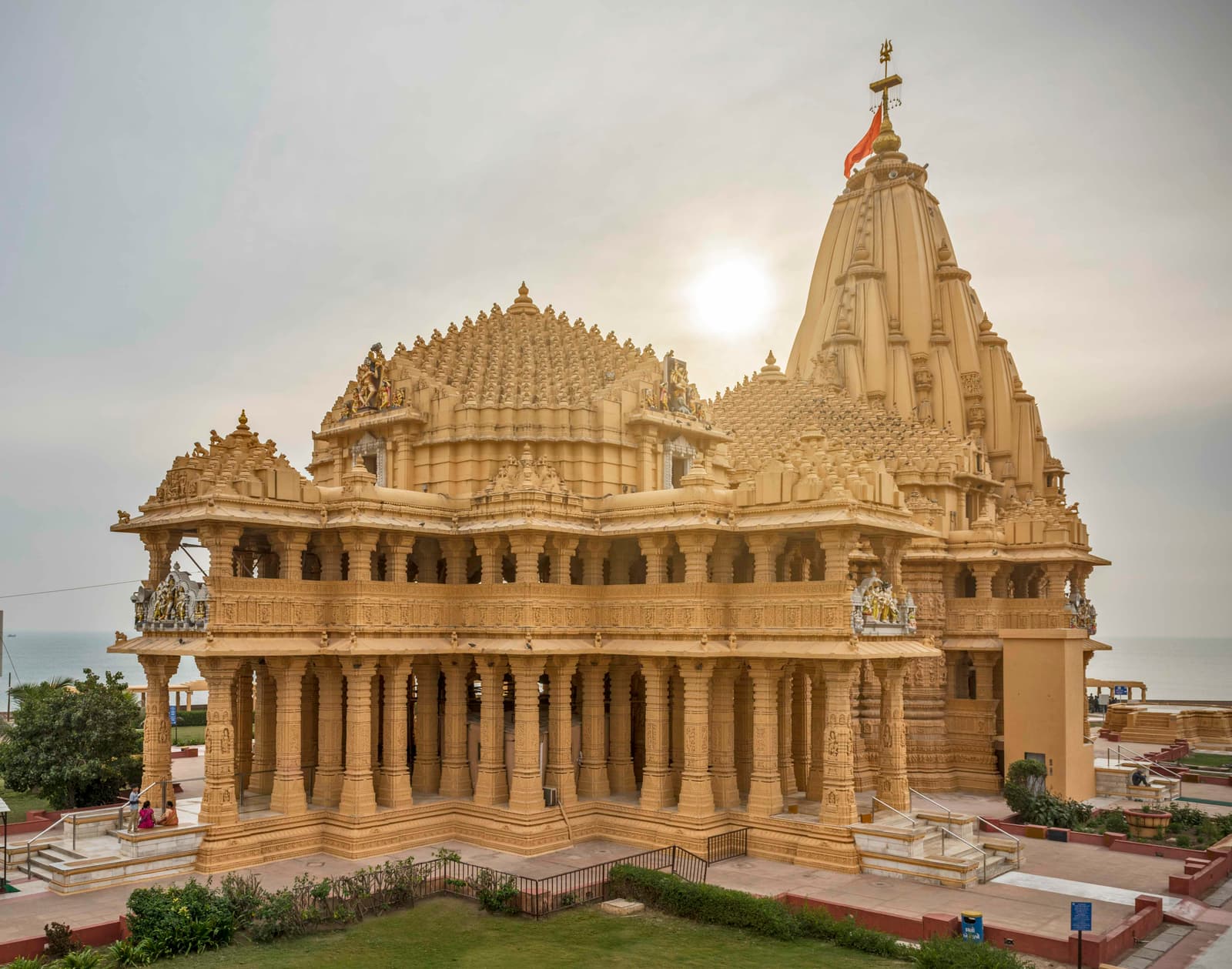
The first name on every list stands on the Saurashtra coast at Prabhas Patan, where the shrine faces east over open sea. Pilgrim tradition ranks Prabhasa among the great tirthas, and the Puranas place a shrine of Soma here long before any standing structure.
In the tradition. In the traditional account the Moon god Chandra married Daksha's daughters and neglected all but Rohini, so Daksha cursed him to fade. He came to Prabhasa, made a lingam and worshipped Shiva until the god restored his brilliance in cycles of waxing and waning. The shrine takes its name from that act: Somnath, the lord of Soma. A second local tradition places Krishna's departure from the world at Bhalka, a short distance along the same coast.
In the record. What the record shows is a long sequence of building and ruin. A temple of the Gupta period is generally taken as the earliest historical phase. The raid of Mahmud of Ghazni in 1025–26 is among the best-documented events of medieval Indian history, recorded in Persian chronicles, and rebuilding followed under Solanki kings in the twelfth century. Later destructions are attributed to Khalji, Tughlaq and Mughal armies. After 1947 a reconstruction committee excavated the site and found foundations of earlier temples; the present shrine was completed in 1951.
At the temple today. The temple now standing is a sandstone shrine in the Chalukya or Solanki manner: east-facing, a clustered shikhara over a square sanctum, a pillared assembly hall and an outer wall added in the twentieth century. Fragments recovered from earlier phases are displayed in the site museum. The Shree Somnath Trust manages the complex, and the evening aarti at the seafront is the fixed point of the visitor day.
Documented sequence
- Gupta periodThe earliest temple phase at Prabhas Patan is generally assigned to the Gupta era.
- 1025–26Mahmud of Ghazni raids the shrine; the event is recorded in Persian chronicles.
- 12th centuryRebuilding under the Solanki kings of Gujarat.
- 1665Destruction under Aurangzeb, after which the site stays in ruins for a long period.
- 1951The present shrine is completed and begins its life under the Shree Somnath Trust.
Mallikarjuna — Srisailam, Nallamala hills
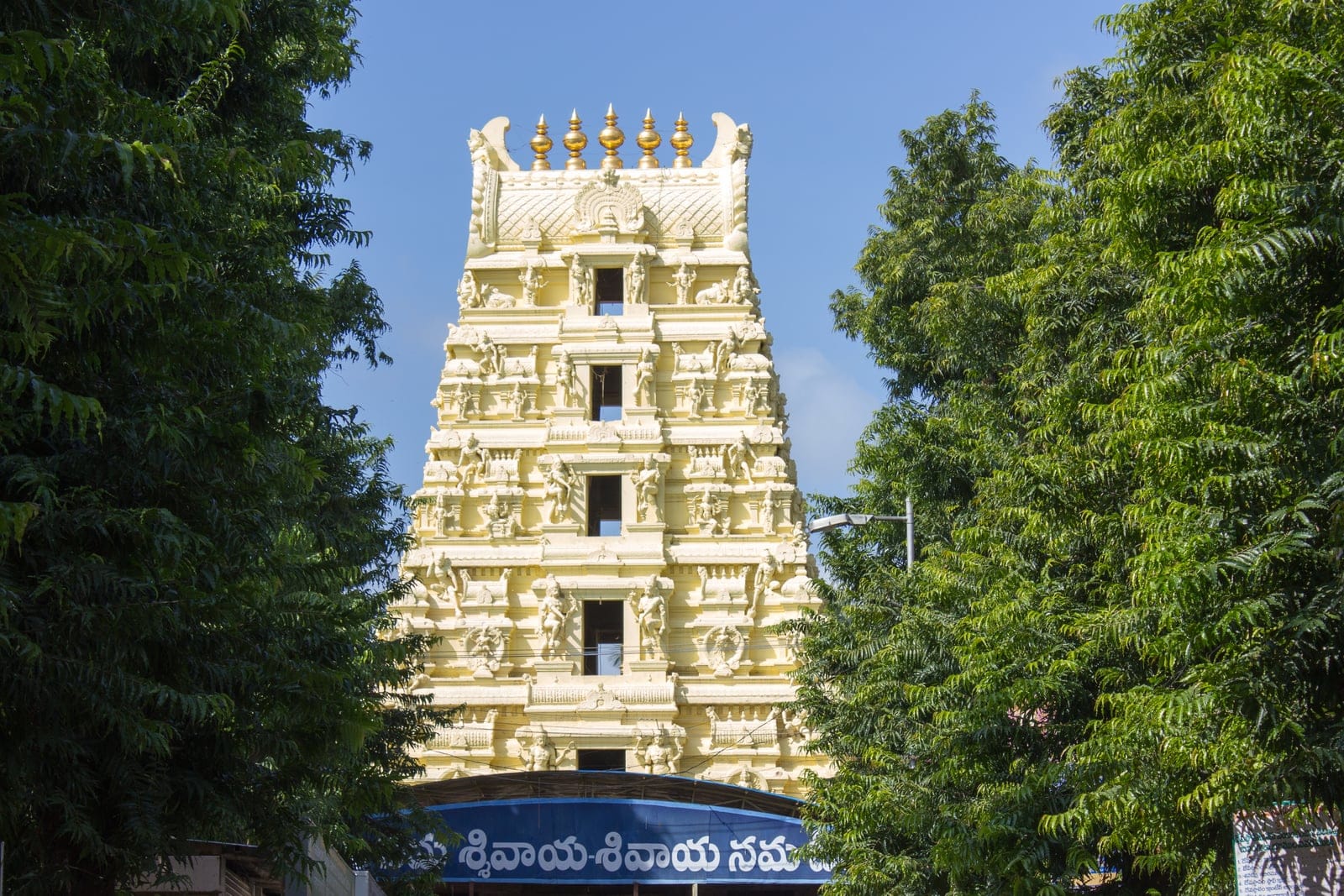
Srisailam sits on the Nallamala hills above the Krishna, a forested stretch of the eastern Deccan where the complex crowns a ridge rather than a town. It is one of the two places on this list where a Jyotirlinga and a Shakti Peetha share the same precinct, the other being Deoghar.
In the tradition. Two stories are told together. In one, Parvati worships here as the daughter of the mountain and Shiva agrees to marry her, which the name Mallikarjuna is said to encode — mallika, jasmine, for Parvati, and arjuna, white, for Shiva. In the other, the goddess appears as Bhramaramba, the bee, to calm Narasimha after the death of Hiranyakashipu. As a Shakti Peetha the site is where a part of Sati is held to have fallen, and her shrine faces the lingam across the courtyard.
In the record. Worship at Srisailam has a long documented history. Donation records and inscription slabs in Old Telugu and Kannada on the inner walls cover gifts from the second century CE into the sixteenth, which places the shrine among the better-attested Shaiva institutions of the Deccan. Kakatiya rulers added to the complex, and inscriptions of 1515–1520 record Krishnadevaraya's gifts of villages and revenue. The hilltop position is commonly credited with protecting the shrine through the upheavals of the medieval Deccan.
At the temple today. The complex is entered through gopurams and rings of prakaram wall, with granite pillars carved as yali figures in the marriage hall and a shrine to Bhramaramba beside the main sanctum. Both deities are worshipped as a married pair, and pilgrims go to the goddess shrine first. Stone laid without mortar, halls added over centuries and a working temple administration make it, today, as much a living endowment as a monument.
Double status
Srisailam and Deoghar are the two shrines on this list counted as both a Jyotirlinga and a Shakti Peetha. Neither should be described as the only one that holds both distinctions.
Mahakaleshwar — Ujjain, on the Shipra
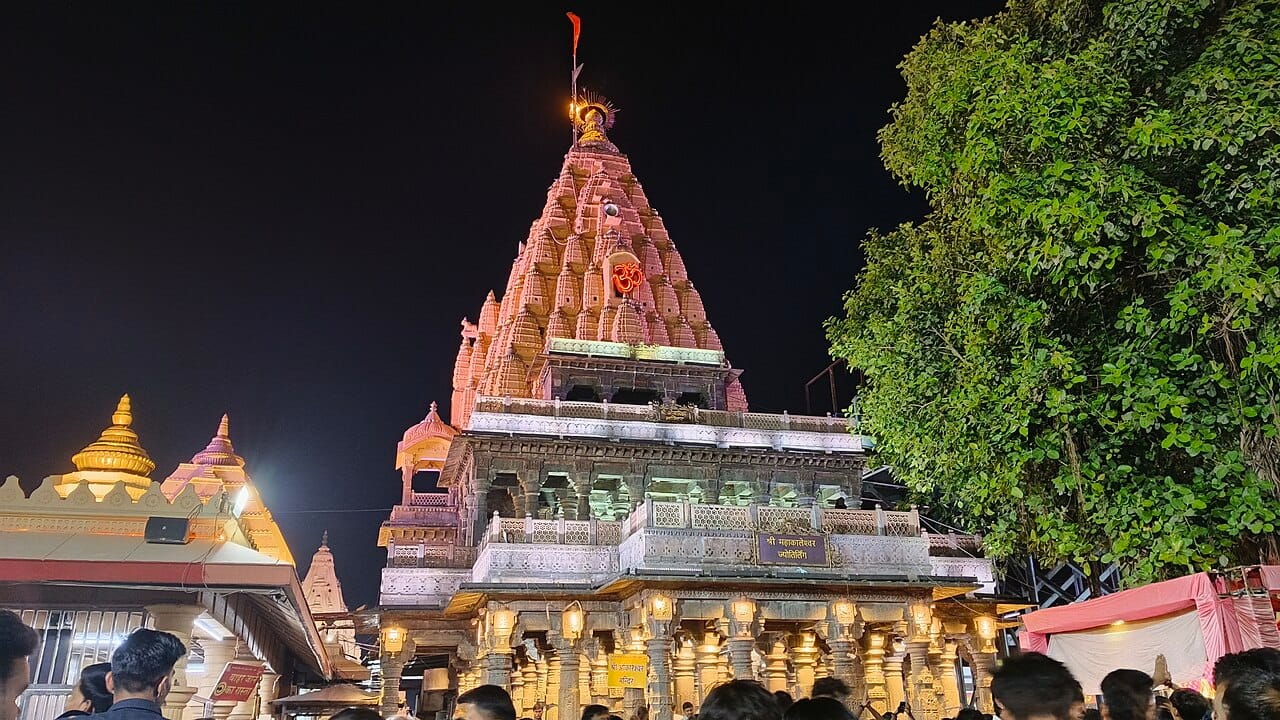
Ujjain has been a sacred city for as long as the texts remember — Avantika in the Puranic record, a city of the meridian in older geography, and the host of the Simhastha Kumbh. Mahakaleshwar stands within the old town, its sanctum turned to the south, an orientation the tradition calls dakshinamukhi.
In the tradition. The classical story is of King Chandrasena's devotion and the demon Dushana's attack on Avantika. As the king prayed, Shiva rose from the ground as Mahakala — great time — and destroyed the army; the pillar of light settled into the self-manifested lingam. The name carries the theology: Mahakala is what stands beyond time. The pre-dawn ritual of Bhasma Aarti, in which ash is applied to the lingam, is explained by the same idea — Shiva as the one who outlasts cremation.
In the record. The recorded history runs through the Paramara rulers of Malwa, whose period supplies the earliest structural references, and into the sack of Ujjain in 1235 by the armies of Iltutmish. Rebuilding followed under local rulers, but it was under the Scindias of the Maratha Confederacy in the eighteenth century that the present complex took shape. In 2022 a new approach corridor and pilgrim facilities were completed around the temple, replacing the market streets that had closed in on it.
At the temple today. The sanctum is a sunken chamber reached by a flight of steps, with the lingam set under a silver face-mask and crown, and the hall above carved with episodes from the Shiva Purana. The Bhasma Aarti before dawn is the temple's best-known observance and requires prior registration. Subsidiary shrines to Ganesha, Kartikeya, Parvati and the Saptarishis stand within the walled courtyard, and the whole complex sits inside walking distance of the Shipra ghats.
The orientation
The sanctum faces south rather than east, which is the point the name dakshinamukhi makes. The orientation is presented as distinctive among the twelve rather than unique in all of Shaiva practice.
Omkareshwar — Mandhata island, Narmada
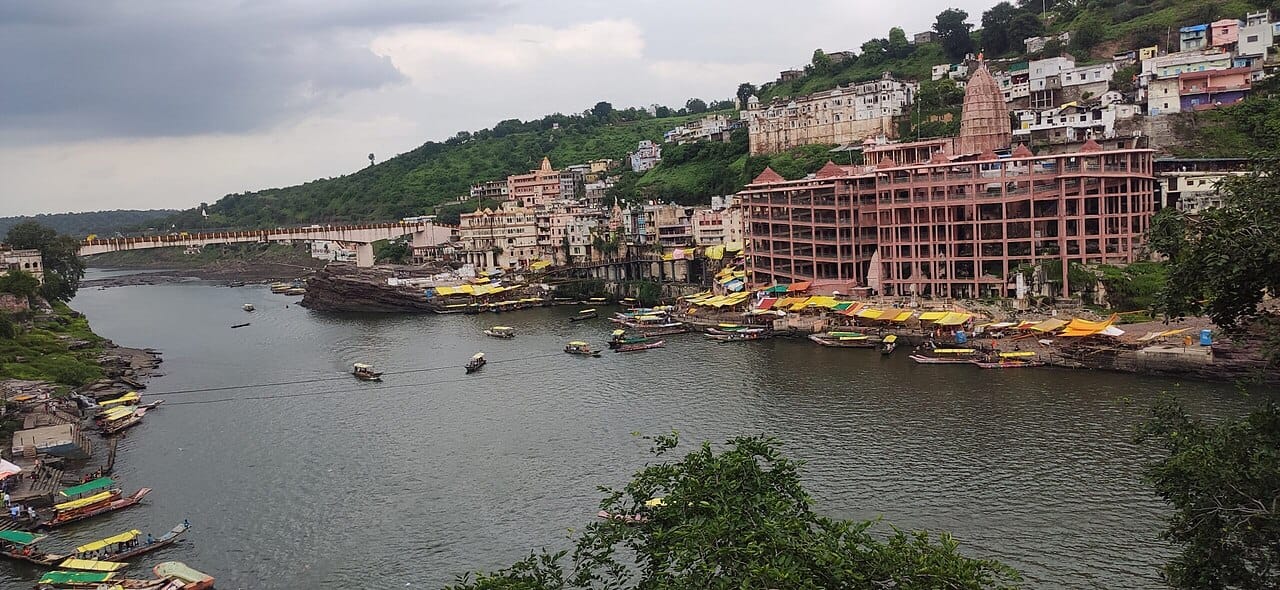
The island in the Narmada that gives this shrine its name lies off Mandhata in western Madhya Pradesh, where the river splits around a hill. The shape pilgrims read in the island's outline is the syllable Om, and the ascent to the shrine is made on foot up the steps cut into the rock.
In the tradition. The name is explained by the syllable itself. In one account King Mandhata of the solar dynasty performs penance here until Shiva appears as Omkareshwara, the lord of the sound Om; in another the Narmada is Shiva's own river, born of his penance, and the island is what the current made as it went around the hill. The lingam is understood as the first sound from which creation proceeds, which is why the site is named for Om rather than for a form.
In the record. Inscriptions place the temple's beginnings with the Paramaras of Malwa, who ruled central India from the ninth to the thirteenth centuries and patronised the shrine under kings of the tenth and eleventh. The Deccan wars of the fourteenth century left their mark, and the major restoration of the eighteenth century is attributed to Ahilyabai Holkar, who also worked at Kashi Vishwanath and Somnath and is credited with the ghats along the river.
At the temple today. The main shrine keeps a Nagara-style shikhara crowned by an amalaka and kalasha, standing on a raised platform above the island's steps. Across the river the shrine of Mamleshwar, also called Amareshwar, is paired with it, and local practice treats the two together as the single Jyotirlinga of the site. Boats and a bridge now carry pilgrims across, and the walk round the island is part of the visit rather than an optional extra.
A paired shrine
Omkareshwar is regularly listed as one Jyotirlinga while being worshipped as two shrines — the island temple and Mamleshwar on the south bank. The pairing is a feature of the tradition, not a discrepancy in the count.
Kedarnath — Garhwal Himalaya, above the Mandakini
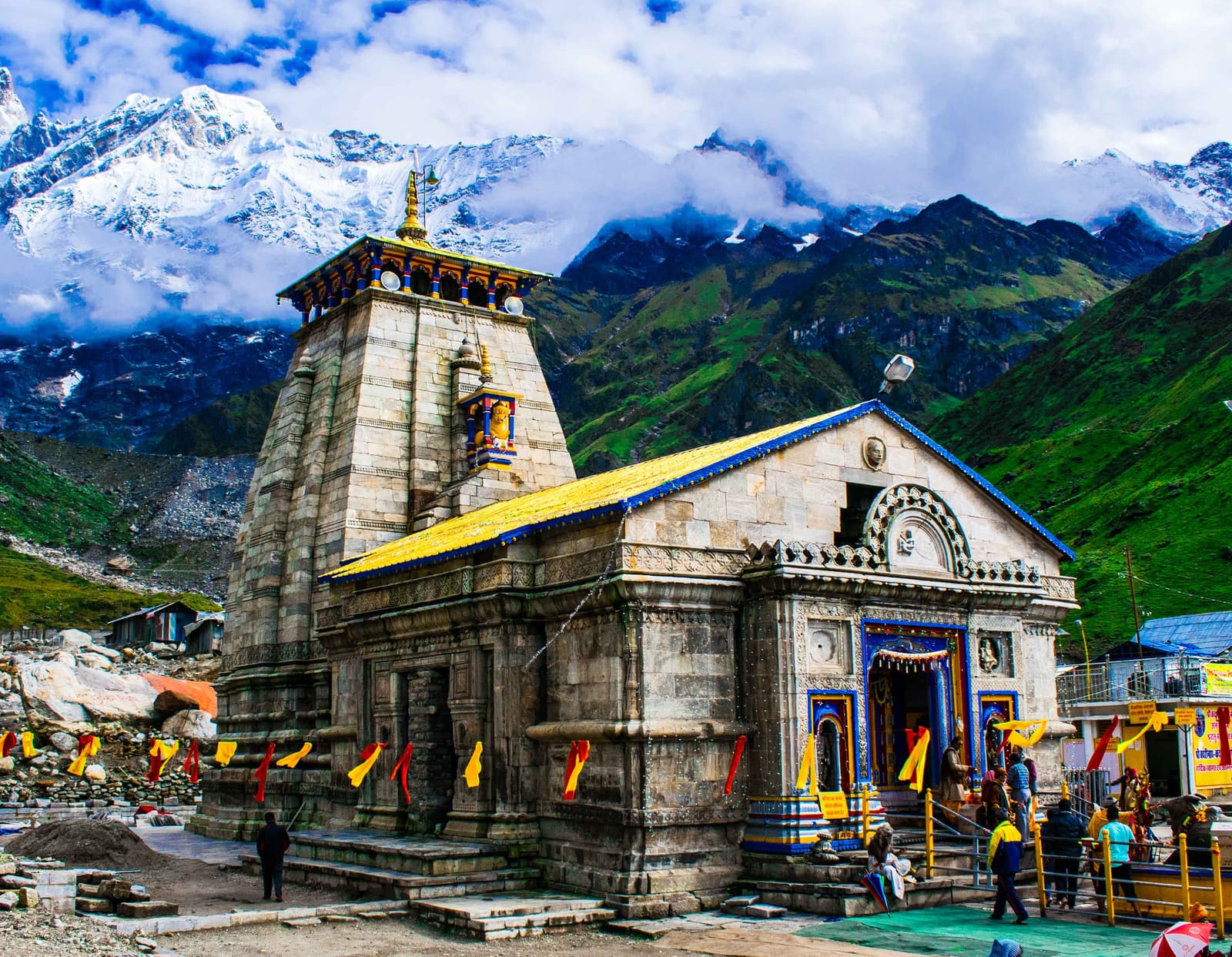
Kedarnath stands high in the Garhwal Himalaya above the Mandakini, at the head of a valley closed by snow for much of the year. Of the twelve, this is the one whose setting does most of the work: a small, severe stone building in an enormous landscape, reached on foot.
In the tradition. This is the chief of the Panch Kedar. In the Mahabharata account the Pandavas seek Shiva to atone for the war; evading them, he takes the form of a bull and dives into the ground at Kedarnath, leaving only the hump. The rest of the body appears at Tungnath, Rudranath, Madhyamaheshwar and Kalpeshwar. The lingam in the sanctum is read as that hump — a natural, self-manifested rock form rather than a carved image.
In the record. The Badarinath Kedarnath Temple Committee gives the shrine's altitude as 3,583 metres and administers it for the state government, announcing the opening and closing dates each year. Direct evidence for the present structure is limited: the tradition that Adi Shankaracharya restored a temple here is deeply held but not documented, and the seventh-century account by the Chinese pilgrim Xuanzang of a Shaiva temple in these hills is not securely identified with Kedarnath. Inscriptions record grants from the Katyuri and Chand rulers of Kumaon, and the 2013 floods destroyed the town around the temple while the shrine itself survived.
At the temple today. The building is of large grey stone slabs fitted together without mortar, with slightly battered walls, a stepped shikhara and a doorframe carved with Ganga and Yamuna; the austerity is practical as much as stylistic at this altitude. Behind the main shrine stand a smaller Bhairavanath temple and the samadhi attributed to Adi Shankaracharya. The trek from Gaurikund is the standard approach, and the temple opens only in the warmer months.
A traditional attribution
The link between Kedarnath and Adi Shankaracharya is reported here as tradition. No inscription or contemporary record documents his involvement, and the site's own accounts say as much.
Bhimashankar — Khed, Pune district
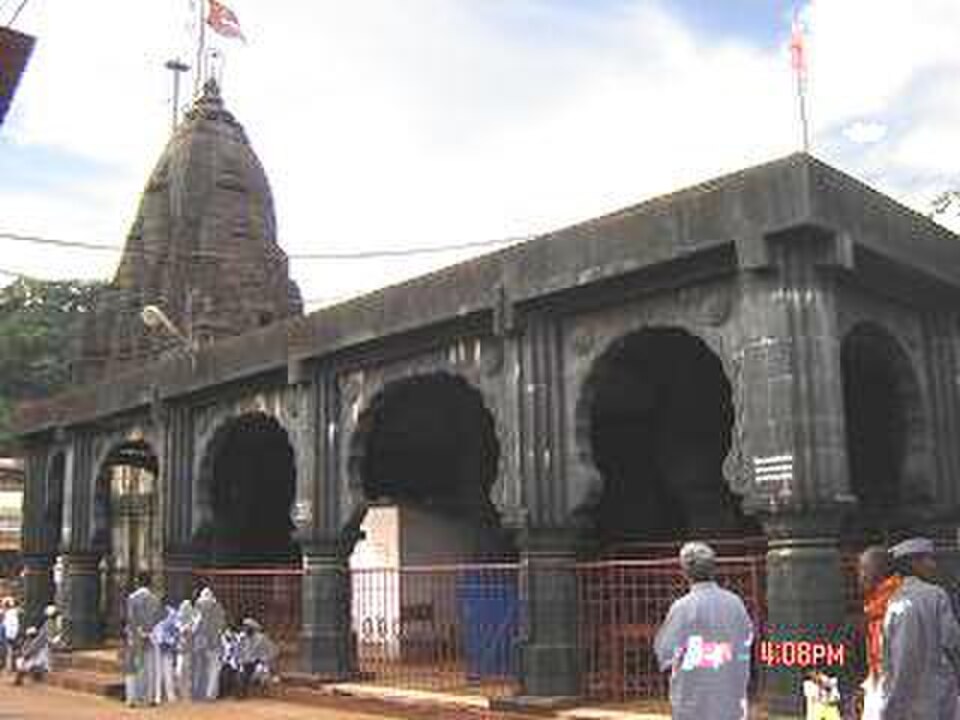
Bhimashankar lies in the Sahyadri above Khed in Pune district, in forest that is now a wildlife sanctuary and the recognised source of the Bhima river. The shrine sits low in a natural hollow, so the approach is downwards — a reversal of the usual climb toward the sanctum.
In the tradition. The Shiva Purana tells that three demons built three moving cities and troubled the gods until Shiva took chariot and bow — Brahma as charioteer, Vishnu as the arrow — and shot all three when they came into line. The lingam marks where he stood. A second story explains the river: Bhima Devi, a form of Parvati, meditated here and her essence flowed from the lingam as the stream that becomes the Bhima.
In the record. The site appears in the Puranic record long before any surviving building, and the shrine standing today is attributed to the Maratha period, with the assembly hall's carving generally dated to the eighteenth century — a dating carried in standard descriptions of the monument rather than in an inscription consulted here. The forest around it was declared a wildlife sanctuary in 1985, and the temple's Rawal priests come from a local Deshastha lineage that predates the present structure.
At the temple today. The plan is a Nagara-type shikhara with an amalaka and kalasha over a dark, plain sanctum, and a hall that carries almost all of the ornament: pillars with floral and geometric carving, a lotus ceiling, figures of dancers and musicians. The contrast between the two is deliberate. Steps descend from the entrance level to the shrine, and the road in passes through forest where the sanctuary's elephants and the giant Indian squirrel are part of the setting rather than an attraction attached to it.
A dating to check
Two datings circulate for this shrine — a medieval attribution and the eighteenth-century Maratha reading used here. Until an inscription or an ASI report settles it, treat any specific century as provisional.
Kashi Vishwanath — Varanasi, beside the Ganga
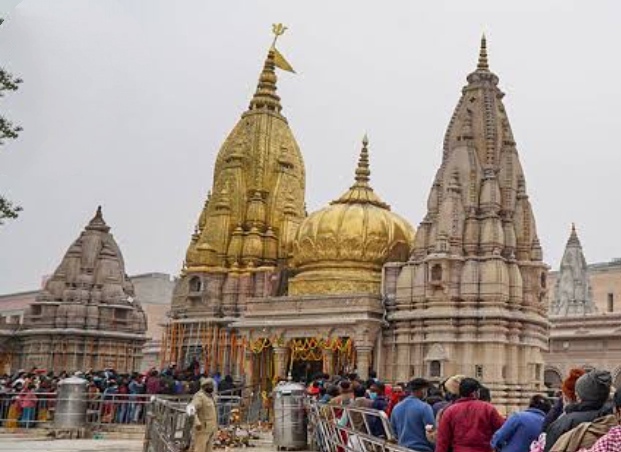
Varanasi's principal Shiva shrine stands inside the old city, a short walk from the Ganga, in a grain of lanes that the recent corridor cut straight through. The temple is small — the sanctum is barely a room — and its importance has never been proportional to its size.
In the tradition. Kashi is described in the Kashi Khanda of the Skanda Purana as the one place that survives dissolution, resting on Shiva's trident. The temple's stories are about that permanence: the pillar of light that Brahma and Vishnu could not measure, the promise that whoever dies in Kashi is released from rebirth, and the mantra Shiva is said to whisper to the dying. The name Vishwanath, lord of the universe, is his title as ruler of the city.
In the record. A temple of the Gupta period is the earliest phase usually recognised. The recorded demolitions are specific: the forces of Qutb-ud-din Aibak in 1194, the campaigns of the late fifteenth century, and Aurangzeb's construction of the Gyanvapi mosque on the site in 1669, against which the present shrine was later built. Ahilyabai Holkar's temple of 1780 stands beside the mosque to this day, the gold plating of the spire is credited to Maharaja Ranjit Singh in 1835, and the corridor to the ghats opened in 2022.
At the temple today. The shikhara is a curvilinear Nagara tower plated in gold, visible from the river, over a square sanctum with silver doors; smaller shrines in the same manner stand around it. The Gyanvapi well lies between the temple and the mosque and is treated as sacred. Darshan runs through long queues and fixed time-slots, the temple is administered by a trust under the state government, and the corridor has changed the walk from the river as much as it changed the approach to the shrine.
Documented sequence
- 5th–6th c.The earliest temple phase usually recognised, of the Gupta period.
- 1194Qutb-ud-din Aibak's forces sack Varanasi and the temple is destroyed.
- 1669Aurangzeb demolishes the shrine; the Gyanvapi mosque is built on the site.
- 1780Ahilyabai Holkar builds the present temple beside the mosque.
- 1835Gold plating of the spire funded by Maharaja Ranjit Singh.
- 2022The corridor linking the temple to the Ganga ghats opens.
Trimbakeshwar — Trimbak, Brahmagiri
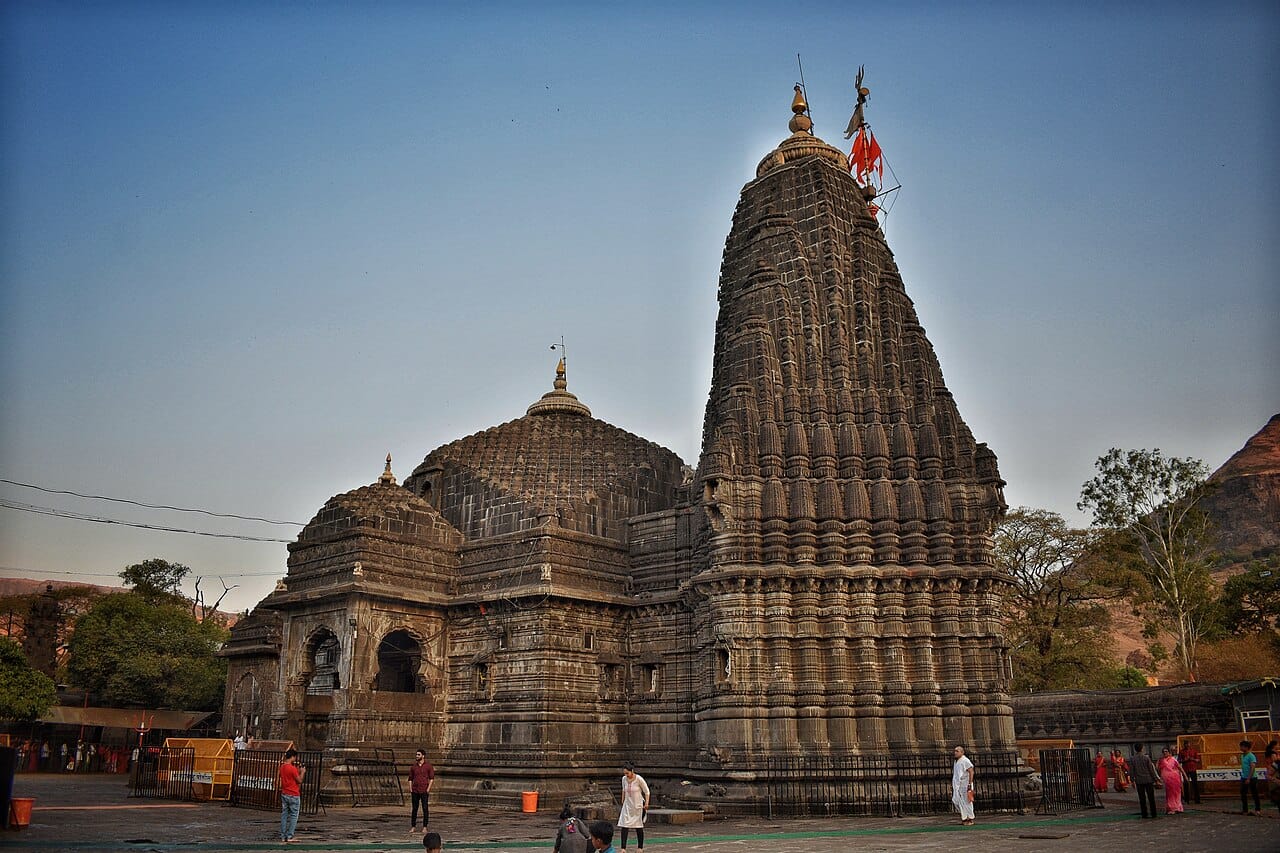
Trimbak lies near Nashik at the foot of Brahmagiri, where the Godavari begins. The river is named for the sage Gautama in one telling, and the temple at its source is walled, compact and built of dark local stone quarried nearby.
In the tradition. The Brahmanda Purana credits the sage Gautama with asking Shiva for a river during a long drought; Shiva struck Brahmagiri with his trident and the Godavari came out, and the river is also called Gautami. The three-faced lingam has a second explanation from the churning of the ocean: when the poison threatened creation, Brahma and Vishnu fanned Shiva to cool it, and the three faces — Shiva's calm one in the centre, Brahma and Vishnu at the sides — commemorate that act.
In the record. The site's antiquity is asserted from the Puranas onward, but the standing structure is a Maratha rebuilding: the present temple was commissioned in the mid-eighteenth century by the Peshwa Nana Saheb and raised on earlier foundations, reusing older carved stone. The black basalt construction and mortarless joinery are usually described as Hemadpanti, a term attributed to the thirteenth-century minister Hemadri — a traditional label rather than a dated inscription. Trimbakeshwar is one of the four sites of the Kumbh Mela in the twelve-year cycle.
At the temple today. The compound is rectangular, walled with four gateways, and holds the main shrine with a porch, an assembly hall of massive pillars and a small, dark sanctum whose three-faced lingam is dressed daily. Subsidiary shrines include one to Gautama and one to Ahalya. Flowers and the flag on the shikhara are part of the daily routine, and the first water of the Godavari is taken from near here before the river begins its long eastward run.
A traditional label
Hemadpanti is a style name attached to a minister and a century, not a classification confirmed by a dated inscription on this building. It is used here because the site's own descriptions use it.
Baidyanath — Deoghar, Baidyanath Dham
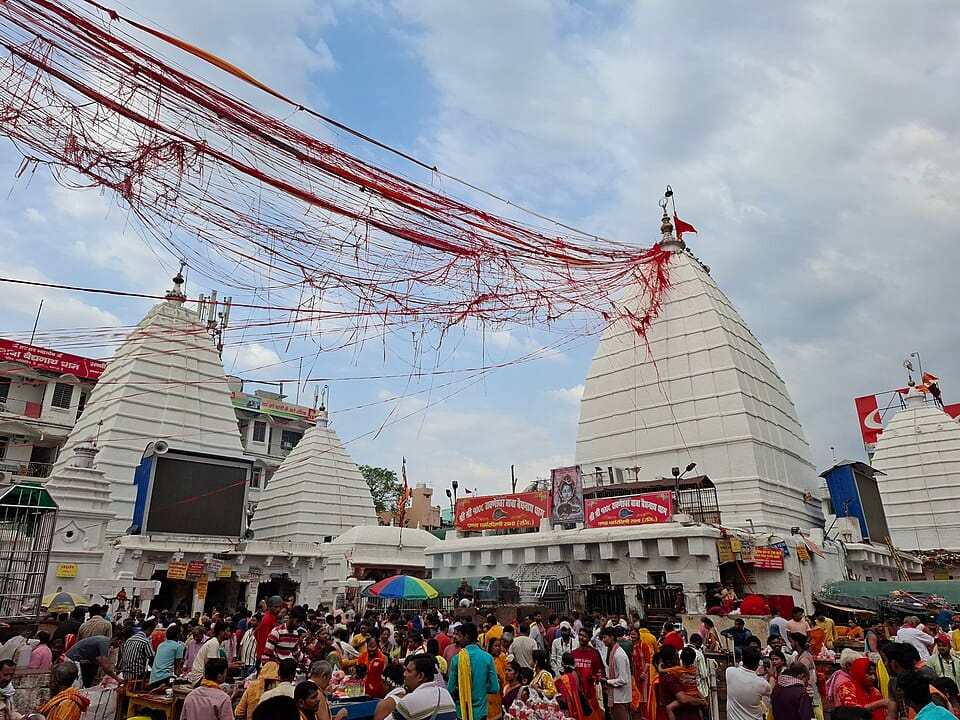
Deoghar is a plain-town shrine rather than a scenic one: Baidyanath Dham stands in the middle of a market town in Jharkhand, reached on foot through streets that fill to capacity every Shravan. The complex holds the lingam and, facing it, the goddess shrine.
In the tradition. Two traditions meet here. In one, Ravana earns the Atmalinga from Shiva and, told never to let it touch the ground, hands it to a Brahmin boy who is Vishnu in disguise; the boy sets it down and it roots at Deoghar, where marks attributed to Ravana's attempt to lift it are still shown. In the other this is the Hridaya Peetha, where Sati's heart fell, so the shrine counts both a Jyotirlinga and a Shakti Peetha and the two are worshipped as a pair.
In the record. Patronage of the shrine is recorded from the Pala and Sena periods onward, with the medieval Gidhaur rulers among its benefactors and later rebuilding under Maratha families; the standing fabric is attributed to that later sequence rather than to any single date. What has changed most in recent times is not the building but the pilgrimage: the Shravani Mela and the Kaanwar Yatra, in which pilgrims carry Ganga water from Sultanganj on foot, grew through the twentieth century into one of the country's largest recurring gatherings.
At the temple today. The sanctum is a small dark chamber where the lingam sits on a silver platform, slightly flattened on one side; the Shakti shrine of Jaya Durga faces it, and worshippers go to the goddess first. A ring of subsidiary shrines — Parvati, Ganesha, Hanuman, Nandi and the Navagrahas — stands around the courtyard, and the halls fill completely during Shravan. The temple is administered by a trust, and hereditary priestly families keep records of returning pilgrim households.
Two names, one shrine
Baidyanath and Vaidyanath are spellings of the same name, and the stotram uses the second. Local usage prefers the first, which is why both appear across this site's pages.
Nageshwar — Near Dwarka, Saurashtra coast
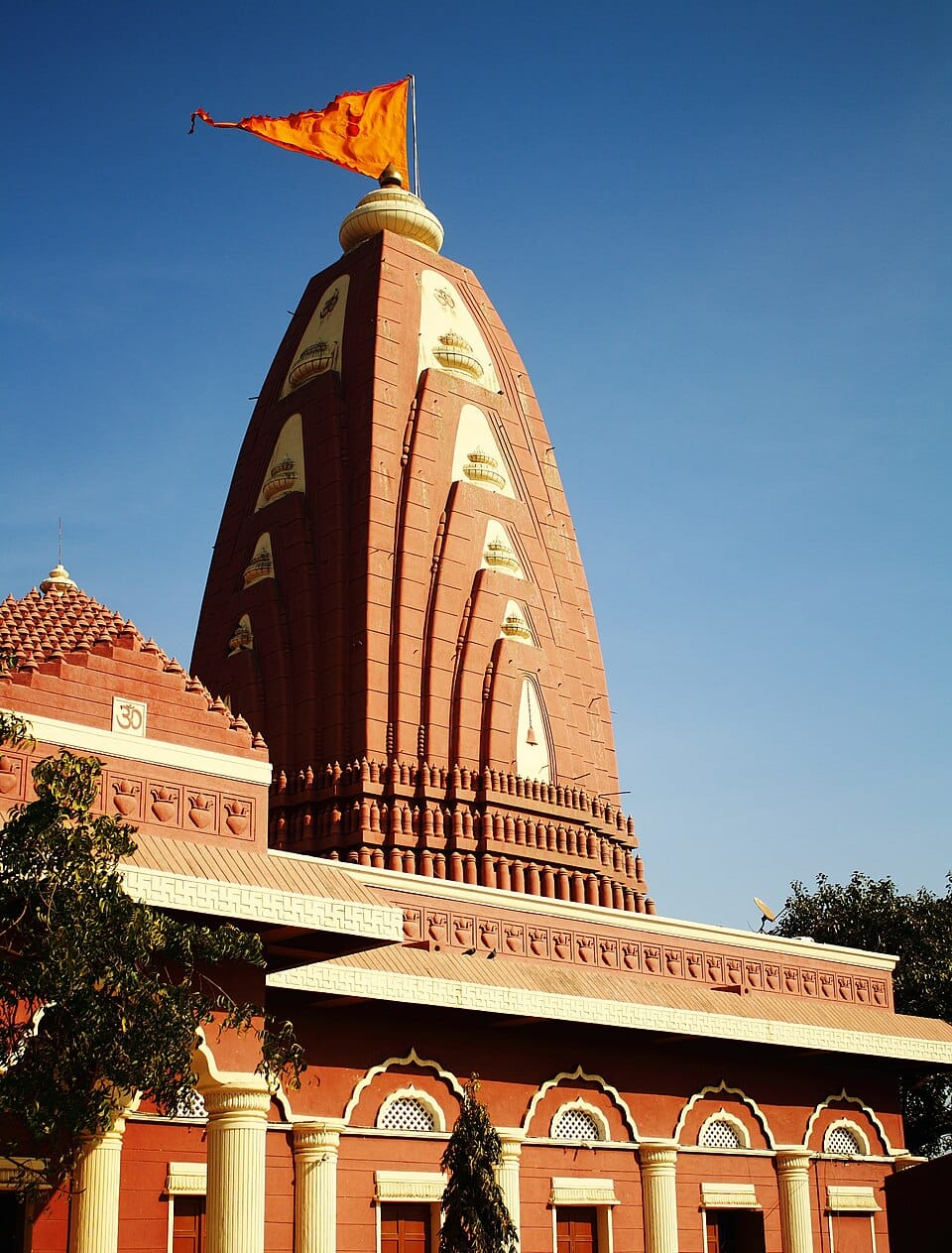
Nageshwar is approached across low, wet ground on the Saurashtra coast near Dwarka, where egrets and flamingos feed in the shallows beside the road. The shrine itself is modest; what most visitors notice first is the large outdoor statue of Shiva seated in meditation outside the complex.
In the tradition. The Shiva Purana's account is of the Daruka forest: the demon Daruka oppressed the land while his wife Daruki, protected by a boon and devoted to Shiva, made the forest untouchable. Shiva resolved the impasse by appearing here as a lingam that neither could ignore, and the forest became sacred ground. A second story concerns Supriya, bitten by a snake and revived by prayer, which is why Nageshwar is sought as protection against snakebite and poison.
In the record. The shrine is named in the Puranic list of twelve, and rebuilding is associated with the Solankis of Gujarat, whose period saw major work at the religious monuments of the region. What is not settled is the identification: the Dwarka site is the one commonly listed here, while another tradition places the Puranic Nageshwar at Aundha Nagnath in Maharashtra. Different texts support the different readings and no inscription resolves it, so the variation is carried here rather than decided.
At the temple today. The temple keeps a simple Saurashtra-type shikhara over the sanctum, with serpent images carved into the pillars, and the coast's salt and monsoon weather visible on the stone. The outdoor statue, in padmasana with the hands in the meditation gesture, stands against the sea. Nageshwar sits close enough to Dwarka that most pilgrims visit both in the same outing, and Nag Panchami draws the largest crowds of the year.
An unresolved identification
Dwarka in Gujarat and Aundha Nagnath in Maharashtra are both proposed as the Nageshwar of the Puranas. This site follows the Dwarka identification and states the alternative rather than hiding it.
Ramanathaswamy — Rameswaram island, Pamban
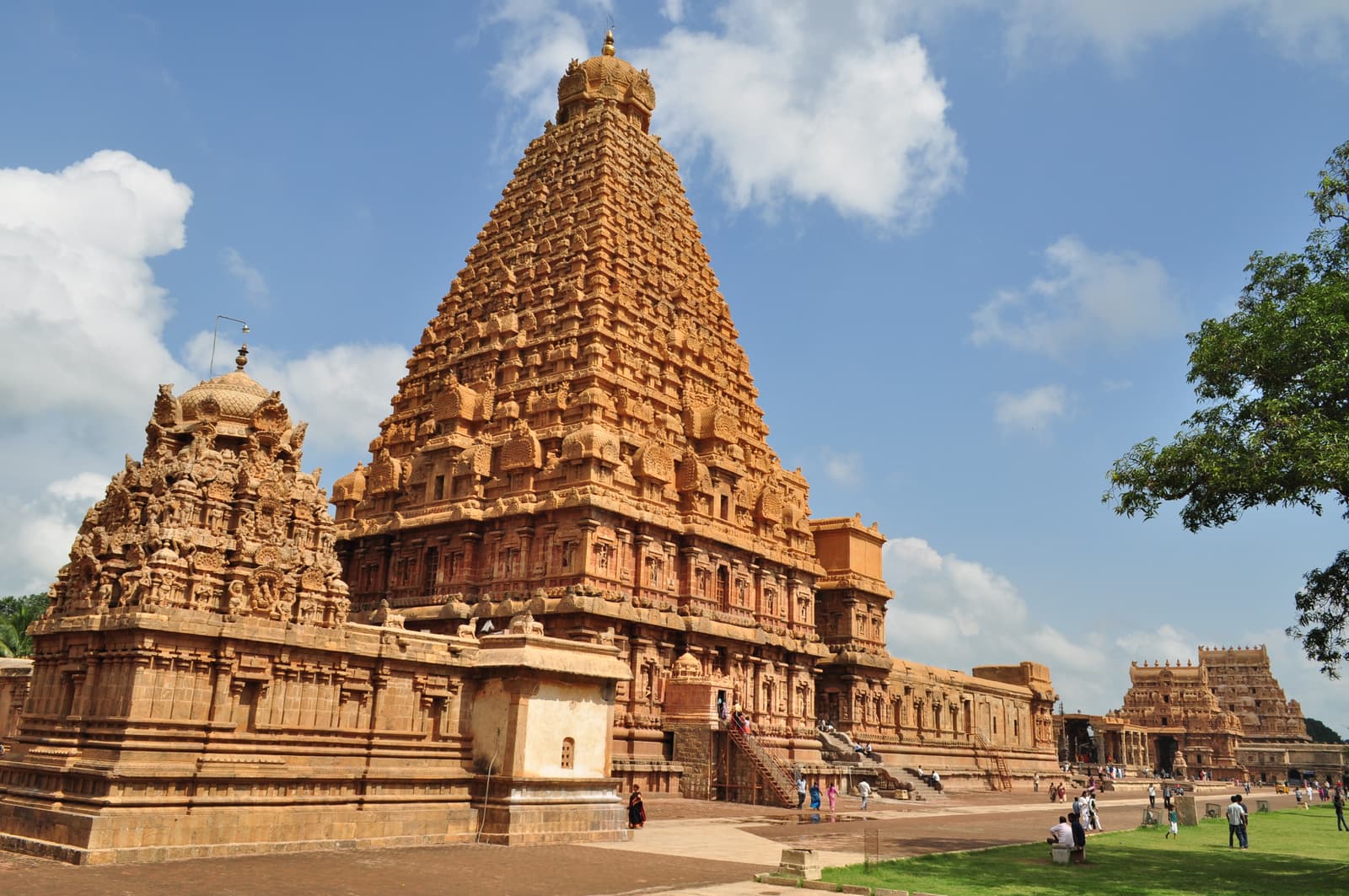
Rameswaram is an island town on the Pamban channel, facing Sri Lanka across the shallow line of shoals that tradition identifies with Rama's bridge. The temple occupies a large rectangle of the island's grid, and the corridors around it are what most pilgrims come to walk.
In the tradition. The story begins after the war with Ravana. Rama, concerned at having killed a Brahmin, worships Shiva here; Hanuman is sent to Kailash for a lingam and delayed, so Sita makes one from the sand of the beach. When Hanuman returns, Rama enshrines both — the sand lingam as Ramanathaswamy and Hanuman's as Viswalingam, which pilgrims are expected to visit in the same round. The tanks inside the complex are read as places for specific observances.
In the record. The temple's documented growth begins with the Pandyas and continues under the Cholas and the Vijayanagara rulers, but the corridors are the work of the Setupatis of Ramnad, who traced their lineage to the guardians of the bridge and built the two circuits of carved granite pillars between the seventeenth and eighteenth centuries; the eastern gopuram was completed in 1904. The shrine is administered today by the HR&CE department of Tamil Nadu, and damage from the 2004 Indian Ocean tsunami was repaired.
At the temple today. The corridors are the signature: two concentric circuits of granite pillars, many carved with figures and yali brackets, roofed with stone slabs and built for walking the full round, and commonly described as the longest temple corridor in the world. Inside the sanctum the two lingams stand side by side. Four gopurams mark the cardinal directions, and the tanks — rectangular wells reached by steps — line the outermost passage, each with its own observance attached.
The corridors
The claim that these are the world's longest temple corridors is repeated widely and is reported here as a description rather than a measurement taken for this page. The builders and the centuries are documented; the superlative is not.
Grishneshwar — Verul, beside Ellora
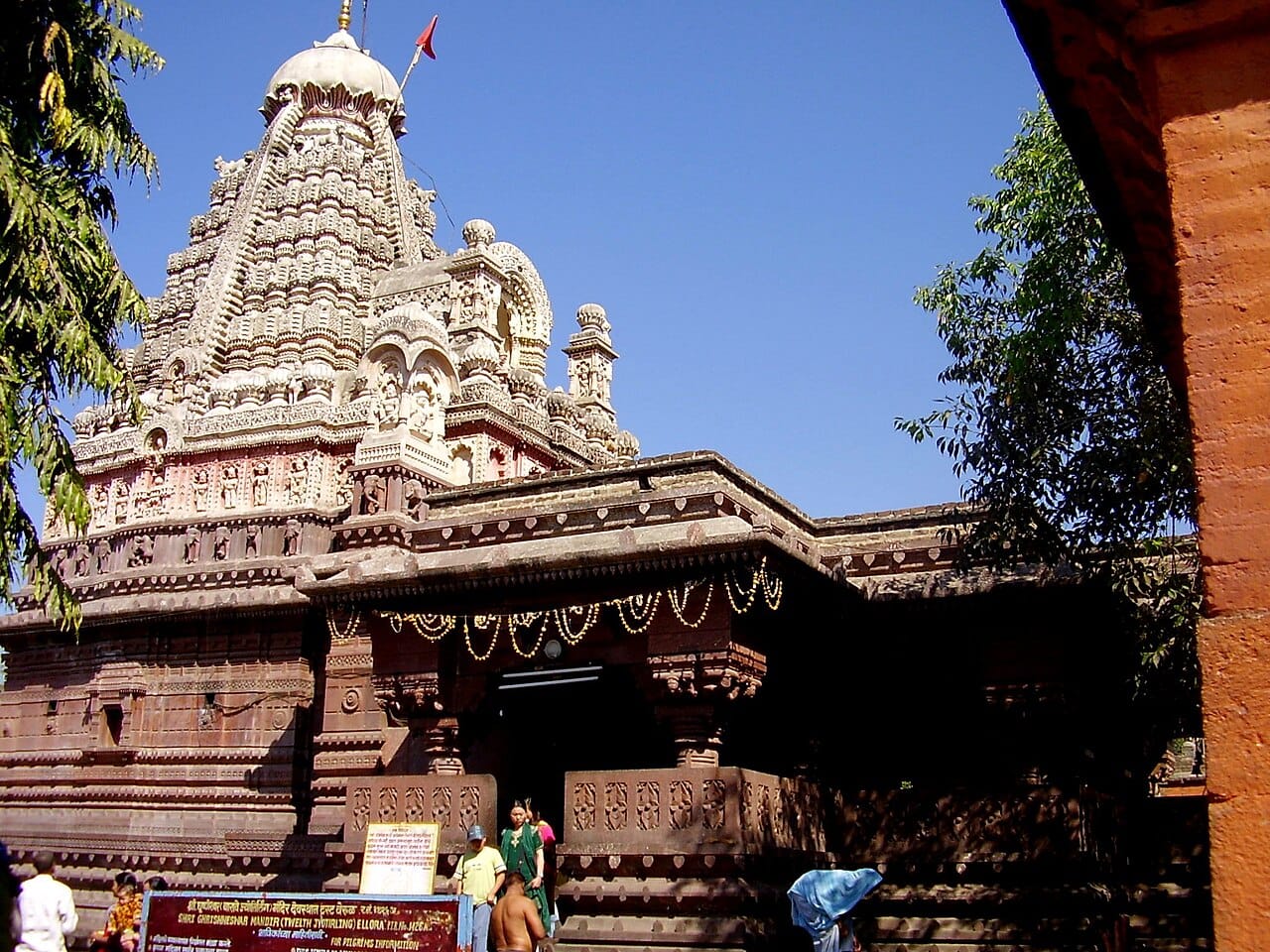
Grishneshwar stands at Verul, a short walk from the rock-cut temples of Ellora, in red Deccan stone that changes colour through the day. It is the last name on the list and the closest to another monument that appears on no list at all.
In the tradition. The shrine is also called Kusumeshwar, lord of flowers, from the story of Sudhanya, a villager who brought blooms daily to a lingam in the forest and, finding his garden stripped overnight, prepared to offer himself instead. The wilted flowers of the previous day are said to have lighted up and revealed Shiva, who took the name from them. Flowers are still the offering: the sanctum is dressed in petals and the day's worship turns on them.
In the record. The Deccan campaigns of the thirteenth and fourteenth centuries pulled down the shrine, and local worship continued at the broken lingam through repeated, increasingly modest rebuildings. The standing temple is attributed to Ahilyabai Holkar's eighteenth-century programme of restoration — the same patronage that rebuilt Kashi Vishwanath in Varanasi and the shrine at Somnath — using local stone and local craftsmen. The setting is documented independently: Ellora, the cave complex a short walk away, was inscribed on the UNESCO World Heritage List in 1983 for its sequence of monuments.
At the temple today. The plan is compact — sanctum, antechamber, hall and a Nandi pavilion — under a five-tiered shikhara with amalaka elements and a kalasha. The pillars carry deep relief of Shiva as Nataraja, the marriage of Parvati and the descent of the Ganga, and the ceiling is a lotus cut from a single block. The Nandi is black basalt against the red stone, and the temple is the natural second stop after the caves rather than a separate day out.
Setting and structure
- 13th–14th c.The shrine is destroyed during the Delhi Sultanate's Deccan campaigns.
- 14th–18th c.Repeated rebuildings, each more modest than the one before.
- 18th c.Ahilyabai Holkar's restoration gives the temple its present form.
- 1983Ellora, a short walk away, is inscribed on the UNESCO World Heritage List.
Visitor information: planning the journey
There is no binding order to the circuit, and no scriptural duration attached to it. What decides most itineraries is geography: the twelve fall into groups that can be worked through one at a time without crossing the country repeatedly.
Gujarat and Maharashtra hold five of them — Somnath and Nageshwar in Gujarat, Bhimashankar, Trimbakeshwar and Grishneshwar in Maharashtra — and they pair naturally with a run through the Deccan. Madhya Pradesh holds the central pair of Mahakaleshwar and Omkareshwar on the Shipra and the Narmada. Uttar Pradesh and Uttarakhand hold Kashi Vishwanath and the high shrine at Kedarnath. Srisailam, Ramanathaswamy and Baidyanath sit in the south and the east.
Season does more work than sequence. Kedarnath opens only in the warmer months, with the temple committee announcing the dates each year, so that leg is fixed before anything else. The coastal and southern shrines are most comfortable through the winter. The monsoon is heavy on the Sahyadri, where Bhimashankar sits in forest, and the largest crowds fall in the month of Shravan, when the Kaanwar Yatra fills the road to Deoghar.
Two of the twelve belong to wider circuits that are worth reading before travel. Kedarnath is part of both the Char Dham and the Panch Kedar, and Ramanathaswamy is the southern Char Dham shrine; Srisailam and Deoghar appear in the Shakti Peetha lists as well. Each of those circuits has its own sequence and its own season, and they do not have to be walked to visit the Jyotirlinga.
Questions this guide answers
Are there exactly twelve Jyotirlingas?
Shaiva tradition says yes, and the number twelve is stable across the texts that name them. What varies is the detail: the order the names appear in, the spelling of some of them, and in one or two cases which town a Puranic name is attached to. Where the tradition carries a variation, this guide states it rather than smoothing it away.
Is there a fixed order for visiting the twelve?
No. The Dvadasha Jyotirlinga Stotram supplies a sequence, and many pilgrims begin with Somnath because tradition numbers it first, but no enumeration of the twelve is presented here as a definitive geographical order. In practice visitors group the shrines by region — Gujarat and Maharashtra together, Madhya Pradesh together — and work through one region at a time.
What is the difference between a Jyotirlinga and an ordinary lingam?
An ordinary lingam is installed and consecrated by priests through prana pratishtha. A Jyotirlinga is held to be svayambhu — self-manifested, not made by human hands — which is why the tradition describes each of the twelve as a place where Shiva appeared rather than an image that was installed. That distinction is the theological point of the whole circuit.
Which of the Jyotirlingas are also Shakti Peethas?
Two of them. Srisailam in Andhra Pradesh, where the goddess Bhramaramba faces the lingam across the courtyard, and Baidyanath at Deoghar in Jharkhand, identified as the Hridaya Peetha where Sati's heart fell. At both sites the Shakti shrine and the Jyotirlinga are treated as a pair, and worship at the goddess shrine comes first.
Which is the most difficult of the twelve to reach?
Kedarnath. It stands at about 3,583 metres and is reached on foot or by helicopter from Gaurikund, and the temple committee opens it only during the warmer months, announcing the dates each year. The other eleven are reached by road, with the trek and the season — not distance — being the deciding factors.
How long does it take to visit all twelve?
It depends on how the circuit is grouped and on the season; there is no scriptural duration attached to the yatra. Most pilgrims break the journey into regional stages rather than attempting one continuous run, and the practical constraints — Kedarnath's opening season, the Shravan crowds at Deoghar, the monsoon on the Sahyadri — usually decide the order more than any text does.
Keep reading
12 Jyotirlingas in India: the reference list
The quick-facts directory for all twelve, with timings, travel and architecture summary for each shrine.
Open the directory CircuitsPilgrimage circuits of India
How the major routes fit together — Char Dham, Panch Kedar, Shakti Peethas and the Jyotirlinga circuit.
See the circuits Research & GuidesBack to all research
Every long-form guide, from temple chronology to architectural classification.
All guidesReviewed 8 October 2026 against the Puranic and stotram tradition, temple trust records, ASI and UNESCO documentation.
Where an attribution is traditional rather than documented, the text says so on the spot.