From ancient rock-cut marvels to towering imperial shrines, discover the architectural soul of Bharat through our verified digital archive.
Explore More Temples
Builder
Ahilyabai Holkar
Dynasty
Maratha (Holkar)
Construction
18th Century (Rebuilt)
Style
Maratha
Main Deity
Grishneshwar (Shiva)
Location
Ellora, Maharashtra
Significance
12th / Final Jyotirlinga
Also Known As
Kusumeshwar
Material
Red Volcanic Rock
Neighbor
Ellora Caves (UNESCO)
Shikhara
Five-tiered
Grishneshwar is the last of the twelve Jyotirlingas — the final destination. In the Dwadasha Jyotirlinga Stotram, the hymn that enumerates the twelve, Grishneshwar is mentioned at the end. There is no thirteenth. To complete the Jyotirlinga pilgrimage at Grishneshwar is to finish a journey that spans the Himalayas, the coasts of Gujarat, the Narmada valley, and the Deccan plateau.
The position of Grishneshwar as the 12th Jyotirlinga is not merely ordinal. In Hindu cosmology, the number twelve represents completion — the twelve months of the year, the twelve Adityas (solar deities), the twelve signs of the zodiac. A pilgrimage that visits all twelve Jyotirlingas is considered a spiritual year made manifest, a complete cycle of devotion. Grishneshwar is the closing of that cycle. Pilgrims who have walked the circuit from Somnath in Gujarat end their journey here, in the red-stone temple flanked by the Ellora hills.
The Shiva Purana describes the manifestation of the Grishneshwar lingam as the culmination of Shiva's cosmic revelation. Each Jyotirlinga represents a specific aspect of Shiva's infinite being — his anger at Bhimashankar, his grace at Somnath, his cosmic dance at Kedarnath. Grishneshwar represents completeness: the part of Shiva that is the sum of all parts. The temple's architecture reinforces this symbolism — the five-tiered shikhara rises in stages, each tier representing an element, and the final tier representing the formless absolute beyond the elements.
Grishneshwar is also called Kusumeshwar — a name that means "Lord of Flowers" (kusuma = flower, ishwar = lord). The name comes from a story that is among the most tender in the Shaivite tradition, a story not about kings or cosmic battles but about a poor flower seller whose devotion moved Shiva to reveal himself.
The devotee was named Sudhanya. He was a flower seller in the village of Verul, and every day he would gather the freshest blooms from his garden and offer them to a Shiva lingam in the forest. He had no wealth, no status, no lineage — only flowers. Day after day, year after year, he made his offering: jasmine, marigold, hibiscus, rose. He was not seeking boons or blessings. He offered because offering was his nature.
One day, Sudhanya woke to find his garden had been stripped overnight — every flower, every bud, every petal was gone. He had nothing to offer. In his desperation, he decided that if he could not offer flowers, he would offer himself. He went to the lingam and resolved to give his own life as the ultimate offering. As he prepared to end himself, a voice stopped him. The pile of wilted flowers from the previous day's offering began to glow. The flowers transformed into a column of light. Shiva emerged from the heap of blooms and declared that the lingam at that spot would be known as Kusumeshwar — the one who emerged from flowers.
The legend explains the temple's defining ritual feature: flowers are the primary offering. Unlike other Jyotirlingas where water, milk, or bilva leaves dominate the ritual, at Grishneshwar, flower offerings take precedence. The sanctum is perpetually covered in fresh petals, and the fragrance of jasmine and marigold fills the inner chambers. The Kusumeshwar legend ensures that the temple remains, in a literal sense, the temple of flowers.
The name Grishneshwar itself has multiple interpretations. One tradition derives it from "Grishma" (summer) + "Ishwar" (lord) — Shiva as the lord who endures the summer heat. Another connects it to the Marathi word "ghrish" (to rub or polish), referencing the smooth, polished appearance of the lingam. The most widely accepted meaning, however, comes from the legend of Sudhanya: "Grish" as derived from the sound of flowers being crushed — the soft sound of devotion.
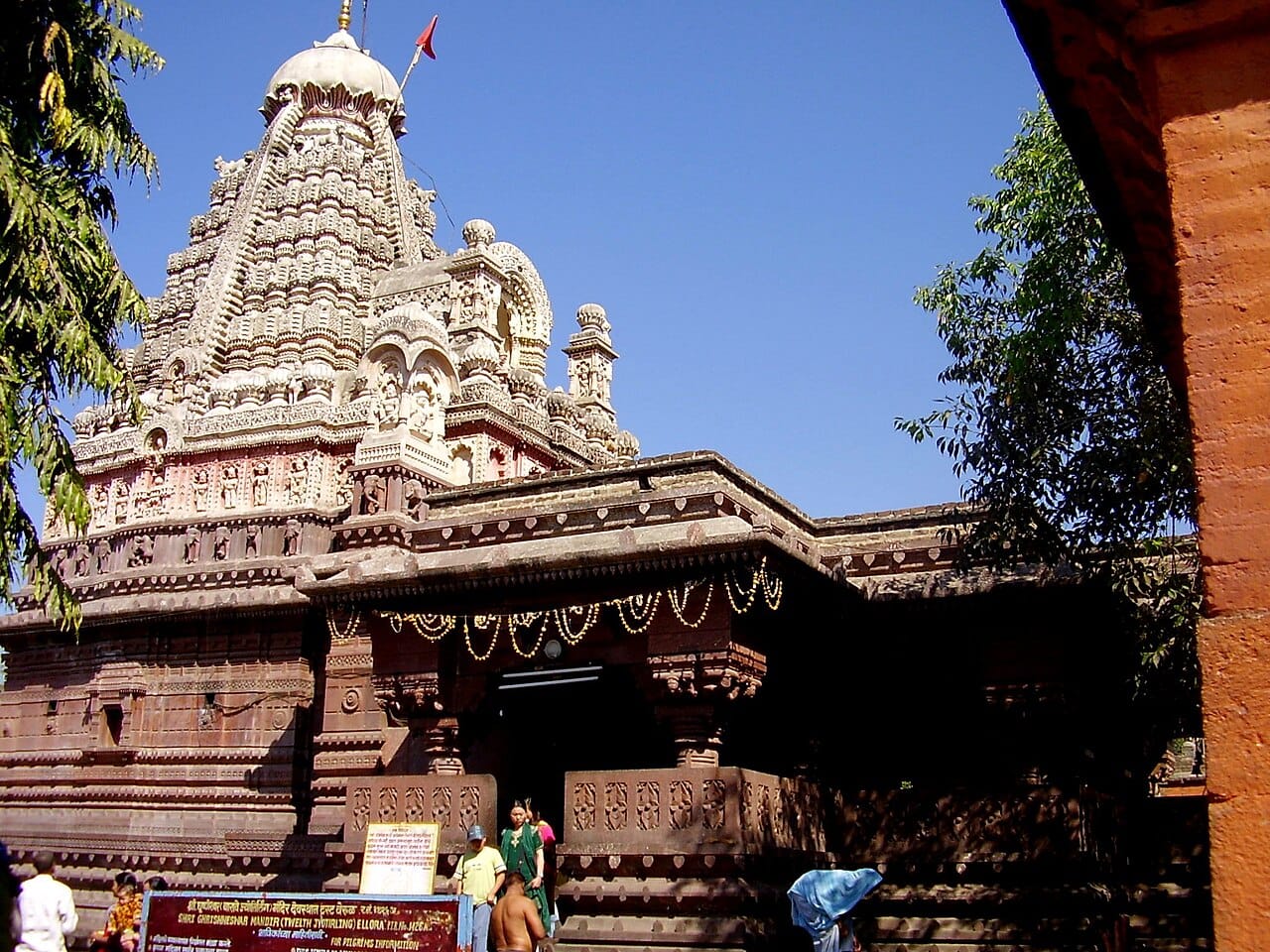
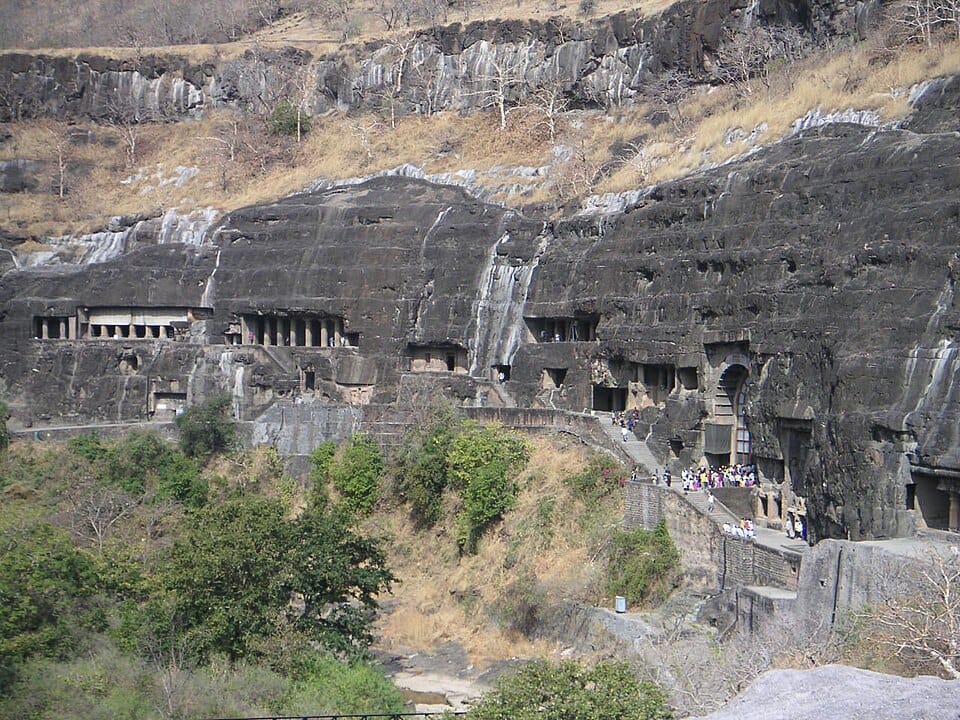
Grishneshwar Temple is located exactly 1 kilometer from the Ellora Caves — a celebrated UNESCO World Heritage site in India. The proximity is not coincidental. Verul (the old name for Ellora) was a major religious center for over a millennium. The rock-cut caves represent the Buddhist, Hindu, and Jain traditions carved into the basalt escarpment. Grishneshwar represents the structural temple tradition built at the foot of the same hill. Together, they constitute one of the densest concentrations of sacred architecture in the world.
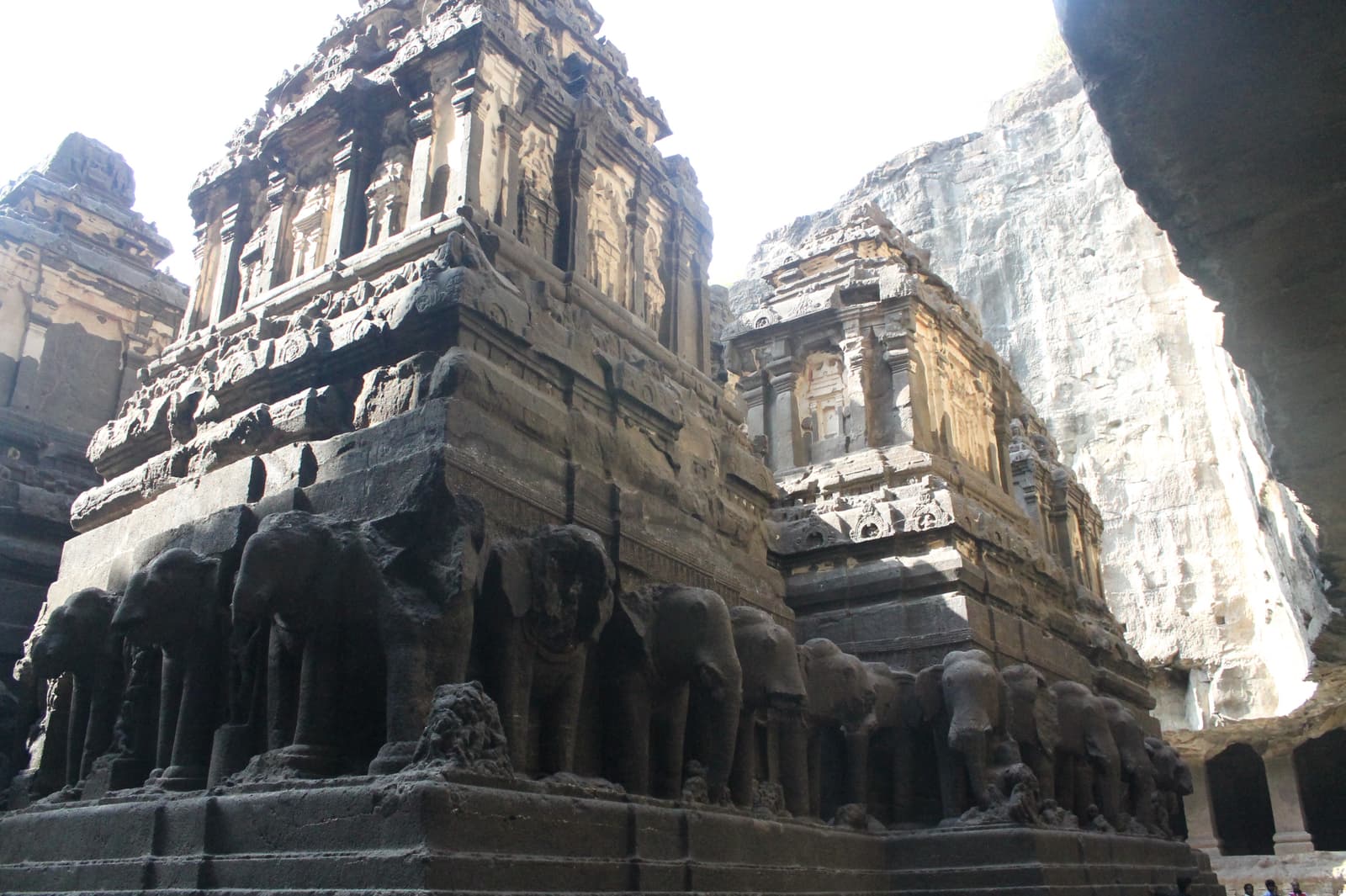
A pilgrim visiting Ellora today will see Cave 16 — the Kailasa Temple, the world's largest monolithic structure — and then walk one kilometer east to Grishneshwar. The contrast is striking: Kailasa is rock-cut, massive, ancient, carved from a single basalt cliff. Grishneshwar is structural, human-scaled, rebuilt in the 18th century, built from red volcanic stone. One is the work of the Rashtrakutas (8th century). The other is the work of the Marathas (18th century). One is carved from the mountain. The other stands before it.
The relationship between the two sites deepens the experience of both. The Kailasa Temple represents Shiva as the cosmic force carved from the mountain itself. Grishneshwar represents Shiva as the approachable deity, the one who accepts flowers from a poor devotee. The scale shifts from the terrifying vastness of the monolith to the intimate warmth of the red-stone shrine. Pilgrims who visit both in one day experience the full range of Shaivite expression — from the cosmic to the personal, from the Rashtrakuta vision of divine power to the Maratha vision of divine accessibility.
The Ellora-Grishneshwar combination is also a pilgrimage microcosm of Deccan history. The Buddhist caves represent the early period (6th-7th centuries). The Hindu caves including Kailasa represent the Rashtrakuta period (8th-10th centuries). The Jain caves represent the later Rashtrakuta-Yadava period (9th-12th centuries). And Grishneshwar represents the Maratha period (18th century). A single day at Ellora and Grishneshwar walks through twelve centuries of architectural and religious history.
Grishneshwar completes the trio of Maharashtra Jyotirlingas, alongside Bhimashankar in the Sahyadri forests and Trimbakeshwarat the source of the Godavari. Together, these three form the Deccan circuit of the twelve Jyotirlingas, each representing a different facet of Maharashtra's sacred geography.
Grishneshwar Temple is built from a distinctive red stone — a locally quarried volcanic rock that gives the temple a warm, almost glowing appearance. The material is significantly different from the basalt used in the neighboring Ellora Caves and the granite used in most Dravidian temples. The red stone has a porous quality that catches the light differently at different times of day: deep crimson at dawn, ochre at midday, amber at sunset.
The geological origin of the red stone is the Deccan Traps — one of the largest volcanic features on Earth, formed by massive lava flows that covered much of western India 60-65 million years ago. The iron content in the volcanic rock gives it its red hue, with variations in mineral composition creating streaks of brown, orange, and purple across the stone surface. Unlike the dense, dark basalt of the Ellora caves, this red stone is softer and more workable — allowing the Maratha sculptors to carve finer details with greater precision.
The choice of red stone was not purely aesthetic. The material was locally abundant and could be quarried from the hills surrounding Verul. The Maratha builders under Ahilyabai Holkar favored local materials for practical reasons — transporting stone long distances was prohibitively expensive in the 18th century. But the red stone also carried symbolic weight. It distinguished Grishneshwar from every other Jyotirlinga temple, none of which use this material. The temple's color became its identity: the red temple, the warm temple, the temple that glows.
The Grishneshwar Temple that stands today is the work of one woman: Ahilyabai Holkar (1725-1795), the Maratha queen of the Malwa region. She is among the most remarkable figures in Indian architectural history — a ruler who personally oversaw the reconstruction of dozens of major Hindu temples that had been destroyed by the Delhi Sultanate and Mughal campaigns. Her list of rebuilt temples includes Kashi Vishwanath in Varanasi, Somnath in Gujarat, and Grishneshwar in Ellora.
Ahilyabai came to power in 1767 after the death of her husband Khanderao Holkar and her father-in-law Malharrao Holkar. She ruled from the city of Maheshwar on the Narmada River, governing a territory that stretched across central India. While she was a capable military strategist who defended her kingdom against the Mughals and the Pindaris, her enduring legacy is architectural. She saw temple reconstruction not as a religious act alone but as a cultural assertion — a statement that the Hindu kingdoms of India would restore what had been broken.
Her approach to temple building was systematic. She established a workshop of architects, sculptors, and masons who traveled with her court. She studied the original architectural styles of each site before beginning reconstruction. She used local materials and local craftsmen wherever possible, ensuring that each rebuilt temple retained its regional character. At Grishneshwar, she followed the original temple plan but added Maratha elements — the five-tiered shikhara, the Nandi mandapa, and the deeply carved pillars that give the hall its distinctive character.
Ahilyabai Holkar rebuilt more than temples. She rebuilt the idea that sacred sites could be restored after destruction. Her work at Kashi Vishwanath, Somnath, and Grishneshwar established a precedent that independent India would follow after 1947. When Sardar Patel rebuilt Somnath in 1951, he was continuing a tradition that Ahilyabai had begun — the conviction that no destruction is final, that the temple will return. She spent an estimated ₹1 crore (10 million) on temple reconstruction in 18th-century currency — a staggering sum that reflected her commitment.
Grishneshwar Temple exemplifies the Maratha style of temple architecture — a tradition that blended elements of the earlier Nagara style with Maratha innovations in proportion, material, and ornamentation. The most distinctive feature is the five-tiered shikhara (spire), which rises above the sanctum in a stepped pyramidal profile. Each tier is adorned with ribbed amalaka elements and crowned with a kalasha (finial) that catches the first and last light of the day.
The temple follows a compact plan: a sanctum (garbhagriha), an antarala (antechamber), a mandapa (pillared hall), and a Nandi mandapa (pavilion for Shiva's bull). The mandapa is the architectural highlight — its pillars are carved with Puranic scenes, floral patterns, and geometric motifs. The carving is deep and bold, typical of the Maratha style, with figures emerging from the stone in high relief. The ceiling of the mandapa is a stepped lotus pattern, carved from a single block of red stone.
The Nandi mandapa stands facing the sanctum, housing a monolithic bull carved from black basalt — a deliberate contrast to the red stone of the main temple. Nandi faces east, toward the sanctum door, his posture alert but serene. The contrast between black and red stone is intentional: the bull is the witness, carved from the ancient basalt of the Deccan, while the temple is the offering, built from the young volcanic rock of the same region.
Five-Tiered Shikhara
The stepped pyramidal spire rises in five diminishing tiers, each with ribbed amalaka. The kalasha finial is visible from the surrounding hills.
Puranic Pillars
The mandapa pillars are carved with scenes from the Puranas — Shiva as Nataraja, the marriage of Parvati, and the descent of the Ganga. Deep high-relief carving.
Nandi Mandapa
A separate pavilion housing a monolithic black basalt Nandi facing the sanctum. The contrast between black Nandi and red temple is deliberate and dramatic.
Lotus Ceiling
The mandapa ceiling is a stepped lotus pattern carved from a single block of red stone, a hallmark of Maratha temple craftsmanship.
Like many of the twelve Jyotirlingas, Grishneshwar was not spared the wave of destruction that swept through the Deccan in the medieval period. The original temple — built centuries before Ahilyabai's reconstruction — was destroyed by the armies of the Delhi Sultanate during their campaigns into the Deccan in the 13th and 14th centuries. The Delhi Sultans, particularly Alauddin Khalji and his general Malik Kafur, systematically targeted major Hindu temples in the Deccan as part of their military campaigns.
The destruction of Grishneshwar followed a pattern: the shikhara was pulled down, the sanctum was defiled, the stone was repurposed for Islamic structures. Contemporary accounts describe the systematic demolition of the spire, the breaking of the lingam, and the removal of sculptural panels. But the site was not abandoned. Local communities continued to worship at the broken lingam, maintaining the sacred geography even without the structure. The sanctity of the spot — the exact location where Sudhanya's flowers had transformed into light — was never forgotten.
The temple was rebuilt multiple times between the 14th and 18th centuries. Each reconstruction was more modest than the last — the resources of the Deccan kingdoms were strained by continuous warfare. It was not until the Maratha Confederacy consolidated power in the 18th century that a comprehensive reconstruction became possible. Ahilyabai Holkar's work was not the first rebuilding, but it was the definitive one. She built in stone where others had built in brick, and she built with a permanence that has survived to the present day.
The resilience narrative of Grishneshwar is different from that of Somnath. Somnath was destroyed seven times and rebuilt at great political expense. Grishneshwar was destroyed once, then rebuilt gradually, modestly, by local communities and regional rulers, until a queen from central India made it her project. The temple's survival is less dramatic but more representative: most destroyed temples were not rebuilt by kings with national platforms. They were rebuilt by local communities, one stone at a time, over generations.
Grishneshwar Temple stands in the village of Verul — the ancient name for what is now called Ellora. The name Verul predates the Ellora Caves themselves, appearing in ancient Sanskrit texts as a settlement on the trade route between the western coast and the Deccan interior. The village was a center of religious activity for centuries before the first cave was excavated — a place where merchants, monks, and pilgrims gathered at the foot of the basalt escarpment.
The temple was originally known as "Veruleshwar" (Lord of Verul) before the name Grishneshwar became dominant. The older name survives in local usage and in some inscriptions. The connection between the temple and the village is intimate: the temple tank, the marketplace, and the residential quarters of the priests form a continuous urban fabric that wraps around the temple on three sides. Unlike the Ellora Caves, which are isolated from the settlement, Grishneshwar is embedded in the village — a living temple in a living community.
The setting of Verul at the edge of the Deccan plateau, where the basalt escarpment rises from the agricultural plain, gives the temple a distinctive landscape context. The hills behind the temple are the same basalt formation into which the Ellora Caves are cut. The fields in front are irrigated by streams that flow from the plateau. The red stone of the temple matches the red soil of the fields — the temple seems to grow from the earth rather than being imposed upon it. This sense of organic belonging is one of Grishneshwar's most powerful qualities.
The daily rituals at Grishneshwar follow the traditional Maratha Shaivite schedule, with distinctive local variations. The temple opens at 5:30 AM with the Kakad Aarti (morning offering), during which the lingam is bathed in milk and water while the priests chant the Rudram. Flower offerings dominate every puja — baskets of marigold, jasmine, and roses are brought by devotees and placed at the lingam throughout the day, continuing the tradition established by Sudhanya.
One of the most distinctive features of Grishneshwar is the Maratha custom of entering the sanctum area bare-chested. Male devotees remove their upper garments — shirts, vests, kurtas — before approaching the lingam. The practice is a mark of humility and vulnerability, a physical acknowledgment that one comes before the divine with nothing to hide and nothing to offer but oneself. The custom is rare among the twelve Jyotirlingas — only at Grishneshwar and a few other Maratha temples is it strictly observed.
The abhishekam (ritual bathing) at Grishneshwar uses panchamrita — milk, curd, ghee, honey, and sugar — but with a Maratha addition: sugarcane juice, pressed fresh each morning. The lingam is anointed with five substances, then sugarcane juice, then water from the temple tank, then milk. The sequence is specific to Grishneshwar and is not followed at any other Jyotirlinga. The sugarcane juice is a Maratha agricultural offering — a gift of the Deccan's most vital cash crop.
Kakad Aarti
Morning offering, milk abhishekam, Rudram chanting
Panchamrita Abhishekam
Bathing with milk, curd, ghee, honey, sugar, and sugarcane juice
Flower Offering
Devotees offer flowers to the lingam, continuing the Kusumeshwar tradition
Madhyan Puja
Midday worship, temple closes for afternoon rest
Dhoop Aarti
Evening incense offering, temple reopens
Sandhya Aarti
Main evening aarti with oil lamps and flower petals
Shayan Aarti
Closing ritual, temple doors close for the night
Maha Shivaratri at Grishneshwar is celebrated with distinctive Maratha rituals. The lingam is decorated entirely with flowers — tens of thousands of fresh blooms are arranged in patterns that cover the entire lingam and the surrounding pedestal. The temple remains open all night, and devotees perform jagran (night vigil) with bhajans and kirtans in the Marathi tradition. At midnight, the priests perform a special abhishekam using water brought from the Godavari River at Trimbakeshwar — connecting the 12th Jyotirlinga with the waters of the 5th.
Kartik Purnima (the full moon of October-November) is the second major festival. The temple tank is illuminated with thousands of oil lamps (diyas) placed on floating platforms. The reflection of the illuminated temple in the water is the most photographed sight in Maharashtra. Devotees bathe in the tank at dawn and offer flowers at the sanctum throughout the day. The festival also includes a procession of the utsava murti (processional deity) through the streets of Verul, carrying the deity on a silver palanquin.
Lingam decorated entirely with flowers. All-night vigil with Marathi bhajans. Special midnight abhishekam with Godavari water from Trimbakeshwar. Procession through Verul village.
February-March (Phalguna)
Temple tank illuminated with thousands of floating oil lamps. Dawn bath in the tank. Silver palanquin procession of the utsava murti. Continuous flower offerings throughout the day.
October-November (Kartik)
A. The Dwadasha Jyotirlinga Stotram, the canonical hymn listing the twelve, ends with Grishneshwar. It represents the completion of the pilgrimage circuit. The number twelve symbolizes cosmic completeness in Hindu cosmology — twelve months, twelve Adityas — making Grishneshwar the culminating shrine that closes the sacred cycle.
A. Kusumeshwar means 'Lord of Flowers' (kusuma = flower, ishwar = lord). The name comes from the legend of Sudhanya, a flower seller whose devotion caused Shiva to emerge from a pile of flowers. The temple is unique among the twelve in that flower offerings take precedence over all other ritual substances.
A. The temple is exactly 1 kilometer from the Ellora Caves UNESCO site. Absolutely visit both — they form a complementary pair. The Kailasa Temple (Cave 16) represents the Rashtrakuta vision of cosmic Shiva carved from basalt, while Grishneshwar represents the Maratha vision of accessible Shiva built from red stone. They span 1,000 years of architectural history.
A. Ahilyabai Holkar (1725-1795) was the Maratha queen of Malwa. She rebuilt Grishneshwar, Kashi Vishwanath, Somnath, and dozens of other temples destroyed by the Delhi Sultanate. She saw temple reconstruction as a cultural assertion — restoring not just buildings but the civilization they represented. Her architectural legacy is unparalleled among Indian female rulers.
A. The temple is built from locally quarried red volcanic rock (iron-rich Deccan Trap stone) that gives it a warm, glowing appearance. It is softer and more workable than the basalt of the neighboring Ellora caves, allowing finer carving. The color changes through the day — deep crimson at dawn, ochre at noon, amber at sunset.
A. This is a traditional Maratha custom symbolizing humility and vulnerability before the divine. By removing their upper garments, devotees physically demonstrate that they come with nothing to hide and nothing to offer but themselves. The practice is strictly observed at Grishneshwar and reflects the Maratha cultural emphasis on simplicity in worship.
A. Sudhanya was a poor flower seller who offered flowers to Shiva daily. When his garden was stripped, he decided to offer himself. As he prepared to give his life, Shiva emerged from a pile of wilted flowers and declared the spot would be known as Kusumeshwar. The legend is unique among the twelve — no other Jyotirlinga has a flower-centered origin story.
A. The five-tiered shikhara represents the five elements (pancha bhuta) — earth, water, fire, air, and ether. Each tier corresponds to an element, and the final tier with the kalasha represents the formless absolute beyond all elements. The stepped pyramidal form is characteristic of Maratha temple architecture.
Virupaksha Temple
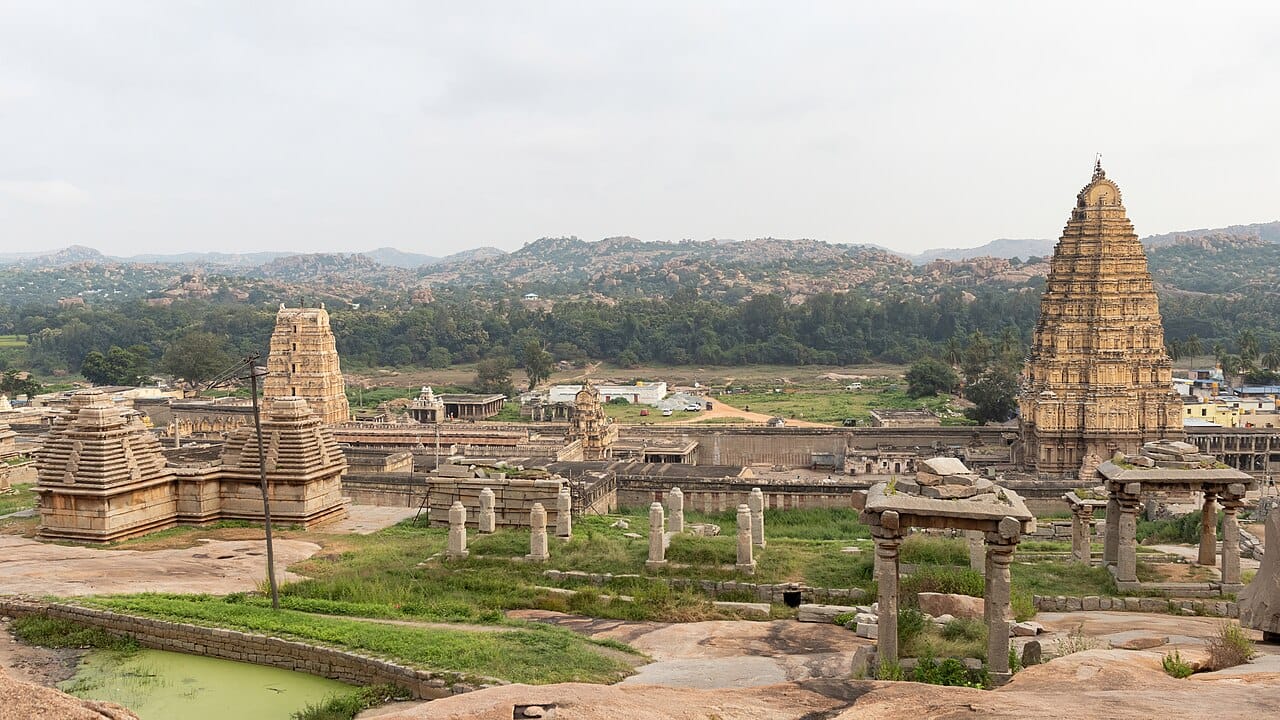
The Virupaksha Temple in Hampi, Karnataka, is a UNESCO World Heritage Site and the oldest functioning temple in India, dedicated to Lord Shiva as Virupaksha.
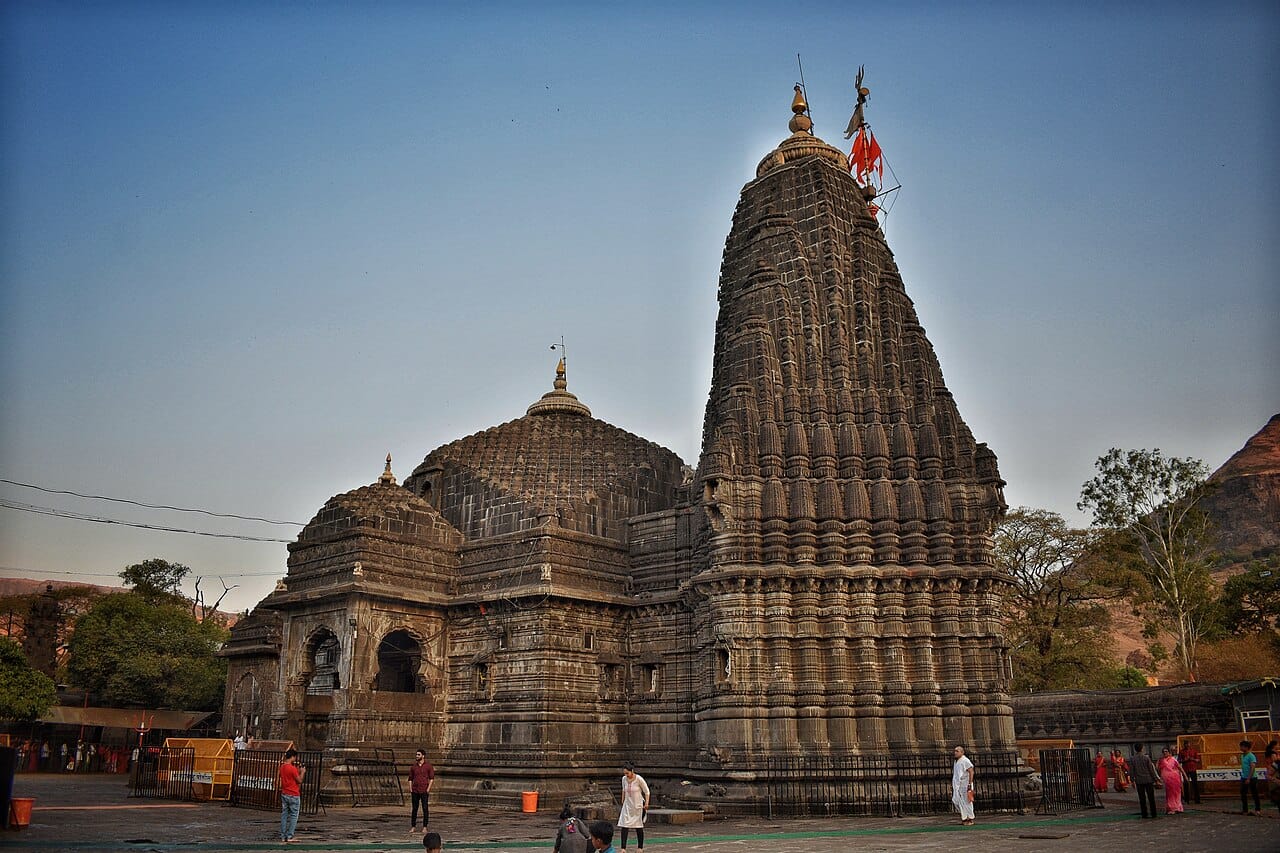
Trimbakeshwar Temple
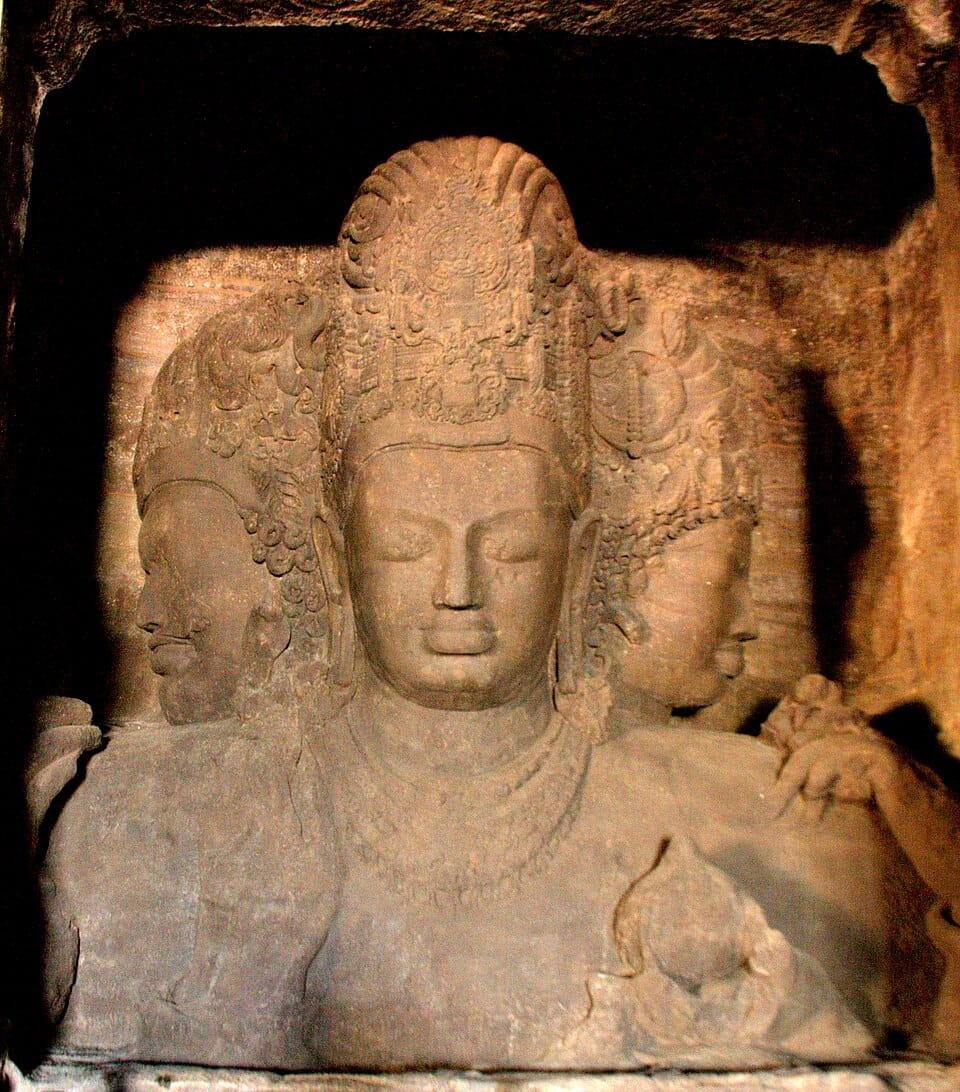
The Trimbakeshwar Temple in Maharashtra is one of the twelve Jyotirlingas, unique for its three-faced linga representing the Trimurti and the source of the Godavari River.
Airavatesvara Temple
The Airavatesvara Temple at Darasuram, built by Rajaraja Chola II between 1146 and 1172 CE, is one of the three UNESCO World Heritage 'Great Living Chola Temples.' It is renowned for its stone chariot, musical steps, and exquisite 12th-century Chola sculptures.
Gangaikonda Cholapuram Temple
The Gangaikonda Cholapuram Temple, built by Rajendra Chola I in 1035 CE, is a UNESCO World Heritage 'Great Living Chola Temple.' Its 53-metre vimana with recessed corners and six pairs of monolithic dvarapalas represents a refined evolution of Chola Dravidian architecture.
Kampaheswarar Temple
Kampaheswarar Temple in Tribhuvanam, built by Kulothunga Chola III in 1202 CE, is one of the later great Chola temples and completes the quartet of magnificent Chola stone temples alongside the Brihadeeswarar at Thanjavur, Gangaikonda Cholapuram, and Airavatesvara at Darasuram. The temple represents the mature phase of Chola architecture, featuring a 30-metre granite vimana, a separate Devi shrine, and a unique chariot-wheel carving in the mandapa. It is maintained by the Archaeological Survey of India as a protected monument of national importance.
Koranganatha Temple
Koranganatha Temple, built during the reign of the Chola king Parantaka I (907-955 CE) at Srinivasanallur near Tiruchirappalli, is a well-preserved example of early Chola architecture with exquisite stone carvings. The temple is maintained by the Archaeological Survey of India and is notable for its peaceful setting on the banks of the Kaveri River.
Trimbakeshwar Temple
The Trimbakeshwar Temple in Maharashtra is one of the twelve Jyotirlingas, unique for its three-faced linga representing the Trimurti and the source of the Godavari River.
Alampur Jogulamba Temple
One of the 18 Maha Shakti Peethas, located in a complex that also houses nine ancient 7th-century Chalukyan temples.
Somnath Temple
Somnath Temple, the first of the twelve Jyotirlingas, is an ancient Shiva temple in Gujarat known for its resilience through repeated destruction and reconstruction over a millennium.
Siddhesvara Dham (Char Dham)
A grand complex featuring a 108-foot Shiva statue and replicas of the 12 Jyotirlingas and the four Char Dham sites.
Ramanathaswamy Temple
The Ramanathaswamy Temple in Rameswaram is one of the 12 Jyotirlingas and a Char Dham site, famous for its magnificent thousand-pillared corridors, the longest temple corridor in the world, and its sacred association with Lord Rama's worship of Shiva.
Omkareshwar Temple
Situated on a sacred island in the Narmada River, Omkareshwar is the only Jyotirlinga located on an island. The temple stands at the confluence of the Narmada and Kaveri rivers, with the lingam positioned where the river forms the shape of the sacred symbol Om.
Trimbakeshwar Temple
The Trimbakeshwar Temple in Maharashtra is one of the twelve Jyotirlingas, unique for its three-faced linga representing the Trimurti and the source of the Godavari River.
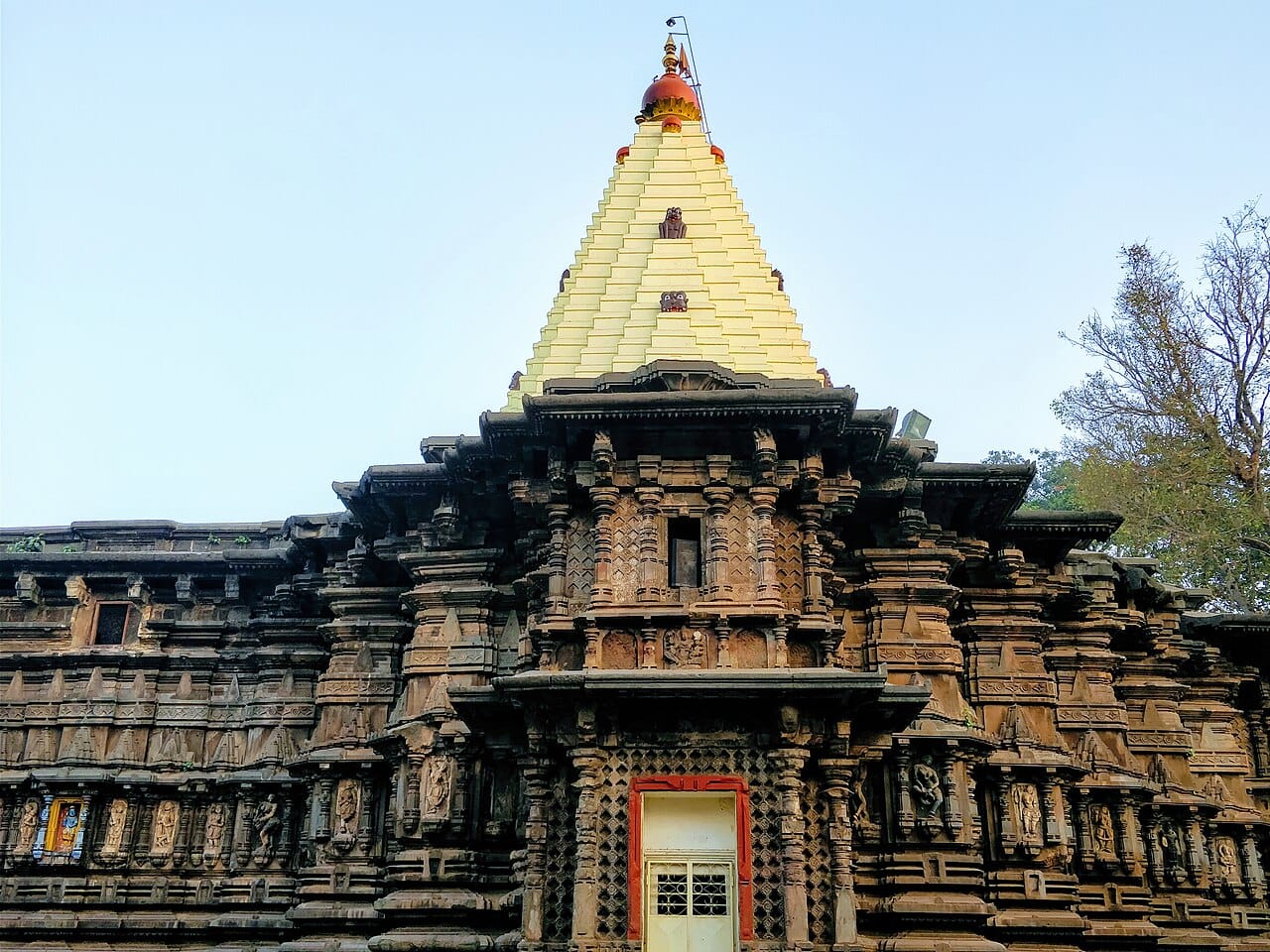
Mahalakshmi Temple
Mahalakshmi Temple in Kolhapur, also known as Ambabai Temple, is one of the 18 Maha Shakti Peethas and one of six Shakti sites in India. The temple is famous for the Kirnotsav solar event where sunlight falls directly on the deity's face twice a year, and for its 3-foot gemstone idol of Goddess Mahalakshmi weighing 40 kilograms.
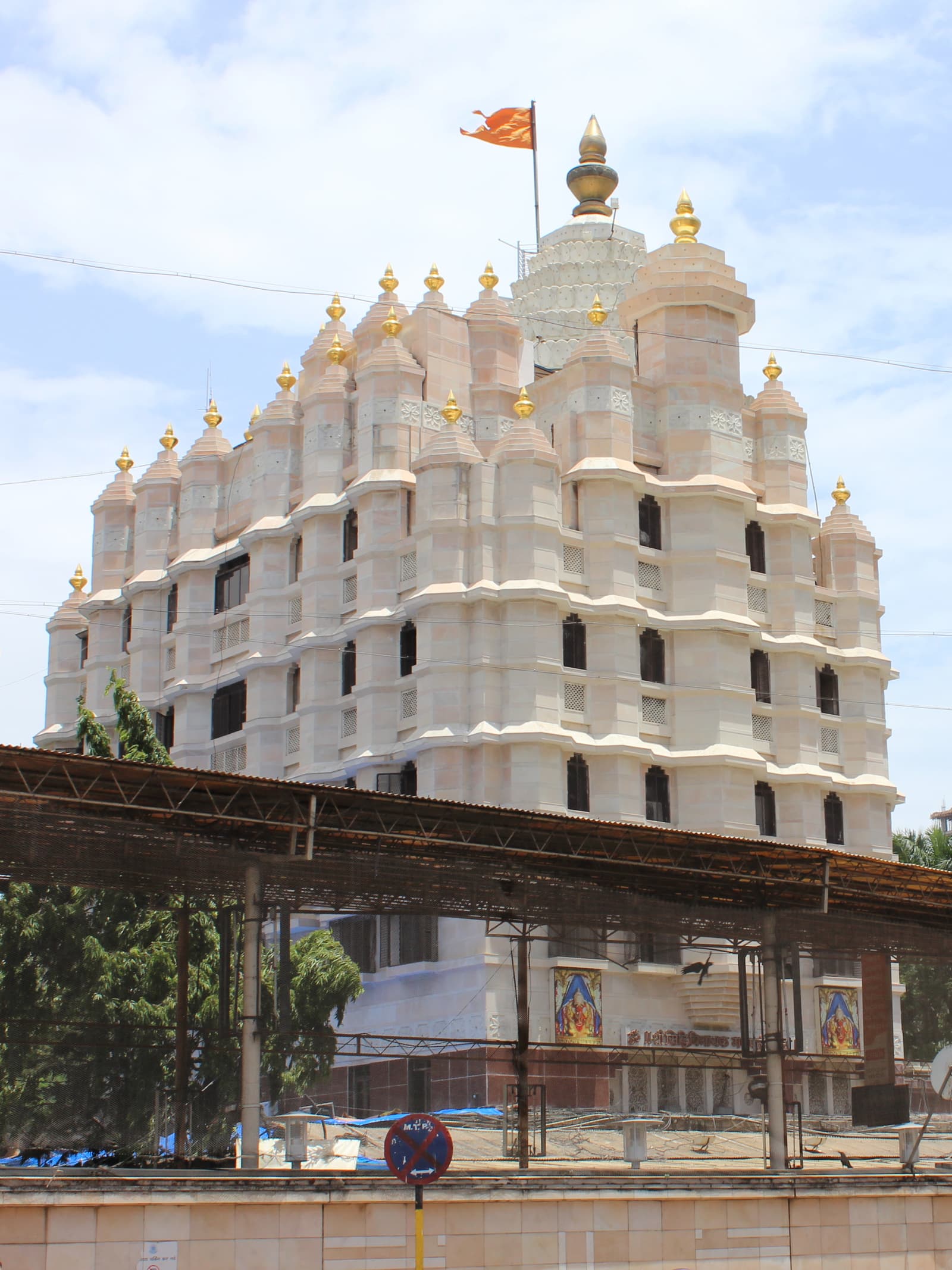
Shree Siddhivinayak Ganapati Temple, Mumbai
Mumbai's most famous temple and among the richest in India, dedicated to the wish-fulfilling form of Lord Ganesha, drawing over 100,000 devotees daily.
Shirdi Sai Baba Temple (Samadhi Mandir)
The holiest Sai Baba shrine where the saint lived and taught, with his Samadhi (tomb) drawing 25,000+ daily pilgrims from across religions.
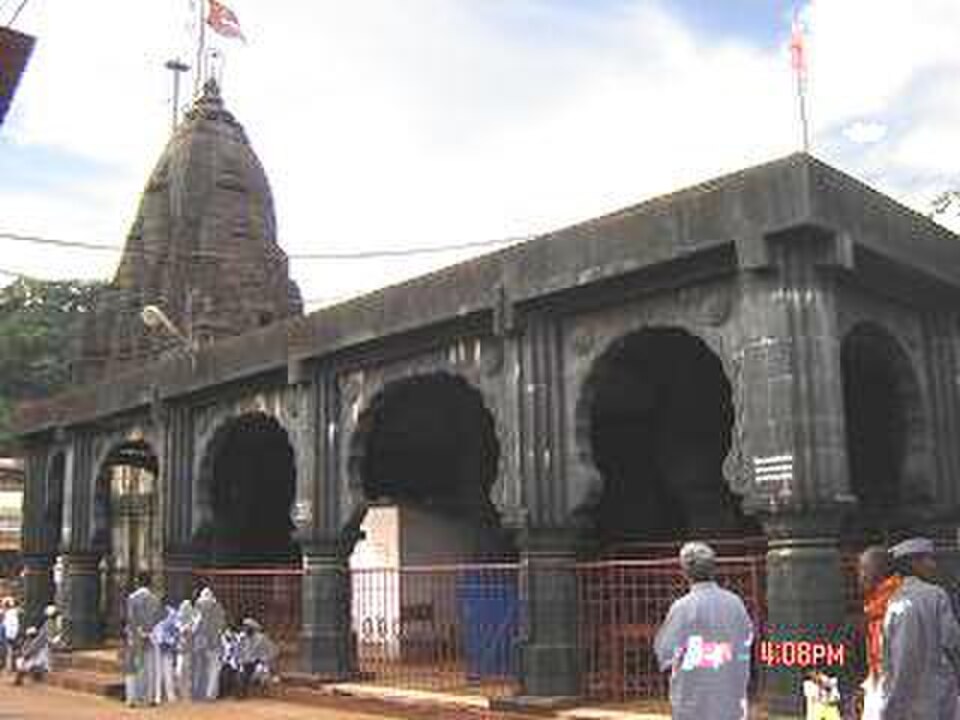
Bhimashankar Jyotirlinga
The source of the Bhima River deep in the Sahyadri hills. A Jyotirlinga surrounded by a wildlife sanctuary, with the legend of Tripurasura.
Kailasa Temple, Ellora
The world's largest monolithic rock-cut structure, carved top-down from a single basalt cliff.
Tarakeshwar Temple Hooghly
A massive 18th-century pilgrimage site dedicated to Lord Taraknath, especially vibrant during the Gajan festival.
Virupaksha Temple
The Virupaksha Temple in Hampi, Karnataka, is a UNESCO World Heritage Site and the oldest functioning temple in India, dedicated to Lord Shiva as Virupaksha.
Jageshwar Temple
A cluster of 124 ancient stone temples from the 7th-12th centuries, nestled in a dense deodar forest.
Neelkanth Mahadev Temple
Situated at 1,330 meters, this is where Lord Shiva is believed to have consumed the poison (Halahala) during the Samudra Manthan.
Tungnath Temple
The highest Shiva temple in the world, situated at 3,680 meters on the Chandranath Parbat; it is the 'Tritiya Kedar' in the sacred Panch Kedar pilgrimage circuit.
Rudranath Temple
One of the Panch Kedar shrines, representing Lord Shiva's face, situated at an altitude of 2,286 meters amidst meadows and rhododendron forests.
India's temples are living traditions — not museums. Every temple has its own customs. This guide helps first-time visitors prepare with confidence and respect.
Foreign Visitors
AllowedAll visitors welcome. Non-Hindus can enter the temple and observe the lingam.
Visitor Information
Entry policies vary between temples. Most temples welcome visitors, while some may restrict access to specific areas, rituals, or the inner sanctum. Always verify the latest entry guidelines with the official temple authorities before your visit.
Modest clothing is expected at every Indian temple — a sign of respect, not a restriction. Think of it as dressing for a formal ceremony.
October — March
April — June
July — September
Common local languages: Marathi, Hindi, English
Cash (Indian Rupees) is the most reliable option, especially for temple offerings, small shops, and local transport.
UPI digital payments (Google Pay, PhonePe, Paytm) are widely accepted across India — even at roadside stalls. Download one before you arrive.
International credit/debit cards work at most ATMs, hotels, and larger establishments. Smaller vendors may only accept cash or UPI.
Carry small denominations (₹10, ₹20, ₹50, ₹100 notes) for offerings and temple donations. Large notes (₹500, ₹2000) can be hard to break at smaller counters.
Wheelchair: Limited. The temple area has steps and uneven stone flooring.
Stay hydrated — carry a reusable water bottle, especially in hot climates.
Keep valuables secure — use hotel lockers for passports and excess cash.
Wear comfortable, sturdy footwear — temple floors can be hot, wet, or uneven.
Beware of unofficial guides or touts near temple entrances. Only use authorised services.
Carry a photocopy of your passport and visa. Leave originals in your hotel safe.
Download offline maps — mobile networks can be unreliable near remote temple sites.
These short explanations help make sense of what you see and experience.
Darshan means 'seeing' — but in a temple it means being seen by the deity. It is a sacred moment of connection, not just a viewing.
Removing footwear is a sign of humility. It also keeps the temple floor clean, since devotees sit and pray on the ground.
Food offered to the deity and then distributed to devotees. It is considered blessed. Accept it with both hands and do not discard it.
The bell creates a focused acoustic atmosphere, wards off distractions, and announces your presence before entering the inner sanctum.
Circumambulation (pradakshina) is done clockwise, keeping the sanctum on your right — an auspicious direction aligned with the sun's path.
Flowers symbolise devotion, coconuts represent the ego being broken, incense purifies the air, and lamps represent the victory of light over darkness.
Sacred viewing of the deity; the central act of temple worship.
Clockwise circumambulation of the sanctum.
Blessed food offered to the deity and distributed to devotees.
The innermost sanctum where the main deity resides.
The towering spire above the sanctum, a defining feature of temple architecture.
A pillared hall or pavilion within the temple complex.
The Indian Rupee (?, INR) is the local currency. ATMs are widely available in cities and towns. For temple offerings, keep small notes (₹10, ₹20, ₹50). Most temples accept donations in cash only — digital payments are uncommon at the offering counter itself.
Offerings (dakshina) are given with the right hand. Place cash in the donation box (hundi) or give it directly to the priest. There is no fixed amount — give what feels appropriate. Some temples have fixed fees for special entry or puja participation.
Shoes and sandals are removed before entering the temple building. Most temples have a designated shoe counter (free or a small fee of ₹5–₹20). Socks are generally allowed. In monsoon, carry a plastic bag for wet shoes.
Darshan queues can take 30 minutes to 3 hours at popular temples. Many offer paid VIP darshan (₹100–₹500) for faster entry. Special queues for women, elderly, and disabled visitors exist at some temples. No line jumping.
Major festivals draw enormous crowds — sometimes hundreds of thousands. Book accommodation months in advance. Expect road closures, restricted vehicle access, and limited phone network. Arrive early (before dawn) to avoid the worst congestion.
Always look for signage before taking photos. When in doubt, ask a priest. Never take photos of devotees in prayer without permission. Selfie sticks are banned at most temples. Silently switch your phone to silent mode.
Police / Ambulance / Fire: 112 (National Emergency Number)
Tourist Helpline: 1800-111-363 (Multi-lingual, Ministry of Tourism)
Women's Helpline: 1091
Official Temple WebsiteState Tourism WebsiteTemple-specific visitor information is continuously researched and updated from official sources. Where specific data is unavailable, general India travel guidance is provided. Always verify current policies with the temple authority before your visit.
Continue your journey through the spiritual and architectural wonders of India.

The Trimbakeshwar Temple in Maharashtra is one of the twelve Jyotirlingas, unique for its three-faced linga representing the Trimurti and the source of the Godavari River.

The source of the Bhima River deep in the Sahyadri hills. A Jyotirlinga surrounded by a wildlife sanctuary, with the legend of Tripurasura.

Mahalakshmi Temple in Kolhapur, also known as Ambabai Temple, is one of the 18 Maha Shakti Peethas and one of six Shakti sites in India. The temple is famous for the Kirnotsav solar event where sunlight falls directly on the deity's face twice a year, and for its 3-foot gemstone idol of Goddess Mahalakshmi weighing 40 kilograms.

Mumbai's most famous temple and among the richest in India, dedicated to the wish-fulfilling form of Lord Ganesha, drawing over 100,000 devotees daily.
"The Ellora Caves feature 34 monasteries and temples, including the massive monolithic Kailasa Temple."