From ancient rock-cut marvels to towering imperial shrines, discover the architectural soul of Bharat through our verified digital archive.
Explore More Temples
Location
Gangaikonda Cholapuram
Presiding Deity
Lord Shiva (Brihadeeswarar)
Architecture
Chola Dravidian
Dynasty
Chola (Rajendra Chola I)
Timings
6:00 AM to 6:00 PM daily. The temple is a protected monument under the Archaeological Survey of India (ASI). Photography is permitted throughout the complex.
Entry Fee
Free
Best Time
October to March offers the most pleasant weather for visiting, with temperatures ranging from 20°C to 30°C. The temple is open year-round. Early morning and late afternoon provide the best lighting for photography. Summer months (April to June) can be very hot, with temperatures exceeding 38°C.
UNESCO
2004
The Gangaikonda Cholapuram Temple, built by Rajendra Chola I in 1035 CE, is a UNESCO World Heritage 'Great Living Chola Temple.' Its 53-metre vimana with recessed corners and six pairs of monolithic dvarapalas represents a refined evolution of Chola Dravidian architecture.
Rajendra Chola I inherited a vast empire from his father Rajaraja Chola I. Between 1019 and 1025 CE, he led a military expedition to the Gangetic plains, defeating the Pala king Mahipala, the Kalinga ruler, and several other kings and chieftains along the eastern coast. This campaign is recorded in the Tiruvalangadu copper plates, the Esalam plates, and inscriptions at the temple itself. After his victory, Rajendra assumed the title Gangaikonda Cholan (the one who conquered the Ganges). He brought pots of Ganges water back to his kingdom and poured them into a massive artificial lake called Chola Gangam, built as part of the new capital. The earliest inscription mentioning the city of Gangaikonda Cholapuram is dated 1029 CE, while the first gift to the temple is recorded in 1035 CE. The city was planned according to the principles of Tamil Vastu and Agama Sastra texts, with a royal palace, several temples (including shrines to Vishnu and Dharma Sasta), and fortified walls. Most of these structures were destroyed in the late 13th and 14th centuries following the decline of the Chola Empire. Only the main Shiva temple survives intact. Excavations have revealed the outlines of the ancient city, with mounds marking the locations of collapsed structures, broken pillar stumps, and brick walls spread over a large area.
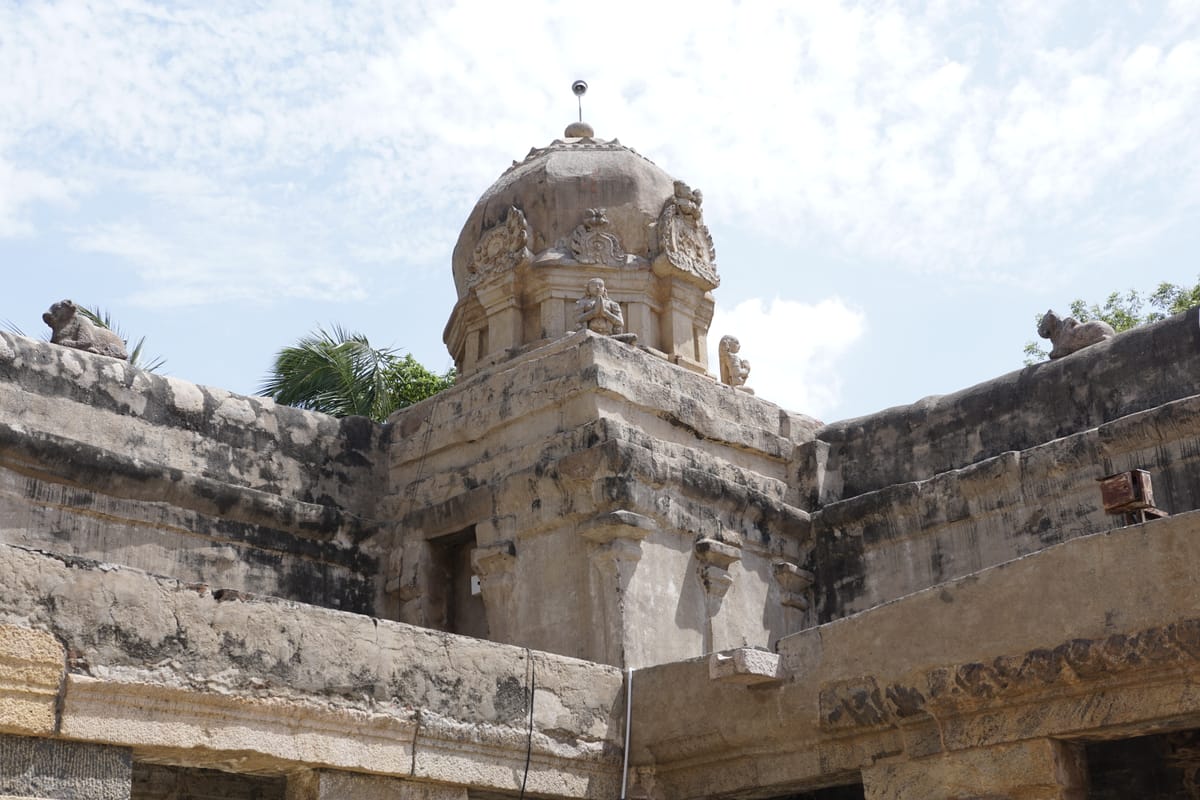
“According to a well-known legend, Rajendra Chola I brought water from the Ganges River after his northern conquest and used it to fill the temple's well, which was originally called Cholagangam. The king is said to have demanded that defeated rulers send pots of Ganges water as tribute. More broadly, the temple's mythology is tied to Shiva as the cosmic lord. The main lingam is considered a form of Shiva that represents the Chola king's devotion and power. The temple also features mythological reliefs depicting scenes from the Shiva Purana, though many sculptures were damaged or removed during the period of destruction that followed the Chola decline.”
The temple follows the Chola Dravidian style and was built entirely of granite. Its most striking feature is the 53-metre vimana (sanctum tower), which differs from the Thanjavur temple in having recessed corners that create a graceful upward curving movement. The layout follows the standard Chola plan: sanctum (garbhagriha) with its axial mandapas (ardhamandapa, mahamandapa, mukhamandapa), the Chandikesvara shrine, a cloister mandapa with subsidiary shrines, and an eastern gopura (gateway). The temple introduces several architectural improvements over the Thanjavur temple, including provisions for erecting wooden scaffolding within the masonry of the sanctum during construction, and a more pleasing elevation achieved by carefully proportioning the hara (decorative elements on each storey). Six pairs of massive monolithic dvarapalas (guardian deities) stand at the entrances — each pair carved from a single block of granite. These figures, standing over 2 metres tall, are carved with elaborate jewellery, weapons, and expressions that range from fierce to benevolent. The temple's outer walls feature niches with sculptures of Shiva in various forms, including a notable Dakshinamurthy (Shiva as the teacher). The temple had a single east-facing gopura that was never fully completed.
The Gangaikonda Cholapuram Temple represents the second phase of the Great Living Chola Temples, marking the expansion of the Chola Empire to its greatest territorial extent. Architecturally, it is significant for its refined proportions — the shrine is smaller than the Thanjavur temple but considered more elegant. The temple features the innovation of recessed corners on the vimana, which gives the tower a lighter, more graceful appearance. Its six pairs of monolithic dvarapala statues guarding the entrances are among the largest and finest in South India. The bronze sculptures housed inside, including the famous dancing Shiva (Nataraja) bronzes, are celebrated examples of Chola metalwork. UNESCO recognises the temple under criteria (ii) and (iii) as bearing exceptional testimony to the Chola civilisation and the development of Dravidian architecture.
Maha Shivaratri is the most important festival, celebrated with night-long vigils, special abhishekams, and cultural programmes. The temple also observes Pradosham (the 13th day of each lunar fortnight) with special pujas. Kartikai Deepam (November-December) is observed with lighting of lamps around the temple. The annual Brahmotsavam is conducted according to Agama traditions. Aadi Perukku (July-August), a Tamil harvest festival, is observed with offerings at the Chola Gangam lake.
UNESCO Great Living Chola Temple, 53-metre vimana with recessed corners, six pairs of colossal monolithic dvarapalas, Chola bronze collection, Chola Gangam artificial lake, refined architectural proportions.
October to March offers the most pleasant weather for visiting, with temperatures ranging from 20°C to 30°C. The temple is open year-round. Early morning and late afternoon provide the best lighting for photography. Summer months (April to June) can be very hot, with temperatures exceeding 38°C.
6:00 AM to 6:00 PM daily. The temple is a protected monument under the Archaeological Survey of India (ASI). Photography is permitted throughout the complex.
Gangaikonda Cholapuram village is located in Udayarpalayam taluk of Ariyalur district, Tamil Nadu. The nearest railway station is Jayankondam (8 km). The nearest major railway junction is Thanjavur (70 km). The nearest airport is Tiruchirappalli International Airport (80 km). Local buses connect Jayankondam to Gangaikonda Cholapuram. Plan a full day trip combining all three Great Living Chola Temples. Hire a private taxi from Thanjavur or Kumbakonam for the most efficient route. The site has limited food options, so carry water and snacks.
The Brihadeeswarar Temple at Thanjavur (70 km southwest) and the Airavatesvara Temple at Darasuram (30 km southwest) complete the UNESCO Great Living Chola Temples triangle. The Gangaikonda Cholapuram site itself includes the excavated remains of the ancient Chola capital, including the massive Chola Gangam artificial lake (5 km long, built by Rajendra Chola I). The Nageswaran Temple at Kumbakonam (40 km) and the Kampaheswarar Temple at Tribhuvanam (35 km) are other notable Chola-era temples in the region.
A. It means 'City of the Chola who conquered the Ganges.' Rajendra Chola I assumed the title Gangaikonda Cholan after his successful military campaign to the Gangetic plains (circa 1023 CE) and built this city and temple to commemorate the achievement.
A. The Gangaikonda Cholapuram temple is smaller but considered architecturally more refined. Its vimana has recessed corners creating a lighter, more graceful profile compared to the straight, severe tower at Thanjavur. It also features six pairs of monolithic dvarapalas and introduced construction innovations like built-in scaffolding provisions.
A. Chola Gangam is a massive artificial lake (about 5 km long) built by Rajendra Chola I as part of his new capital. According to tradition, it was filled with water brought from the Ganges River by the defeated northern kings as tribute. The lake is one of the largest man-made water bodies of its era in South India.
A. After the Chola Empire declined in the late 13th century, the city of Gangaikonda Cholapuram was largely abandoned. The Pandyas, who overthrew the Cholas, and subsequent invasions by the Malik Kafur-led Delhi Sultanate campaigns (1310-1311 CE) led to widespread destruction of the non-temple structures. Only the main Shiva temple survived intact due to its solid granite construction.
A. The temple is open from 6:00 AM to 6:00 PM daily. It is maintained by the Archaeological Survey of India (ASI).
A. The site is in Ariyalur district, Tamil Nadu. The nearest railway station is Jayankondam (8 km). The nearest airport is Tiruchirappalli International Airport (80 km). Buses and taxis are available from Jayankondam, Kumbakonam, and Thanjavur.
A. Some bronzes remain in the temple, but many important Chola bronzes from the region are now displayed at the Thanjavur Art Gallery, the Government Museum in Chennai, and international museums. The temple's Nataraja bronze, if present, is kept in the temple's treasury and brought out only for special occasions.
Virupaksha Temple
The Virupaksha Temple in Hampi, Karnataka, is a UNESCO World Heritage Site and the oldest functioning temple in India, dedicated to Lord Shiva as Virupaksha.
Trimbakeshwar Temple
The Trimbakeshwar Temple in Maharashtra is one of the twelve Jyotirlingas, unique for its three-faced linga representing the Trimurti and the source of the Godavari River.
Airavatesvara Temple
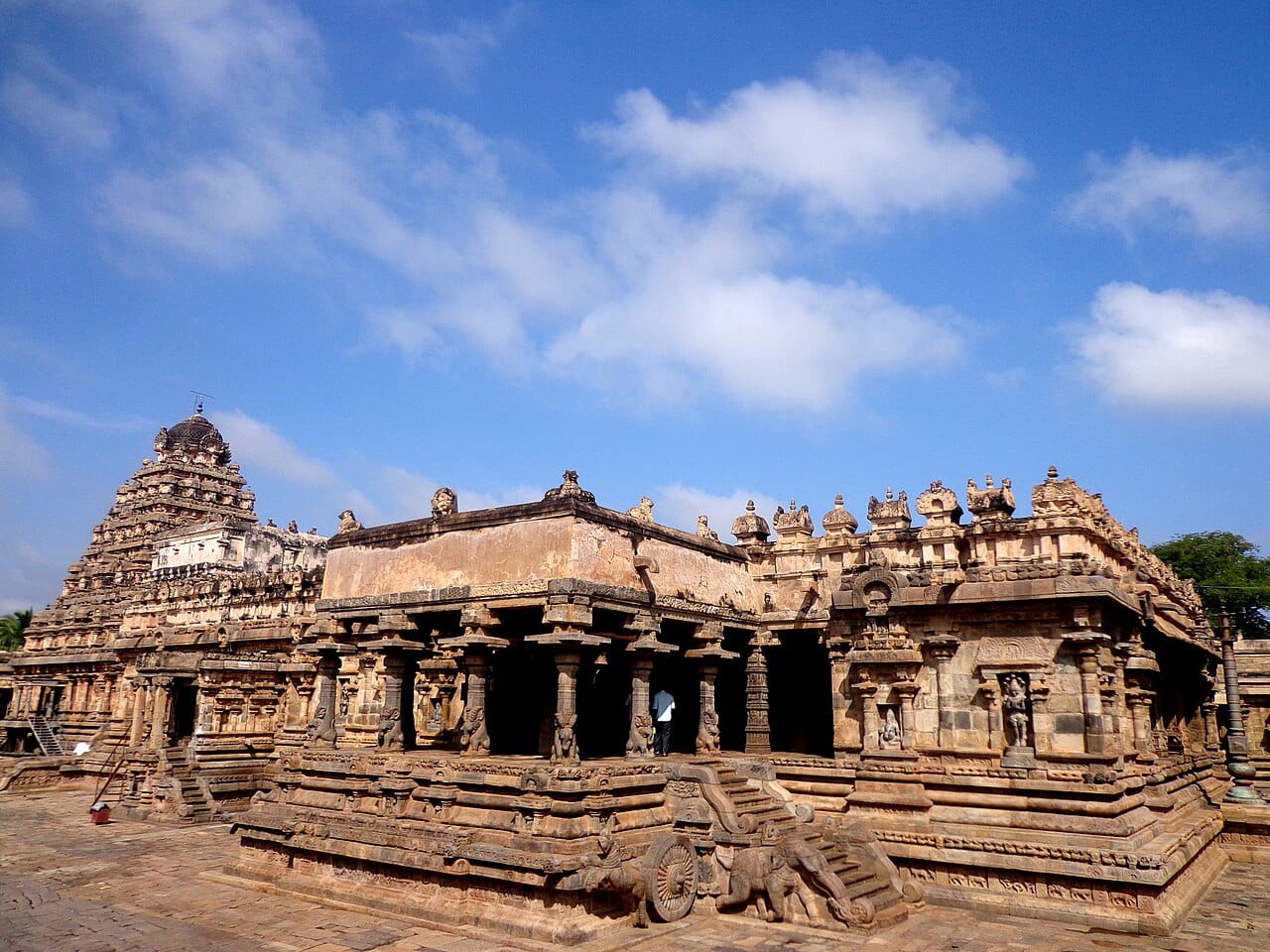
The Airavatesvara Temple at Darasuram, built by Rajaraja Chola II between 1146 and 1172 CE, is one of the three UNESCO World Heritage 'Great Living Chola Temples.' It is renowned for its stone chariot, musical steps, and exquisite 12th-century Chola sculptures.
Kampaheswarar Temple
Kampaheswarar Temple in Tribhuvanam, built by Kulothunga Chola III in 1202 CE, is one of the later great Chola temples and completes the quartet of magnificent Chola stone temples alongside the Brihadeeswarar at Thanjavur, Gangaikonda Cholapuram, and Airavatesvara at Darasuram. The temple represents the mature phase of Chola architecture, featuring a 30-metre granite vimana, a separate Devi shrine, and a unique chariot-wheel carving in the mandapa. It is maintained by the Archaeological Survey of India as a protected monument of national importance.
Koranganatha Temple
Koranganatha Temple, built during the reign of the Chola king Parantaka I (907-955 CE) at Srinivasanallur near Tiruchirappalli, is a well-preserved example of early Chola architecture with exquisite stone carvings. The temple is maintained by the Archaeological Survey of India and is notable for its peaceful setting on the banks of the Kaveri River.
Pancha Rathas
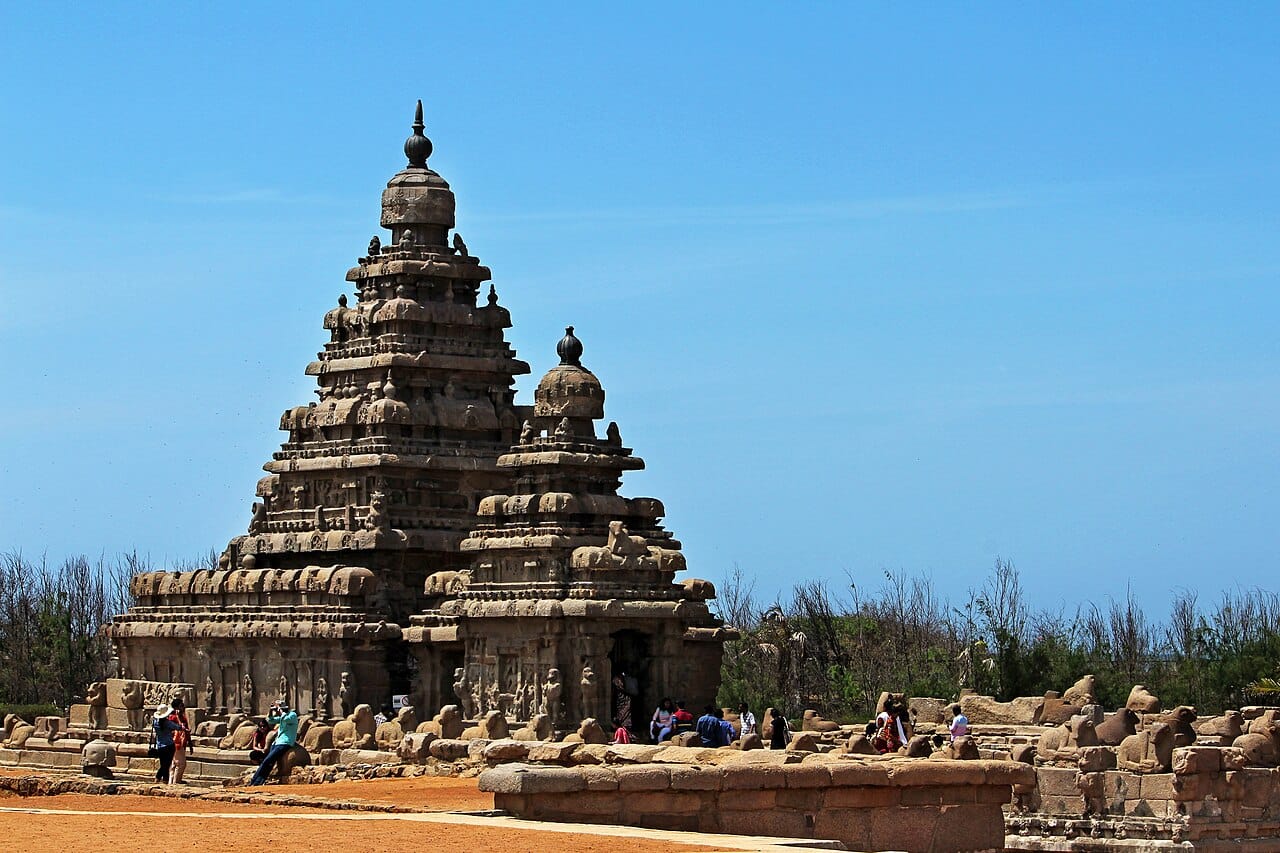
The Pancha Rathas (Five Chariots) are a set of five monolithic temple structures carved from single granite outcrops during the reign of Narasimhavarman I (Mamalla, 630-668 CE) in Mahabalipuram. Part of the UNESCO World Heritage Site 'Group of Monuments at Mahabalipuram,' these rathas represent the earliest and most ambitious examples of monolithic rock-cut architecture in Tamil Nadu.
Airavatesvara Temple
The Airavatesvara Temple at Darasuram, built by Rajaraja Chola II between 1146 and 1172 CE, is one of the three UNESCO World Heritage 'Great Living Chola Temples.' It is renowned for its stone chariot, musical steps, and exquisite 12th-century Chola sculptures.
Kampaheswarar Temple
Kampaheswarar Temple in Tribhuvanam, built by Kulothunga Chola III in 1202 CE, is one of the later great Chola temples and completes the quartet of magnificent Chola stone temples alongside the Brihadeeswarar at Thanjavur, Gangaikonda Cholapuram, and Airavatesvara at Darasuram. The temple represents the mature phase of Chola architecture, featuring a 30-metre granite vimana, a separate Devi shrine, and a unique chariot-wheel carving in the mandapa. It is maintained by the Archaeological Survey of India as a protected monument of national importance.
Koranganatha Temple
Koranganatha Temple, built during the reign of the Chola king Parantaka I (907-955 CE) at Srinivasanallur near Tiruchirappalli, is a well-preserved example of early Chola architecture with exquisite stone carvings. The temple is maintained by the Archaeological Survey of India and is notable for its peaceful setting on the banks of the Kaveri River.
Airavatesvara Temple
The Airavatesvara Temple at Darasuram, built by Rajaraja Chola II between 1146 and 1172 CE, is one of the three UNESCO World Heritage 'Great Living Chola Temples.' It is renowned for its stone chariot, musical steps, and exquisite 12th-century Chola sculptures.
Kampaheswarar Temple
Kampaheswarar Temple in Tribhuvanam, built by Kulothunga Chola III in 1202 CE, is one of the later great Chola temples and completes the quartet of magnificent Chola stone temples alongside the Brihadeeswarar at Thanjavur, Gangaikonda Cholapuram, and Airavatesvara at Darasuram. The temple represents the mature phase of Chola architecture, featuring a 30-metre granite vimana, a separate Devi shrine, and a unique chariot-wheel carving in the mandapa. It is maintained by the Archaeological Survey of India as a protected monument of national importance.
Koranganatha Temple
Koranganatha Temple, built during the reign of the Chola king Parantaka I (907-955 CE) at Srinivasanallur near Tiruchirappalli, is a well-preserved example of early Chola architecture with exquisite stone carvings. The temple is maintained by the Archaeological Survey of India and is notable for its peaceful setting on the banks of the Kaveri River.
Pancha Rathas
The Pancha Rathas (Five Chariots) are a set of five monolithic temple structures carved from single granite outcrops during the reign of Narasimhavarman I (Mamalla, 630-668 CE) in Mahabalipuram. Part of the UNESCO World Heritage Site 'Group of Monuments at Mahabalipuram,' these rathas represent the earliest and most ambitious examples of monolithic rock-cut architecture in Tamil Nadu.
Olakkaneswara Temple
Olakkaneswara Temple, located on a rocky outcrop at the southern end of Mahabalipuram beach, was built by the Pallavas in the 7th century. The temple later served as a lighthouse for ships navigating the Bay of Bengal, with a beacon light placed on its tower in the late 19th century. The site offers panoramic views of the Mahabalipuram coastline.
Vaikuntha Perumal Temple
Built by the Pallava king Nandivarman II in the 8th century (circa 770 CE), the Vaikuntha Perumal Temple in Kanchipuram is a key monument of Pallava architecture featuring three tiers of sanctums one above the other, a unique architectural design representing the three aspects of Vishnu — seated (bhoga), standing (sthita), and reclining (sayana).
Virupaksha Temple
The Virupaksha Temple in Hampi, Karnataka, is a UNESCO World Heritage Site and the oldest functioning temple in India, dedicated to Lord Shiva as Virupaksha.
Airavatesvara Temple
The Airavatesvara Temple at Darasuram, built by Rajaraja Chola II between 1146 and 1172 CE, is one of the three UNESCO World Heritage 'Great Living Chola Temples.' It is renowned for its stone chariot, musical steps, and exquisite 12th-century Chola sculptures.
Konark Sun Temple
A 13th-century colossal stone chariot of the Sun God Surya, the Konark Sun Temple is a UNESCO World Heritage Site and the most architecturally ambitious solar temple in India, with 24 massive stone wheels and intricate carvings depicting life, dance, and divinity.
Brihadeeswarar Temple
The Brihadeeswarar Temple in Thanjavur, built by Raja Raja Chola I in the 11th century, is a UNESCO World Heritage Site and the tallest Shiva temple in India, crowned by a monolithic granite vimana that remains one of the greatest engineering achievements of the ancient world.
Kailasa Temple, Ellora
The world's largest monolithic rock-cut structure, carved top-down from a single basalt cliff.
Ajanta Cave Temples
A UNESCO World Heritage site with 30 rock-cut Buddhist caves famous for ancient mural paintings and Jataka tale depictions.
Tarakeshwar Temple Hooghly
A massive 18th-century pilgrimage site dedicated to Lord Taraknath, especially vibrant during the Gajan festival.
Virupaksha Temple
The Virupaksha Temple in Hampi, Karnataka, is a UNESCO World Heritage Site and the oldest functioning temple in India, dedicated to Lord Shiva as Virupaksha.
Jageshwar Temple
A cluster of 124 ancient stone temples from the 7th-12th centuries, nestled in a dense deodar forest.
Neelkanth Mahadev Temple
Situated at 1,330 meters, this is where Lord Shiva is believed to have consumed the poison (Halahala) during the Samudra Manthan.
Tungnath Temple
The highest Shiva temple in the world, situated at 3,680 meters on the Chandranath Parbat; it is the 'Tritiya Kedar' in the sacred Panch Kedar pilgrimage circuit.
Rudranath Temple
One of the Panch Kedar shrines, representing Lord Shiva's face, situated at an altitude of 2,286 meters amidst meadows and rhododendron forests.
India's temples are living traditions — not museums. Every temple has its own customs. This guide helps first-time visitors prepare with confidence and respect.
Foreign visitor information is being researched
Please verify with the official temple authority before planning your visit.
Foreign Visitors
Verify Before VisitingVisitor Information
Entry policies vary between temples. Most temples welcome visitors, while some may restrict access to specific areas, rituals, or the inner sanctum. Always verify the latest entry guidelines with the official temple authorities before your visit.
Modest clothing is expected at every Indian temple — a sign of respect, not a restriction. Think of it as dressing for a formal ceremony.
A scarf is always useful — it covers shoulders, works as a head covering, and can double as a makeshift face cover if needed.
Outdoor photography is generally permitted. Indoor photography is often restricted. Always look for signage or ask a priest before taking photos inside.
October to March offers the most pleasant weather for visiting, with temperatures ranging from 20°C to 30°C. The temple is open year-round. Early morning and late afternoon provide the best lighting for photography. Summer months (April to June) can be very hot, with temperatures exceeding 38°C.
April — June
July — September
English is widely understood at major tourist temples. In smaller local temples, Hindi and the regional language are more common. A smile and simple hand gestures go a long way. Learning a few words of the local language is always appreciated.
Cash (Indian Rupees) is the most reliable option, especially for temple offerings, small shops, and local transport.
UPI digital payments (Google Pay, PhonePe, Paytm) are widely accepted across India — even at roadside stalls. Download one before you arrive.
International credit/debit cards work at most ATMs, hotels, and larger establishments. Smaller vendors may only accept cash or UPI.
Carry small denominations (₹10, ₹20, ₹50, ₹100 notes) for offerings and temple donations. Large notes (₹500, ₹2000) can be hard to break at smaller counters.
Many historic temples have uneven stone floors, multiple steps, and narrow passages. Wheelchair access is limited at older sites — contact the temple in advance.
Basic restroom facilities and drinking water are available at most major temples. Some charge a small fee (₹5–₹10).
Stay hydrated — carry a reusable water bottle, especially in hot climates.
Keep valuables secure — use hotel lockers for passports and excess cash.
Wear comfortable, sturdy footwear — temple floors can be hot, wet, or uneven.
Beware of unofficial guides or touts near temple entrances. Only use authorised services.
Carry a photocopy of your passport and visa. Leave originals in your hotel safe.
Download offline maps — mobile networks can be unreliable near remote temple sites.
These short explanations help make sense of what you see and experience.
Darshan means 'seeing' — but in a temple it means being seen by the deity. It is a sacred moment of connection, not just a viewing.
Removing footwear is a sign of humility. It also keeps the temple floor clean, since devotees sit and pray on the ground.
Food offered to the deity and then distributed to devotees. It is considered blessed. Accept it with both hands and do not discard it.
The bell creates a focused acoustic atmosphere, wards off distractions, and announces your presence before entering the inner sanctum.
Circumambulation (pradakshina) is done clockwise, keeping the sanctum on your right — an auspicious direction aligned with the sun's path.
Flowers symbolise devotion, coconuts represent the ego being broken, incense purifies the air, and lamps represent the victory of light over darkness.
Sacred viewing of the deity; the central act of temple worship.
Clockwise circumambulation of the sanctum.
Blessed food offered to the deity and distributed to devotees.
The innermost sanctum where the main deity resides.
The towering spire above the sanctum, a defining feature of temple architecture.
A pillared hall or pavilion within the temple complex.
The Indian Rupee (?, INR) is the local currency. ATMs are widely available in cities and towns. For temple offerings, keep small notes (₹10, ₹20, ₹50). Most temples accept donations in cash only — digital payments are uncommon at the offering counter itself.
Offerings (dakshina) are given with the right hand. Place cash in the donation box (hundi) or give it directly to the priest. There is no fixed amount — give what feels appropriate. Some temples have fixed fees for special entry or puja participation.
Shoes and sandals are removed before entering the temple building. Most temples have a designated shoe counter (free or a small fee of ₹5–₹20). Socks are generally allowed. In monsoon, carry a plastic bag for wet shoes.
Darshan queues can take 30 minutes to 3 hours at popular temples. Many offer paid VIP darshan (₹100–₹500) for faster entry. Special queues for women, elderly, and disabled visitors exist at some temples. No line jumping.
Major festivals draw enormous crowds — sometimes hundreds of thousands. Book accommodation months in advance. Expect road closures, restricted vehicle access, and limited phone network. Arrive early (before dawn) to avoid the worst congestion.
Always look for signage before taking photos. When in doubt, ask a priest. Never take photos of devotees in prayer without permission. Selfie sticks are banned at most temples. Silently switch your phone to silent mode.
Police / Ambulance / Fire: 112 (National Emergency Number)
Tourist Helpline: 1800-111-363 (Multi-lingual, Ministry of Tourism)
Women's Helpline: 1091
Temple-specific visitor information is continuously researched and updated from official sources. Where specific data is unavailable, general India travel guidance is provided. Always verify current policies with the temple authority before your visit.
Information last verified July 2026. Temple-specific data coming soon.
Continue your journey through the spiritual and architectural wonders of India.

The Airavatesvara Temple at Darasuram, built by Rajaraja Chola II between 1146 and 1172 CE, is one of the three UNESCO World Heritage 'Great Living Chola Temples.' It is renowned for its stone chariot, musical steps, and exquisite 12th-century Chola sculptures.
Kampaheswarar Temple in Tribhuvanam, built by Kulothunga Chola III in 1202 CE, is one of the later great Chola temples and completes the quartet of magnificent Chola stone temples alongside the Brihadeeswarar at Thanjavur, Gangaikonda Cholapuram, and Airavatesvara at Darasuram. The temple represents the mature phase of Chola architecture, featuring a 30-metre granite vimana, a separate Devi shrine, and a unique chariot-wheel carving in the mandapa. It is maintained by the Archaeological Survey of India as a protected monument of national importance.

Koranganatha Temple, built during the reign of the Chola king Parantaka I (907-955 CE) at Srinivasanallur near Tiruchirappalli, is a well-preserved example of early Chola architecture with exquisite stone carvings. The temple is maintained by the Archaeological Survey of India and is notable for its peaceful setting on the banks of the Kaveri River.

The Pancha Rathas (Five Chariots) are a set of five monolithic temple structures carved from single granite outcrops during the reign of Narasimhavarman I (Mamalla, 630-668 CE) in Mahabalipuram. Part of the UNESCO World Heritage Site 'Group of Monuments at Mahabalipuram,' these rathas represent the earliest and most ambitious examples of monolithic rock-cut architecture in Tamil Nadu.

Olakkaneswara Temple, located on a rocky outcrop at the southern end of Mahabalipuram beach, was built by the Pallavas in the 7th century. The temple later served as a lighthouse for ships navigating the Bay of Bengal, with a beacon light placed on its tower in the late 19th century. The site offers panoramic views of the Mahabalipuram coastline.

Built by the Pallava king Nandivarman II in the 8th century (circa 770 CE), the Vaikuntha Perumal Temple in Kanchipuram is a key monument of Pallava architecture featuring three tiers of sanctums one above the other, a unique architectural design representing the three aspects of Vishnu — seated (bhoga), standing (sthita), and reclining (sayana).

Arunachaleswarar Temple at the foot of Arunachala Hill in Tiruvannamalai is one of the largest Shiva temples in the world, covering 25 acres. It represents the fire element (Agni) of the Pancha Bhoota Sthalas and is a Paadal Petra Sthalam glorified by the 7th-century Tevaram hymns.

Ekambareswarar Temple in Kanchipuram represents the earth element (Prithvi) of the Pancha Bhoota Sthalas. Its sand-made Prithvi Lingam, 192-foot Raja Gopuram built by Krishnadevaraya (1509), and the 3,500-year-old sacred mango tree make it among the most significant Shiva temples in South India.
"The Meenakshi Temple in Madurai has 14 gopurams (gateway towers), ranging from 45 to 52 meters in height."