From ancient rock-cut marvels to towering imperial shrines, discover the architectural soul of Bharat through our verified digital archive.
Explore More Temples
Location
Kumbakonam (Darasuram)
Presiding Deity
Lord Shiva (Airavatesvara)
Architecture
Chola Dravidian
Dynasty
Chola (Rajaraja Chola II)
Timings
6:00 AM to 6:00 PM daily. The temple is a protected monument under the Archaeological Survey of India (ASI). Photography is permitted throughout the complex. Tripods may require permission from the ASI site office.
Entry Fee
Free
Best Time
October to March is the ideal period, with pleasant weather for exploring the temple complex. November to February is particularly comfortable. The temple can be visited year-round, though April to June can be very hot with temperatures reaching 40°C. The late afternoon light (3:00 PM to 5:00 PM) provides the best conditions for photography.
UNESCO
2004
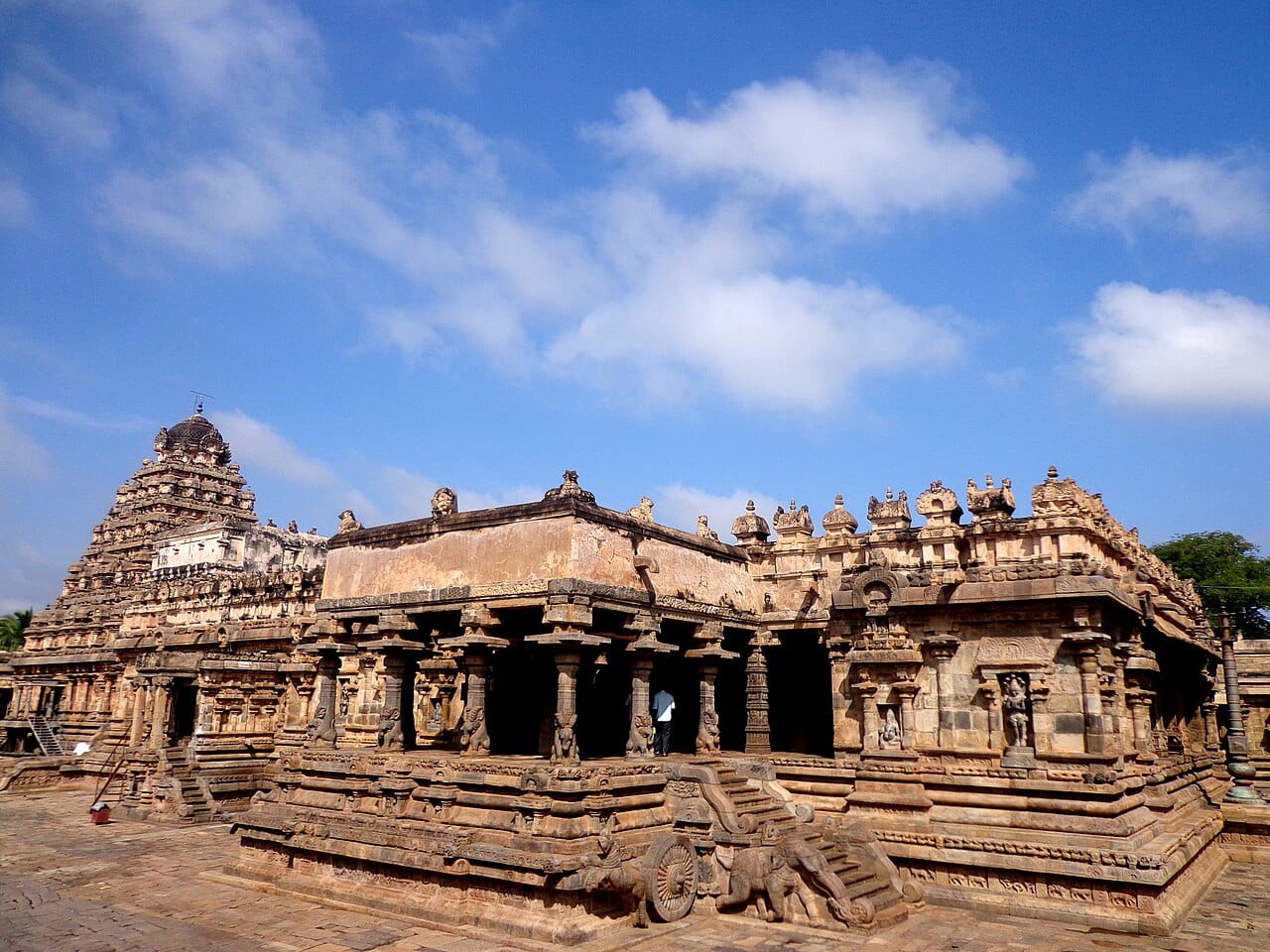
The Airavatesvara Temple at Darasuram, built by Rajaraja Chola II between 1146 and 1172 CE, is one of the three UNESCO World Heritage 'Great Living Chola Temples.' It is renowned for its stone chariot, musical steps, and exquisite 12th-century Chola sculptures.
King Rajaraja Chola II ruled the Chola Empire from 1146 to 1172 CE. He spent most of his reign in the secondary capital of Ayirattali (Pazhaiyarai), an urban complex that included Darasuram. Unlike his predecessors who focused on expanding existing temples, Rajaraja II sponsored the construction of new temples. The Airavatesvara Temple was his principal architectural legacy. The temple was much larger in its original form than what survives today. It originally formed part of a vast complex with seven concentric enclosures, of which only the innermost remains. The temple's inscriptions are in Tamil and record donations made to the deity. The Devanayaki Amman shrine in the adjacent enclosure was built later by Rajaraja II's successor, Kulothunga III, and was extensively modified during the Nayaka period. This separate shrine for the goddess marks an important development in Chola temple architecture — it was among the earliest instances where the goddess was given a shrine of her own rather than being placed as an attendant deity within the main complex. In the 19th and early 20th centuries, several sculptures from Airavatesvara, including the famous Bhikshatana panel depicting Shiva as a wandering mendicant, were relocated to the Thanjavur Museum and the Madras Museum for preservation.
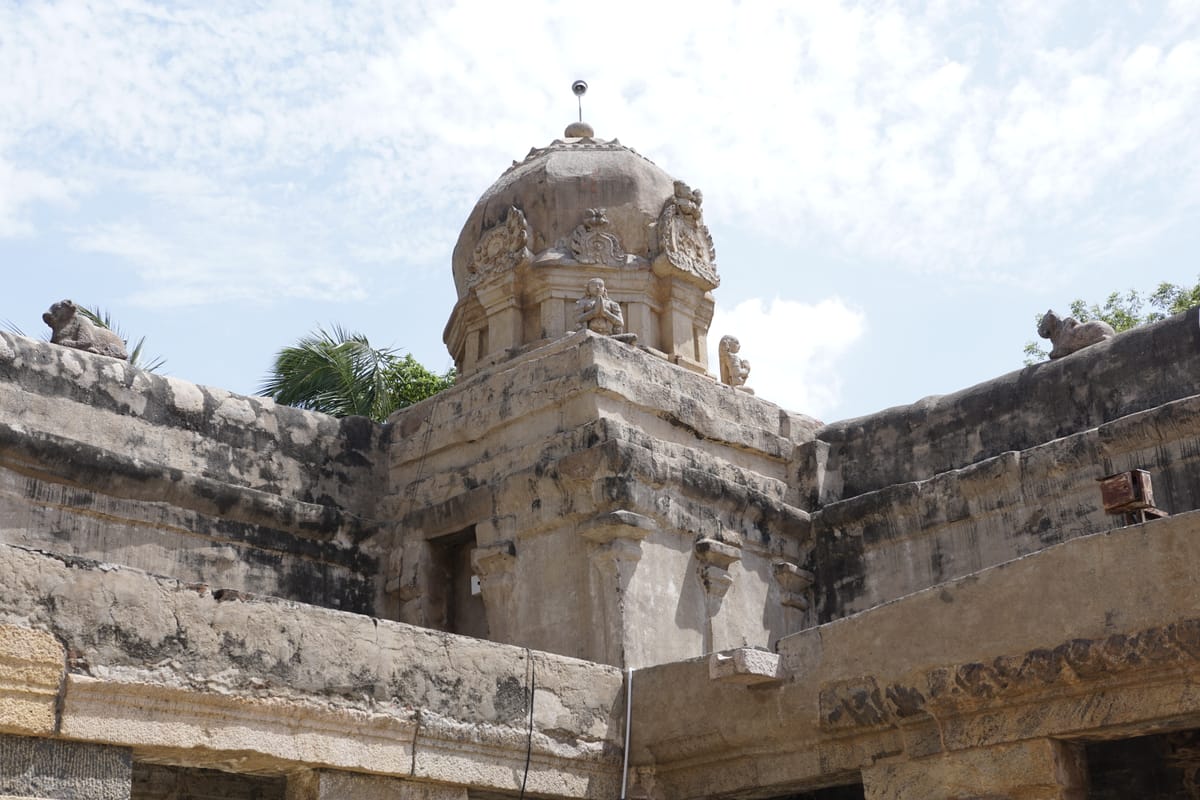
“The temple's name is linked to the legend of Airavata, the celestial white elephant of Lord Indra. According to the sthala purana, Airavata once trampled the sacred garland given by Sage Durvasa to Indra, earning a curse that stripped it of its white lustre. The elephant was born on earth, roaming forests in search of relief. At Darasuram, Airavata prayed to Lord Shiva, who appeared and lifted the curse, restoring the elephant's divine colour. An older name of the temple, Airathali (Aira-thali, meaning 'temple of Aira'), preserves this connection. Another legend associates the temple's musical steps with the celestial musician Tumburu, who is said to have performed at the temple, causing the stone steps to resonate with musical notes in response to his dancing.”
The Airavatesvara Temple is built in the Chola Dravidian style, entirely of granite. Its vimana (sanctum tower) rises to 24 metres and features two tiers, unlike the taller single-tower design of the Thanjavur temple. The temple measures approximately 70 by 30 metres. The most celebrated architectural feature is the stone chariot (rath) in the Agra-mandapa, with stone wheels that are fully carved and a pillared pavilion designed to resemble a processional chariot drawn by horses. The temple's musical steps (Sopanam) are stone steps outside the main mandapa that produce different musical notes when tapped, a remarkable acoustic achievement of Chola engineering. A high wall surrounds the temple complex, with a pillared cloister (malika) running along the interior. At the four corners of the cloister are mandapas. The temple has a Nandi pavilion facing the main shrine. A notable optical illusion carving shows an image that appears as a bull when viewed from one angle and an elephant when viewed from another. The niches below the platforms are replete with friezes depicting episodes from Hindu mythology — the battle between Vali and Sugreeva from the Ramayana, stories from the Mahabharata, the lives of the Nayanmars (Shaivite saints), and Shiva in his various forms. The sculptural programme is exceptionally rich, with some of the finest figure sculpture in the Chola tradition.
The Airavatesvara Temple is one of the four great Chola stone temples that represent the pinnacle of Chola Dravidian architecture, alongside the Brihadeeswarar Temple at Thanjavur (built by Rajaraja I), the Gangaikonda Cholapuram Temple (built by Rajendra I), and the Kampaheswarar Temple at Tribhuvanam (built by Kulothunga III). It is classified as a Karak Koil (stone chariot temple) because its main mandapa was designed in the form of a processional chariot, a style that influenced later temple architecture. The temple's sculptures are considered among the finest examples of 12th-century Chola art, displaying remarkable naturalism and detail. As a UNESCO World Heritage Site under criteria (ii) and (iii), it is recognised as an outstanding testimony to the development of Chola architecture and Tamil civilisation in South India.
The temple observes Maha Shivaratri as its most important festival, celebrated with night-long vigils and special abhishekams. Pradosham (the 13th day of each lunar fortnight) is observed monthly with special rituals. The temple also celebrates the Tamil month of Aadi (July-August) with Aadi Perukku, a festival honouring water bodies, observed with offerings at the temple's stepped tank. Kartikai Deepam (November-December) is marked with the lighting of lamps. The annual Brahmotsavam is conducted according to Agama traditions.
Part of UNESCO 'Great Living Chola Temples', the stone chariot in the Agra-mandapa, musical steps (Sopanam), the optical illusion 'bull-elephant' carving, Bhikshatana sculpture (now at Thanjavur Museum), and the finest Chola sculptural work.
October to March is the ideal period, with pleasant weather for exploring the temple complex. November to February is particularly comfortable. The temple can be visited year-round, though April to June can be very hot with temperatures reaching 40°C. The late afternoon light (3:00 PM to 5:00 PM) provides the best conditions for photography.
6:00 AM to 6:00 PM daily. The temple is a protected monument under the Archaeological Survey of India (ASI). Photography is permitted throughout the complex. Tripods may require permission from the ASI site office.
Darasuram is well connected by road from Kumbakonam. Auto-rickshaws and taxis are readily available in Kumbakonam. Combine your visit with the other two Great Living Chola Temples in Thanjavur and Gangaikonda Cholapuram for a comprehensive Chola heritage tour. The nearest railway station is Kumbakonam (4 km), and the nearest major airport is Tiruchirappalli International Airport (90 km). Allow at least 2-3 hours to explore the temple thoroughly.
Kumbakonam (4 km) is a major temple town with the Mahamaham Tank, Nageswaran Temple, Kumbeswarar Temple, and the Kasi Viswanathar Temple. The Brihadeeswarar Temple at Gangaikonda Cholapuram (30 km northeast) and the Brihadeeswarar Temple at Thanjavur (40 km southwest) are the other two UNESCO Great Living Chola Temples, making a triangle of Chola heritage. The Swamimalai Temple (10 km) is one of the six abodes of Murugan (Arupadai Veedu). The Kampaheswarar Temple at Tribhuvanam (15 km) represents the later Chola style. Darasuram is also known for its traditional bronze casting workshops.
A. Airavatesvara is part of the 'Great Living Chola Temples' UNESCO cluster, recognised for its outstanding Chola architecture. It was added to the list in 2004, alongside the Brihadeeswarar Temple at Thanjavur and Gangaikonda Cholapuram. UNESCO commends it as an exceptional testimony to Chola civilisation and Dravidian temple architecture.
A. The musical steps (Sopanam) are stone steps in the Agra-mandapa that produce different musical notes when tapped. This acoustic feature reflects the advanced knowledge of stone resonance in Chola engineering. Each step was carved to resonate at a specific frequency.
A. The stone chariot in the Agra-mandapa is not a separate structure but an integral part of the mandapa designed in the form of a processional chariot (rath). It features fully carved stone wheels, a pillared pavilion, and horses, all carved from a single granite mass. This design classifies Airavatesvara as a Karak Koil (stone chariot temple).
A. A famous carving in the temple shows an animal that appears as a bull when viewed from the front and an elephant when viewed from the side. This sculptural illusion demonstrates the advanced skill of Chola artisans in creating perspectival art.
A. The temple is open from 6:00 AM to 6:00 PM daily. It is maintained by the Archaeological Survey of India (ASI). The best time for photography is late afternoon when the sun illuminates the stone carvings.
A. Darasuram is 4 km from Kumbakonam in Thanjavur district, Tamil Nadu. The nearest railway station is Kumbakonam Junction (4 km). The nearest airport is Tiruchirappalli International Airport (90 km). Regular bus services and taxis are available from Kumbakonam.
A. There is no strict dress code for this ASI-protected monument as it is not a fully functioning temple for daily worship. However, visitors are advised to dress modestly out of respect for the sacred site.
A. The temple originally had seven concentric enclosures (sapta veedhi), but only the innermost enclosure survives. The outer enclosures were likely destroyed during the turbulent periods following the Chola decline in the late 13th and 14th centuries.
Virupaksha Temple
The Virupaksha Temple in Hampi, Karnataka, is a UNESCO World Heritage Site and the oldest functioning temple in India, dedicated to Lord Shiva as Virupaksha.
Trimbakeshwar Temple
The Trimbakeshwar Temple in Maharashtra is one of the twelve Jyotirlingas, unique for its three-faced linga representing the Trimurti and the source of the Godavari River.
Gangaikonda Cholapuram Temple
The Gangaikonda Cholapuram Temple, built by Rajendra Chola I in 1035 CE, is a UNESCO World Heritage 'Great Living Chola Temple.' Its 53-metre vimana with recessed corners and six pairs of monolithic dvarapalas represents a refined evolution of Chola Dravidian architecture.
Kampaheswarar Temple
Kampaheswarar Temple in Tribhuvanam, built by Kulothunga Chola III in 1202 CE, is one of the later great Chola temples and completes the quartet of magnificent Chola stone temples alongside the Brihadeeswarar at Thanjavur, Gangaikonda Cholapuram, and Airavatesvara at Darasuram. The temple represents the mature phase of Chola architecture, featuring a 30-metre granite vimana, a separate Devi shrine, and a unique chariot-wheel carving in the mandapa. It is maintained by the Archaeological Survey of India as a protected monument of national importance.
Koranganatha Temple
Koranganatha Temple, built during the reign of the Chola king Parantaka I (907-955 CE) at Srinivasanallur near Tiruchirappalli, is a well-preserved example of early Chola architecture with exquisite stone carvings. The temple is maintained by the Archaeological Survey of India and is notable for its peaceful setting on the banks of the Kaveri River.
Pancha Rathas
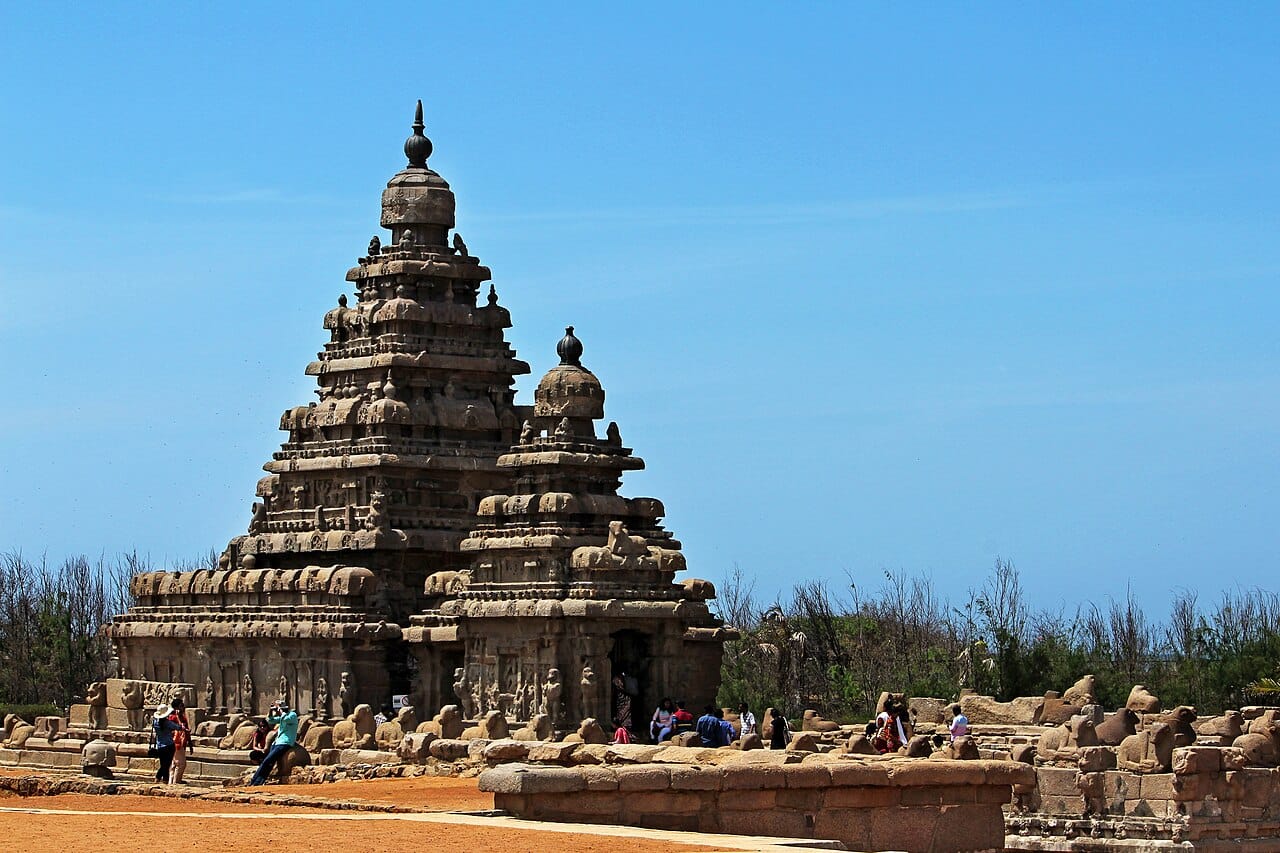
The Pancha Rathas (Five Chariots) are a set of five monolithic temple structures carved from single granite outcrops during the reign of Narasimhavarman I (Mamalla, 630-668 CE) in Mahabalipuram. Part of the UNESCO World Heritage Site 'Group of Monuments at Mahabalipuram,' these rathas represent the earliest and most ambitious examples of monolithic rock-cut architecture in Tamil Nadu.
Gangaikonda Cholapuram Temple
The Gangaikonda Cholapuram Temple, built by Rajendra Chola I in 1035 CE, is a UNESCO World Heritage 'Great Living Chola Temple.' Its 53-metre vimana with recessed corners and six pairs of monolithic dvarapalas represents a refined evolution of Chola Dravidian architecture.
Kampaheswarar Temple
Kampaheswarar Temple in Tribhuvanam, built by Kulothunga Chola III in 1202 CE, is one of the later great Chola temples and completes the quartet of magnificent Chola stone temples alongside the Brihadeeswarar at Thanjavur, Gangaikonda Cholapuram, and Airavatesvara at Darasuram. The temple represents the mature phase of Chola architecture, featuring a 30-metre granite vimana, a separate Devi shrine, and a unique chariot-wheel carving in the mandapa. It is maintained by the Archaeological Survey of India as a protected monument of national importance.
Koranganatha Temple
Koranganatha Temple, built during the reign of the Chola king Parantaka I (907-955 CE) at Srinivasanallur near Tiruchirappalli, is a well-preserved example of early Chola architecture with exquisite stone carvings. The temple is maintained by the Archaeological Survey of India and is notable for its peaceful setting on the banks of the Kaveri River.
Gangaikonda Cholapuram Temple
The Gangaikonda Cholapuram Temple, built by Rajendra Chola I in 1035 CE, is a UNESCO World Heritage 'Great Living Chola Temple.' Its 53-metre vimana with recessed corners and six pairs of monolithic dvarapalas represents a refined evolution of Chola Dravidian architecture.
Kampaheswarar Temple
Kampaheswarar Temple in Tribhuvanam, built by Kulothunga Chola III in 1202 CE, is one of the later great Chola temples and completes the quartet of magnificent Chola stone temples alongside the Brihadeeswarar at Thanjavur, Gangaikonda Cholapuram, and Airavatesvara at Darasuram. The temple represents the mature phase of Chola architecture, featuring a 30-metre granite vimana, a separate Devi shrine, and a unique chariot-wheel carving in the mandapa. It is maintained by the Archaeological Survey of India as a protected monument of national importance.
Koranganatha Temple
Koranganatha Temple, built during the reign of the Chola king Parantaka I (907-955 CE) at Srinivasanallur near Tiruchirappalli, is a well-preserved example of early Chola architecture with exquisite stone carvings. The temple is maintained by the Archaeological Survey of India and is notable for its peaceful setting on the banks of the Kaveri River.
Pancha Rathas
The Pancha Rathas (Five Chariots) are a set of five monolithic temple structures carved from single granite outcrops during the reign of Narasimhavarman I (Mamalla, 630-668 CE) in Mahabalipuram. Part of the UNESCO World Heritage Site 'Group of Monuments at Mahabalipuram,' these rathas represent the earliest and most ambitious examples of monolithic rock-cut architecture in Tamil Nadu.
Olakkaneswara Temple
Olakkaneswara Temple, located on a rocky outcrop at the southern end of Mahabalipuram beach, was built by the Pallavas in the 7th century. The temple later served as a lighthouse for ships navigating the Bay of Bengal, with a beacon light placed on its tower in the late 19th century. The site offers panoramic views of the Mahabalipuram coastline.
Vaikuntha Perumal Temple
Built by the Pallava king Nandivarman II in the 8th century (circa 770 CE), the Vaikuntha Perumal Temple in Kanchipuram is a key monument of Pallava architecture featuring three tiers of sanctums one above the other, a unique architectural design representing the three aspects of Vishnu — seated (bhoga), standing (sthita), and reclining (sayana).
Virupaksha Temple
The Virupaksha Temple in Hampi, Karnataka, is a UNESCO World Heritage Site and the oldest functioning temple in India, dedicated to Lord Shiva as Virupaksha.
Gangaikonda Cholapuram Temple
The Gangaikonda Cholapuram Temple, built by Rajendra Chola I in 1035 CE, is a UNESCO World Heritage 'Great Living Chola Temple.' Its 53-metre vimana with recessed corners and six pairs of monolithic dvarapalas represents a refined evolution of Chola Dravidian architecture.
Konark Sun Temple
A 13th-century colossal stone chariot of the Sun God Surya, the Konark Sun Temple is a UNESCO World Heritage Site and the most architecturally ambitious solar temple in India, with 24 massive stone wheels and intricate carvings depicting life, dance, and divinity.
Brihadeeswarar Temple
The Brihadeeswarar Temple in Thanjavur, built by Raja Raja Chola I in the 11th century, is a UNESCO World Heritage Site and the tallest Shiva temple in India, crowned by a monolithic granite vimana that remains one of the greatest engineering achievements of the ancient world.
Kailasa Temple, Ellora
The world's largest monolithic rock-cut structure, carved top-down from a single basalt cliff.
Ajanta Cave Temples
A UNESCO World Heritage site with 30 rock-cut Buddhist caves famous for ancient mural paintings and Jataka tale depictions.
Tarakeshwar Temple Hooghly
A massive 18th-century pilgrimage site dedicated to Lord Taraknath, especially vibrant during the Gajan festival.
Virupaksha Temple
The Virupaksha Temple in Hampi, Karnataka, is a UNESCO World Heritage Site and the oldest functioning temple in India, dedicated to Lord Shiva as Virupaksha.
Jageshwar Temple
A cluster of 124 ancient stone temples from the 7th-12th centuries, nestled in a dense deodar forest.
Neelkanth Mahadev Temple
Situated at 1,330 meters, this is where Lord Shiva is believed to have consumed the poison (Halahala) during the Samudra Manthan.
Tungnath Temple
The highest Shiva temple in the world, situated at 3,680 meters on the Chandranath Parbat; it is the 'Tritiya Kedar' in the sacred Panch Kedar pilgrimage circuit.
Rudranath Temple
One of the Panch Kedar shrines, representing Lord Shiva's face, situated at an altitude of 2,286 meters amidst meadows and rhododendron forests.
India's temples are living traditions — not museums. Every temple has its own customs. This guide helps first-time visitors prepare with confidence and respect.
Foreign visitor information is being researched
Please verify with the official temple authority before planning your visit.
Foreign Visitors
Verify Before VisitingVisitor Information
Entry policies vary between temples. Most temples welcome visitors, while some may restrict access to specific areas, rituals, or the inner sanctum. Always verify the latest entry guidelines with the official temple authorities before your visit.
Modest clothing is expected at every Indian temple — a sign of respect, not a restriction. Think of it as dressing for a formal ceremony.
A scarf is always useful — it covers shoulders, works as a head covering, and can double as a makeshift face cover if needed.
Outdoor photography is generally permitted. Indoor photography is often restricted. Always look for signage or ask a priest before taking photos inside.
October to March is the ideal period, with pleasant weather for exploring the temple complex. November to February is particularly comfortable. The temple can be visited year-round, though April to June can be very hot with temperatures reaching 40°C. The late afternoon light (3:00 PM to 5:00 PM) provides the best conditions for photography.
April — June
July — September
English is widely understood at major tourist temples. In smaller local temples, Hindi and the regional language are more common. A smile and simple hand gestures go a long way. Learning a few words of the local language is always appreciated.
Cash (Indian Rupees) is the most reliable option, especially for temple offerings, small shops, and local transport.
UPI digital payments (Google Pay, PhonePe, Paytm) are widely accepted across India — even at roadside stalls. Download one before you arrive.
International credit/debit cards work at most ATMs, hotels, and larger establishments. Smaller vendors may only accept cash or UPI.
Carry small denominations (₹10, ₹20, ₹50, ₹100 notes) for offerings and temple donations. Large notes (₹500, ₹2000) can be hard to break at smaller counters.
Many historic temples have uneven stone floors, multiple steps, and narrow passages. Wheelchair access is limited at older sites — contact the temple in advance.
Basic restroom facilities and drinking water are available at most major temples. Some charge a small fee (₹5–₹10).
Stay hydrated — carry a reusable water bottle, especially in hot climates.
Keep valuables secure — use hotel lockers for passports and excess cash.
Wear comfortable, sturdy footwear — temple floors can be hot, wet, or uneven.
Beware of unofficial guides or touts near temple entrances. Only use authorised services.
Carry a photocopy of your passport and visa. Leave originals in your hotel safe.
Download offline maps — mobile networks can be unreliable near remote temple sites.
These short explanations help make sense of what you see and experience.
Darshan means 'seeing' — but in a temple it means being seen by the deity. It is a sacred moment of connection, not just a viewing.
Removing footwear is a sign of humility. It also keeps the temple floor clean, since devotees sit and pray on the ground.
Food offered to the deity and then distributed to devotees. It is considered blessed. Accept it with both hands and do not discard it.
The bell creates a focused acoustic atmosphere, wards off distractions, and announces your presence before entering the inner sanctum.
Circumambulation (pradakshina) is done clockwise, keeping the sanctum on your right — an auspicious direction aligned with the sun's path.
Flowers symbolise devotion, coconuts represent the ego being broken, incense purifies the air, and lamps represent the victory of light over darkness.
Sacred viewing of the deity; the central act of temple worship.
Clockwise circumambulation of the sanctum.
Blessed food offered to the deity and distributed to devotees.
The innermost sanctum where the main deity resides.
The towering spire above the sanctum, a defining feature of temple architecture.
A pillared hall or pavilion within the temple complex.
The Indian Rupee (?, INR) is the local currency. ATMs are widely available in cities and towns. For temple offerings, keep small notes (₹10, ₹20, ₹50). Most temples accept donations in cash only — digital payments are uncommon at the offering counter itself.
Offerings (dakshina) are given with the right hand. Place cash in the donation box (hundi) or give it directly to the priest. There is no fixed amount — give what feels appropriate. Some temples have fixed fees for special entry or puja participation.
Shoes and sandals are removed before entering the temple building. Most temples have a designated shoe counter (free or a small fee of ₹5–₹20). Socks are generally allowed. In monsoon, carry a plastic bag for wet shoes.
Darshan queues can take 30 minutes to 3 hours at popular temples. Many offer paid VIP darshan (₹100–₹500) for faster entry. Special queues for women, elderly, and disabled visitors exist at some temples. No line jumping.
Major festivals draw enormous crowds — sometimes hundreds of thousands. Book accommodation months in advance. Expect road closures, restricted vehicle access, and limited phone network. Arrive early (before dawn) to avoid the worst congestion.
Always look for signage before taking photos. When in doubt, ask a priest. Never take photos of devotees in prayer without permission. Selfie sticks are banned at most temples. Silently switch your phone to silent mode.
Police / Ambulance / Fire: 112 (National Emergency Number)
Tourist Helpline: 1800-111-363 (Multi-lingual, Ministry of Tourism)
Women's Helpline: 1091
Temple-specific visitor information is continuously researched and updated from official sources. Where specific data is unavailable, general India travel guidance is provided. Always verify current policies with the temple authority before your visit.
Information last verified July 2026. Temple-specific data coming soon.
Continue your journey through the spiritual and architectural wonders of India.

The Gangaikonda Cholapuram Temple, built by Rajendra Chola I in 1035 CE, is a UNESCO World Heritage 'Great Living Chola Temple.' Its 53-metre vimana with recessed corners and six pairs of monolithic dvarapalas represents a refined evolution of Chola Dravidian architecture.
Kampaheswarar Temple in Tribhuvanam, built by Kulothunga Chola III in 1202 CE, is one of the later great Chola temples and completes the quartet of magnificent Chola stone temples alongside the Brihadeeswarar at Thanjavur, Gangaikonda Cholapuram, and Airavatesvara at Darasuram. The temple represents the mature phase of Chola architecture, featuring a 30-metre granite vimana, a separate Devi shrine, and a unique chariot-wheel carving in the mandapa. It is maintained by the Archaeological Survey of India as a protected monument of national importance.

Koranganatha Temple, built during the reign of the Chola king Parantaka I (907-955 CE) at Srinivasanallur near Tiruchirappalli, is a well-preserved example of early Chola architecture with exquisite stone carvings. The temple is maintained by the Archaeological Survey of India and is notable for its peaceful setting on the banks of the Kaveri River.

The Pancha Rathas (Five Chariots) are a set of five monolithic temple structures carved from single granite outcrops during the reign of Narasimhavarman I (Mamalla, 630-668 CE) in Mahabalipuram. Part of the UNESCO World Heritage Site 'Group of Monuments at Mahabalipuram,' these rathas represent the earliest and most ambitious examples of monolithic rock-cut architecture in Tamil Nadu.

Olakkaneswara Temple, located on a rocky outcrop at the southern end of Mahabalipuram beach, was built by the Pallavas in the 7th century. The temple later served as a lighthouse for ships navigating the Bay of Bengal, with a beacon light placed on its tower in the late 19th century. The site offers panoramic views of the Mahabalipuram coastline.

Built by the Pallava king Nandivarman II in the 8th century (circa 770 CE), the Vaikuntha Perumal Temple in Kanchipuram is a key monument of Pallava architecture featuring three tiers of sanctums one above the other, a unique architectural design representing the three aspects of Vishnu — seated (bhoga), standing (sthita), and reclining (sayana).

Arunachaleswarar Temple at the foot of Arunachala Hill in Tiruvannamalai is one of the largest Shiva temples in the world, covering 25 acres. It represents the fire element (Agni) of the Pancha Bhoota Sthalas and is a Paadal Petra Sthalam glorified by the 7th-century Tevaram hymns.

Ekambareswarar Temple in Kanchipuram represents the earth element (Prithvi) of the Pancha Bhoota Sthalas. Its sand-made Prithvi Lingam, 192-foot Raja Gopuram built by Krishnadevaraya (1509), and the 3,500-year-old sacred mango tree make it among the most significant Shiva temples in South India.
"Hampi, the capital of the Vijayanagara Empire, became a UNESCO World Heritage site in 1986."