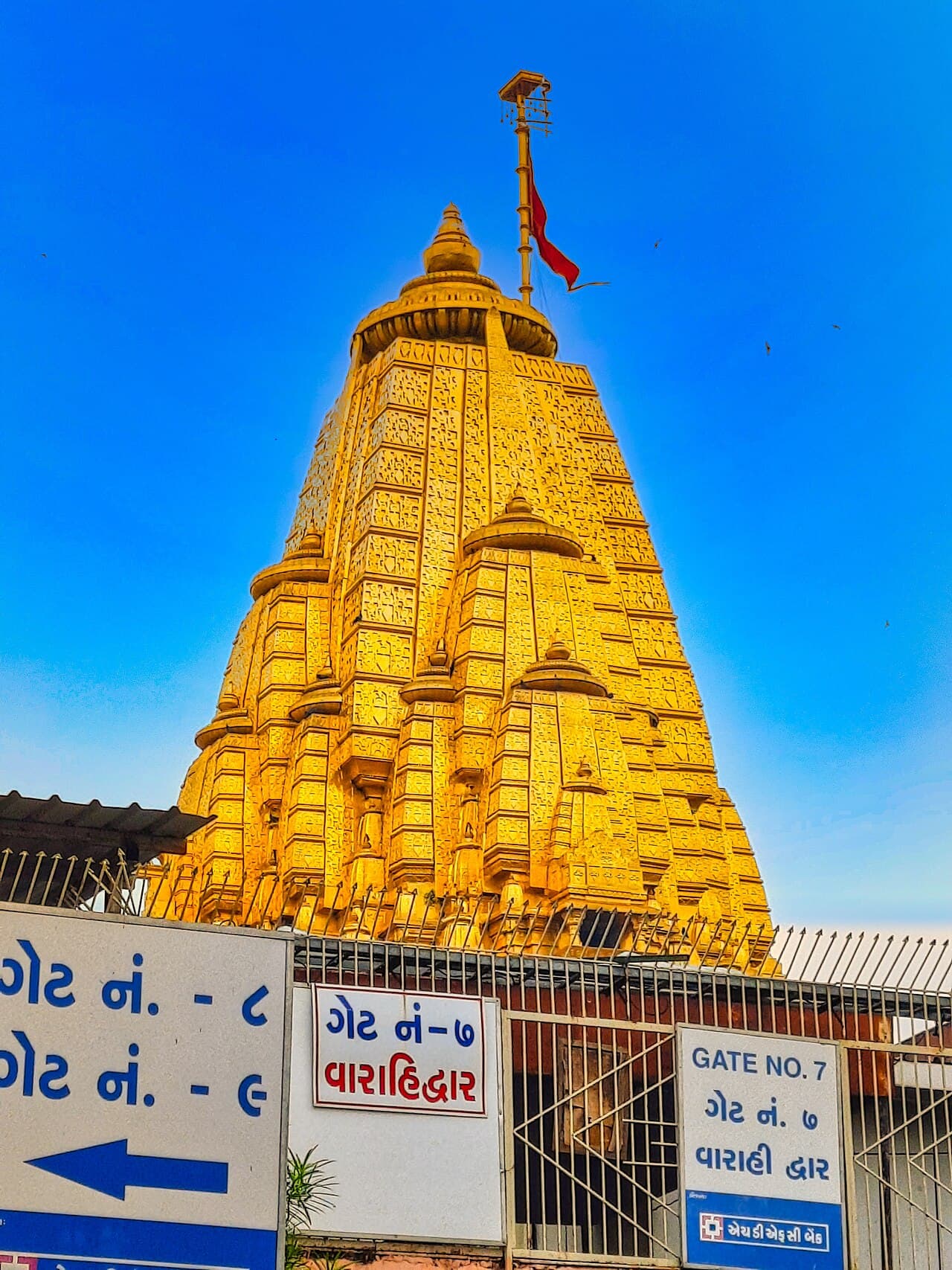
One of the 12 Jyotirlingas — the most sacred abodes of Lord Shiva
Key Takeaways
Dedicated to Lord Shiva
Chalukya architecture
Located in Somnath/Veraval, Gujarat
Quick Facts
Builder
Sardar Vallabhbhai Patel (reconstruction 1947–51, designed by Prabhashankar Sompura)
Dynasty
Solanki (Chalukya); Maratha patronage (Ahilyabai Holkar); modern India
Construction
Consecrated 11 May 1951 by Dr. Rajendra Prasad
Style
Kailash Mahameru Prasad (Chalukya/Solanki)
Main Deity
Somnath (Shiva as first Jyotirlinga)
Location
Prabhas Patan, Gir Somnath, Gujarat
Veraval Distance
6.5 km from Veraval Bus Station (15–20 min)
Height / Pillar
Shikhara 50 m (165 ft); Baan Stambh 36 m
Significance
First (Swayambhu) of the 12 Jyotirlingas
Season
October to March
Pilgrimage Circuit
Dwadash Jyotirlinga, Saurashtra circuit
Darshan
6:00 AM – 9:30 PM daily
Nearest Transit
Veraval Bus Station (6.5 km) | Somnath Rly (1.5 km)
Official Website
somnath.org
Overview
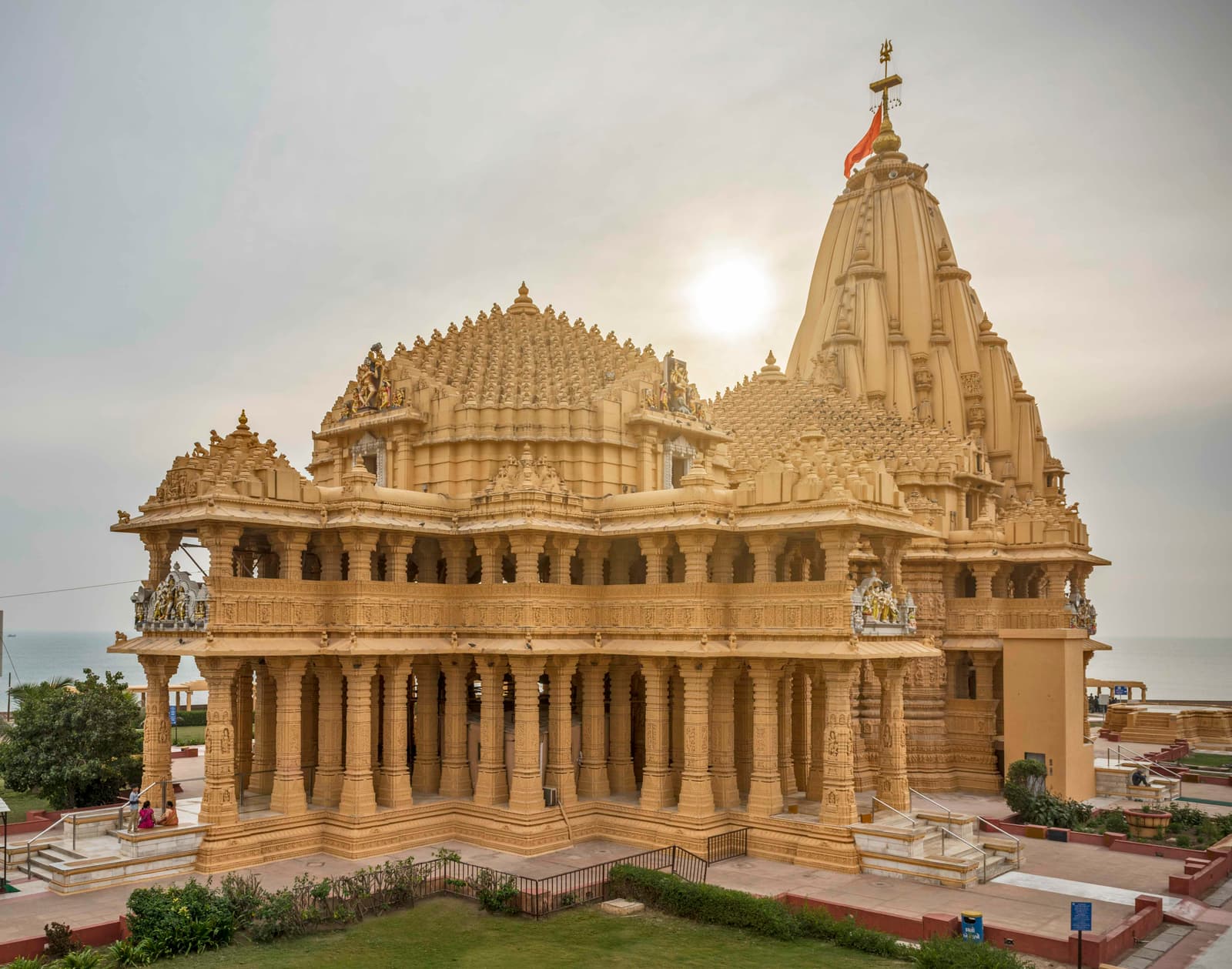
Somnath is the first of the twelve Jyotirlingas, standing where the Hiran, Kapila and the mythical Saraswati rivers meet the Arabian Sea in Gujarat. For a thousand years it was destroyed and rebuilt in an unbroken cycle. The present Chalukya-styled temple, completed in 1951 under Sardar Patel, rises 50 metres over the sea at Prabhas Patan — a living symbol of resilience.
The Cycle of Resilience
The Seven Lives of Somnath
No temple in India has been destroyed as many times as Somnath. No temple has been rebuilt as many times either. Over the course of roughly 900 years, successive armies marched to this coastline, smashed the shrine, and left. Time and again, kings and communities rebuilt it. The current temple, completed in 1951 under Sardar Patel, is the latest chapter in a story that refuses to end.
The Cycles
Legendary
Legendary Origins
A first temple of Soma (the Moon) is said to have been built in gold; later forms in silver, wood and stone appear in the Puranas. This belongs to mythology, not recorded history.
~1024/1025 CE
Destruction 1
Mahmud of Ghazni mounted the most destructive raid — the one best recorded, in Persian chronicles and Al-Biruni's Tahqiq-e-Hind. The temple was later rebuilt under Solanki kings such as Bhima I.
~1297–1299 CE
Destruction 2
Ulugh Khan, general of Alauddin Khalji, raided Gujarat and destroyed the rebuilt temple. The Vaghela dynasty restored it.
~1400 CE
Destruction 3
Zafar Khan (Muzaffar Shah I) of the Gujarat Sultanate ordered its destruction. The temple was rebuilt under local Hindu rulers with imperial permission.
~1546 CE
Destruction 4
Portuguese galleons bombarded the temple from the sea during their campaign on the Gujarat coast. Repairs were carried out by local Maratha and Hindu chiefs.
~1665 CE (tradition)
Destruction 5
Aurangzeb is traditionally held to have ordered the temple's destruction. The Marathas under the Peshwas later sponsored worship nearby.
~1783 CE
Destruction 6
The Maratha queen Ahilyabai Holkar rebuilt the temple in stone near the ruins. Later neglect left the site in decay by the 19th century.
1951 CE
Destruction 7
Sardar Vallabhbhai Patel initiated the reconstruction as a national project. The Prana Pratishtha was performed by President Dr. Rajendra Prasad on 11 May 1951.
What makes the Somnath story unprecedented is the deliberate symbolism of each destruction. Mahmud of Ghazni's raid in 1024/1025 was not a random act of plunder — Somnath was among the wealthiest temples in India, its treasury legendary across the Islamic world. The Persian poet Firdausi, in the Shahnameh, described Mahmud breaking the idol of Somnath as the climax of his military career. The temple was not collateral damage. It was the target.
The raid itself, the difficult return through Kutch and Sindh, and the punitive expedition against the Jat communities of the Sindh Sagar doab in 1027 are examined in detail in our research guide on Mahmud of Ghazni's raid on Somnath and the Jat campaign, which separates what the chronicles report from what later writers added.
Subsequent rulers followed his precedent. To destroy Somnath was to symbolically claim supremacy over the conquered kingdoms. To rebuild it was to resist that claim. The temple became a stage on which the great powers of the subcontinent expressed their ambitions through stone and destruction.
Sardar Patel and the 1951 Reconstruction
When Sardar Patel visited the ruins in 1947, he found a dilapidated structure that had been used as a government office. He declared that the reconstruction of Somnath was not just a religious act but a national one — a statement that independent India would restore what had been destroyed. The temple was completed within a few years, blending traditional Chalukya architectural elements with seismic reinforcement. Patel died before the inauguration, but his vision transformed Somnath from a ruin into a living temple. The reconstruction cost roughly ₹2.5 crore (25 million) in 1951, equivalent to hundreds of crores today.
Legendary Origins
The Moon God Temple
The Somnath story begins not with a king or a conqueror, but with a god who was cursed to disappear. Soma, the Moon God, was married to the 27 daughters of Daksha Prajapati — the lunar constellations. He neglected all of them except one: Rohini. Daksha cursed him to wane into nothingness. Soma, terrified, fled to Prabhas Patan — literally the radiant path — at the confluence of the Hiran, Kapila and (mythical) Saraswati rivers on the Gujarati coast. He built a lingam of gold and worshipped Shiva for restoration. Shiva, pleased, lifted the curse partially: Soma would wane for fifteen days and wax for fifteen days for eternity. The site became Soma-nath — Lord of the Moon.
This legend is why Somnath is called a Swayambhu (self-manifested) Jyotirlinga — not established by human hands but revealed by divine will. The name Prabhas Patan, the ancient name of the region, refers to the radiant energy of the Moon God restored. Even today, the temple's rituals are tied to the lunar calendar, which governs the festival and abhishekam schedule.
The Puranas describe the original temple as having successive legendary forms: a golden lingam established by Soma, a silver one by Ravana, a wooden one by Krishna, and a stone temple by Bhima (of the Pandavas) after the Mahabharata war.
The Name Prabhas Patan
Prabhas means radiant or splendid in Sanskrit. The name refers to the restored radiance of the Moon God after Shiva's blessing. Patan means path or place. Together, Prabhas Patan is the place of radiance — a name that predates the current temple and appears in the Puranas as a sacred Shaiva pilgrimage centre.
The Arrow Pillar
The Baan Stambh and the Eye on the Sea
One of Somnath's most distinctive features stands not on the skyline but on the sea wall that separates the temple from the Arabian Sea. The Baan Stambh (Arrow Pillar), a 36-metre stone pillar unveiled in 1951, is inscribed with the claim that a marble arrow at its base points directly to the South Pole — the axis around which the earth revolves. Etched below is the temple's exact latitude: 20.8883° N.
The pillar was conceived as both an astronomical marker and a symbolic anchor. Standing on the west coast of Saurashtra, the Baan Stambh reaffirms the ancient role of the temple as a landmark for sailors — a coastal beacon visible to ships that once traded across the Indian Ocean. From the temple spire to the ocean-facing pillar, Somnath has always faced the sea.
Interesting Facts
Interesting Facts About Somnath
The Baan Stambh (Arrow Pillar) on the sea wall marks the exact latitude of the temple (20.8883° N) and points to the South Pole. It was erected in 1951 as both an astronomical marker and a symbolic navigational landmark.
Al-Biruni, the Persian scholar who wrote during the Ghaznavid period, recorded in his Tahqiq-e-Hind that the Somnath lingam was heavily guarded, requiring invaders days to reach the sanctum through layers of priests and guards.
The current temple shikhara rises 50 metres (165 feet), among the tallest of all Jyotirlinga temples. The copper kalasha (finial) is visible from ships approaching the Saurashtra coast.
Sardar Patel visited the Somnath ruins in 1947 and found the temple being used as a government office. He personally ordered its evacuation and began the reconstruction within months of India's independence.
The 1951 reconstruction cost roughly ₹2.5 crore (25 million rupees), equivalent to several hundred crore rupees today when adjusted for inflation.
Archaeological excavations during the reconstruction revealed the foundations of five earlier temples stacked one above another, each built directly on the ruins of its predecessor.
Somnath is traditionally mentioned in the Rigveda, one of the oldest known texts in any Indo-European language, composed roughly 3,500 years ago.
The temple's evening sound and light show is one of the only permanent installations of its kind at a Jyotirlinga temple, projecting the Somnath story onto the temple walls nightly.
The Somnath Sagar Aarti (ocean worship ceremony) is performed facing the Arabian Sea with 101 oil lamps and is regarded as one of India's most powerful coastal rituals.
The temple's Nandi mandapa houses a monolithic black stone Nandi bull. Unlike many such sculptures that face the sanctum from a distance, this one sits at the entrance of the sabhamandapa, aligned with the lingam.
Architecture
Kailash Mahameru Prasad Style
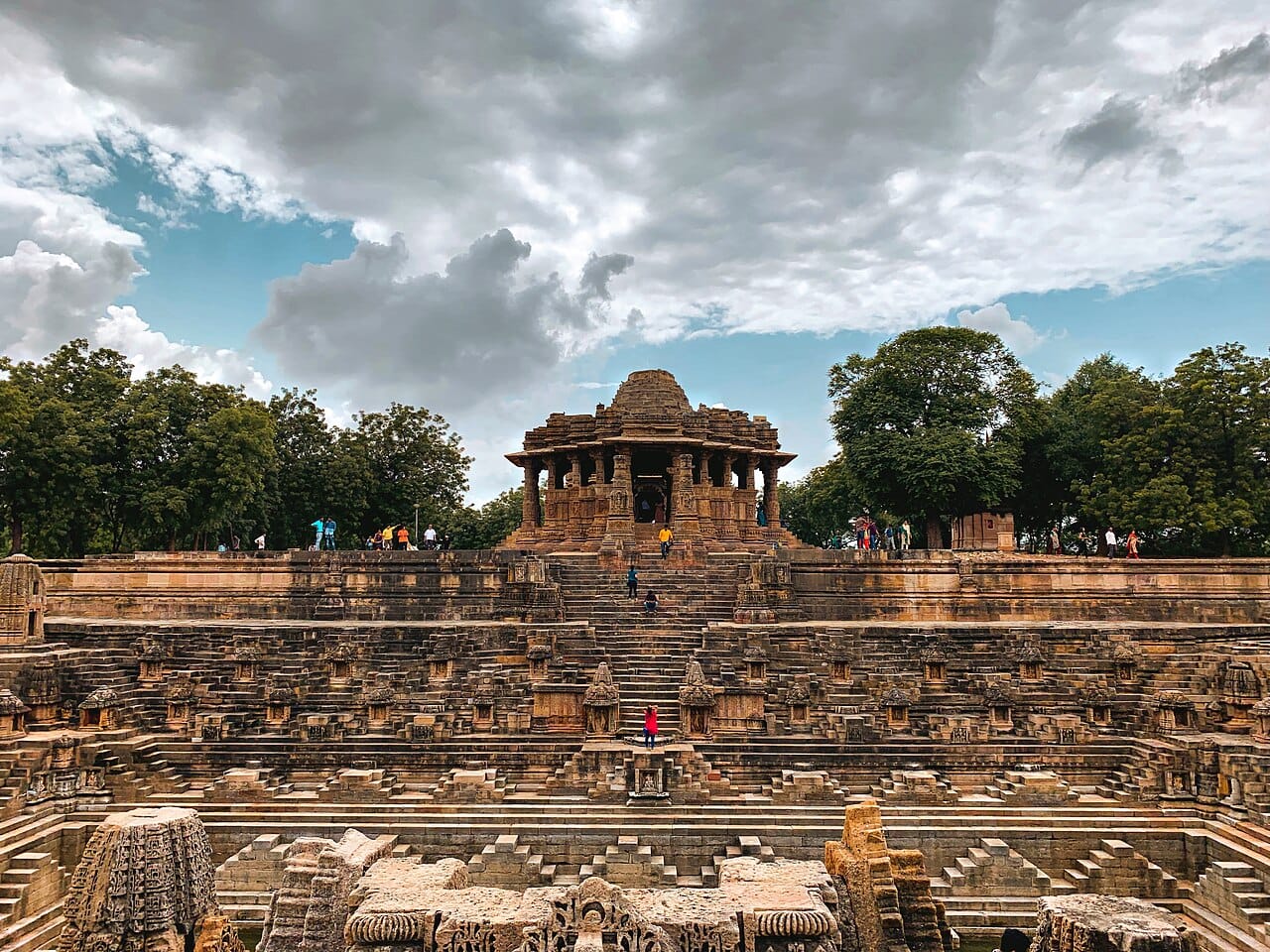
The current Somnath Temple, completed in 1951, follows the Kailash Mahameru Prasad style of Chalukya (Solanki) architecture — the same tradition that produced the Sun Temple at Modhera and the Rudra Mahalaya at Siddhpur. The style is characterised by a stepped, pyramidal shikhara (spire) rising in progressively smaller tiers, each adorned with ribbed elements and sculptural panels. The Somnath shikhara rises 50 metres (165 feet) above the sanctum, its copper kalasha visible from the sea.
The architects of the reconstruction deliberately studied surviving Solanki structures — the ruins of the original Somnath, the temples at Modhera and Siddhpur, and the inscriptions that described the original temple dimensions. The result is not a replica of any single earlier structure but a synthesis: a centuries-old architectural vocabulary expressed in modern reinforced stone. Engineers added hidden seismic reinforcements — steel rods concealed within the stone joints — so that the new temple endures where its predecessors fell.
The Baan Stambh (Arrow Pillar)
One of Somnath's most distinctive features stands on the sea wall that separates the complex from the Arabian Sea. The Baan Stambh is a 36-metre (120-foot) stone pillar erected by the Somnath Trust in 1951. At its base, an inscription reads that the arrow points directly to the South Pole, the axis around which the earth revolves. A marble arrow embedded in the pillar base marks the exact latitude of the temple: 20.8883° N.
Shikhara Height
50 metres (165 feet) — among the tallest of the Jyotirlinga towers, deliberately visible from the Arabian Sea.
Garbhagriha
The sanctum houses the Jyotirlinga, positioned to receive direct sunlight at specific times of the year.
Nandi Mandapa
A monolithic Nandi bull faces the sanctum, carved from black stone — a hallmark of the Kailash Mahameru style.
Sabhamandapa
The assembly hall features carved pillars and intricate floral and geometric patterns.
Sacred Confluence
The Eternal Shrine
Somnath is built at the Triveni Sangam — the confluence of the Hiran, Kapila and (mythical) Saraswati rivers with the Arabian Sea. This makes it a sangam tirtha, a site of extraordinary purifying power in Hindu cosmology. The Saraswati, though not visible today (she is believed to flow underground), is present in the ritual geography. Pilgrims bathe at the Triveni Ghat before entering the temple, following a tradition described in the Shiva Purana as essential for the pilgrimage to be complete.
As the first of the twelve Jyotirlingas, Somnath holds a special position in the Jyotirlinga canon. The Shiva Purana states that the Somnath Jyotirlinga was the first to manifest — a Swayambhu lingam that appeared at the beginning of the current cosmic age. The other eleven Jyotirlingas are described as expansions of this original divine light. Pilgrims who begin their Jyotirlinga pilgrimage (Dwadash Jyotirlinga Yatra) here are said to complete the cycle with greater spiritual merit.
Along the same Saurashtra coastline lies Nageshwar Jyotirlinga, the coastal guardian of the Dwarka marshlands. Together, Somnath and Nageshwar form two great Shaiva sentinels of Gujarat's western seaboard. Further along the same devotional map, Kashi Vishwanath in Varanasi holds its own special place among the twelve shrines.
Daily Worship
Daily Rituals and Aartis
Somnath follows a structured daily schedule preserved since the reconstruction. The day begins with the Mangala Aarti — the first offering of light to the lingam. The priests chant the Rudram and Chamakam from the Yajur Veda as the sun rises over the sea. The Abhishekam follows, bathing the lingam in milk, curd, ghee, honey and sugar, followed by water from the Triveni Sangam.
The evening aarti at sunset is the most-attended ritual of the day. The evening is crowned by the famous Sagar Aarti — an ocean worship ceremony in which 101 lamps are offered to the Arabian Sea, regarded as one of India's most powerful religious ceremonies.
Daily Ritual Schedule
6:00 AM
Mangala Aarti (Opening)
First offering, Vedic chanting begins
7:00 AM
Shringar Aarti (Adorning)
Decorating the lingam with flowers and ornaments
12:00 PM
Bhog Aarti (Offering)
Vegetarian bhog offered, prasad distributed
7:00 PM
Sandhya Aarti (Evening)
Main evening aarti in the sanctum
7:30 PM
Sagar Aarti (Ocean)
101 lamps offered to the Arabian Sea
7:45 PM
Sound & Light Show
Projected narrative on the temple walls
9:30 PM
Shayan Aarti (Closing)
Final aarti, temple doors close for the night
Festivals
Festivals and Celebrations
Maha Shivaratri at Somnath is the grandest festival on the Saurashtra calendar. Over 500,000 pilgrims converge on the temple complex over three days. The lingam is decorated with gold leaf, and the main puja is performed at midnight — the moment when the planetary alignment is considered most favourable by the priests.
Kartik Purnima (the full moon of October–November) ends the monsoon and is celebrated as the Somnath Fair. Pilgrims walk from across Gujarat carrying decorated palanquins. The festival includes a dip in the Triveni Sangam at dawn, a procession of the deity, and a floating-lamp ceremony on the Arabian Sea at sunset.
Maha Shivaratri
The temple is illuminated with thousands of oil lamps. A gold-leaf abhishekam is performed at midnight, with continuous chanting, dance performances and a massive fair on the temple grounds.
February-March (Phalguna)
Kartik Purnima
The Somnath Fair — a festival with deep roots. A floating-lamp ceremony, palanquin procession, and the ritual bath at the Triveni Sangam at dawn.
October-November (Kartik)
Why This Temple Matters
Why Somnath Matters
Somnath holds a unique position in Indian religious geography. It is the first of the twelve Jyotirlingas, meaning the Shiva Purana describes its lingam as the first self-manifested pillar of light from which all others emerged. For Shaiva pilgrims, a journey to Somnath is not merely a visit to one of twelve equal shrines — it is a return to the source.
Its historical importance is equally singular. No other Indian temple has been a direct military target across as many centuries, by as many different powers, as Somnath. The temple was destroyed and rebuilt in an unbroken cycle for nearly a thousand years, from Mahmud of Ghazni in 1024/1025 to Sardar Patel in 1947. Each destruction was recorded in Persian, Arabic, Sanskrit and European sources, making Somnath one of the best-documented religious sites in Asia.
Architecturally, the 1951 reconstruction revived the Kailash Mahameru Prasad style of the Solanki period, a tradition that had fallen into disuse for centuries. The temple stands today as the finest modern example of this style, built using traditional proportions and techniques but reinforced with modern engineering.
History & Legacy
Ancient and Puranic Origins
The origins of the site at Prabhas Patan are ancient, though the earliest specific references are traditional. The Rigveda and the Puranas (Skanda, Shiva, and Bhagavata) sanctify Prabhas as a Shaiva pilgrimage centre at the confluence of the Hiran, Kapila and (mythical) Saraswati rivers. The first historically plausible temple is usually placed in the Gupta period (4th–6th century), with the Yadava rulers of Gujarat building a grand temple in the 8th century.
The gold-silver-wood-stone succession described for the earliest forms of the shrine belongs to mythology rather than recorded fact.
The Ghazni Destruction (1024/1025)
The first historically documented destruction came with the raid of Mahmud of Ghazni, dated by most scholars to 1024/1025 CE, who destroyed the temple and carried away its treasures. This is among the best-documented events in medieval Indian history, recorded by Al-Biruni (Tahqiq-e-Hind) and in later Persian chronicles such as Ferishta's. The temple was rebuilt after by the Solanki kings of Gujarat.
Medieval Cycles of Destruction and Reconstruction
For roughly six centuries the shrine alternated between demolition and rebuilding. Later destructions are attributed to rulers including Alauddin Khalji's general Ulugh Khan (c. 1297–1299), Muhammad bin Tughluq, Mahmud Begada, and — by tradition — Aurangzeb (c. 1665).
For several of these events the historical record is thinner and rests partly on tradition, so they are best treated as approximations. After Aurangzeb, the site remained substantially in ruins for nearly three centuries, with worship continuing at a modest temple built nearby by Ahilyabai Holkar around 1783.
The Modern Reconstruction (1947–1951)
After independence, Sardar Vallabhbhai Patel made the rebuilding of Somnath a national project and a symbol of cultural resurgence. Archaeological excavation of the ground exposed the foundations of at least five earlier temples stacked one upon another. The current structure was completed in 1951 and inaugurated by President Rajendra Prasad on 1 December 1951 (a minority of sources cite 1955). The Shree Somnath Trust and the Archaeological Survey of India continue to oversee the site today.
Architecture
Key Features
Kailash Mahameru Prasad (Chalukya) Style
Somnath follows the Chalukya (Solanki) tradition of temple architecture, famous in western India for its stepped, pyramidal shikhara built in receding tiers. The style is sometimes written as Chaulukya. The same family of design produced the Sun Temple at Modhera and the Rudra Mahalaya at Siddhpur.
Shikhara and Kalasha
The spire rises about 50 metres (165 feet) above the sanctum, among the tallest of the Jyotirlinga towers, and is crowned by a large copper kalasha (finial). The silhouette of the tower rising above the sea is one of the most striking images of the Gujarat coast.
Plan and Halls
The temple is essentially square in plan, with an inner sanctum (garbhagriha) housing the Jyotirlinga, linked through a vestibule to a sabhamandapa (assembly hall) of carved pillars. A black stone Nandi mandapa faces the sanctum. The whole complex is enclosed within a defensive wall separating the sacred precinct from the oceanfront.
The Baan Stambh (Arrow Pillar)
The Baan Stambh, a 36-metre pillar on the sea wall, is one of Somnath's most famous features. Erected in 1951, it carries an inscription saying that a marble arrow at its base points directly to the South Pole, and it marks the exact latitude of the temple (20.8883° N).
Modern Reinforcement
Unlike the earlier temples, the 1951 building integrates concealed steel reinforcing within the stone joints. The result gives the new temple a resilience its predecessors could not claim — an engineering answer to why this time the shrine endures.
Religious & Cultural Significance
Somnath is the first of the twelve Jyotirlingas, believed to be the primal manifestation of Shiva's infinite light. The name means Lord of the Moon (Soma). Beyond its Jyotirlinga status, it carries a cultural weight unlike any other shrine: a temple destroyed and rebuilt many times across a millennium. Each rebuilding was an act of cultural continuity, crowned in the modern era by Sardar Patel's national reconstruction of 1947–1951.
The location at the Triveni Sangam makes it one of the three and a half tirtha rajas, and the Sagar Aarti each evening draws the ocean itself into the worship.
Festivals & Celebrations
Festival
The great festivals of Somnath — Maha Shivaratri, Kartik Purnima (the Somnath Fair), Shravan Mondays, the Somnath Mahotsav and Deepotsav — are marked by large gatherings, ocean lanterns, processions and ritual baths at the Triveni Sangam. See the festival calendar below for details and dates.
Interesting Facts
Somnath is the first (Swayambhu) of the twelve Jyotirlingas — the earliest self-manifested light of Shiva in the Shiva Purana.
No Indian temple has been destroyed and rebuilt more times — roughly five or six verified destructions over about 1,000 years, plus legendary constructions.
The present temple dates from the national reconstruction of 1947–1951, crowned by a 50-metre Chalukya-style spire over the Arabian Sea.
During the 1951 excavations, the foundations of five earlier temples were found stacked one directly on top of another.
The Baan Stambh on the sea wall points to the South Pole and marks the temple's latitude of 20.8883° N.
The evening Sagar Aarti, with 101 lamps offered to the sea, is a famous ocean worship ceremony unique among the Jyotirlinga sites.
October to March is the ideal period, with daytime temperatures between 15°C and 30°C.
Temple timings, dress codes, and photography rules can change without notice. Always verify with the temple administration or official website before your visit.
Nearby Sacred Places
Other sacred sites within reach
Somnath Museum
Inside the temple complex. Displays artifacts recovered from the archaeological excavations of the five earlier temples, including carved pillars and stone fragments that reveal the site's layered history.
Triveni Sangam & Somnath Beach
Just off the sea wall. The confluence of the Hiran, Kapila and (mythical) Saraswati rivers with the Arabian Sea. The beach hosts the evening Sagar Aarti and is ideal for sunset walks.
Bhalka Tirtha
5 km away. The site where Lord Krishna is traditionally believed to have been mistakenly struck by a hunter's arrow before his departure. Features a Krishna temple and a large statue.
Dehotsarg (Bhakti Tirtha)
Near Bhalka Tirtha. Believed to be where Krishna's body was cremated (Dehotsarg). A quiet pilgrimage halt on the Saurashtra circuit.
85 km north. Junagadh holds the ancient Uperkot Fort and the Girnar Jain temples; Girnar is a major hill pilgrimage hub. Combines well with a Somnath visit.
Gir National Park
About 50 km away. The only place in the world where the Asiatic lion lives in the wild. Popularly combined with Somnath as a wildlife day trip.
Prabhas Patan (Heritage town)
The settlement around the temple, once the ancient city of Prabhas. Walking through its lanes and ghats offers a sense of the millennia-old pilgrimage town.
Historical Timeline
Vedic era (traditional)
Tradition and the Puranas place the sacred site of Prabhas Patan among India's oldest Shaiva tirthas, linked to the Moon God Soma and to Krishna's departure. These earliest references rest on tradition, not archaeology.
4th–6th c. CE
The first historically plausible temple is believed to have been built in the Gupta period; accounts of golden, silver, wooden and stone predecessors belong to mythology.
8th century CE
The Yadava rulers of Gujarat built a grand temple at the site.
Yadava
1024/1025 CE
Mahmud of Ghazni sacked the temple, destroyed the lingam and plundered its legendary treasury. This is the best-documented destruction, recorded by Al-Biruni (Tahqiq-e-Hind) and later Persian chronicles.
Ghaznavid
12th century CE
Solanki patronage rebuilt and enriched the shrine; minister Vastupala is credited in tradition with endowments.
Solanki (Chalukya)
~1297–1299 CE
Ulugh Khan, general of Alauddin Khalji, raided Gujarat and destroyed the rebuilt temple; the Vaghela dynasty restored it.
Khalji / Vaghela
14th century CE
A further cycle of destruction and rebuilding followed under the Tughlaq rulers, with reconstruction by local Hindu chiefs.
Tughlaq
15th century CE
Mahmud Begada of the Gujarat Sultanate ordered the temple demolished; it was rebuilt again with imperial permission.
Gujarat Sultanate
16th century CE
Portuguese galleons bombarded the temple from the sea during coastal campaigns; repairs were carried out by local Maratha and Hindu chiefs.
1665 CE (tradition)
Aurangzeb is traditionally said to have ordered the temple's destruction — the record for this event is debated. The site lay substantially in ruins for nearly three centuries afterwards.
Mughal
1783 CE
The Maratha queen Ahilyabai Holkar built a modest temple at Prabhas Patan, maintaining worship through the 19th century.
Maratha (Holkar)
1947
Sardar Vallabhbhai Patel visited the ruins and turned the reconstruction of Somnath into a national project within months of independence.
1951
The Prana Pratishtha (consecration of the Jyotirlinga) was performed by the first President of India, Dr. Rajendra Prasad, on 11 May 1951. Subsequent construction of the sabhamandapa and the Digvijay Dwar continued through 1955–1965 under the Shree Somnath Trust.
1951
The Shree Somnath Trust was established; excavations beneath the temple revealed the foundations of five earlier structures stacked one above another.
1970s–2000s
Later additions included the permanent sound-and-light show, the on-site museum, the Sagar Aarti tradition, and continuing beautification of the complex.
2026
Ongoing conservation and modern visitor infrastructure (ticketing, amenities, maintenance) continue under the Shree Somnath Trust with the ASI.
Festival Calendar
March
1 festival
Maha Shivaratri
3 days
Somnath
The grandest festival of the Saurashtra calendar. Over 500,000 pilgrims converge; the lingam is adorned with gold leaf and a midnight abhishekam is performed, alongside continuous chanting and cultural programs.
Pronunciation Guide
Somnath
Sanskrit
/sohm-naath/
Lord of the Moon (Soma)
Jyotirlinga
Sanskrit
/jyo-tir-ling-ah/
Column of divine light
Prabhas Patan
Hindi
/pra-bhaas pa-tan/
City of radiance / place of splendor
Swayambhu
Sanskrit
/sva-yam-bhoo/
Self-manifested or self-born
Triveni Sangam
Sanskrit
/tri-veh-nee san-gam/
Confluence of three rivers
Baan Stambh
Hindi
/baan stambh/
Arrow pillar (latitude marker)
Garbhagriha
Sanskrit
/gar-bha-gree-ha/
Inner sanctum
Sagar Aarti
Hindi
/saa-gar aar-tee/
Ocean worship ceremony
Kailash Mahameru
Sanskrit
/kai-laash ma-ha-meh-roo/
Chalukya temple style named after the cosmic mountain
Sabhamandapa
Sanskrit
/sab-ha-man-da-pa/
Assembly hall of the temple
Click the speaker icon to hear pronunciation. Browser text-to-speech may vary.
Exam Notes for UPSC / SSC
UPSC Prelims & Mains (GS-I: Indian Heritage & Culture)SSC CGL / CHSL (General Awareness)Gujarat State PCSUGC NET (Indian History)State Tourism Board Exams
First Jyotirlinga
Somnath is the first of the twelve Jyotirlingas, regarded as a Swayambhu (self-manifested) lingam. The Shiva Purana presents it as the primal pillar of divine light from which the others emanated.
Cycle of Destruction and Resurrection
No Indian temple has been destroyed and rebuilt as many times. Verified destructions number five or six over roughly 1,000 years, beginning with Mahmud of Ghazni (1024/1025 CE). The current structure dates from 1951.
1951 Reconstruction and Sardar Patel
After independence, Sardar Vallabhbhai Patel made rebuilding Somnath a national project. The new temple was inaugurated by President Rajendra Prasad on 1 December 1951 (a few sources cite 1955).
Kailash Mahameru (Chalukya) Style
The temple follows the Kailash Mahameru Prasad (Chalukya/Solanki) tradition, with a 50-metre stepped shikhara, a copper kalasha and a large mandapa. It is among the tallest Jyotirlinga spires.
Sagar Aarti
Somnath holds a nightly Sagar Aarti on the oceanfront, offering 101 lamps to the Arabian Sea. It is regarded as one of India's most powerful coastal worship ceremonies.
Frequently Asked Questions
What is the distance from Veraval bus stand to Somnath Temple?
A.
Somnath Temple is approximately 6 km from the Veraval GSRTC central bus station. Auto-rickshaws, shared tempos, and local GSRTC state transport buses run continuously between Veraval and Somnath/Prabhas Patan, taking about 15 minutes.
Was Somnath really destroyed and rebuilt seven times?
A.
Historically verified destructions number five or six over roughly 1,000 years, starting with Mahmud of Ghazni in 1024/1025 CE. The seven-cycle count includes legendary Puranic temples (of the Moon God Soma and the Pandava era). The current structure, completed in 1951 under Sardar Patel's direction, is the latest temple on the site.
What is the Baan Stambh and why does it point to the South Pole?
A.
The Baan Stambh (Arrow Pillar) is a historic stone pillar erected on the Somnath sea wall. It carries an arrow pointing due south with a Sanskrit inscription ('Aasamudrant Dakshin Dhrva Paryant Abaadhita Jyotirmarga'), signifying that from this geographical longitude (~70.40° E), an unbroken sea path extends straight to Antarctica and the South Pole without intersecting any landmass.
Who destroyed Somnath first and why is that event so famous?
A.
Mahmud of Ghazni, in a raid usually dated 1024/1025 CE. The event was recorded by the scholar Al-Biruni and in later Persian chronicles, making it the best-documented destruction in the temple's history.
How did Sardar Patel get involved in rebuilding Somnath?
A.
Patel visited the ruins in 1947 and found the structure being used as a government office. He made the reconstruction of Somnath a national project, completed in 1951.
Is Somnath really the first Jyotirlinga?
A.
Yes. The Shiva Purana lists Somnath as the first (Swayambhu) Jyotirlinga — a self-manifested lingam that appeared at the beginning of the current cosmic age.
What is the entry fee for Somnath Temple?
A.
There is no entry fee for general darshan. Special darshan passes are available at a nominal fee. The sound and light show has a separate ticket.
Can non-Hindus enter the Somnath Temple?
A.
Yes. The temple is open to visitors of all faiths. Non-Hindus can enter the main hall and observe the rituals from the sabhamandapa.
Showing 8 of 15 questions
Answers are based on verified information. Site rules may change — verify locally before visiting.
Did You Know?
No temple in India has been destroyed and rebuilt as many times as Somnath — roughly five or six verified destructions spread over 1,000 years, plus legendary constructions. The present temple dates from 1951.
During the 1951 reconstruction, excavators discovered the stone foundations of five earlier temples stacked one directly above another — the clearest single image of the cycle of Somnath.
The Baan Stambh (Arrow Pillar) on the sea wall marks an unobstructed meridian along this longitude (~70.40° E) running south across the ocean to Antarctica without any landmass, and the temple's copper finial serves as a coastal landmark.
Somnath is the first (Swayambhu) of the twelve Jyotirlingas; the others are traditionally held to emanate from its primal light.
Somnath holds a nightly Sagar Aarti before the Arabian Sea — an ocean worship ceremony with 101 lamps that draws the entire town to the beach each evening.
Sources & References
Temple Trust1 source
Shree Somnath Trust
"Official darshan, aarti, timings and temple history"