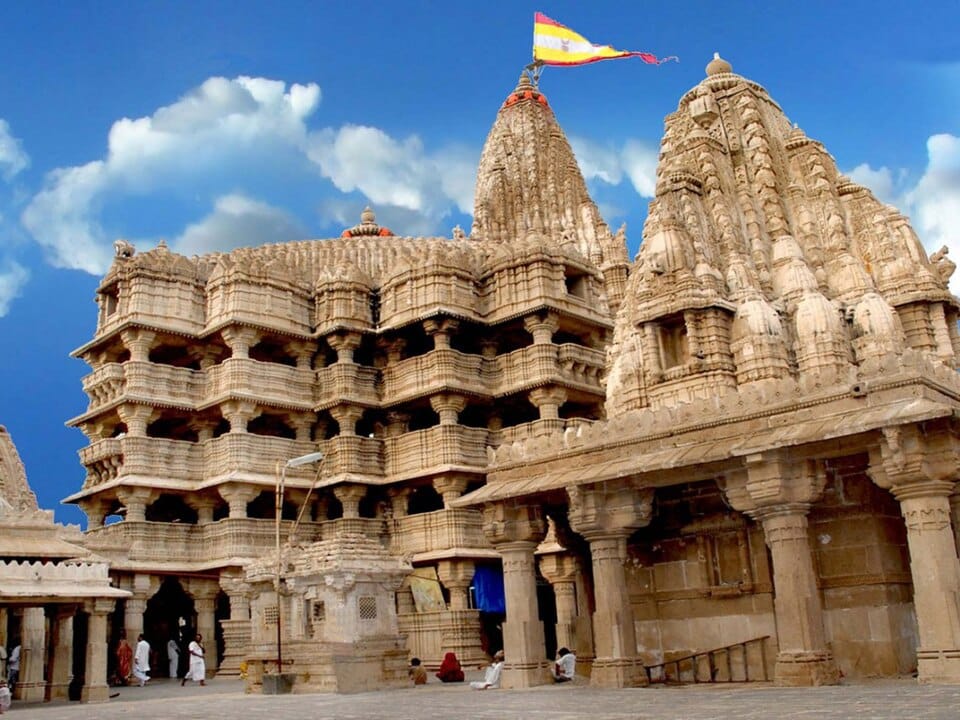
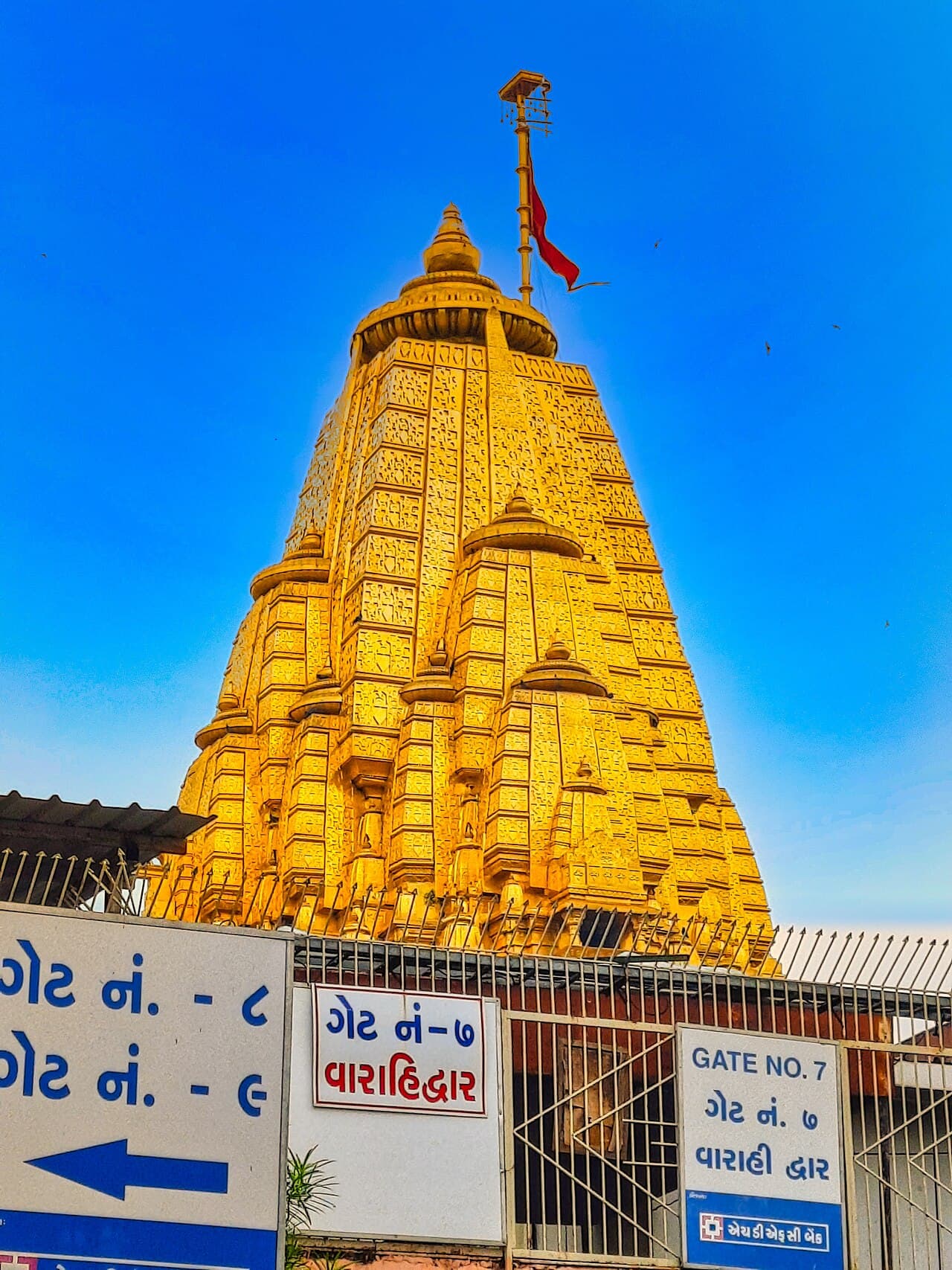
Dwarkadhish Temple, also known as the Jagat Mandir or Trilok Sundar, stands at the western edge of the Indian subcontinent where the Gomti River meets the Arabian Sea, in the ancient city of Dwarka, Gujarat. The temple rises five stories to a height of approximately 78 meters (256 feet) and is supported by 60 ornate pillars. 5-foot-tall black stone idol of Lord Krishna in his four-armed form as Dwarkadhish (Lord of Dwarka), holding a conch, discus, mace, and lotus.
The temple's shikhara (spire) is crowned by a flag that changes color several times a day. The main entrance, the Moksha Dwar (Door of Liberation), faces east onto the Gomti riverfront, and the complex also includes the shrine of Devaki, Krishna's mother. Dwarka is the westernmost of the four Char Dham sites established in the tradition of Adi Shankaracharya and one of the Sapta Puri (seven sacred cities).
Modern underwater archaeology, conducted by the National Institute of Oceanography and the Archaeological Survey of India since the 1980s, has discovered submerged structures extending up to 1 km from the current shoreline, giving new credibility to the legend of a golden city reclaimed by the sea.
The Submerged City
The Golden City Beneath the Sea
The mythology of Dwarkadhish is inseparable from the life of Lord Krishna as described in the Mahabharata, the Harivamsa, the Vishnu Purana, and the Srimad Bhagavatam. After killing his uncle Kamsa in Mathura, Krishna faced repeated attacks from Kamsa's father-in-law Jarasandha. To protect his people, he relocated his capital to a defensible site on the western coast, praying to Samudra Dev (the god of the ocean), who granted him twelve yojanas of reclaimed land.
On this land, the divine architect Vishwakarma raised Dwarka, a golden city of ramparts, palaces, gardens, and a magnificent temple. The Srimad Bhagavatam describes a curse by the sage Gandhari that led to the destruction of the Yadava clan. After the fratricidal war among the Yadavas, Krishna retired to the forest and was shot by the hunter Jara, who mistook his foot for a deer. With Krishna's departure, tradition holds, the ocean reclaimed Dwarka and submerged the golden city in a single day.
For centuries the story was read as pure myth. That changed in the 1980s, when the National Institute of Oceanography and the Archaeological Survey of India began underwater surveys off the Dwarka coast. They have since located submerged stone walls, pillars, anchors, and pottery extending up to 1 km from the current shoreline, with carbon dating of some artifacts suggesting dates around 1500-2000 BCE. For many, these are the actual walls of Krishna's Dwaravati; for scholars, they are evidence of a long-flooded ancient anchorage.
A City Beneath the Waves
The discoveries offshore have placed Dwarka in global headlines and renewed debates about the historicity of the Mahabharata. For countless devotees, the submerged structures are visible proof of the epic's reality — the western anchor of a sacred geography that stretches the length of India.
Dwarka is the westernmost of the four sacred sites of the Char Dham pilgrimage circuit associated with Adi Shankaracharya. Just as Puri anchors the east, Dwarka anchors the west — a site where faith and tide meet at the same shore.
The Flag of Dwarka
Four Flags a Day, and a Family in the Sky
A distinctive ritual at Dwarkadhish is the flag-changing ceremony, the Dhwaja Badlav. Every day, four times a day — at approximately 7:00 AM, 11:00 AM, 6:00 PM, and once more after the Sandhya Aarti — the saffron flag atop the main spire is changed. The old flag is given to devotees as a sacred gift, and pieces of the cloth are treasured as prasad.
The flag-changing is performed by members of a specific family who have held this hereditary right for centuries. The ritual is conducted by climbing the 78-meter structure without any safety equipment, a practice that demands immense skill and courage and regularly draws crowds of onlookers. The climber ascends using iron rungs set into the masonry, carrying the new flag to the summit while the previous one is lowered to the expectant crowd below.
A Flag in Changing Colours
The flag is not a single colour. Saffron in the morning, white at noon, and red in the evening, its changes are traditionally interpreted as reflecting the changing moods of the Lord. The cloth that comes down from the sky each time is shared among devotees as a blessing.
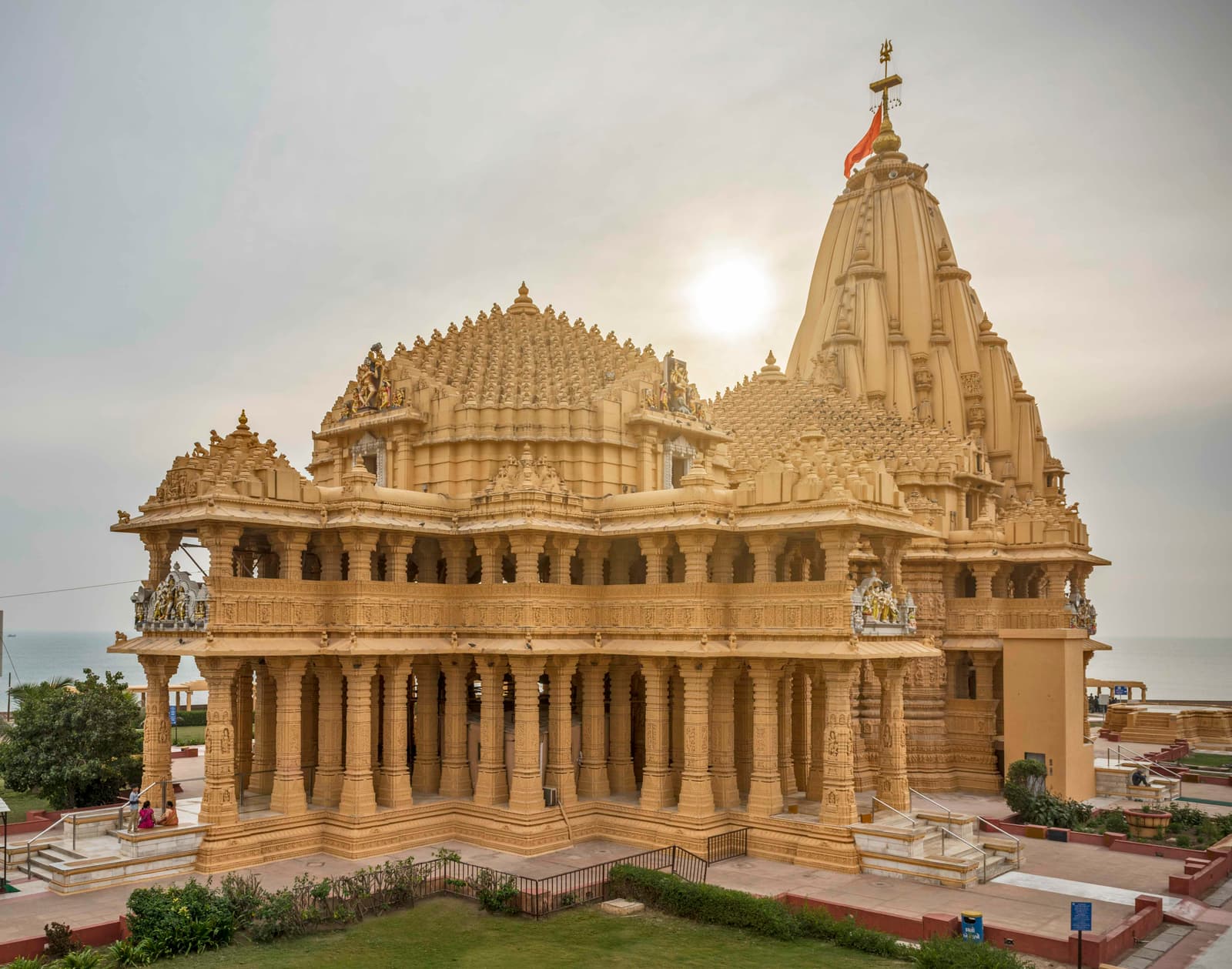
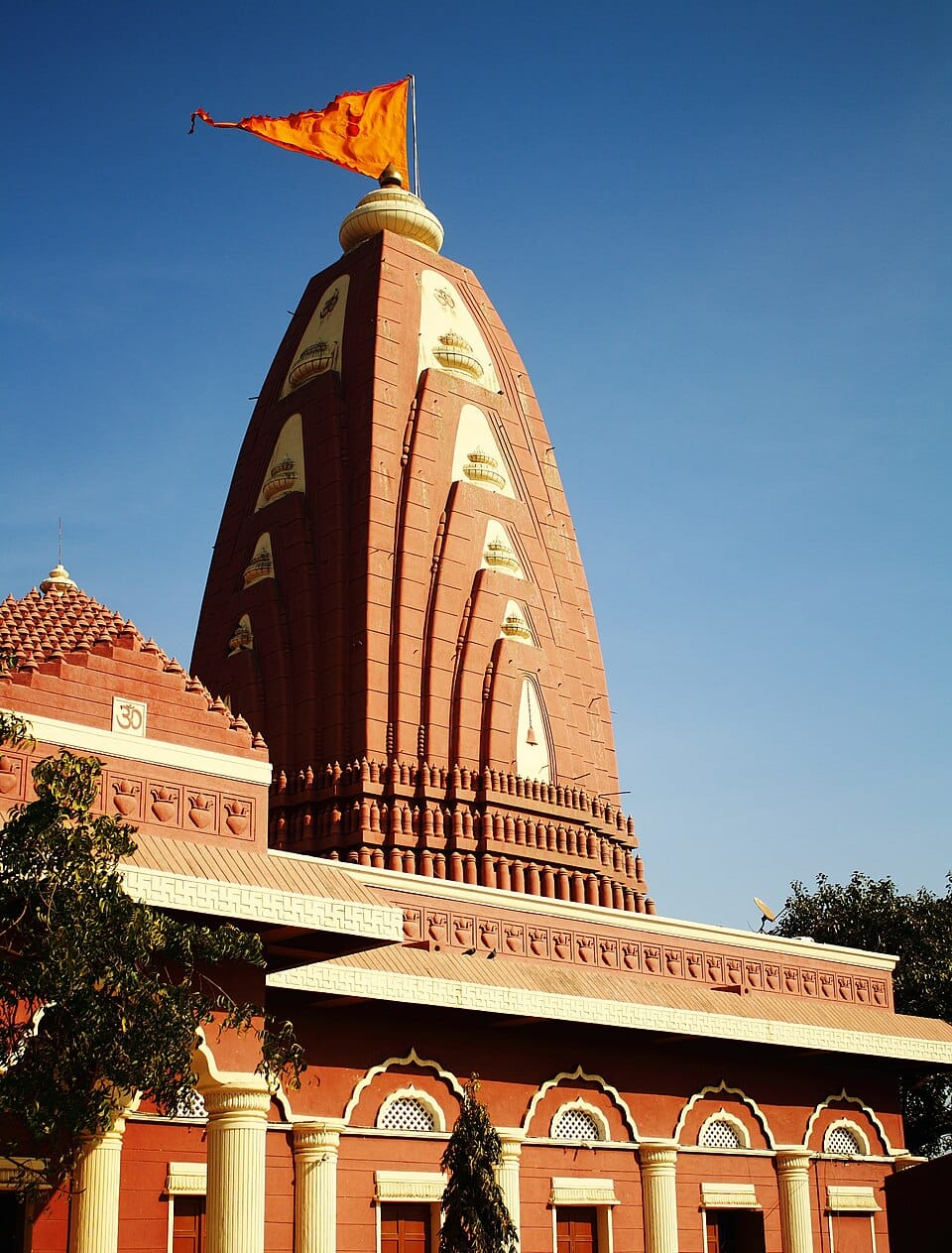
Dwarkadhish shares its coast with two other great pilgrimage anchors: the nearby Nageshwar Jyotirlinga rises a short ride away, while the Saurashtra circuit is capped by Somnath Templeon the peninsula's southern shore. Together they trace the western spine of Gujarat's sacred route.
Trilok Sundar
The Beautiful One of the Three Worlds
In the heart of the temple sits the idol that gave the shrine its name, Trilok Sundar, the beautiful one of the three worlds. It is a 2.5-foot black stone image of Krishna in his royal, four-armed Vishnu form, holding the shankha (conch), chakra (discus), gada (mace), and padma (lotus). This is not the playful cowherd of Vrindavan, nor the charioteer of the Bhagavad Gita — it is Krishna as sovereign, king, and statesman.
The core legend of the temple involves Vajranabha, Krishna's grandson. After the submersion of the old city, Vajranabha is said to have retrieved this very idol from the sea. During the medieval invasions, tradition holds, the same beloved murti was concealed in a well — traditionally called the Sharada Peeth well — to keep it from harm. Today the image is dressed, crowned, and garlanded several times a day, a constant act of homage to a deity who, the devotees say, never sleeps.
The deity faces east through the Moksha Dwar, the Gate of Liberation, toward the Gomti River. The whole complex, covering roughly 2,700 square metres, also holds the shrine of Devaki, Krishna's mother, and the buildings of the Dwarka Shankaracharya Peeth. In the wider sacred geography of India, this western gate of the faith stands older in legend than even the celebrated circuit of the twelve Jyotirlingas.
History & Legacy
A City Older Than the Temple
The Mahabharata, Harivamsa, Vishnu Purana and Srimad Bhagavatam describe Dwarka (Dwaravati) as Krishna's capital, founded after he left Mathura. The original temple is traditionally attributed to Vajranabha, Krishna's grandson. The earliest historical reference to the site comes from the Greek geographer Ptolemy (2nd century CE), who mentions a western port that scholars commonly identify with Dwarka.
The Chinese pilgrim Hiuen Tsang (7th century) wrote of a western Indian kingdom that may correspond to the Dwarka region, though the identification is uncertain.
Solanki Patronage and Reconstruction
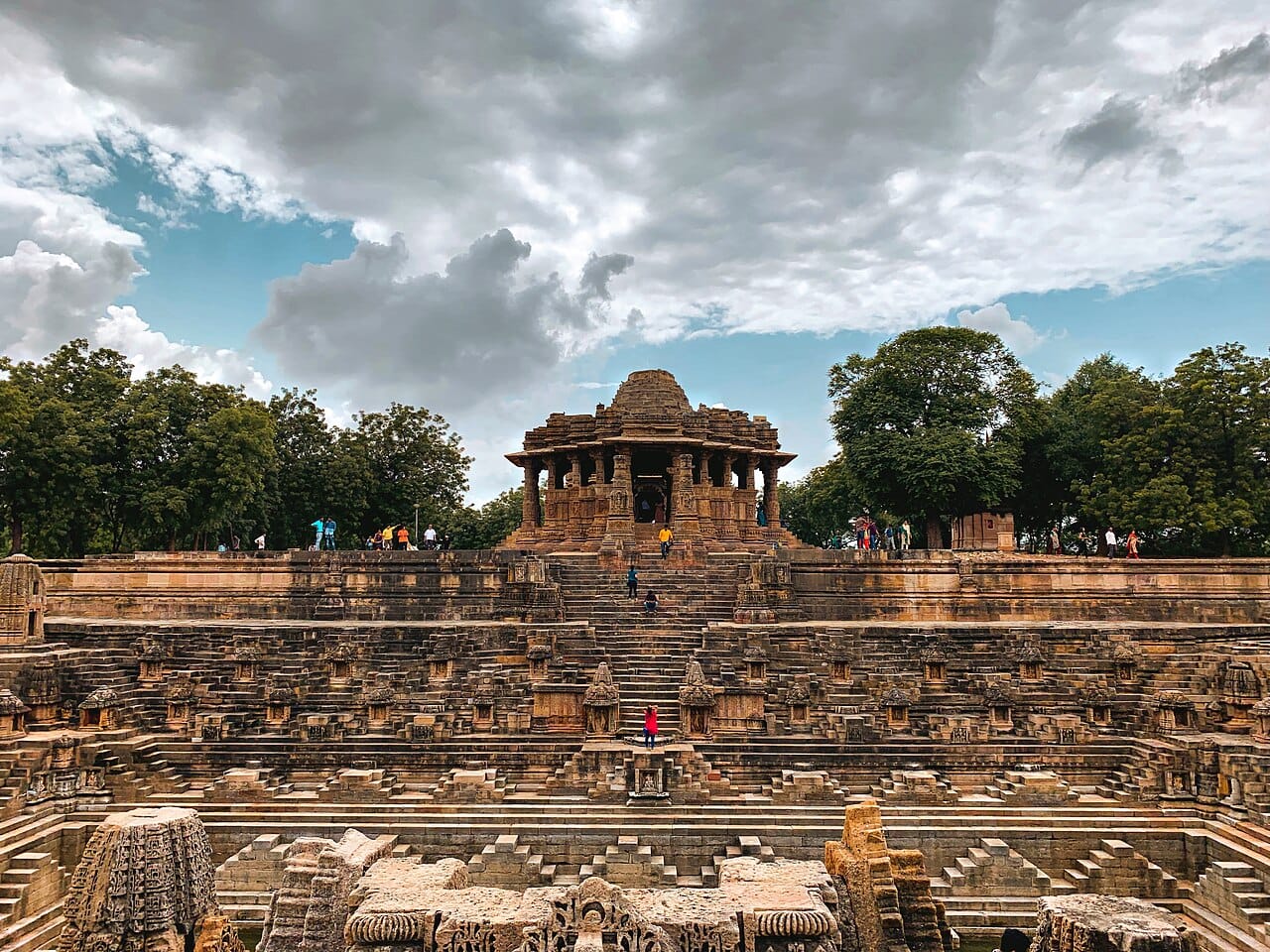
The Solanki (Chaulukya) dynasty, which ruled Gujarat from the 10th to 13th centuries, was responsible for building major temples across the region, including the Sun Temple at Modhera. Dwarka was part of this building tradition, though the shrine has been rebuilt and renovated many times. In the 13th century the temple was damaged during Delhi Sultanate invasions, and the idol was reportedly hidden in a well (traditionally the Sharada Peeth well) to protect it.
It was restored under the Vaghela rulers in the late 13th century. In 1473, Mahmud Begada, the Sultan of Gujarat, conquered Dwarka and again damaged the temple. The temple was rebuilt soon after, and the current structure largely dates from this 15th–16th century reconstruction.
Maratha Patronage
The Maratha Gaekwads of Baroda became patrons of the temple in the 18th century. Maharaja Sayajirao Gaekwad III made substantial grants for temple maintenance and renovation in the late 19th and early 20th centuries. The administration continued under the Gaekwad trust until the merger of the princely states into independent India, after which management passed to modern temple trustees that continue the daily worship today.
Underwater Discovery and Status Today
Since the 1980s, the National Institute of Oceanography and the Archaeological Survey of India have mapped the submerged structures off the coast of Dwarka, including stone walls, pillars, anchors, and pottery dated by some studies to around 1500-2000 BCE. These findings have renewed interest in the submerged-city tradition. Today Dwarkadhish remains the western focus of the Char Dham pilgrimage and the seat of the Dwarka Shankaracharya Peeth.
Architecture
Key Features
Five Floors Above the Gomti
Dwarkadhish is built in the Solanki (Gujarat) school of temple architecture, characterized by its soaring verticality and horizontal layering. The temple rises five stories, each marked by a distinct balconied projection and diminishing in width as the spire ascends. The shikhara is topped with an amalaka and a gold-plated kalasha, with the flagpole extending above.
The temple is built of limestone and sandstone blocks joined with lime mortar and finished with a white plaster that gives the shrine its gleaming appearance.
The 60 Pillars of the Sabha Mandap
The assembly hall (Sabha Mandap) is the architectural highlight, with 60 pillars arranged in concentric squares, each carved with different motifs — floral scrolls, geometric patterns, divine figures, and scenes from Krishna's life. The central ceiling is carved with a deeply undercut lotus pattern. The pillars follow the 'Ghadsar' type (square base, octagonal middle, circular top) typical of Solanki architecture, yet each is a unique composition.
The sanctum (garbhagriha) stands behind the hall and is preceded by an open nritya mandapa (dance hall) at the entrance.
The Two Gates
Gates carry special significance at Dwarka, the city of doors. The main entrance, the Moksha Dwar (Door of Liberation), faces east across the Gomti riverfront. A secondary entrance, the Swarga Dwar (Door of Heaven), faces north. The complex, covering approximately 2,700 square metres, also includes the smaller shrine of Devaki, Krishna's mother, and the building of the Dwarka Shankaracharya Peeth.
Engineering the Flag
The flag-changing mechanism is a remarkable piece of engineering. The climber ascends using a series of iron rungs embedded in the masonry, changing a roughly 7-metre-long bamboo pole carrying the saffron cloth flag while balanced on the spire's summit. The construction combines load-bearing masonry for the lower stories with a lighter brick-and-lime core for the spire, an engineering technique that has helped the temple survive repeated earthquakes.
Religious & Cultural Significance
Dwarkadhish Temple holds a unique position in Hindu sacred geography as one of the four Char Dham sites established in the tradition of Adi Shankaracharya: Badrinath in the north, Puri in the east, Rameswaram in the south, and Dwarka in the west. Completing the Char Dham Yatra is believed to grant moksha (liberation). The temple is also one of the Sapta Puri (seven sacred cities) — Ayodhya, Mathura, Haridwar, Varanasi, Kanchipuram, Ujjain, and Dwarka — and the westernmost of these.
In the Vaishnava tradition, Dwarka holds immense importance as the site where Krishna lived as a king and statesman, in contrast to Mathura where he spent his youth as a cowherd, and it is deeply revered by ISKCON and Gaudiya Vaishnavas. The Dwarka Shankaracharya Peeth, one of the four cardinal centers of Advaita Vedanta established by Adi Shankaracharya in the 8th century CE, adds a philosophical dimension to the temple's significance.
The connection to the submerged city has also made Dwarka a site of both religious and archaeological interest.
Interesting Facts
Dwarkadhish is the westernmost of the four Char Dham sites, standing where the Gomti River meets the Arabian Sea in Gujarat.
The temple is also one of the Sapta Puri (seven sacred cities) and the seat of the Dwarka Shankaracharya Peeth, one of four cardinal Advaita Vedanta mathas.
The black stone idol, known as Trilok Sundar (the beautiful one of the three worlds), shows Krishna in his four-armed Vishnu form holding a conch, discus, mace, and lotus.
The saffron flag on the 78-metre spire is changed four times a day by a hereditary family that climbs without any safety equipment.
Since the 1980s, underwater surveys by the National Institute of Oceanography and the Archaeological Survey of India have found submerged stone walls, anchors, and pottery off Dwarka, with carbon dates often reported around 1500-2000 BCE.
The temple's assembly hall (Sabha Mandap) is supported by 60 intricately carved pillars in the Solanki (Gujarat) architectural style.
Visitor Information
Temple Timings
Verified
Temple open 6:00 AM - 9:30 PM. Darshan 6:30 AM-12:00 PM and 4:30-9:30 PM. Mangala Aarti 6:15 AM, Sandhya Aarti 6:30 PM, Shej Aarti 9:30 PM. No entry fee; photography prohibited inside the sanctum.
Best Time to Visit
Verified
November to February (15-30°C). Janmashtami (Aug-Sep) is the grandest visit but the most crowded. Mornings before 8:00 AM and evenings after 8:00 PM are least crowded.
Temple timings, dress codes, and photography rules can change without notice. Always verify with the temple administration or official website before your visit.
30 km from Dwarka by road to Okha port, then a 15-minute ferry. Traditionally regarded as Krishna's own residence, the island houses a Krishna temple, the Rukmini Temple and the Sudama Setu, and is known for its conch shells.
Gomti Ghat
The bathing ghats on the Gomti River immediately beside the temple, where pilgrims perform ritual purification before darshan. The point where the Gomti meets the Arabian Sea is close by.
Rukmini Devi Temple
About 2 km from the main temple, a small shrine dedicated to Krishna's principal queen, noted for its fine Solanki-era stone carvings.
Dwarka Beach
A broad, sandy beach on the Arabian Sea, roughly 2 km from the temple, popular for its sunset views.
Gopi Talav
About 20 km from Dwarka, a pond linked to the legend of the gopis of Vrindavan who were said to have followed Krishna to Dwarka.
Sudama Setu
A pedestrian footbridge on Bet Dwarka, named for the legendary friendship between Krishna and his childhood friend Sudama, who is remembered as a devoted visitor to the island.
Shankhoddhar Island
An island forming the extension of Bet Dwarka, known for its conch shells (shankh) and the ancient Shankhoddhar temple dedicated to the conch-bearing deity.
Historical Timeline
Mahabharata & Puranic Era
The Mahabharata, Harivamsa, Vishnu Purana and Srimad Bhagavatam describe Dwarka (Dwaravati) as Krishna's golden coastal capital. The original temple is traditionally attributed to Vajranabha, Krishna's grandson.
Yadava (traditional)
~2nd c. CE
The Greek geographer Ptolemy records a western Indian port, commonly identified with Dwarka, in his geography of the subcontinent.
~7th c. CE
Chinese pilgrim Hiuen Tsang (Xuanzang) writes of a western Indian kingdom, possibly the Dwarka region, with its temples; the identification is uncertain.
10th–13th Centuries
The Solanki (Chaulukya) dynasty rules Gujarat and is associated with major temple building across the region, a patronage tradition that included Dwarka.
Solanki (Chaulukya)
12th Century (tradition)
Tradition places a reconstruction of the Dwarka temple in the Solanki (Chaulukya) period; it is not independently documented.
Solanki (Chaulukya)
13th Century
The temple is damaged during Delhi Sultanate incursions; the idol is said to have been hidden in a well (traditionally the Sharada Peeth well) to protect it.
Late 13th Century
The temple is restored under the Vaghela rulers of Gujarat.
Vaghela
1473
Mahmud Begada, Sultan of Gujarat, sacks and damages the Dwarka temple; the attack is documented in the historical record.
Gujarat Sultanate
15th–16th Centuries
The temple is rebuilt and renovated after the 1473 attack; the present structure largely dates from this reconstruction.
18th Century
The Maratha Gaekwads of Baroda become patrons of the temple and fund its repairs.
Gaekwad
Late 19th–early 20th Century
Maharaja Sayajirao Gaekwad III makes substantial grants for temple maintenance and renovation.
Gaekwad
1980s–present
The National Institute of Oceanography and the Archaeological Survey of India conduct underwater archaeology off Dwarka, locating submerged stone walls, anchors and pottery often dated to roughly 1500-2000 BCE.
2026
Dwarkadhish remains the western focal point of the Char Dham yatra; the newer Dwarka airport at Khambhalia (open since 2024) and ongoing offshore research keep the submerged-city site in global focus.
Festival Calendar
October
1 festival
Sharad Purnima
1 day
Dwarkadhish Temple
Kheer (rice pudding) is offered to the moonlight, recalling Krishna's rasa lila on the Sharad Purnima night.
Pronunciation Guide
Dwarkadhish
Sanskrit
/dwahr-ka-dheesh/
Lord of Dwarka
Dwarka
Sanskrit
/dwahr-ka/
City of gates (from 'dwar')
Jagat Mandir
Hindi
/juh-gut muhn-deer/
Temple of the world
Trilok Sundar
Sanskrit
/tri-lohk sun-duhr/
Beautiful one of the three worlds
Gomti
Sanskrit
/gohm-tee/
Sacred river beside the temple
Char Dham
Hindi
/chahr dahm/
Four abodes of pilgrimage
Sapta Puri
Sanskrit
/suhp-tuh poo-ree/
Seven sacred cities
Rathyatra
Hindi
/ruhth-ya-tra/
Chariot procession
Moksha Dwar
Sanskrit
/moke-shuh dwahr/
Gate of liberation
Swarga Dwar
Sanskrit
/swuhr-guh dwahr/
Gate of heaven
Click the speaker icon to hear pronunciation. Browser text-to-speech may vary.
Exam Notes for UPSC / SSC
UPSC Prelims & Mains (GS-I: Indian Heritage & Culture)SSC CGL / CHSL (General Awareness)Gujarat State PCSUGC NET (Tourism Management)State Tourism Board Exams
Western Char Dham Site
Dwarkadhish is the western of the four Char Dham sites associated with Adi Shankaracharya: Badrinath (north), Puri (east), Rameswaram (south) and Dwarka (west). It is also one of the Sapta Puri (seven sacred cities).
Underwater Archaeology
Since the 1980s the National Institute of Oceanography and the Archaeological Survey of India have mapped submerged structures, stone walls, pillars, anchors and pottery off Dwarka at depths of 5-20 metres. Carbon dates of artifacts are often reported around 1500-2000 BCE.
Dhwaja Badlav Flag Ritual
A saffron flag atop the 78-metre spire is changed four times a day by a family holding the hereditary right, climbing without safety equipment. Pieces of the replaced flag are given to devotees as a sacred gift.
Solanki (Chaulukya) Style
The five-storey temple rises roughly 78 metres in the Solanki (Gujarat) style, dominated by 60 richly carved pillars inside the Sabha Mandap. It is built of limestone and sandstone.
Dwarka Shankaracharya Peeth
The Dwarka Peeth (monastery) is one of the four cardinal Advaita Vedanta mathas established by Adi Shankaracharya in the 8th century CE, alongside those at Badrinath, Puri and Sringeri.
Frequently Asked Questions
What is the significance of Dwarkadhish in the Char Dham circuit?
A.
Dwarkadhish is the westernmost of the four Char Dham pilgrimage sites associated with Adi Shankaracharya. The four sites — Badrinath (north), Puri (east), Rameswaram (south), and Dwarka (west) — mark the four cardinal directions of India, and completing the Char Dham Yatra is believed to grant moksha (liberation).
What is the history of the Dwarkadhish Temple?
A.
The present structure largely dates from the 15th-16th century, rebuilt after the temple was damaged in the 13th century during Delhi Sultanate invasions and again by Mahmud Begada in 1473. The site has been a place of worship since antiquity; tradition says the original temple was raised by Vajranabha, Krishna's grandson. The Maratha Gaekwads of Baroda became patrons in the 18th century.
What are the Dwarkadhish temple timings?
A.
The temple opens at 6:00 AM and closes at 9:30 PM. Morning darshan runs 6:30 AM to 12:00 PM, with an afternoon break from 12:00 PM to 4:30 PM and evening darshan from 4:30 PM to 9:30 PM. The Mangala Aarti is at 6:15 AM, the Sandhya Aarti at 6:30 PM, and the Shej Aarti at 9:30 PM. The flag-changing ceremony occurs four times daily: 7:00 AM, 11:00 AM, 6:00 PM, and after the Sandhya Aarti.
Is there an underwater city near Dwarka?
A.
Yes. Since the 1980s the National Institute of Oceanography and the Archaeological Survey of India have located submerged stone walls, pillars, anchors, and pottery off Dwarka at depths of 5-20 metres, within roughly 1 km of the coast. Carbon dating of some artifacts suggests dates around 1500-2000 BCE. Many Hindus believe these are the remains of Krishna's legendary city of Dwaravati described in the Mahabharata.
How do I reach Dwarka from Ahmedabad?
A.
The distance from Ahmedabad to Dwarka is approximately 450 km (about 8 hours by road); direct state and private buses run regularly from Ahmedabad's Geeta Mandir Bus Stand. By train, Dwarka station (code: DWK) is on the broad-gauge line via Rajkot and Jamnagar, served by the Saurashtra Mail and Okha Express. By air, the nearest airport is Jamnagar (140 km), and Dwarka's newer airport at Khambhalia (60 km) has been operational since 2024.
What is Bet Dwarka and how do I visit it?
A.
Bet Dwarka (Shankhodhara) is an island 30 km from Dwarka city, reached by road to Okha port and then a 15-minute ferry. Tradition regards the island as Krishna's actual residence. It houses a Krishna temple, the Rukmini Temple, and the Sudama Setu, and is known for its conch shells. A combined visit takes 3-4 hours.
What is the architectural style of the Dwarkadhish Temple?
A.
Dwarkadhish is built in the Solanki (Gujarat) style of temple architecture. It is a five-storey structure rising approximately 78 metres with a tapering shikhara and a carved spire, built of limestone and sandstone. The Sabha Mandap (assembly hall) contains 60 exquisitely carved pillars, and the sanctuary houses the black stone idol of Krishna.
Which dynasty built the Dwarkadhish Temple?
A.
The current structure broadly dates from the 15th-16th century reconstruction that followed the 1473 attack by Mahmud Begada. Earlier phases of the temple were associated with the Solanki (Chaulukya) dynasty of Gujarat, which ruled from the 10th to 13th centuries, and the Maratha Gaekwads of Baroda became its patrons in the 18th century.
Showing 8 of 14 questions
Answers are based on verified information. Site rules may change — verify locally before visiting.
Did You Know?
Dwarkadhish is the westernmost of the four Char Dham sites, standing where the Gomti River meets the Arabian Sea.
The saffron flag on the 78-metre spire is changed four times each day by a hereditary family that climbs without safety equipment.
Underwater archaeology by the National Institute of Oceanography and the Archaeological Survey of India has revealed stone walls, anchors, and pottery off the coast of Dwarka, with carbon dates often reported around 1500-2000 BCE.
The temple is one of the Sapta Puri (seven sacred cities), and the Dwarka Shankaracharya Peeth is one of the four cardinal Advaita Vedanta mathas established by Adi Shankaracharya.
The black stone idol, Trilok Sundar, is said to have been hidden in a well during the medieval invasions to keep it from destruction.
Sources & References
Temple Trust1 source
Shri Dwarkadhish Temple Trust
"Official temple darshan, timings and puja information"
November to February (15-30°C). Janmashtami (Aug-Sep) is the grandest visit but the most crowded. Mornings before 8:00 AM and evenings after 8:00 PM are least crowded.
Language & Communication
Common local languages: Gujarati, Hindi, English
English spokenLicensed guides available at the temple entrance
Verified 2026-07-03Sources: Dwarkadhish Temple Trust, Gujarat Tourism Department, Archaeological Survey of India, Underwater Archaeology of Dwarka by S.R. Rao (1999), The Lost City of Dwarka by Dr. S.R. Rao (2001)
Rules change — confirm current policies with the site's authority before you travel.
By Naveen singh negi
—
Updated: 2026-07-03
—
Last reviewed: 2026-07-03
—
Fact-checked
—
Editorial review
—
Sources: Dwarkadhish Temple Trust, Gujarat Tourism Department, Archaeological Survey of India, Underwater Archaeology of Dwarka by S.R. Rao (1999), The Lost City of Dwarka by Dr. S.R. Rao (2001)