From ancient rock-cut marvels to towering imperial shrines, discover the architectural soul of Bharat through our verified digital archive.
Explore More Temples
Location
Somanathapura
Presiding Deity
Lord Krishna (Keshava)
Architecture
Hoysala (Karnata Dravida)
Dynasty
Hoysala (Narasimha III)
Timings
6:00 AM to 6:00 PM daily. Entry is free for ASI-protected monuments maintained under the UNESCO site.
Entry Fee
Free
Best Time
October to March offers pleasant weather. The temple is less crowded than Belur or Halebidu, offering a more serene experience. Early morning light (6:00-8:00 AM) creates dramatic shadows on the star-shaped platform, highlighting the geometric precision of the Hoysala architects. The temple is at its most photogenic during the golden hour, when the soapstone carvings catch the warm sunlight.
The Keshava Temple at Somanathapura, built in 1268 CE by Somanatha Dandanayaka, a general of the Hoysala king Narasimha III, is one of the finest surviving examples of Hoysala architecture. Inscribed as a UNESCO World Heritage Site in 2023 as part of the 'Sacred Ensembles of the Hoysalas,' the temple is renowned for its perfectly preserved star-shaped platform, three identical shrines (trikuta), and the most complete sculptural programme of any Hoysala temple.
The Keshava Temple was built in 1268 CE by Somanatha Dandanayaka (also known as Somanayaka), a powerful general and minister in the court of the Hoysala king Narasimha III. The Hoysala kingdom was at its cultural peak during this period, and the temple represents the mature phase of Hoysala architecture. Unlike the earlier Hoysaleswara Temple at Halebidu which was a royal commission, the Keshava Temple was built by a nobleman, reflecting the spread of Hoysala patronage beyond the royal family. The temple was constructed in just three years (1265-1268 CE), an astonishingly short period for such an elaborately carved structure. The temple remained in continuous worship until the 16th century when it fell into disuse, but its structural integrity was preserved. The temple was documented by British archaeologists in the 19th century and was maintained by the Mysore Archaeological Department and later the Archaeological Survey of India. In 2023, UNESCO inscribed the temple as part of the Sacred Ensembles of the Hoysalas. The village of Somanathapura was named after the patron Somanatha, who also built a dam on the Kaveri River and established an agrahara (scholarly settlement) with 200 Brahmin families. The temple's foundation inscription, written in Kannada and Sanskrit, provides a detailed account of Somanatha's lineage, his military achievements, and the land grants made for the temple's maintenance. The inscription also records that the temple was consecrated by the Vaishnava acharya Vedanta Desika, linking the temple to the Sri Vaishnava tradition of Ramanuja.
“The Keshava Temple is dedicated to Lord Krishna as Keshava, a form of Vishnu. According to the Bhagavata Purana, Keshava is the name of Krishna as the slayer of the Kesi demon, who was sent by Kamsa to kill the infant Krishna. The temple's three sanctums represent the three aspects of Vishnu: Keshava (the creator), Janardhana (the preserver), and Venugopala (the divine cowherd). The temple's outer walls narrate the complete story of the Ramayana in sculptural friezes — from the birth of Rama to his coronation after returning to Ayodhya. The 240 large panels include scenes from the Mahabharata war, Krishna's childhood in Vrindavan (including the Govardhana lifting episode), and the 24 forms of Vishnu as described in the Vaishnava Agamas. A notable panel depicts the churning of the cosmic ocean (Samudra Manthan), with the gods and demons pulling the serpent Vasuki around Mount Mandara. The selection of Keshava as the primary deity is significant: Keshava literally means 'the slayer of the Kesi demon,' and this martial aspect of Krishna was particularly appropriate for a temple built by a military commander. The narrative panels on the south wall of the sanctum focus on Krishna's martial exploits — the slaying of Kamsa, the defeat of Jarasandha, and the Kurukshetra war — while the north wall panels depict his more gentle pastoral life in Vrindavan, creating a deliberate contrast between the warrior and the cowherd aspects of the deity.”
The temple is built on a star-shaped (stellate) jagati (platform) measuring approximately 50 metres in length, characteristic of mature Hoysala architecture. The temple follows the trikuta (three-shrine) plan — three identical sanctums connected by a common pillared hall (mandapa). Each sanctum has its own vimana (tower), and all three shikharas survive intact, a rarity among Hoysala temples. The temple is built of black soapstone (chloritic schist), allowing for the finest detail in carving. The exterior walls are covered with two horizontal registers of sculptural friezes: the lower register with elephants, lions, and scrollwork, and the upper register with 240 large sculpted panels depicting deities, dancers, and mythological scenes. The interior features 46 lathe-turned, mirror-polished soapstone pillars. The ceiling panels feature elaborate lotus medallions. The star-shaped platform at Somanathapura has 16 points, creating a complex geometry that generates 64 distinct facets on the outer wall surface — the maximum number of facets among surviving Hoysala temples. The sculptural programme follows a deliberate hierarchy: the lowest frieze features 416 elephants, each carved in a different pose, symbolising strength and stability; above them, 416 lions represent courage; and above the lions, 416 scrollwork patterns represent the infinite complexity of the cosmos. The main narrative panels, each approximately 2 feet by 1.5 feet, are arranged in a sequential order that allows viewers to trace the complete story of the Ramayana by walking around the temple clockwise, with detailed captions in medieval Kannada script carved below each panel identifying the episode depicted.
The Keshava Temple is architecturally significant as the most perfectly preserved Hoysala temple, retaining its original shikhara (tower) and all three sanctums intact. UNESCO describes the temple as representing 'the complete expression of the Hoysala style.' The temple's sculptural programme is the most extensive among Hoysala temples, with friezes depicting scenes from the Ramayana, Mahabharata, Bhagavata Purana, and each of the 24 forms of Vishnu. The temple is one of the three 'Sacred Ensembles of the Hoysalas' inscribed as a UNESCO World Heritage Site in 2023 under criteria (i), (ii), and (iv), recognising it as a masterpiece of human creative genius.
The Keshava Temple is a protected monument under the Archaeological Survey of India and is inscribed as a UNESCO World Heritage Site (Sacred Ensembles of the Hoysalas, 2023). No regular daily worship or ritual activities are conducted at the temple. The site is preserved for its architectural and sculptural significance as the most perfectly preserved Hoysala temple. No regular aartis, abhishekams, or puja ceremonies are performed here. The annual Brahmotsavam is occasionally observed with symbolic ceremonies. The temple's importance lies in its complete trikuta plan with three intact shikharas, its 240 sculpted panels depicting the Ramayana and Mahabharata, and its 46 mirror-polished lathe-turned pillars — representing the complete expression of the Hoysala style as recognised by UNESCO.
The temple's annual Brahmotsavam in February-March features processions and special pujas. Vaikuntha Ekadasi (December-January) is observed with special offerings to the three deities. Krishna Janmashtami (August-September) celebrates the birth of Lord Krishna with night-long bhajans and processions.
UNESCO World Heritage Sacred Ensembles of the Hoysalas (2023), most perfectly preserved Hoysala temple, trikuta (three-shrine) plan with intact shikharas, 240 sculpted panels on outer walls, star-shaped platform.
October to March offers pleasant weather. The temple is less crowded than Belur or Halebidu, offering a more serene experience. Early morning light (6:00-8:00 AM) creates dramatic shadows on the star-shaped platform, highlighting the geometric precision of the Hoysala architects. The temple is at its most photogenic during the golden hour, when the soapstone carvings catch the warm sunlight.
6:00 AM to 6:00 PM daily. Entry is free for ASI-protected monuments maintained under the UNESCO site.
Somanathapura is 40 km from Mysore and 160 km from Bengaluru. The nearest railway station is Mysore Junction (40 km). The nearest airport is Mysore Airport (45 km) or Bengaluru International Airport (160 km). The temple is the southernmost of the three UNESCO Hoysala temples and is best visited in combination with them. Allow 1-2 hours for a thorough visit. Local guides are available at the site. The temple's remote location means fewer crowds than Belur or Halebidu, offering a more peaceful experience for photography and detailed study of the carvings.
Chennakeshava Temple at Belur (90 km), Hoysaleswara Temple at Halebidu (100 km), Mysore Palace (40 km), Chamundeshwari Temple (45 km), Srirangapatna (35 km).
A. It is the most perfectly preserved Hoysala temple, retaining its original three shikharas (towers) intact. It was inscribed as a UNESCO World Heritage Site in 2023 as part of the Sacred Ensembles of the Hoysalas.
A. The temple was built in 1268 CE by Somanatha Dandanayaka, a general and minister of the Hoysala king Narasimha III. It was completed in just three years.
A. The temple has three identical sanctums (trikuta) dedicated to Keshava (central), Janardhana (north), and Venugopala (south) — all forms of Vishnu. Each sanctum retains its original shikhara tower.
A. Somanathapura is 40 km from Mysore. The nearest railway station is Mysore Junction. Taxis and buses are available from Mysore.
A. The outer walls feature 240 large sculpted panels depicting scenes from the Ramayana, Mahabharata, and Bhagavata Purana, plus the 24 forms of Vishnu. The lower friezes have elephants, lions, and scrollwork.
A. Unlike Belur and Halebidu which lost their shikharas (towers), all three shikharas at Somanathapura survive intact. The temple was completed in just three years (1265-1268 CE) and remained in continuous worship until the 16th century. Its remote location protected it from major destruction.
Krishna Temple
The Krishna Temple in Hampi was built in 1515 CE by the Vijayanagara emperor Krishnadevaraya to commemorate his successful military campaign against the Gajapati kingdom of Odisha. One of the largest temples in Hampi's sacred centre, it originally housed a magnificent image of Balakrishna (infant Krishna) brought from Odisha as a war trophy.
Vittala Temple
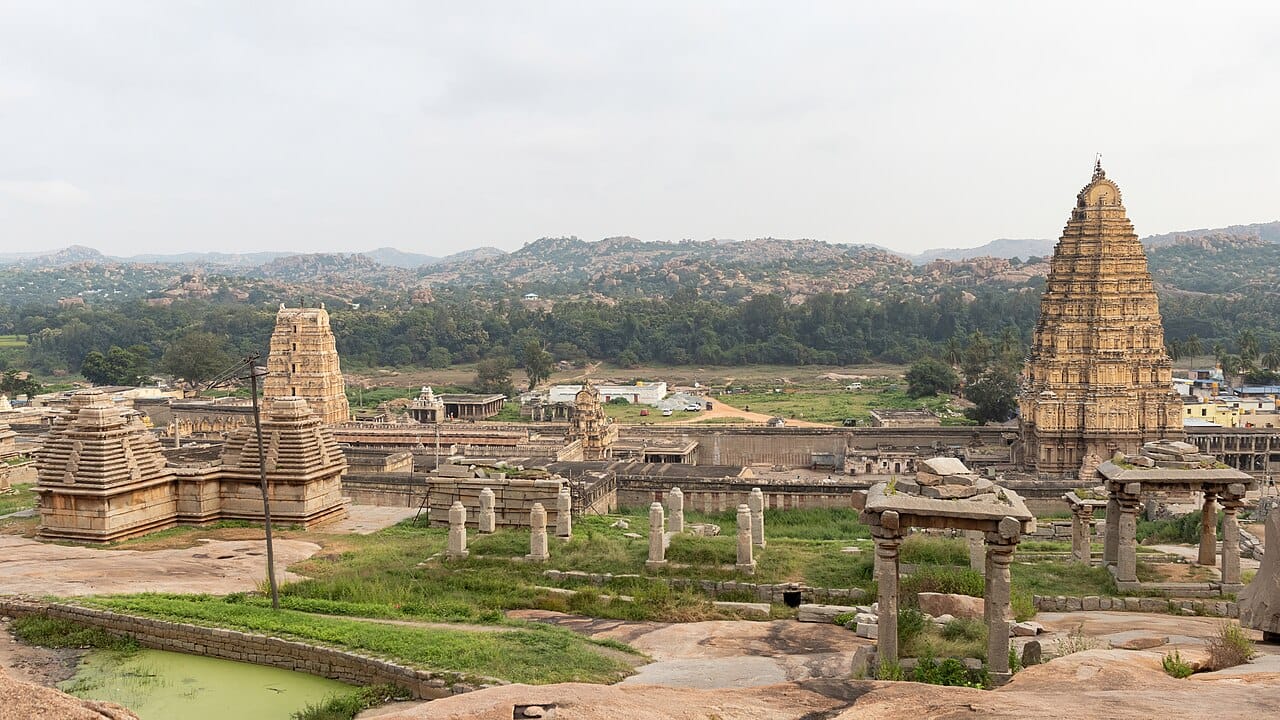
The Vittala Temple is the crowning architectural achievement of the Vijayanagara Empire. Located in Hampi's sacred centre, the temple is renowned for its iconic stone chariot carved from a single granite block and its musical pillars that produce different notes when struck. As a UNESCO World Heritage Site within the 'Group of Monuments at Hampi,' the Vittala Temple represents the pinnacle of Vijayanagara temple architecture.
Jagannath Temple
Jagannath Temple in Puri, Odisha, is one of the four Char Dham sites, famous for the annual Rath Yatra (Chariot Festival) and its unique deities made of neem wood.
Dwarkadhish Temple
The westernmost of the four Char Dham pilgrimage sites, Dwarkadhish Temple marks the legendary kingdom of Lord Krishna in the ancient city of Dwarka. Built on the banks of the Gomti River where it meets the Arabian Sea, the temple is a five-story marvel of Solanki architecture revered by Vaishnavites worldwide.
Hoysaleswara Temple
The Hoysaleswara Temple in Halebidu, built circa 1121-1160 CE, is the largest Shiva temple built by the Hoysalas. Inscribed as a UNESCO World Heritage Site in 2023 as part of the Sacred Ensembles of the Hoysalas, it is celebrated for its hyper-realistic soapstone sculptures covering every surface of the structure.
Kedareshwara Temple
The Kedareshwara Temple at Halebidu, built in 1319 CE by the Hoysala king Veera Ballala III, is a Hoysala-era temple dedicated to Lord Shiva. It features the characteristic Hoysala star-shaped platform (jagati), intricately carved soapstone pillars, and elaborate sculptural friezes. The temple is a protected monument under the Archaeological Survey of India.
Lakshminarasimha Temple
The Lakshminarasimha Temple at Nuggehalli, built in 1246 CE by the Hoysala king Vira Someshwara, is a well-preserved example of Hoysala architecture dedicated to Lord Narasimha (the half-man half-lion avatar of Vishnu) with his consort Lakshmi. The temple features the characteristic Hoysala star-shaped platform, intricate soapstone carvings, and a sculptural programme depicting Vaishnava themes.
Virupaksha Temple
The Virupaksha Temple in Hampi, Karnataka, is a UNESCO World Heritage Site and the oldest functioning temple in India, dedicated to Lord Shiva as Virupaksha.
Chamundeshwari Temple
Perched atop Chamundi Hills at 3,489 feet, the Chamundeshwari Temple is the tutelary shrine of the Wodeyar dynasty of Mysore. The goddess Chamundeshwari, an eight-armed form of Durga who defeated the demon Mahishasura, is the state deity (Naada Devi) of Karnataka. The temple is accessed by 1,000 stone steps built in 1664.
Badami Cave Temples
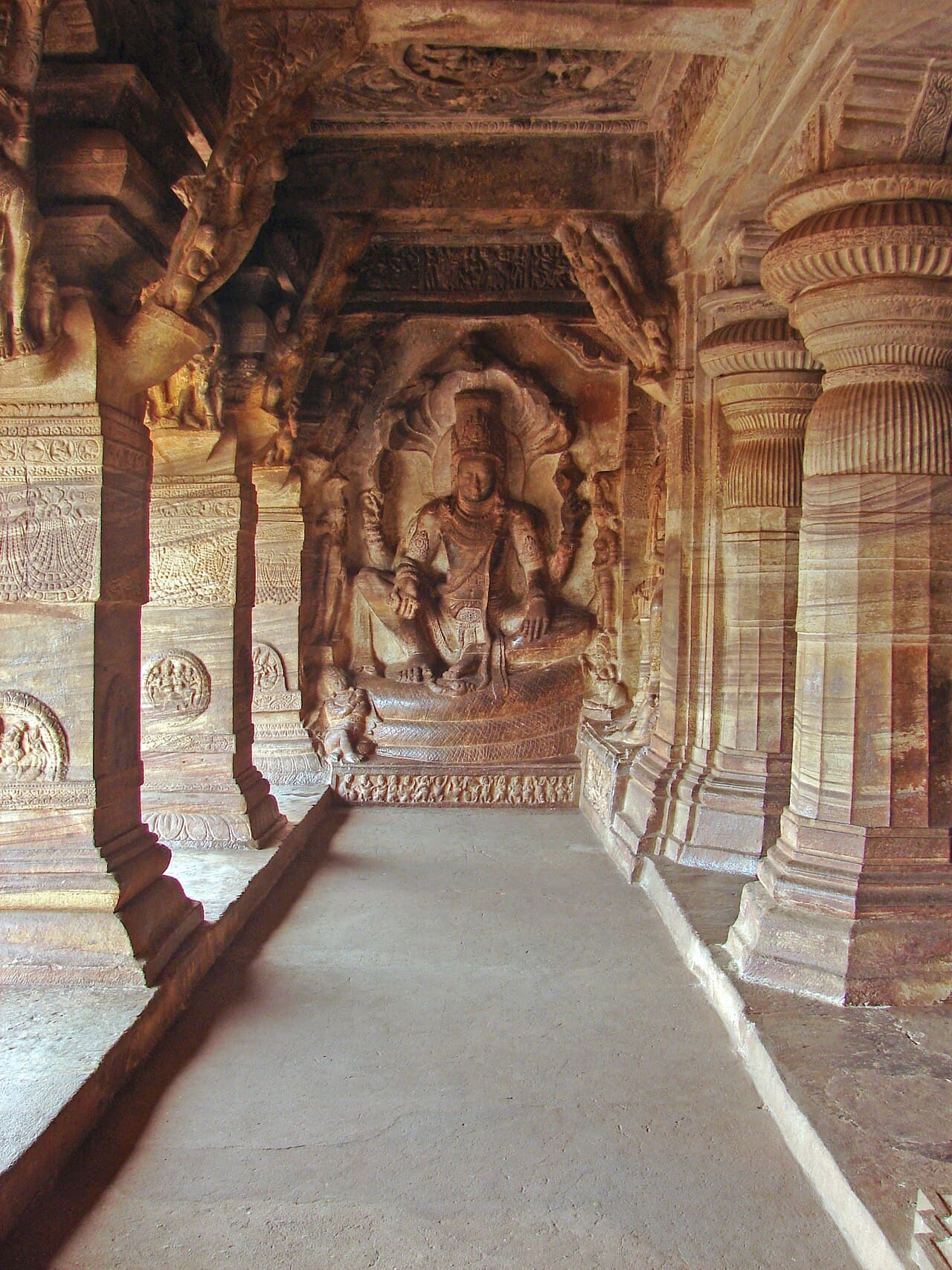
The Badami Cave Temples are a complex of four rock-cut cave temples carved into the soft sandstone cliffs of Badami, the capital of the Early Chalukya dynasty. Dating from the 6th-7th century CE, these caves represent the earliest known examples of South Indian temple architecture in rock-cut form and are considered the birthplace of Chalukya art. The site is on UNESCO's tentative list of World Heritage Sites.
Durga Temple
The Durga Temple at Aihole, built in the 7th-8th century CE, is a distinctive architectural experiment of the Early Chalukya period. Featuring a unique apsidal (horseshoe-shaped) plan modelled after a Buddhist chaitya hall, a raised gallery with carved stone pillars, and a massive Dravidian-style shikhara, it represents the creative fusion of architectural traditions that Characterises Aihole as the 'cradle of Indian temple architecture.'
Lad Khan Temple
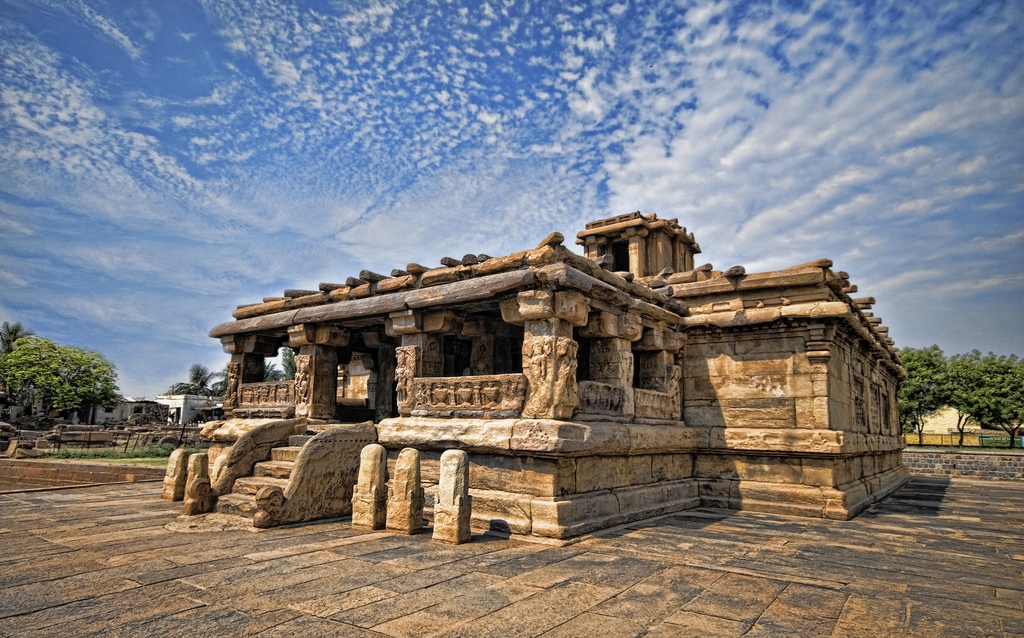
The Lad Khan Temple at Aihole is one of the oldest surviving stone temples in India, dating to the 5th century CE. Built by the Early Chalukya dynasty, the temple is a key monument in the evolution of Hindu temple architecture, representing an early experimental phase when temple builders were adapting earlier wooden and brick construction methods into permanent stone forms. The temple features a flat-roofed mandapa with 16 carved stone pillars and a small ground-level sanctum.
Meguti Temple
The Meguti Temple atop the Aihole hill is a Jain temple built in 634 CE by Ravikirti, the court poet of the Chalukya emperor Pulakeshin II. The temple is historically paramount for its inscription — the Aihole Prashasti — which provides the earliest known securely dated reference in Chalukya history and records the military campaigns of Pulakeshin II, including his victory over the Pallava king Mahendravarman I.
Rasmancha Bishnupur
The oldest 17th-century brick structure in Bishnupur, unique for its massive pyramidal roof and arched galleries.
Jor-Bangla Temple Bishnupur
Known for its 'twin hut' design and incredibly detailed terracotta panels depicting the Ramayana and Mahabharata.
Shyam Rai Temple Bishnupur
A five-towered terracotta temple famous for its circular friezes showing the Rasa-lila of Lord Krishna.
Dashavatara Temple
Dating to around 500 CE, this is the earliest known North Indian temple with a shikhara (curvilinear tower). The temple is famous for its carved panels depicting the ten incarnations (Dashavatara) of Vishnu on the sanctum walls.
Shri Ram Janmabhoomi Mandir
A grand and historic temple marking the birthplace of Lord Rama, the seventh avatar of Vishnu, representing the pinnacle of Nagara architecture.
Prem Mandir
A stunning modern white-marbled complex in Vrindavan dedicated to Divine Love, known for its life-like tableaus of Krishna's pastimes.
India's temples are living traditions — not museums. Every temple has its own customs. This guide helps first-time visitors prepare with confidence and respect.
Foreign visitor information is being researched
Please verify with the official temple authority before planning your visit.
Foreign Visitors
Verify Before VisitingVisitor Information
Entry policies vary between temples. Most temples welcome visitors, while some may restrict access to specific areas, rituals, or the inner sanctum. Always verify the latest entry guidelines with the official temple authorities before your visit.
Modest clothing is expected at every Indian temple — a sign of respect, not a restriction. Think of it as dressing for a formal ceremony.
A scarf is always useful — it covers shoulders, works as a head covering, and can double as a makeshift face cover if needed.
Outdoor photography is generally permitted. Indoor photography is often restricted. Always look for signage or ask a priest before taking photos inside.
October to March offers pleasant weather. The temple is less crowded than Belur or Halebidu, offering a more serene experience. Early morning light (6:00-8:00 AM) creates dramatic shadows on the star-shaped platform, highlighting the geometric precision of the Hoysala architects. The temple is at its most photogenic during the golden hour, when the soapstone carvings catch the warm sunlight.
April — June
July — September
English is widely understood at major tourist temples. In smaller local temples, Hindi and the regional language are more common. A smile and simple hand gestures go a long way. Learning a few words of the local language is always appreciated.
Cash (Indian Rupees) is the most reliable option, especially for temple offerings, small shops, and local transport.
UPI digital payments (Google Pay, PhonePe, Paytm) are widely accepted across India — even at roadside stalls. Download one before you arrive.
International credit/debit cards work at most ATMs, hotels, and larger establishments. Smaller vendors may only accept cash or UPI.
Carry small denominations (₹10, ₹20, ₹50, ₹100 notes) for offerings and temple donations. Large notes (₹500, ₹2000) can be hard to break at smaller counters.
Many historic temples have uneven stone floors, multiple steps, and narrow passages. Wheelchair access is limited at older sites — contact the temple in advance.
Basic restroom facilities and drinking water are available at most major temples. Some charge a small fee (₹5–₹10).
Stay hydrated — carry a reusable water bottle, especially in hot climates.
Keep valuables secure — use hotel lockers for passports and excess cash.
Wear comfortable, sturdy footwear — temple floors can be hot, wet, or uneven.
Beware of unofficial guides or touts near temple entrances. Only use authorised services.
Carry a photocopy of your passport and visa. Leave originals in your hotel safe.
Download offline maps — mobile networks can be unreliable near remote temple sites.
These short explanations help make sense of what you see and experience.
Darshan means 'seeing' — but in a temple it means being seen by the deity. It is a sacred moment of connection, not just a viewing.
Removing footwear is a sign of humility. It also keeps the temple floor clean, since devotees sit and pray on the ground.
Food offered to the deity and then distributed to devotees. It is considered blessed. Accept it with both hands and do not discard it.
The bell creates a focused acoustic atmosphere, wards off distractions, and announces your presence before entering the inner sanctum.
Circumambulation (pradakshina) is done clockwise, keeping the sanctum on your right — an auspicious direction aligned with the sun's path.
Flowers symbolise devotion, coconuts represent the ego being broken, incense purifies the air, and lamps represent the victory of light over darkness.
Sacred viewing of the deity; the central act of temple worship.
Clockwise circumambulation of the sanctum.
Blessed food offered to the deity and distributed to devotees.
The innermost sanctum where the main deity resides.
The towering spire above the sanctum, a defining feature of temple architecture.
A pillared hall or pavilion within the temple complex.
The Indian Rupee (?, INR) is the local currency. ATMs are widely available in cities and towns. For temple offerings, keep small notes (₹10, ₹20, ₹50). Most temples accept donations in cash only — digital payments are uncommon at the offering counter itself.
Offerings (dakshina) are given with the right hand. Place cash in the donation box (hundi) or give it directly to the priest. There is no fixed amount — give what feels appropriate. Some temples have fixed fees for special entry or puja participation.
Shoes and sandals are removed before entering the temple building. Most temples have a designated shoe counter (free or a small fee of ₹5–₹20). Socks are generally allowed. In monsoon, carry a plastic bag for wet shoes.
Darshan queues can take 30 minutes to 3 hours at popular temples. Many offer paid VIP darshan (₹100–₹500) for faster entry. Special queues for women, elderly, and disabled visitors exist at some temples. No line jumping.
Major festivals draw enormous crowds — sometimes hundreds of thousands. Book accommodation months in advance. Expect road closures, restricted vehicle access, and limited phone network. Arrive early (before dawn) to avoid the worst congestion.
Always look for signage before taking photos. When in doubt, ask a priest. Never take photos of devotees in prayer without permission. Selfie sticks are banned at most temples. Silently switch your phone to silent mode.
Police / Ambulance / Fire: 112 (National Emergency Number)
Tourist Helpline: 1800-111-363 (Multi-lingual, Ministry of Tourism)
Women's Helpline: 1091
Temple-specific visitor information is continuously researched and updated from official sources. Where specific data is unavailable, general India travel guidance is provided. Always verify current policies with the temple authority before your visit.
Information last verified July 2026. Temple-specific data coming soon.
Continue your journey through the spiritual and architectural wonders of India.

The Hoysaleswara Temple in Halebidu, built circa 1121-1160 CE, is the largest Shiva temple built by the Hoysalas. Inscribed as a UNESCO World Heritage Site in 2023 as part of the Sacred Ensembles of the Hoysalas, it is celebrated for its hyper-realistic soapstone sculptures covering every surface of the structure.

The Kedareshwara Temple at Halebidu, built in 1319 CE by the Hoysala king Veera Ballala III, is a Hoysala-era temple dedicated to Lord Shiva. It features the characteristic Hoysala star-shaped platform (jagati), intricately carved soapstone pillars, and elaborate sculptural friezes. The temple is a protected monument under the Archaeological Survey of India.
The Lakshminarasimha Temple at Nuggehalli, built in 1246 CE by the Hoysala king Vira Someshwara, is a well-preserved example of Hoysala architecture dedicated to Lord Narasimha (the half-man half-lion avatar of Vishnu) with his consort Lakshmi. The temple features the characteristic Hoysala star-shaped platform, intricate soapstone carvings, and a sculptural programme depicting Vaishnava themes.

Perched atop Chamundi Hills at 3,489 feet, the Chamundeshwari Temple is the tutelary shrine of the Wodeyar dynasty of Mysore. The goddess Chamundeshwari, an eight-armed form of Durga who defeated the demon Mahishasura, is the state deity (Naada Devi) of Karnataka. The temple is accessed by 1,000 stone steps built in 1664.

The Badami Cave Temples are a complex of four rock-cut cave temples carved into the soft sandstone cliffs of Badami, the capital of the Early Chalukya dynasty. Dating from the 6th-7th century CE, these caves represent the earliest known examples of South Indian temple architecture in rock-cut form and are considered the birthplace of Chalukya art. The site is on UNESCO's tentative list of World Heritage Sites.

The Durga Temple at Aihole, built in the 7th-8th century CE, is a distinctive architectural experiment of the Early Chalukya period. Featuring a unique apsidal (horseshoe-shaped) plan modelled after a Buddhist chaitya hall, a raised gallery with carved stone pillars, and a massive Dravidian-style shikhara, it represents the creative fusion of architectural traditions that Characterises Aihole as the 'cradle of Indian temple architecture.'

The Lad Khan Temple at Aihole is one of the oldest surviving stone temples in India, dating to the 5th century CE. Built by the Early Chalukya dynasty, the temple is a key monument in the evolution of Hindu temple architecture, representing an early experimental phase when temple builders were adapting earlier wooden and brick construction methods into permanent stone forms. The temple features a flat-roofed mandapa with 16 carved stone pillars and a small ground-level sanctum.

The Meguti Temple atop the Aihole hill is a Jain temple built in 634 CE by Ravikirti, the court poet of the Chalukya emperor Pulakeshin II. The temple is historically paramount for its inscription — the Aihole Prashasti — which provides the earliest known securely dated reference in Chalukya history and records the military campaigns of Pulakeshin II, including his victory over the Pallava king Mahendravarman I.
"The Shore Temple at Mahabalipuram is one of the oldest structural stone temples of South India."