From ancient rock-cut marvels to towering imperial shrines, discover the architectural soul of Bharat through our verified digital archive.
Explore More Temples
Location
Badami
Presiding Deity
Shiva, Vishnu, Jain Tirthankaras
Architecture
Indian rock-cut architecture (Deccan)
Dynasty
Chalukya (Badami Chalukya)
Timings
6:00 AM to 6:00 PM daily. Entry fee: Rs 25 (Indian citizens), Rs 300 (foreign tourists). Maintained by the Archaeological Survey of India.
Entry Fee
Free
Best Time
October to March offers pleasant weather. Early morning and late afternoon provide the best light for viewing the cave interiors and the cliff-face setting.
The Badami Cave Temples are a complex of four rock-cut cave temples carved into the soft sandstone cliffs of Badami, the capital of the Early Chalukya dynasty. Dating from the 6th-7th century CE, these caves represent the earliest known examples of South Indian temple architecture in rock-cut form and are considered the birthplace of Chalukya art. The site is on UNESCO's tentative list of World Heritage Sites.
The Badami region was the heartland of the Early Chalukya dynasty, which ruled the Deccan from the 6th to 8th centuries CE. The caves were excavated during the reigns of Kirtivarman I, his brother Mangalesha, and their successors. The Chalukya ruler Pulakeshin II (610-642 CE), the most famous of the dynasty, patronised the final cave. The Chalukyas were contemporaries of the Pallavas in the south and the Gupta and Vakataka dynasties in the north, and their art reflects influences from both traditions. After the decline of the Chalukyas, the caves fell into disuse but were never entirely forgotten. They were documented by British archaeologists in the 19th century, including the pioneering work of John Marshall and James Burgess. The caves have been protected by the Archaeological Survey of India since the early 20th century. In 2014, Badami was added to UNESCO's tentative list as part of the 'Evolution of Temple Architecture in the Chalukyan Heartland.' The local legend behind the naming of Badami (formerly Vatapi) is linked to the Ramayana: the demon brothers Vatapi and Ilvala lived in this region and were known for a deceptive practice where Vatapi would transform into a goat, be cooked and fed to guests, and then Ilvala would call him back, causing the guest to burst. The sage Agastya foiled this scheme by digesting Vatapi before Ilvala could call him, and the region was named after the defeated demon. The Chalukya adoption of Vatapi as their capital symbolically represented their conquest of the region and their assertion of a mythological lineage.
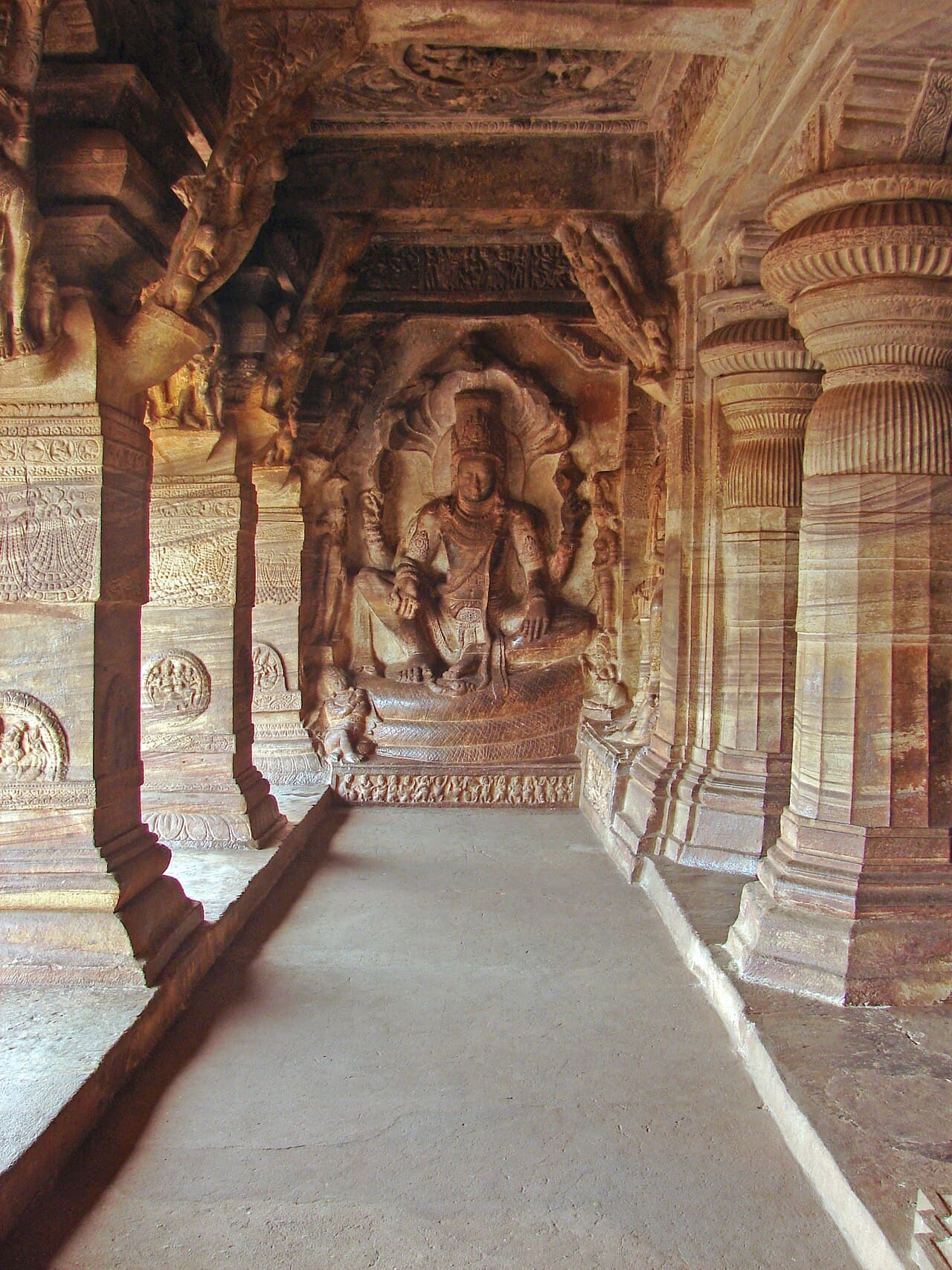
“The Badami Cave Temples are steeped in Puranic mythology, with each cave dedicated to different deities. Cave 1 is dedicated to Shiva and contains the celebrated 18-armed Nataraja panel depicting Shiva's cosmic dance (Ananda Tandava). According to Shaiva mythology, this dance represents the fivefold cosmic functions of creation, preservation, destruction, concealment, and grace. Cave 2 features Vishnu as Trivikrama (the Vamana avatar), depicting the legend of King Bali from the Bhagavata Purana, where Vishnu as the dwarf Vamana takes three strides to measure the universe. Cave 3, the largest, contains multiple Vishnu forms including the Narasimha (half-man, half-lion) avatar slaying Hiranyakashipu, and the Varaha (boar) avatar rescuing Bhudevi from the cosmic ocean. The Puranic narratives carved on the cave walls reflect the religious synthesis of the Early Chalukya period, when Shaiva, Vaishnava, and Jain traditions coexisted under royal patronage.”
The caves are cut into the horizontal strata of soft Badami sandstone, which allowed sculptors to carve with relative ease. Cave 3 is the largest, measuring approximately 21 metres wide and 15 metres deep. Each cave follows a similar plan: a verandah (mukhamandapa) with stone pillars, a pillared hall (mahamandapa), and a small square sanctum (garbhagriha) cut into the rear wall. The pillars are massive, square at the base and top with octagonal or sixteen-sided sections in the middle, characteristic of the Early Chalukya style. The ceiling panels feature sculpted figures and lotus medallions. The Cliffside location and the artificial lake below create dramatic visual settings. The caves are oriented to face the lake. The Cave 3 inscription of 578 CE, carved in Sanskrit and Kannada scripts, is a historical document of the highest importance: it records the construction of the cave by the Chalukya king Kirtivarman I and provides precise chronological data for the Early Chalukya period. The inscription is also notable for its palaeographic significance, preserving one of the earliest known examples of the Kannada script. A sculptural feature unique to Badami is the depiction of flying celestials (vidyadharas) on the ceiling of Cave 1, shown in dynamic poses with flowing garments that convey a sense of motion unusual in early rock-cut art. The natural spring that emerges near Cave 1 was channelled into a stone cistern and used to supply water to the cave complex, an early example of hydraulic engineering in a rock-cut context.
The Badami Cave Temples are the earliest surviving examples of South Indian temple architecture in the rock-cut medium. They demonstrate the transition from the earlier Buddhist and Jain rock-cut tradition (as seen at Ajanta and Ellora) to the Hindu temple idiom. The sculptural programme at Badami is exceptional for its naturalism, dynamic poses, and iconographic detail. The 18-armed Nataraja in Cave 1 is a celebrated sculpture in Indian art, depicting Shiva's cosmic dance in over 100 distinct dancing poses. Cave 3 contains the earliest securely dated Hindu cave temple inscription (578 CE), making the site chronologically fundamental to the study of early Indian temple architecture. The caves are a foundation site for understanding the evolution of Hindu iconography.
The Badami Cave Temples are a protected monument under the Archaeological Survey of India and are preserved as a UNESCO-tentative heritage site. No regular worship or ritual activities are conducted within the caves. As rock-cut monuments from the 6th-7th century CE, they are maintained exclusively for archaeological, historical, and tourism purposes. No aartis, abhishekams, or puja ceremonies are performed here. The site is significant as the birthplace of Chalukya art and the earliest surviving example of South Indian Hindu rock-cut architecture. Visitors come to study the 18-armed Nataraja in Cave 1, the earliest securely dated Hindu cave inscription (578 CE) in Cave 3, and the exceptional sculptural quality across all four caves. The annual Badami Utsav (January-February) organises cultural programmes at the site.
The site does not host active festivals. It is visited primarily as an archaeological and historical monument. The annual Badami Utsav (January-February) organised by the Karnataka tourism department features cultural programmes at the site.
Earliest South Indian Hindu rock-cut caves, 18-armed Nataraja sculpture, securely dated inscription of 578 CE, four-cave complex dedicated to Shiva, Vishnu, and Jain Tirthankaras, Chalukya rock-cut architecture, UNESCO tentative site.
October to March offers pleasant weather. Early morning and late afternoon provide the best light for viewing the cave interiors and the cliff-face setting.
6:00 AM to 6:00 PM daily. Entry fee: Rs 25 (Indian citizens), Rs 300 (foreign tourists). Maintained by the Archaeological Survey of India.
Badami is approximately 500 km from Bengaluru and 140 km from Hubli. The nearest railway station is Badami (5 km) on the Hubli-Solapur line. The nearest airport is Hubli Airport (140 km). Regular KSRTC buses connect Badami to Hubli, Bijapur, and Bengaluru. Combine Badami with Aihole and Pattadakal for a complete Chalukya heritage tour. Comfortable walking shoes are essential as climbing to the caves involves steps. Carry water and sun protection. Allow 2-3 hours for a thorough visit. Photography is permitted inside the caves (no flash). The Agastya Tirtha lake at the base of the caves is considered sacred and bathing ghats are available for pilgrims. Entry to the Archaeological Museum located near the caves is free with the cave entry ticket, displaying sculptures and inscriptions from the Chalukya period.
Aihole (35 km) is the 'cradle of Indian temple architecture' with over 125 temples including the Durga Temple and Lad Khan Temple. Pattadakal (22 km) is a UNESCO World Heritage Site with a cluster of Chalukya temples. Banashankari Temple (6 km) is a Shakti shrine. Mahakuta group of temples (10 km) is an early Chalukya site.
A. They are the earliest surviving examples of South Indian temple architecture in rock-cut form (6th century CE). Cave 3 contains the earliest securely dated Hindu cave temple inscription (578 CE). The 18-armed Nataraja is a celebrated sculpture in Indian art.
A. There are four main rock-cut caves — Cave 1 (Shiva, Nataraja), Cave 2 (Vishnu as Trivikrama), Cave 3 (Vishnu in multiple forms, the largest), and Cave 4 (Jain Tirthankara Adinatha).
A. Open from 6:00 AM to 6:00 PM daily. Entry is Rs 25 for Indians, Rs 300 for foreign tourists. The site is maintained by the ASI.
A. The nearest railway station is Badami (5 km). Hubli Airport (140 km) is the nearest airport. Regular buses connect from Hubli, Bijapur, and Bengaluru.
A. Aihole (35 km) with over 125 Chalukya temples, Pattadakal UNESCO site (22 km), and Mahakuta (10 km) are the key nearby attractions for Chalukya heritage.
A. The Badami Chalukya dynasty, which ruled the Deccan from the 6th to 8th centuries CE. The caves were excavated during the reigns of Kirtivarman I, Mangalesha, and Pulakeshin II.
Virupaksha Temple
The Virupaksha Temple in Hampi, Karnataka, is a UNESCO World Heritage Site and the oldest functioning temple in India, dedicated to Lord Shiva as Virupaksha.
Trimbakeshwar Temple
The Trimbakeshwar Temple in Maharashtra is one of the twelve Jyotirlingas, unique for its three-faced linga representing the Trimurti and the source of the Godavari River.
Airavatesvara Temple
The Airavatesvara Temple at Darasuram, built by Rajaraja Chola II between 1146 and 1172 CE, is one of the three UNESCO World Heritage 'Great Living Chola Temples.' It is renowned for its stone chariot, musical steps, and exquisite 12th-century Chola sculptures.
Gangaikonda Cholapuram Temple
The Gangaikonda Cholapuram Temple, built by Rajendra Chola I in 1035 CE, is a UNESCO World Heritage 'Great Living Chola Temple.' Its 53-metre vimana with recessed corners and six pairs of monolithic dvarapalas represents a refined evolution of Chola Dravidian architecture.
Kampaheswarar Temple
Kampaheswarar Temple in Tribhuvanam, built by Kulothunga Chola III in 1202 CE, is one of the later great Chola temples and completes the quartet of magnificent Chola stone temples alongside the Brihadeeswarar at Thanjavur, Gangaikonda Cholapuram, and Airavatesvara at Darasuram. The temple represents the mature phase of Chola architecture, featuring a 30-metre granite vimana, a separate Devi shrine, and a unique chariot-wheel carving in the mandapa. It is maintained by the Archaeological Survey of India as a protected monument of national importance.
Koranganatha Temple
Koranganatha Temple, built during the reign of the Chola king Parantaka I (907-955 CE) at Srinivasanallur near Tiruchirappalli, is a well-preserved example of early Chola architecture with exquisite stone carvings. The temple is maintained by the Archaeological Survey of India and is notable for its peaceful setting on the banks of the Kaveri River.
Virupaksha Temple
The Virupaksha Temple in Hampi, Karnataka, is a UNESCO World Heritage Site and the oldest functioning temple in India, dedicated to Lord Shiva as Virupaksha.
Chamundeshwari Temple
Perched atop Chamundi Hills at 3,489 feet, the Chamundeshwari Temple is the tutelary shrine of the Wodeyar dynasty of Mysore. The goddess Chamundeshwari, an eight-armed form of Durga who defeated the demon Mahishasura, is the state deity (Naada Devi) of Karnataka. The temple is accessed by 1,000 stone steps built in 1664.
Durga Temple
The Durga Temple at Aihole, built in the 7th-8th century CE, is a distinctive architectural experiment of the Early Chalukya period. Featuring a unique apsidal (horseshoe-shaped) plan modelled after a Buddhist chaitya hall, a raised gallery with carved stone pillars, and a massive Dravidian-style shikhara, it represents the creative fusion of architectural traditions that Characterises Aihole as the 'cradle of Indian temple architecture.'
Lad Khan Temple
The Lad Khan Temple at Aihole is one of the oldest surviving stone temples in India, dating to the 5th century CE. Built by the Early Chalukya dynasty, the temple is a key monument in the evolution of Hindu temple architecture, representing an early experimental phase when temple builders were adapting earlier wooden and brick construction methods into permanent stone forms. The temple features a flat-roofed mandapa with 16 carved stone pillars and a small ground-level sanctum.
Meguti Temple
The Meguti Temple atop the Aihole hill is a Jain temple built in 634 CE by Ravikirti, the court poet of the Chalukya emperor Pulakeshin II. The temple is historically paramount for its inscription — the Aihole Prashasti — which provides the earliest known securely dated reference in Chalukya history and records the military campaigns of Pulakeshin II, including his victory over the Pallava king Mahendravarman I.
Hoysaleswara Temple
The Hoysaleswara Temple in Halebidu, built circa 1121-1160 CE, is the largest Shiva temple built by the Hoysalas. Inscribed as a UNESCO World Heritage Site in 2023 as part of the Sacred Ensembles of the Hoysalas, it is celebrated for its hyper-realistic soapstone sculptures covering every surface of the structure.
Tarakeshwar Temple Hooghly
A massive 18th-century pilgrimage site dedicated to Lord Taraknath, especially vibrant during the Gajan festival.
Virupaksha Temple
The Virupaksha Temple in Hampi, Karnataka, is a UNESCO World Heritage Site and the oldest functioning temple in India, dedicated to Lord Shiva as Virupaksha.
Jageshwar Temple
A cluster of 124 ancient stone temples from the 7th-12th centuries, nestled in a dense deodar forest.
Neelkanth Mahadev Temple
Situated at 1,330 meters, this is where Lord Shiva is believed to have consumed the poison (Halahala) during the Samudra Manthan.
Tungnath Temple
The highest Shiva temple in the world, situated at 3,680 meters on the Chandranath Parbat; it is the 'Tritiya Kedar' in the sacred Panch Kedar pilgrimage circuit.
Rudranath Temple
One of the Panch Kedar shrines, representing Lord Shiva's face, situated at an altitude of 2,286 meters amidst meadows and rhododendron forests.
India's temples are living traditions — not museums. Every temple has its own customs. This guide helps first-time visitors prepare with confidence and respect.
Foreign visitor information is being researched
Please verify with the official temple authority before planning your visit.
Foreign Visitors
Verify Before VisitingVisitor Information
Entry policies vary between temples. Most temples welcome visitors, while some may restrict access to specific areas, rituals, or the inner sanctum. Always verify the latest entry guidelines with the official temple authorities before your visit.
Modest clothing is expected at every Indian temple — a sign of respect, not a restriction. Think of it as dressing for a formal ceremony.
A scarf is always useful — it covers shoulders, works as a head covering, and can double as a makeshift face cover if needed.
Outdoor photography is generally permitted. Indoor photography is often restricted. Always look for signage or ask a priest before taking photos inside.
October to March offers pleasant weather. Early morning and late afternoon provide the best light for viewing the cave interiors and the cliff-face setting.
April — June
July — September
English is widely understood at major tourist temples. In smaller local temples, Hindi and the regional language are more common. A smile and simple hand gestures go a long way. Learning a few words of the local language is always appreciated.
Cash (Indian Rupees) is the most reliable option, especially for temple offerings, small shops, and local transport.
UPI digital payments (Google Pay, PhonePe, Paytm) are widely accepted across India — even at roadside stalls. Download one before you arrive.
International credit/debit cards work at most ATMs, hotels, and larger establishments. Smaller vendors may only accept cash or UPI.
Carry small denominations (₹10, ₹20, ₹50, ₹100 notes) for offerings and temple donations. Large notes (₹500, ₹2000) can be hard to break at smaller counters.
Many historic temples have uneven stone floors, multiple steps, and narrow passages. Wheelchair access is limited at older sites — contact the temple in advance.
Basic restroom facilities and drinking water are available at most major temples. Some charge a small fee (₹5–₹10).
Stay hydrated — carry a reusable water bottle, especially in hot climates.
Keep valuables secure — use hotel lockers for passports and excess cash.
Wear comfortable, sturdy footwear — temple floors can be hot, wet, or uneven.
Beware of unofficial guides or touts near temple entrances. Only use authorised services.
Carry a photocopy of your passport and visa. Leave originals in your hotel safe.
Download offline maps — mobile networks can be unreliable near remote temple sites.
These short explanations help make sense of what you see and experience.
Darshan means 'seeing' — but in a temple it means being seen by the deity. It is a sacred moment of connection, not just a viewing.
Removing footwear is a sign of humility. It also keeps the temple floor clean, since devotees sit and pray on the ground.
Food offered to the deity and then distributed to devotees. It is considered blessed. Accept it with both hands and do not discard it.
The bell creates a focused acoustic atmosphere, wards off distractions, and announces your presence before entering the inner sanctum.
Circumambulation (pradakshina) is done clockwise, keeping the sanctum on your right — an auspicious direction aligned with the sun's path.
Flowers symbolise devotion, coconuts represent the ego being broken, incense purifies the air, and lamps represent the victory of light over darkness.
Sacred viewing of the deity; the central act of temple worship.
Clockwise circumambulation of the sanctum.
Blessed food offered to the deity and distributed to devotees.
The innermost sanctum where the main deity resides.
The towering spire above the sanctum, a defining feature of temple architecture.
A pillared hall or pavilion within the temple complex.
The Indian Rupee (?, INR) is the local currency. ATMs are widely available in cities and towns. For temple offerings, keep small notes (₹10, ₹20, ₹50). Most temples accept donations in cash only — digital payments are uncommon at the offering counter itself.
Offerings (dakshina) are given with the right hand. Place cash in the donation box (hundi) or give it directly to the priest. There is no fixed amount — give what feels appropriate. Some temples have fixed fees for special entry or puja participation.
Shoes and sandals are removed before entering the temple building. Most temples have a designated shoe counter (free or a small fee of ₹5–₹20). Socks are generally allowed. In monsoon, carry a plastic bag for wet shoes.
Darshan queues can take 30 minutes to 3 hours at popular temples. Many offer paid VIP darshan (₹100–₹500) for faster entry. Special queues for women, elderly, and disabled visitors exist at some temples. No line jumping.
Major festivals draw enormous crowds — sometimes hundreds of thousands. Book accommodation months in advance. Expect road closures, restricted vehicle access, and limited phone network. Arrive early (before dawn) to avoid the worst congestion.
Always look for signage before taking photos. When in doubt, ask a priest. Never take photos of devotees in prayer without permission. Selfie sticks are banned at most temples. Silently switch your phone to silent mode.
Police / Ambulance / Fire: 112 (National Emergency Number)
Tourist Helpline: 1800-111-363 (Multi-lingual, Ministry of Tourism)
Women's Helpline: 1091
Temple-specific visitor information is continuously researched and updated from official sources. Where specific data is unavailable, general India travel guidance is provided. Always verify current policies with the temple authority before your visit.
Information last verified July 2026. Temple-specific data coming soon.
Continue your journey through the spiritual and architectural wonders of India.

Perched atop Chamundi Hills at 3,489 feet, the Chamundeshwari Temple is the tutelary shrine of the Wodeyar dynasty of Mysore. The goddess Chamundeshwari, an eight-armed form of Durga who defeated the demon Mahishasura, is the state deity (Naada Devi) of Karnataka. The temple is accessed by 1,000 stone steps built in 1664.

The Durga Temple at Aihole, built in the 7th-8th century CE, is a distinctive architectural experiment of the Early Chalukya period. Featuring a unique apsidal (horseshoe-shaped) plan modelled after a Buddhist chaitya hall, a raised gallery with carved stone pillars, and a massive Dravidian-style shikhara, it represents the creative fusion of architectural traditions that Characterises Aihole as the 'cradle of Indian temple architecture.'

The Lad Khan Temple at Aihole is one of the oldest surviving stone temples in India, dating to the 5th century CE. Built by the Early Chalukya dynasty, the temple is a key monument in the evolution of Hindu temple architecture, representing an early experimental phase when temple builders were adapting earlier wooden and brick construction methods into permanent stone forms. The temple features a flat-roofed mandapa with 16 carved stone pillars and a small ground-level sanctum.

The Meguti Temple atop the Aihole hill is a Jain temple built in 634 CE by Ravikirti, the court poet of the Chalukya emperor Pulakeshin II. The temple is historically paramount for its inscription — the Aihole Prashasti — which provides the earliest known securely dated reference in Chalukya history and records the military campaigns of Pulakeshin II, including his victory over the Pallava king Mahendravarman I.

The Hoysaleswara Temple in Halebidu, built circa 1121-1160 CE, is the largest Shiva temple built by the Hoysalas. Inscribed as a UNESCO World Heritage Site in 2023 as part of the Sacred Ensembles of the Hoysalas, it is celebrated for its hyper-realistic soapstone sculptures covering every surface of the structure.

The Kedareshwara Temple at Halebidu, built in 1319 CE by the Hoysala king Veera Ballala III, is a Hoysala-era temple dedicated to Lord Shiva. It features the characteristic Hoysala star-shaped platform (jagati), intricately carved soapstone pillars, and elaborate sculptural friezes. The temple is a protected monument under the Archaeological Survey of India.

The Keshava Temple at Somanathapura, built in 1268 CE by Somanatha Dandanayaka, a general of the Hoysala king Narasimha III, is one of the finest surviving examples of Hoysala architecture. Inscribed as a UNESCO World Heritage Site in 2023 as part of the 'Sacred Ensembles of the Hoysalas,' the temple is renowned for its perfectly preserved star-shaped platform, three identical shrines (trikuta), and the most complete sculptural programme of any Hoysala temple.
The Lakshminarasimha Temple at Nuggehalli, built in 1246 CE by the Hoysala king Vira Someshwara, is a well-preserved example of Hoysala architecture dedicated to Lord Narasimha (the half-man half-lion avatar of Vishnu) with his consort Lakshmi. The temple features the characteristic Hoysala star-shaped platform, intricate soapstone carvings, and a sculptural programme depicting Vaishnava themes.
"The Sun Temple at Konark is designed as a colossal chariot of the Sun God, with 24 intricately carved wheels."