From ancient rock-cut marvels to towering imperial shrines, discover the architectural soul of Bharat through our verified digital archive.
Explore More Temples
Location
Puri
Presiding Deity
Lord Jagannath
Architecture
Kalinga
Dynasty
Ganga (Eastern) dynasty, 12th century
Timings
Jagannath Temple opens at 5:00 AM and closes at 10:00 PM daily. Darshan timings: Morning darshan from 6:00 AM to 11:00 AM. The temple closes from 12:00 PM to 4:00 PM for the deities' afternoon rest (Pahuda). Evening darshan from 4:00 PM to 9:00 PM. The Badasinghara Aarti (main evening ritual) is at 8:30 PM. The temple is open for darshan on all days of the year. The temple closes for special rituals during the 'Anavasara' period (15 days after Snana Purnima, when the deities are in the sick room). Non-Hindus are not permitted inside the inner sanctum but can view the temple from the 'Mukti Mandapa' area and the outer compound. The chariot festival is open to all.
Entry Fee
Free
Best Time
The best time to visit Puri and the Jagannath Temple is from October to March when the weather is pleasant with temperatures between 15–28°C. This period is ideal for temple visits and exploring Puri's beach and surrounding areas. The winter months (December–February) are particularly comfortable. The Rath Yatra period (June–July) is the most significant but also the most crowded and hot, with temperatures reaching 35–40°C and humidity over 80%. Snana Purnami (June) also draws large crowds. Monsoon (July–September) brings heavy rainfall, though the temple remains open. Summer (April–May) is hot and humid but less crowded. For a meaningful visit with manageable crowds, consider November–February. The temple is open throughout the year; unlike Himalayan temples, it has no seasonal closure.
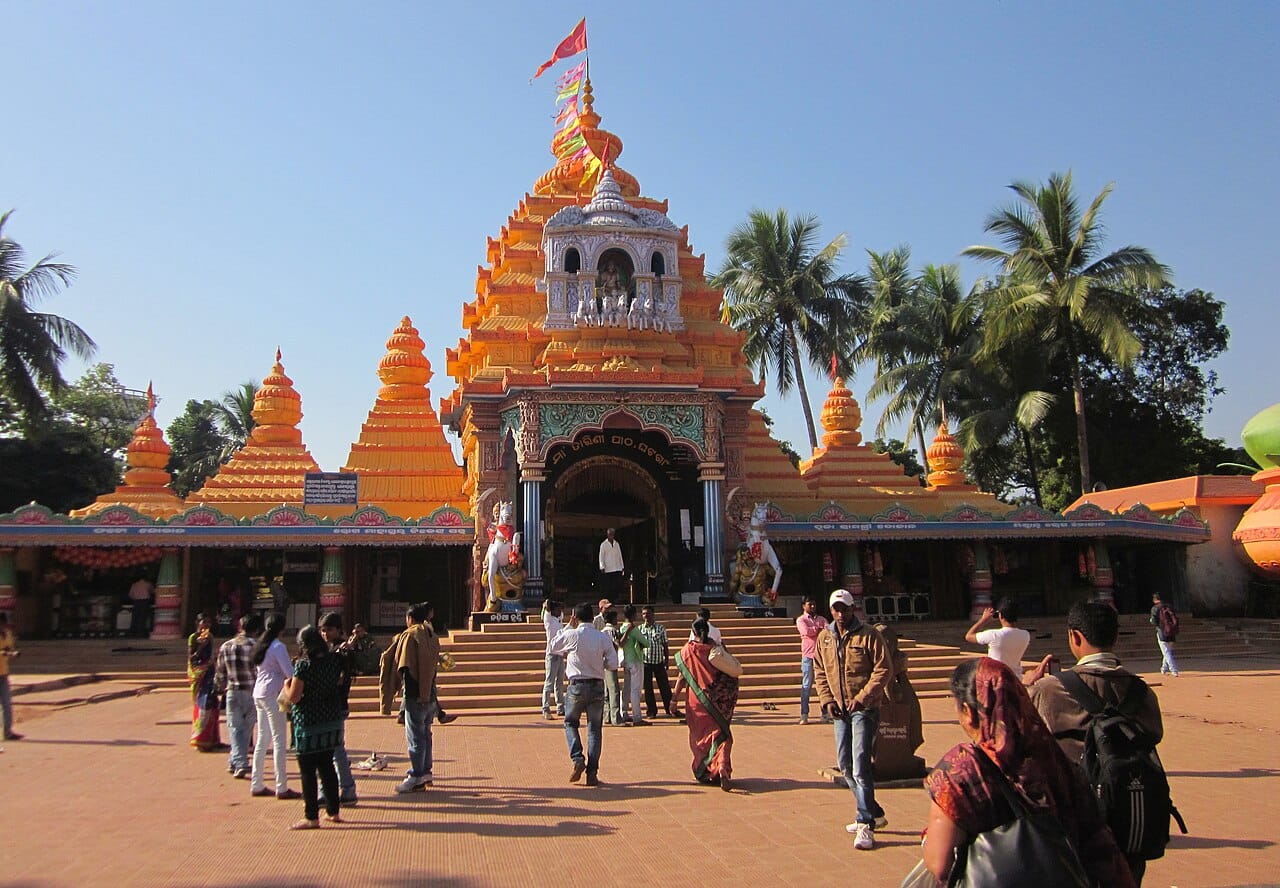
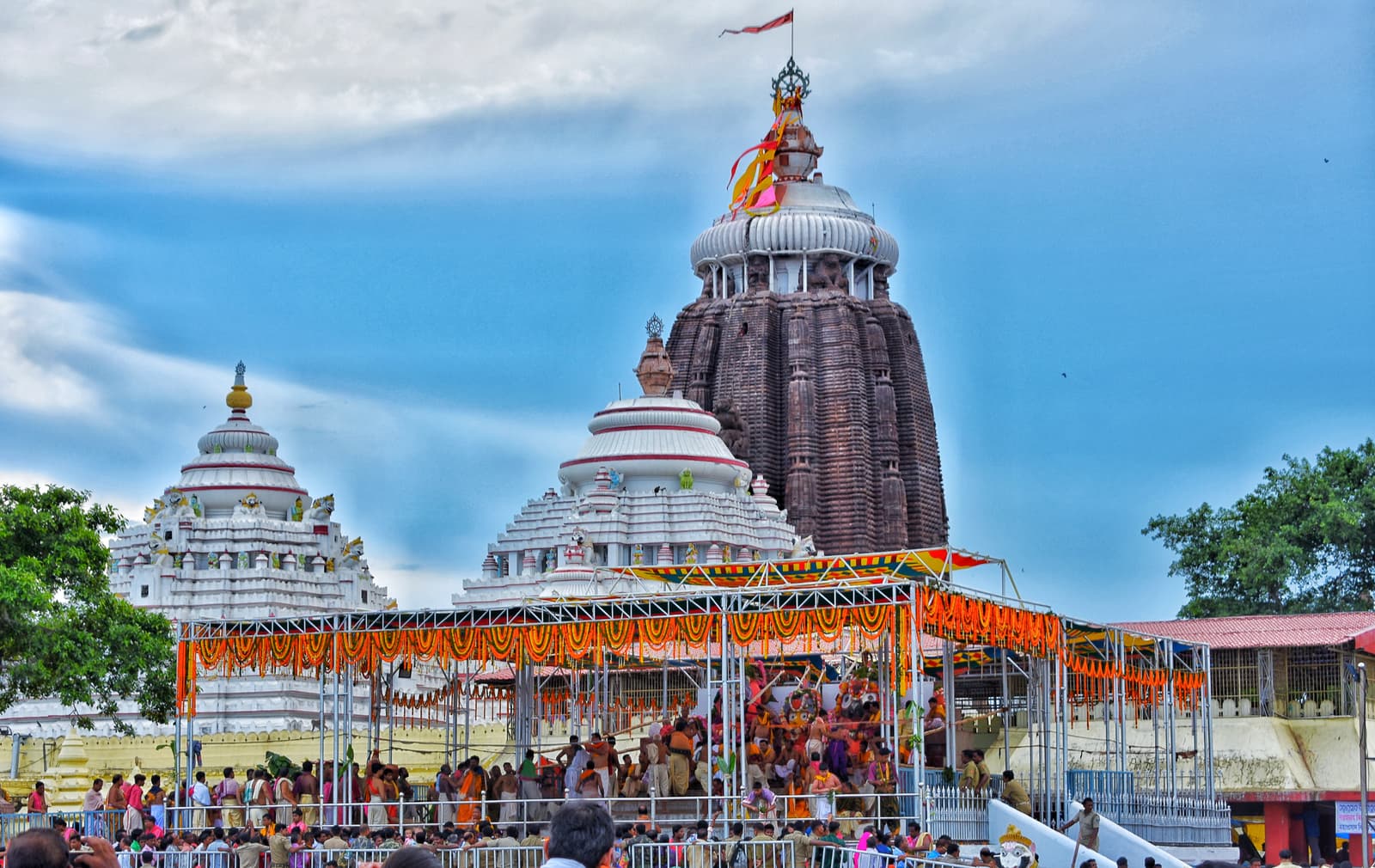
Jagannath Temple in Puri, Odisha, is one of the four Char Dham sites, famous for the annual Rath Yatra (Chariot Festival) and its unique deities made of neem wood.
The history of Jagannath Temple spans over two millennia of religious evolution, political patronage, and cultural synthesis. The earliest literary reference to Jagannath is found in the Rigveda (c. 1500–1200 BCE), which mentions a 'wooden deity' (Daruvigraha). The Puranas, especially the Skanda Purana and the Brahma Purana, contain extensive descriptions of the Jagannath Kshetra (Puri) and its deities. The Sabara (tribal) origins of the Jagannath cult are well-documented. According to traditional accounts, the original deities were worshipped by the Sabara tribal king Viswavasu in the form of Nilamadhava (a blue stone Vishnu). King Indradyumna of Malwa, searching for the deity, discovered the shrine and eventually received a divine command to construct a temple and install wooden deities. The story represents the synthesis of Vedic and indigenous tribal traditions that characterizes the Jagannath cult. The Eastern Ganga dynasty transformed Puri into a major imperial center. King Anantavarman Chodaganga Deva (1078–1147 CE) began construction of the present temple around 1135 CE. His descendant, King Anangabhima Deva III (1211–1238 CE), completed the temple and formally dedicated the kingdom to Lord Jagannath, ruling as the deity's deputy (Rauta). This concept of 'divine kingship' continued through successive dynasties. The temple withstood Muslim invasions in the 16th and 17th centuries. The Afghan general Kalapahad is said to have attacked the temple in 1568, damaging the deities, which were later secretly restored. The Marathas, who controlled Odisha in the 18th century, were great patrons of the temple. The Maratha ruler of Nagpur, Raghuji Bhonsle, established the system of 'Ratha Yatra' management that influenced later traditions. After the British annexed Odisha in 1803, they initially took control of the temple but later restored management to the local rulers. The Puri Temple Administration Act was passed in 1952, establishing the modern Shri Jagannath Temple Administration (SJTA) under the Odisha government. In 1975, the temple became the first in India to install an electronic ticketing system. The 20th century saw the temple becoming a symbol of Odia identity and cultural renaissance. The Temple Entry Movement of the 1940s—1960s, which sought to open the temple to Dalits, was a significant social reform movement. In 2018, the 'Shree Mandira' redevelopment project was launched to modernize facilities while preserving the temple's heritage. The temple's history is also one of remarkable continuity — daily rituals described in 12th-century records are still performed identically today, making it one of the oldest continuously operating temple traditions in the world.
“The mythology of Jagannath Temple is rich and multilayered, combining Vedic, Puranic, and tribal elements. The primary myth concerns King Indradyumna, a pious ruler who heard of the blue god Nilamadhava worshipped by the Sabara tribe. He sent a Brahmin priest, Vidyapati, to find the deity. Vidyapati married the daughter of the Sabara chief Viswavasu and discovered the hidden shrine. King Indradyumna built a magnificent temple, but the deity remained invisible. A divine voice instructed him to install wooden deities carved from a floating log (daaru) that would appear on the seashore. This daaru was found at Puri, and the celestial architect Visvakarma, disguised as an old carpenter, agreed to carve the deities on condition that he not be disturbed. The impatient King opened the door before the work was complete, and the carpenter vanished, leaving the deities unfinished — with large round eyes and stumps for arms. This explains the distinctive iconography of Jagannath. Another myth connects Jagannath to Krishna's death. After Krishna was mistakenly shot by the hunter Jara, his body was left to decompose under a tree. A traveler collected the bones and kept them in a box. By divine will, the box washed ashore at Puri, and King Indradyumna placed the relics inside the wooden deities, infusing them with divine presence. This is why Jagannath is associated with both Vishnu (as the blue god) and Krishna (as the dark god). The sibling relationship of Jagannath, Balabhadra, and Subhadra has its own mythology. Jagannath represents Krishna, Balabhadra is his elder brother Balarama, and Subhadra is their sister. The fourth deity, Sudarshana (the divine discus), completes the quartet. The trio's separation during Rath Yatra — when Subhadra rides her own chariot between her two brothers — symbolizes domestic relationships and sibling bonds. The annual journey to Gundicha Temple, considered the garden house of the deities, reenacts Krishna's journey from Vrindavan to Mathura and back. Additionally, the 'Nabakalebara' (new embodiment) ritual, when the deities are replaced, is mythologically tied to the belief that the original daaru (log) that appeared at the divine command is the only source for carving the new deities.”
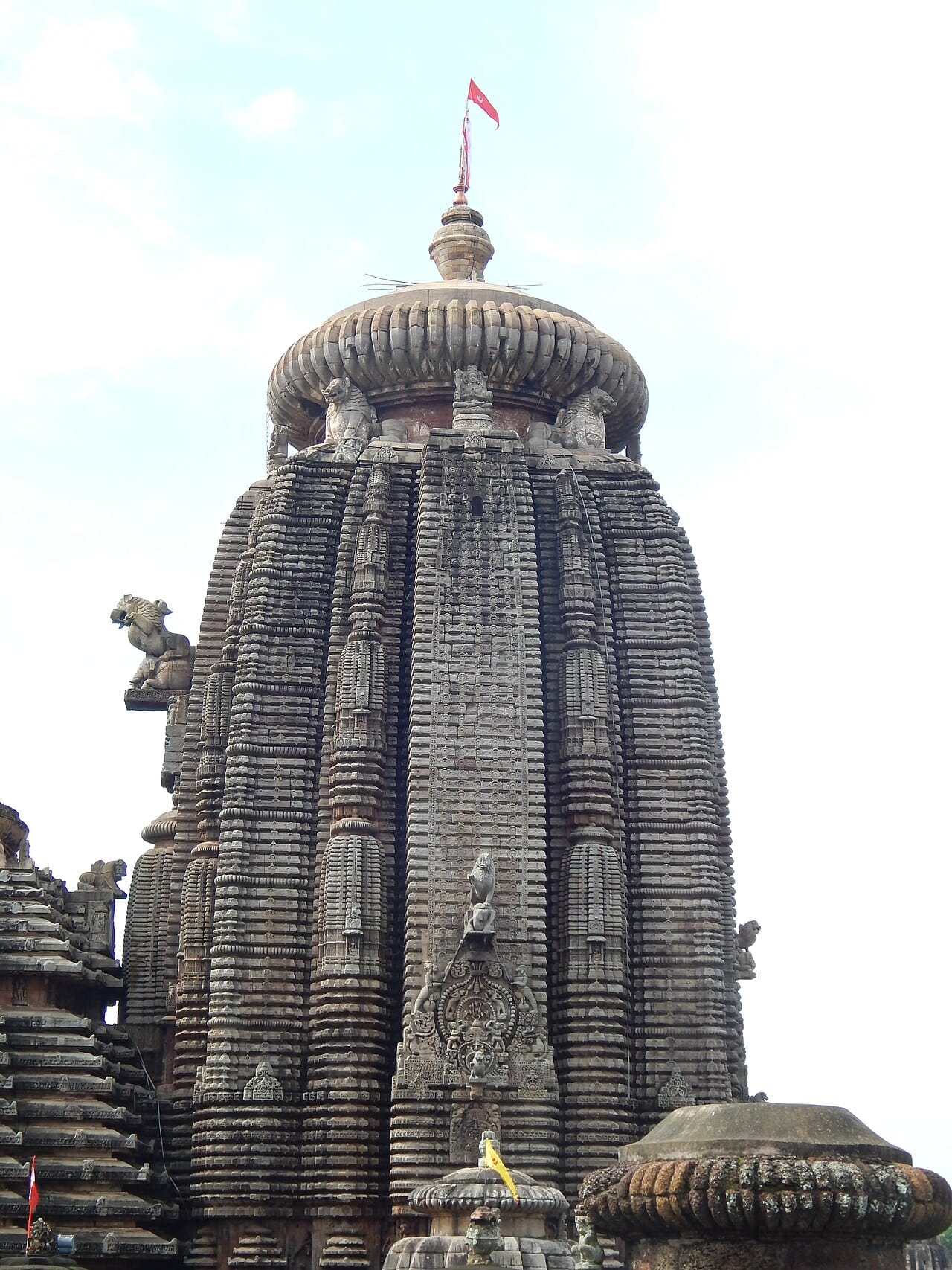
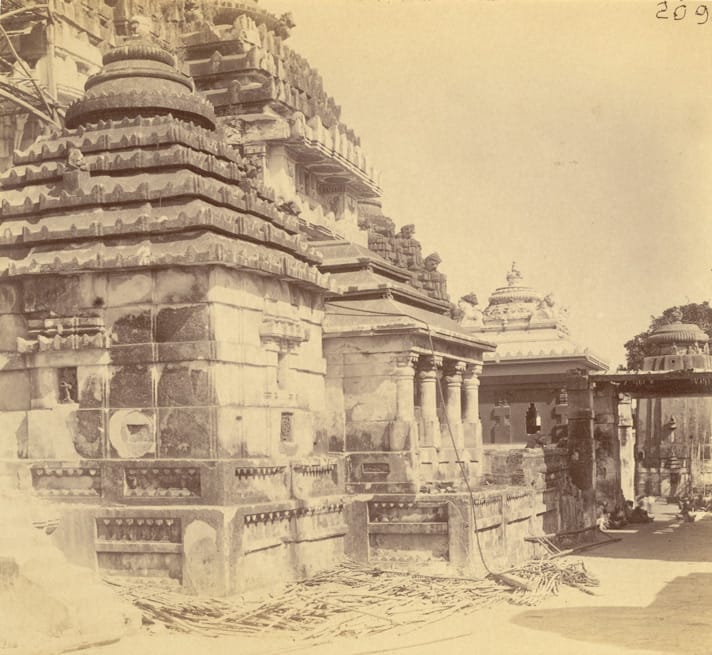
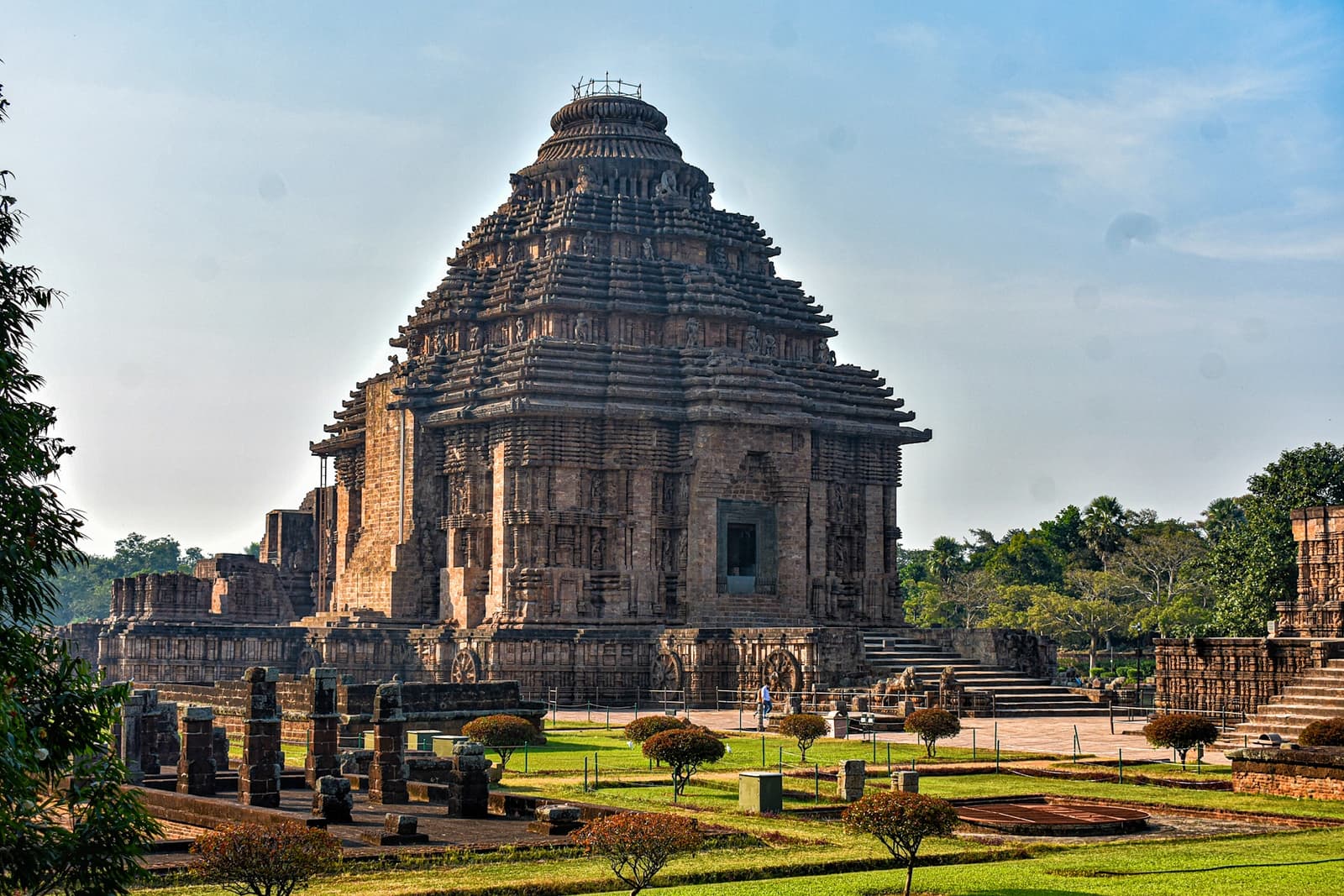
Jagannath Temple is a masterpiece of the Kalinga school of temple architecture, the distinctive Odishan style that evolved between the 8th and 13th centuries. The temple complex covers an area of over 37,000 square meters (10.7 acres) and is enclosed by a 6.4-meter-high fortified wall, punctuated by four gates on each cardinal direction — the Singhadwara (Lion Gate, the main entrance), the Hastidwara (Elephant Gate), the Ashwadwara (Horse Gate), and the Vyaghradwara (Tiger Gate). The main temple (Vimana) rises to a height of 65 meters (214 feet), making it one of the tallest temple structures in India. It consists of four distinct architectural components: the Vimana (sanctum and tower), the Jagamohana (porch/assembly hall), the Natamandira (dance hall), and the Bhogamandapa (offering hall). The Vimana follows the curvilinear rekha deul (recurved tower) style of Kalinga architecture, with a gently upward-curving spire composed of several horizontal sections, each carved with decorative motifs. The spire is crowned with a large stone wheel (chakra) and a flag (dhvaja). The Jagamohana, in contrast, has a stepped pyramidal roof (pidha deul), a distinctive feature of Odishan temples. The Natamandira and Bhogamandapa were later additions, built during the 14th–15th centuries. The temple is built of laterite stone and covered with lime plaster, with the spire painted in a distinctive bright white. The outer walls of the temple are covered with exquisite sculptural panels depicting deities, celestial beings, dancers, musicians, and floral and geometric patterns. These include images of Shiva, Vishnu, Durga, and Surya, reflecting the pan-Hindu nature of the shrine. The Kalasa (finial) atop the spire is gilded with gold. The Singhadwara (Lion Gate) is the most impressive entrance, flanked by massive stone lions and guarded by the Jaya and Vijaya door guardians. The temple complex contains approximately 120 smaller shrines, including the Maha Lakshmi Temple, the Ganesha Temple, and the Baseli Temple. The Aruna Stambha (Pillar of Aruna), a 11-meter-high monolithic column carved with images of Aruna (the charioteer of the Sun God), stands in front of the Singhadwara. Originally from the Konark Sun Temple, it was brought to Puri in the 18th century. The temple's kitchen (Ananda Bazaar) is a massive structure in the southeastern corner of the complex, covered by a distinctive square pidha roof and capable of feeding 100,000 people daily. The temple well (Gambhira) within the complex provides the sacred water used exclusively for cooking Mahaprasad. The architectural style is a fully mature expression of the Kalinga tradition, characterized by its vertical emphasis, intricate ornamentation, and sophisticated volumetric composition.
Jagannath Temple holds extraordinary significance across Hindu tradition as one of the Char Dham — the four cardinal pilgrimage sites that every Hindu aspires to visit. Adi Shankaracharya established this temple as the eastern sacred site completing the circuit with Badrinath (north), Dwarka (west), and Rameswaram (south). A pilgrimage to all four is believed to grant moksha. The temple represents a unique theological synthesis. Jagannath is simultaneously Vishnu (as Purushottama), Krishna (as the lord of the Yadus), and a form that transcends both — the 'Lord of the Universe' whose wooden form democratizes access to the divine. The inclusion of Balabhadra and Subhadra alongside Jagannath represents the integration of Vaishnava, Shaiva (Balabhadra is an avatar of Shesha Naga), and Shakta (Subhadra) traditions. The temple's social significance is profound. The kitchen (Mahaprasad) at Jagannath is the largest temple kitchen in the world, feeding millions of pilgrims annually. The tradition that all food is prepared and served without caste discrimination — everyone eats the same prasad sitting in the same line — challenged the orthodox caste system for centuries. The Rath Yatra is arguably Hinduism's most visible public festival globally. The term 'juggernaut' entered the English lexicon from the massive chariot procession. The festival embodies several key concepts: the annual renewal of community bonds, the temporary dissolution of caste hierarchies (the king sweeps the chariot with a gold broom), and the deity's accessibility to all — even non-Hindus can view and touch the chariots. For the state of Odisha, Jagannath Temple is the cultural and political center. Every Odia government considers the management of the temple a core responsibility. The temple's language, rituals, and calendar govern the rhythm of life in Puri and influence the entire state. The temple is also a center of art and literature. The medieval Odia poets Sarala Das, Balarama Dasa, and Jagannatha Dasa were inspired by the deity, and the temple's annual cycle of festivals supported the development of Odissi dance, Pattachitra painting, and devotional music (Odissi Sangita).
Jagannath Temple follows an extraordinarily elaborate daily ritual schedule governed by the temple's almanac and managed by a hierarchy of hereditary servitors (sebayats). The day begins before sunrise with the 'Dwarapala Puja' (gatekeeping ritual), followed by 'Mangala Aarti' (5:00 AM). The 'Mailam' (cleaning) and 'Abakasha' (offering of water, toothstick, and bathing materials) follow, treating the deities like living beings. The 'Surya Puja' (6:00 AM) worships the rising sun. The 'Gopala Ballabha Bhoga' (8:00 AM) is a light breakfast offering to the deities. The 'Sakala Dhupa' (10:00 AM) is the main morning meal offering. The 'Madhyahna Dhupa' (12:00 PM) is the midday offering. The deities are then given 'Pahuda' (afternoon siesta) until 4:00 PM. Evening rituals include 'Sandhya Aarti' (6:00 PM), 'Chandan Lagi' (sandalwood paste application), and 'Badasinghara Aarti' (8:30 PM) — the most elaborate evening ritual where the deities are adorned in their finest ornaments. The 'Khechudi Bhoga' is the evening meal, followed by 'Pahuda' (night rest) around 10:00 PM. A unique ritual is the 'Besha' (decoration) of the deities, which changes according to the day of the week and the festival calendar. On Sundays, Jagannath is decorated as Lakshmi-Narayana; on Mondays, as Shiva; on Tuesdays, as Gaja (processional); and so on. The 'Mahaprasad' tradition is central. All food is cooked in the temple kitchen using only clay pots and firewood, with the water from a specific well (Gambhira). Food is offered and then distributed as prasad. The temple distributes free Mahaprasad to all pilgrims daily, continuing a tradition that has run uninterrupted for centuries. The rituals are performed by specific servitor families who have inherited these duties for generations — the Daitapatis, Puspalakas, Khuntias, Suaras (cooks), and others. The entire schedule is documented in the temple's sacred calendar, the 'Panjika,' and has been maintained unchanged for over 800 years.
Rath Yatra (June–July) is the most spectacular festival at Jagannath Temple and one of the largest religious processions in the world. The three deities are taken from the main temple to the Gundicha Temple (3 km away) in three massive chariots — Nandighosa (Jagannath, 45 feet tall, 16 wheels), Taladhwaja (Balabhadra, 44 feet, 14 wheels), and Darpadalana (Subhadra, 43 feet, 12 wheels). The chariots are constructed anew each year from specified trees, following ancient architectural prescriptions. The festival lasts 9 days, with the return journey (Bahuda Yatra) on the 9th day. The first day, when the King of Puri sweeps the chariots with a gold-handled broom, is the most iconic moment. Snana Purnima (June) — the bathing festival, one month before Rath Yatra. The deities are brought out and bathed with 108 pots of water from a well within the temple. After the bath, the deities become 'ill' (fever) and retire to a sick room (Ramananda Bhanja) for 15 days, during which they are not visible to devotees. This period is known as 'Anavasara' or 'Netrotsava.' Nabakalebara (every 12–19 years) — the most secretive and significant ritual, where the wooden deities are replaced with new ones. The new logs (daaru) are searched for at night in the forests of Odisha. The carving and consecration rituals take place in strict secrecy within the temple. The old deities are buried at the temple's Koili Baikuntha after a funeral procession. Chandan Yatra (April–May) — a 42-day festival starting on Akshaya Tritiya, involving the bathing of subsidiary deities in sandalwood-scented water. Dola Purnima (March) — Holi celebration where the deities are placed on a swing and colored powders are used. Jhulan Yatra (July–August) — a swing festival where the deities are placed on decorated swings. The temple observes over 60 festivals annually, making it one of the busiest ritual calendars in Hinduism.
One of the four Char Dham temples, the annual Rath Yatra, unique wooden deities replaced every 12–19 years
The best time to visit Puri and the Jagannath Temple is from October to March when the weather is pleasant with temperatures between 15–28°C. This period is ideal for temple visits and exploring Puri's beach and surrounding areas. The winter months (December–February) are particularly comfortable. The Rath Yatra period (June–July) is the most significant but also the most crowded and hot, with temperatures reaching 35–40°C and humidity over 80%. Snana Purnami (June) also draws large crowds. Monsoon (July–September) brings heavy rainfall, though the temple remains open. Summer (April–May) is hot and humid but less crowded. For a meaningful visit with manageable crowds, consider November–February. The temple is open throughout the year; unlike Himalayan temples, it has no seasonal closure.
Jagannath Temple opens at 5:00 AM and closes at 10:00 PM daily. Darshan timings: Morning darshan from 6:00 AM to 11:00 AM. The temple closes from 12:00 PM to 4:00 PM for the deities' afternoon rest (Pahuda). Evening darshan from 4:00 PM to 9:00 PM. The Badasinghara Aarti (main evening ritual) is at 8:30 PM. The temple is open for darshan on all days of the year. The temple closes for special rituals during the 'Anavasara' period (15 days after Snana Purnima, when the deities are in the sick room). Non-Hindus are not permitted inside the inner sanctum but can view the temple from the 'Mukti Mandapa' area and the outer compound. The chariot festival is open to all.
By Air: Biju Patnaik International Airport in Bhubaneswar (60 km) is the nearest airport, with direct flights from Delhi, Mumbai, Kolkata, Bangalore, Hyderabad, and Chennai. From the airport, taxis and buses take about 1.5–2 hours to Puri. By Rail: Puri Railway Station is a major terminus on the East Coast Railway, with direct trains from Delhi (Puri Express, Odisha Sampark Kranti), Kolkata (Howrah-Puri Express), Mumbai, Bangalore, and other cities. The station is 1 km from the temple. By Road: Puri is well-connected by NH-16 and state highways. Regular buses from Bhubaneswar (60 km, 1.5 hours), Cuttack (90 km), Kolkata (500 km), and Visakhapatnam (440 km). The temple is within walking distance from the bus stand and railway station. Tips: Hire an approved temple guide (Panda) for a meaningful darshan experience. Non-Hindus can explore the temple complex up to the Mukti Mandapa but cannot enter the inner sanctum. The best Mahaprasad is available at the Ananda Bazaar within the temple complex. Photography is not allowed inside the temple. Wear comfortable cotton clothing due to the humidity. During Rath Yatra, book accommodation at least 3–6 months in advance. Respect temple customs: leather items and mobile phones are not allowed inside. The 'Suna Besha' (golden ornament decoration) on the day after Bahuda Yatra (return journey) is a spectacular sight when all three deities are adorned with gold jewelry.
Puri Beach (1 km) — a long, sandy beach on the Bay of Bengal, popular for sunrise and sunset views. Gundicha Temple (3 km) — the destination temple of the Rath Yatra; the deities reside here for 7 days during the festival. Lokanath Temple (3 km) — an ancient Shiva temple with a unique underground shrine filled with water. Sun Temple, Konark (35 km) — a UNESCO World Heritage site, the 13th-century chariot-shaped Sun Temple. Chilika Lake (50 km) — Asia's largest brackish water lagoon and a bird sanctuary, famous for migratory birds and Irrawaddy dolphins. Pipili (30 km) — a town famous for applique work (Chandua) handicrafts. Raghurajpur (15 km) — a heritage crafts village known for Pattachitra paintings, Gotipua dance, and traditional artisans. Satapada (55 km) — the gateway to Chilika Lake dolphin viewing. Balighai (8 km) — a sea turtle sanctuary at the confluence of the sea and a river mouth. Puri's Swargadwar ('Gate to Heaven') cremation ground is considered a sacred place to die, similar to Kashi. Alarnath Temple (20 km) — where Jagannath is believed to reside during the Anavasara period.
A. Jagannath Temple is one of the four Char Dham pilgrimage sites and is dedicated to Lord Jagannath (Krishna/Vishnu). The temple represents the eastern cardinal point of the Char Dham circuit and is famous for the annual Rath Yatra and its unique wooden deities.
A. Non-Hindus are not permitted inside the inner sanctum (garbhagriha). However, they can enter the temple complex up to the Mukti Mandapa, view the temple from the outer compound, and participate in the Rath Yatra (chariot procession), which is open to all.
A. The Rath Yatra is typically held in June or July, on the second day of the bright fortnight of the Hindu month of Ashadha. The exact 2026 date will be announced by the Shri Jagannath Temple Administration closer to the event. The festival spans 9 days.
A. There is no entry fee for darshan. However, online passes are required during peak periods. VIP darshan tickets (covering special queue access) are available through the temple's online portal. Photography and videography inside the temple are not permitted.
A. The deities of Jagannath, Balabhadra, and Subhadra are unique in that they are made from neem wood (daaru) rather than stone or metal. They have large, round eyes and stubby limbs, an iconography not found anywhere else. The deities are replaced every 12–19 years in the secret Nabakalebara ritual.
A. Nabakalebara (new body) is the ritual replacement of the wooden deities, occurring every 12–19 years when an extra month (Adhika Masa) occurs in the Hindu calendar. The new logs are secretly searched for in the forests, and the deities are carved and consecrated within the temple in strict secrecy. The old deities are buried in the temple's Koili Baikuntha.
A. The present temple was built in the 12th century CE (c. 1135–1198 CE) by the Eastern Ganga dynasty rulers, particularly King Anantavarman Chodaganga Deva and his descendant King Anangabhima Deva III. The site has been a sacred center since ancient times, with Puranic and Vedic references.
A. Mahaprasad is cooked in the temple's Annakut kitchen, the largest temple kitchen in the world. All food is prepared in earthen pots over wood fire using water from the Gambhira well. The cooking follows strict ritual prescriptions — seven pots are stacked and cooked simultaneously from a single fire. No two dishes taste the same.
A. Traditional or modest clothing is required. Men should wear dhoti and kurta (available on rent at the entrance) or pants and shirts. Women should wear sarees or salwar kameez. Shorts, mini-skirts, sleeveless tops, and inappropriate attire may lead to denied entry.
A. Puri is well-connected by rail (Puri Railway Station is a major terminus), by air through Bhubaneswar Airport (60 km), and by road via NH-16. Direct trains connect Puri to Delhi, Kolkata, Mumbai, Bangalore, and other major cities.
A. The best time is October to March when the weather is pleasant with temperatures between 15–28°C. For the Rath Yatra experience, visit in June–July despite the heat. Avoid the peak summer months of April–May if possible.
A. Anavasara or Netrotsava is a 15-day period after Snana Purnima (bathing festival) when the deities are confined to a sick room (Ramananda Bhanja) because they are believed to fall ill after the elaborate bath. During this period, the temple is closed for darshan, and the deities are not visible to devotees.
A. The temple is managed by the Shri Jagannath Temple Administration (SJTA), a statutory body established under the Puri Temple Administration Act of 1952. The administration functions under the supervision of the Odisha government, with the Gajapati Maharaja of Puri serving as the temple's hereditary chairman.
A. Key nearby attractions include Konark Sun Temple (35 km, a UNESCO World Heritage site), Chilika Lake (50 km, Asia's largest brackish water lagoon), Raghurajpur crafts village (15 km), Pipili applique town (30 km), and Puri Beach. Bhubaneswar (60 km) has numerous temples including Lingaraj Temple and Mukteswara Temple.
Keshava Temple
The Keshava Temple at Somanathapura, built in 1268 CE by Somanatha Dandanayaka, a general of the Hoysala king Narasimha III, is one of the finest surviving examples of Hoysala architecture. Inscribed as a UNESCO World Heritage Site in 2023 as part of the 'Sacred Ensembles of the Hoysalas,' the temple is renowned for its perfectly preserved star-shaped platform, three identical shrines (trikuta), and the most complete sculptural programme of any Hoysala temple.
Krishna Temple
The Krishna Temple in Hampi was built in 1515 CE by the Vijayanagara emperor Krishnadevaraya to commemorate his successful military campaign against the Gajapati kingdom of Odisha. One of the largest temples in Hampi's sacred centre, it originally housed a magnificent image of Balakrishna (infant Krishna) brought from Odisha as a war trophy.
Vittala Temple
The Vittala Temple is the crowning architectural achievement of the Vijayanagara Empire. Located in Hampi's sacred centre, the temple is renowned for its iconic stone chariot carved from a single granite block and its musical pillars that produce different notes when struck. As a UNESCO World Heritage Site within the 'Group of Monuments at Hampi,' the Vittala Temple represents the pinnacle of Vijayanagara temple architecture.
Dwarkadhish Temple
The westernmost of the four Char Dham pilgrimage sites, Dwarkadhish Temple marks the legendary kingdom of Lord Krishna in the ancient city of Dwarka. Built on the banks of the Gomti River where it meets the Arabian Sea, the temple is a five-story marvel of Solanki architecture revered by Vaishnavites worldwide.
Lingaraja Temple
The Lingaraja Temple in Bhubaneswar, Odisha, is the largest and most magnificent temple of the Kalinga architectural tradition, dedicated to Lord Shiva as Tribhuvaneshwara.
Konark Sun Temple
A 13th-century colossal stone chariot of the Sun God Surya, the Konark Sun Temple is a UNESCO World Heritage Site and the most architecturally ambitious solar temple in India, with 24 massive stone wheels and intricate carvings depicting life, dance, and divinity.
Simhachalam Temple
Simhachalam Temple, also known as Sri Varaha Lakshmi Narasimha Temple, is a historic Hindu temple dedicated to Lord Narasimha, the half-man half-lion avatar of Vishnu. Located on a hill about 300 metres above sea level on the outskirts of Visakhapatnam, it is a foremost Vaishnava pilgrimage site in Andhra Pradesh. The temple's distinguishing feature is that the main deity remains covered in sandalwood paste (chandanam) throughout the year and is revealed in its original form only once a year on Akshaya Tritiya.
Yamunotri Temple
The first stop on the Char Dham Yatra at 3,291 meters, where the Yamuna River originates and pilgrims cook offerings in geothermal springs before darshan.
Gangotri Temple
The highest temple dedicated to Goddess Ganga at 3,100 meters, marking where the sacred river descended to earth through Shiva's locks after King Bhagirath's penance.
Dhari Devi Temple
A sacred Shakti temple on the banks of the Alaknanda River, considered the guardian deity of the Char Dham Yatra and famous for the idol that changes color three times daily.
Siddhesvara Dham (Char Dham)
A grand complex featuring a 108-foot Shiva statue and replicas of the 12 Jyotirlingas and the four Char Dham sites.
Ramanathaswamy Temple
The Ramanathaswamy Temple in Rameswaram is one of the 12 Jyotirlingas and a Char Dham site, famous for its magnificent thousand-pillared corridors, the longest temple corridor in the world, and its sacred association with Lord Rama's worship of Shiva.
Kedarnath Temple
Kedarnath Temple — one of 12 Jyotirlingas, part of Char Dham and Panch Kedar. Verified visitor guide for pilgrims and international travellers at 3,583 m.
Tara Tarini Temple
The Tara Tarini Temple on Kumari Hills overlooking the Rushikulya River in Ganjam district, Odisha, is the Sthana Peetha — one of the four major ancient Shakti Peethas of India. Dedicated to the twin goddesses Tara and Tarini, the temple marks the site where the breasts of Goddess Sati are believed to have fallen. The hilltop shrine offers panoramic views of the river valley and the Bay of Bengal in the distance.
Bimala Temple
The Bimala Temple, located within the Jagannath Temple complex in Puri, Odisha, is one of the 51 Shakti Peethas where the feet of Goddess Sati are believed to have fallen. It is the only Shakti Peetha situated inside a Vaishnava temple complex. The temple's unique ritual position gives Goddess Bimala supremacy over the Jagannath Temple's food offerings — no Mahaprasad is considered consecrated until it has been first offered to her.
Mukteswara Temple
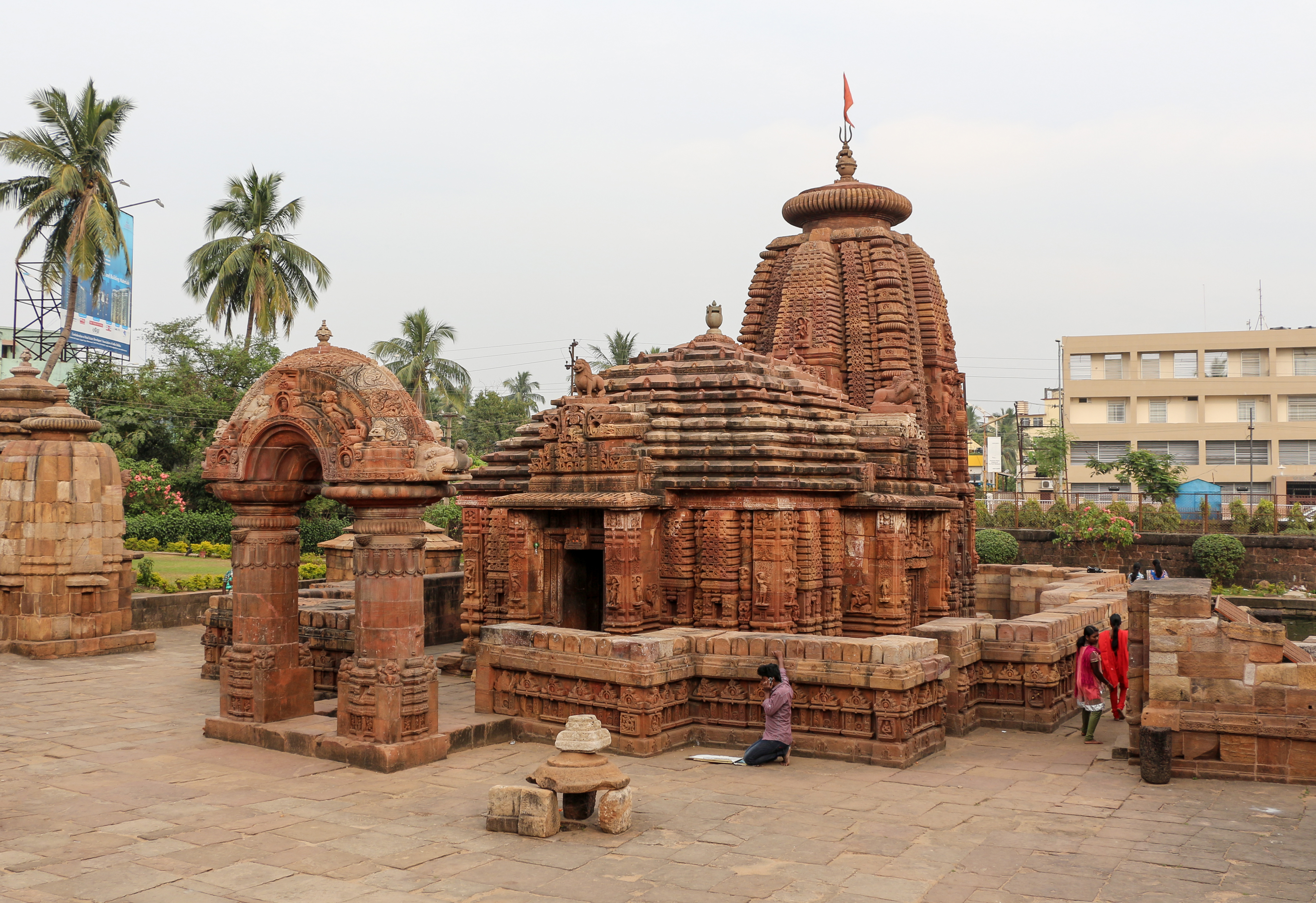
Known as the 'Gem of Odisha Architecture' for its exquisite carvings and its famous stone archway (Torana).
Lingaraja Temple
The Lingaraja Temple in Bhubaneswar, Odisha, is the largest and most magnificent temple of the Kalinga architectural tradition, dedicated to Lord Shiva as Tribhuvaneshwara.
Konark Sun Temple
A 13th-century colossal stone chariot of the Sun God Surya, the Konark Sun Temple is a UNESCO World Heritage Site and the most architecturally ambitious solar temple in India, with 24 massive stone wheels and intricate carvings depicting life, dance, and divinity.
Tarakeshwar Temple Hooghly
A massive 18th-century pilgrimage site dedicated to Lord Taraknath, especially vibrant during the Gajan festival.
Virupaksha Temple
The Virupaksha Temple in Hampi, Karnataka, is a UNESCO World Heritage Site and the oldest functioning temple in India, dedicated to Lord Shiva as Virupaksha.
Jageshwar Temple
A cluster of 124 ancient stone temples from the 7th-12th centuries, nestled in a dense deodar forest.
Neelkanth Mahadev Temple
Situated at 1,330 meters, this is where Lord Shiva is believed to have consumed the poison (Halahala) during the Samudra Manthan.
Tungnath Temple
The highest Shiva temple in the world, situated at 3,680 meters on the Chandranath Parbat; it is the 'Tritiya Kedar' in the sacred Panch Kedar pilgrimage circuit.
Rudranath Temple
One of the Panch Kedar shrines, representing Lord Shiva's face, situated at an altitude of 2,286 meters amidst meadows and rhododendron forests.
India's temples are living traditions — not museums. Every temple has its own customs. This guide helps first-time visitors prepare with confidence and respect.
Foreign Visitors
Not PermittedNon-Hindus are not permitted inside the inner sanctum. The temple complex and Rath Yatra can be viewed by people of all faiths.
Visitor Information
Entry policies vary between temples. Most temples welcome visitors, while some may restrict access to specific areas, rituals, or the inner sanctum. Always verify the latest entry guidelines with the official temple authorities before your visit.
Modest clothing is expected at every Indian temple — a sign of respect, not a restriction. Think of it as dressing for a formal ceremony.
The best time to visit Puri and the Jagannath Temple is from October to March when the weather is pleasant with temperatures between 15–28°C. This period is ideal for temple visits and exploring Puri's beach and surrounding areas. The winter months (December–February) are particularly comfortable. The Rath Yatra period (June–July) is the most significant but also the most crowded and hot, with temperatures reaching 35–40°C and humidity over 80%. Snana Purnami (June) also draws large crowds. Monsoon (July–September) brings heavy rainfall, though the temple remains open. Summer (April–May) is hot and humid but less crowded. For a meaningful visit with manageable crowds, consider November–February. The temple is open throughout the year; unlike Himalayan temples, it has no seasonal closure.
April — June
July — September
Common local languages: Odia, Hindi, English
Indian Rupees (INR). ATMs available in Puri city.
Wheelchair: Not wheelchair accessible inside the temple. Multiple steps at all gates. Rath Yatra viewing areas are ground-level.
Stay hydrated — carry a reusable water bottle, especially in hot climates.
Keep valuables secure — use hotel lockers for passports and excess cash.
Wear comfortable, sturdy footwear — temple floors can be hot, wet, or uneven.
Beware of unofficial guides or touts near temple entrances. Only use authorised services.
Carry a photocopy of your passport and visa. Leave originals in your hotel safe.
Download offline maps — mobile networks can be unreliable near remote temple sites.
These short explanations help make sense of what you see and experience.
Darshan means 'seeing' — but in a temple it means being seen by the deity. It is a sacred moment of connection, not just a viewing.
Removing footwear is a sign of humility. It also keeps the temple floor clean, since devotees sit and pray on the ground.
Food offered to the deity and then distributed to devotees. It is considered blessed. Accept it with both hands and do not discard it.
The bell creates a focused acoustic atmosphere, wards off distractions, and announces your presence before entering the inner sanctum.
Circumambulation (pradakshina) is done clockwise, keeping the sanctum on your right — an auspicious direction aligned with the sun's path.
Flowers symbolise devotion, coconuts represent the ego being broken, incense purifies the air, and lamps represent the victory of light over darkness.
Sacred viewing of the deity; the central act of temple worship.
Clockwise circumambulation of the sanctum.
Blessed food offered to the deity and distributed to devotees.
The innermost sanctum where the main deity resides.
The towering spire above the sanctum, a defining feature of temple architecture.
A pillared hall or pavilion within the temple complex.
The Indian Rupee (?, INR) is the local currency. ATMs are widely available in cities and towns. For temple offerings, keep small notes (₹10, ₹20, ₹50). Most temples accept donations in cash only — digital payments are uncommon at the offering counter itself.
Offerings (dakshina) are given with the right hand. Place cash in the donation box (hundi) or give it directly to the priest. There is no fixed amount — give what feels appropriate. Some temples have fixed fees for special entry or puja participation.
Shoes and sandals are removed before entering the temple building. Most temples have a designated shoe counter (free or a small fee of ₹5–₹20). Socks are generally allowed. In monsoon, carry a plastic bag for wet shoes.
Darshan queues can take 30 minutes to 3 hours at popular temples. Many offer paid VIP darshan (₹100–₹500) for faster entry. Special queues for women, elderly, and disabled visitors exist at some temples. No line jumping.
Major festivals draw enormous crowds — sometimes hundreds of thousands. Book accommodation months in advance. Expect road closures, restricted vehicle access, and limited phone network. Arrive early (before dawn) to avoid the worst congestion.
Always look for signage before taking photos. When in doubt, ask a priest. Never take photos of devotees in prayer without permission. Selfie sticks are banned at most temples. Silently switch your phone to silent mode.
Police / Ambulance / Fire: 112 (National Emergency Number)
Tourist Helpline: 1800-111-363 (Multi-lingual, Ministry of Tourism)
Women's Helpline: 1091
Official Temple WebsiteState Tourism WebsiteTemple-specific visitor information is continuously researched and updated from official sources. Where specific data is unavailable, general India travel guidance is provided. Always verify current policies with the temple authority before your visit.
Continue your journey through the spiritual and architectural wonders of India.

The Lingaraja Temple in Bhubaneswar, Odisha, is the largest and most magnificent temple of the Kalinga architectural tradition, dedicated to Lord Shiva as Tribhuvaneshwara.

A 13th-century colossal stone chariot of the Sun God Surya, the Konark Sun Temple is a UNESCO World Heritage Site and the most architecturally ambitious solar temple in India, with 24 massive stone wheels and intricate carvings depicting life, dance, and divinity.

The Tara Tarini Temple on Kumari Hills overlooking the Rushikulya River in Ganjam district, Odisha, is the Sthana Peetha — one of the four major ancient Shakti Peethas of India. Dedicated to the twin goddesses Tara and Tarini, the temple marks the site where the breasts of Goddess Sati are believed to have fallen. The hilltop shrine offers panoramic views of the river valley and the Bay of Bengal in the distance.

The Bimala Temple, located within the Jagannath Temple complex in Puri, Odisha, is one of the 51 Shakti Peethas where the feet of Goddess Sati are believed to have fallen. It is the only Shakti Peetha situated inside a Vaishnava temple complex. The temple's unique ritual position gives Goddess Bimala supremacy over the Jagannath Temple's food offerings — no Mahaprasad is considered consecrated until it has been first offered to her.
"The Jagannath Temple in Puri is famous for its annual Ratha Yatra, where three massive wooden chariots are pulled by thousands of devotees."