King Harsha of Kashmir and the Temple Looting Crisis of 1089–1101 CE
Kalhana's account of a king who stripped the shrines of Kashmir of their wealth, their endowments and their images — the financial crisis behind it, the officer appointed to carry it out, and the three explanations that have been offered for it since.
Published
11 October 2026
Last reviewed
11 October 2026
Reading time
21 min read
Evidence base
One chronicle, two English translations, modern scholarship
What this guide establishes
- Everything known about Harsha's temple looting comes from one literary source: Book VII of Kalhana's Rājatarangini, composed around 1148–50 CE. No inscription, coin or excavation recording the episode is cited in any source consulted for this page.
- The chronicle itself gives a financial cause. Verse VII.1089 links the policy directly to extravagant expenditure on the army, and the discovery of a hoard inside the long-closed Bhimeshvara temple at Udabhanda is what showed the king where the money was.
- The sequence matters: temple endowments first, then temple treasuries, then the metal images themselves. An officer named Udayaraja was appointed to the office of devotpātananāyaka - the prefect for the overthrow of divine images.
- Two Hindu images, Ranasvamin and Mārtānda, and two colossal Buddhas were spared by petition. Kalhana also calls Harsha 'that Turushka, king Harsha', a label that has been read as proof of Islamic influence and rebutted as inconclusive in the same scholarship.
A treasury problem, a chronicle, and a king named for it
In 1089, a young prince of the Lohara family seized the throne of Kashmir after a reign of twenty-two days by his half-brother. Twelve years later he was dead, killed in a rebellion with his head cut off and his body cremated by a wood-dealer. Between those two points, the royal chronicler Kalhana says, he stripped the temples of the valley of their endowments, then their treasuries, then their images — and appointed a named officer to do it.
This page follows that account through Book VII of the Rājatarangini and then does the part that most retellings skip: it separates what the chronicle reports, what the translators and scholars inferred, and what is still argued about. A claim made by Kalhana is labelled as Kalhana's. A claim made by Aurel Stein in 1900 or A. L. Basham in 1948 is labelled as theirs. Nothing is upgraded from one category to the other.
The subject needs that care because it is politically live in a way that few eleventh-century episodes are. Harsha is regularly produced as evidence that Indian kings destroyed temples before Islam arrived, and just as regularly reinterpreted as a ruler who had gone over to the other side. The verses do not support either conclusion without a good deal of added argument, and the added argument is what this page examines.
The chronicle, the king, and the policy
Sections 01 to 06 stay inside the twelfth-century record. What Kalhana wrote, how Harsha took the throne, the money problem, and the sequence of the confiscations.
What Kalhana wrote, and when
The Rājatarangini — the River of Kings — is a Sanskrit chronicle of Kashmir in eight books. The seventh book covers the second Lohara dynasty, and Harsha rules it from verse 873 to the end of the book. Kalhana began the work's introduction in 1148–49 CE and completed the poem the following year, which places the whole composition within about fifty years of Harsha's death in 1101.
That proximity is unusually good for a medieval Indian history, and Stein argues it is better still. Kalhana's father, Campaka, appears in the chronicle as one of the chief officials under Harsha — as lord of the Gate on the Darad frontier shortly before 1099, and among the last officials to stand by the king at the end. Kalhana also cites testimony of people still alive at the time of writing for the execution of 1095. A reader is therefore dealing with a family tradition, not a fabrication.
It is still one source. The chronicle is a poem with a strongly held moral view of kingship, and it is the only witness to this episode among everything consulted for this page. The honest form for almost every sentence below is: Kalhana reports that …
How Harsha took the throne, 1089
King Kalasha died at Martanda in 1089 while Harsha, his son by a different mother, was a prisoner. Kalasha had spared Harsha's life but had arranged for his own younger son Utkarsa to be brought up from Lohara for the succession. Utkarsa was crowned, kept Harsha imprisoned and refused him permission to leave the country. The half-brother Vijayamalla then raised a rebellion in the capital, and Harsha used the confusion to escape and seize the throne he could claim by right. Utkarsa's reign had lasted twenty-two days. He was twenty-four years old and cut his arteries in captivity.
So the reign that follows begins in violence, and Kalhana introduces it with a verse of deliberate double judgement. A reign, he asks, which shows excessive assertion of power and yet excessive disregard of orders; excessive liberality and equally excessive persistence in confiscation; compassion and murders, pious works and sins — which is to be blessed and condemned, worth remembering and worth forgetting (VII.873). That balancing verse is the frame the chronicle puts around everything that follows, and it is a better guide to how the source should be read than any single accusation inside it.
The rest of the reign is a series of conspiracies: Vijayamalla plotting against the brother who had just been freed, ministers removing rivals, and relatives executed in 1095. Kalhana's portrait of a court at war with itself is the setting in which the temple policy appears.
The money problem
Stein's introduction states the fiscal background in one sentence: extravagant expenditure on the troops and senseless indulgence in costly pleasures gradually involved Harsha in grave financial troubles, and from these he endeavoured to free himself by ruthless spoliation of sacred shrines. Kalhana's own verse says the same thing more compactly at VII.1089: the king, who had grown used to expenditure on the different departments of the army, fixed his mind, for the sake of its efficiency, on robbing the properties of the gods.
The army is the constant. Kalhana describes Harsha's court as splendid, his coinage abundant — at VII.950 he notes that gold and silver money were plentiful in the land while copper money was rare — and his government as one that invented offices to extract cash. Later verses list new imposts, a minister charged with confiscating temple villages, and, at VII.1107, a prefect of night soil created simply because money had to come from somewhere.
It is worth being precise about the status of this explanation. It is Kalhana's causal claim, offered by a writer who believed that a king's finances and a king's morality were the same subject. There is no treasury record, no budget, and no independent figure for the shortfall. What can be said is that the chronicle's explanation for the looting is economic from beginning to end, and that the religious readings were supplied later, by readers.
The locked temple at Udabhanda
Kalhana tells the story of how it started in two movements, and both are worth following because they show the policy arriving through argument rather than decree. First, at VII.1073–1079, a courtier urges the king to take the gold from the dome of the Kalasekhara shrine in Srinagar. The pious counsellor Prayaga stops it. The king's adviser Lostadhara then proposes seizing the shrine's endowed villages and using the stones of the temple to build a bridge over the Vitasta. Prayaga stops that too. The one act of demolition proposed in the entire passage is the one the chronicle records as having been prevented.
The second movement, VII.1080–1086, is the discovery. At Udabhanda there stood a Bhimeshvara temple founded by Bhima Sahi, which had been shut since the reign of Kalasha because of a quarrel among the priests. Lostadhara reframes the closure: the god is a prisoner, the treasure inside is liable to be stolen by thieves, and opening the shrine would release the one and rescue the other. The king acts on it and comes away with a treasury of precious stones, gold and other valuables.
The result is the verse that sets the whole episode in motion. When there is such stuff in a deserted shrine, Harsha wonders, how much more must there be in the other rich temples of the gods (VII.1087)? The chronicle is explicit that from this point the treasure carried away from the shrines of the gods was treasure granted by former kings, and that the images followed the treasury because the images were made of metal.
From treasuries to images, and the office that did it
The three-step sequence is set out in three verses. At VII.1089 the king turns his mind to robbing the properties of the gods. At VII.1090 he carries away the treasures granted by former kings from all the shrines. At VII.1091, once the treasure has been seized, he appoints Udayaraja to remove the images themselves.
Both standard English translations agree on that name and on the title of the office. Stein renders it: he appointed Udayaraja 'prefect for the overthrow of divine images' (devotpātananāyaka). R. S. Pandit renders the same verse: to remove the images of the gods he appointed one Udayaraja, 'officer for uprooting the gods'. Basham, who is careful about this passage, repeats it in both his 1948 article and his 1951 study: the work of temple-looting was carried out so thoroughly that Harsha appointed a special official as superintendent of the destruction of the gods.
The office is the detail that has convinced most readers that this was a policy rather than a series of robberies. Kalhana returns to the title later, at VII.1641, and Stein notes in his commentary that it is uncertain whether devanayaka there is a proper name or an ironical designation of Udayaraja, and that Udayaraja is not mentioned again afterwards. A named official, appointed to a named function, then dropped from the record.
What the verses actually describe
The verses that follow VII.1091 are the ones usually quoted, and they are graphic on purpose. Kalhana says that ordure and urine were thrown on the faces of the images by naked wanderers whose noses, hands and feet had rotted (VII.1092); that statues of gold, silver and other metals rolled along the roads like bundles of firewood, even in excrement (VII.1093); and that images roped at the ankles were dragged and covered with spittle instead of flowers by the maimed and the lepers (VII.1094).
Then comes the sweeping claim. In village, town or Srinagar, Kalhana writes, there was not one temple which was not despoiled of its images by that Turushka, king Harsha (VII.1095). This is a universal statement by a chronicler, not a count, and no number of temples destroyed or images melted is given anywhere in the passage. A page that says Harsha destroyed forty temples, or every temple, is adding a figure the source does not have.
The defilement has attracted more interpretive effort than anything else in the passage, because it is the part least easily explained by a shortage of money. You do not need to contaminate an image in order to melt it. Stein treated the fact as evidence of a further motive; Basham treated it as the key to a specific hypothesis, developed in section 10.
The evidence, claim by claim
Every claim commonly attached to this reign, with what kind of support it actually has. This table is the reference point for Sections 11 and 12.
| Claim | Standing | What supports it |
|---|---|---|
| Harsha seized the temple treasuries of Kashmir and then the metal images | Established | Reported continuously at VII.1087–1098 by a chronicle written about fifty years later, from a family close to the reign, and treated as historical in Stein, Basham and all subsequent scholarship consulted here. |
| He reigned from 1089 to 1101 CE and died aged forty-two | Established | Given in Stein's introduction and confirmed by the chronicle: slain on the fifth day of the bright half of Bhadrapada, 1101, in his forty-second year (VII.1717 records forty-two years and eight months). |
| An official named Udayaraja was appointed devotpātananāyaka | Reported | VII.1091, in both English translations and in Basham's account. It rests on the chronicle alone; no inscription or other record of the office is cited in any source consulted here. |
| Only four large images were spared: Ranasvamin, Mārtānda and two Buddhas | Reported | VII.1096–1098. Kalhana is specific about the exceptions, which is why the detail carries weight — but it is still one writer's account. |
| The motive was fiscal: army expenditure and the need for cash | Established | Stated by the chronicle itself at VII.1089 and repeated in Stein's introduction and in Pandit's commentary, who compares it with the confiscation of church property by later Byzantine emperors. |
| The images were melted down for their metal | Reported | Basham's reading of the sequence — treasuries first, then images in order to possess the valuable metal — and the natural implication of VII.1093, which describes metal images as bundles of firewood. The verses describe removal and defilement; they do not use the word melting. |
| Harsha was a Muslim, or was acting under Islamic influence | Disputed | Stein suggested it in a footnote and in his introduction. Basham examined the same two verses and called them inconclusive, arguing that VII.1095 is metaphorical and that VII.1149 shows Harsha eating pork despite his Turkish captains. No conversion or profession of faith is reported anywhere in the sources consulted. |
| Harsha destroyed the temple buildings themselves | Disputed | Not supported by this passage. VII.1075–1079 reports a plan to use the Kalasekhara temple's stones for a bridge and records that Prayaga stopped it. The verses describe the seizure of endowments, treasuries and images. |
| A number of temples destroyed, or a total of images taken | Disputed | No figure appears in the sources. VII.1095 is a universal statement rather than a tally, and any specific count that circulates online is an addition to the record. |
| An inscription or excavation records the confiscations | Disputed | None is cited in any source consulted for this page. The evidence is literary, from a single chronicle. |
How the labels are applied
Established claims are supported by more than one kind of evidence or carry no significant dissent in the modern historiography. Reported claims rest on a named source and have no independent confirmation. Disputed claims circulate widely and are not found in the sources consulted here, or are contradicted by them. Nothing on this page is presented as established on the strength of a chronicle verse alone.
What the episode has been taken to mean
Sections 07 to 12 follow the exceptions, the wider revenue machine, the word Turushka, and the three explanations that have been offered since 1900.
What was spared, and why the exceptions matter
Kalhana names four survivals. In Srinagar there was the illustrious Ranasvamin; among the towns, the god of Mārtānda (VII.1096). Then two colossal statues of Buddha: one at Parihasapura, saved by the singer Kanaka, who was born there, and the other in the city, saved by the shramana Kusalasri (VII.1097–1098).
The circumstances are the interesting part. Both Buddha images were saved by petition, at a moment when the king was in a liberal mood and dispensing favours. The exceptions were not exemptions written into a policy; they were granted individually, on request, by the man carrying the policy out. That tells you the looting was administered rather than frenzied, and that a refusal was possible.
It also complicates the religious readings of the episode in both directions. A ruler carrying out a sectarian program would have had no reason to spare a Buddhist image at Parihasapura and another in the capital, and equally little reason to spare Mārtānda, the great sun temple of Lalitaditya that still stands in the valley today. Basham, who takes the episode very seriously, notes the same point when he argues that the defilement must have had a motive other than poverty.
Stein's introduction adds the identity that makes the detail matter. The Kanaka who saved the Buddha at Parihasapura was a younger brother of Campaka - that is, Kalhana's uncle - a singer who had taught the music-loving king, received from him a lakh of gold coins, and retired to Benares after Harsha's death. From the mention of Parihasapura as Kanaka's birthplace, Stein infers that the town was the original home of Kalhana's own family, and adds that it is difficult to avoid the conclusion that Kanaka was personally connected with Buddhist worship. One of the four exceptions, on this reading, was saved by a man from the chronicler's household.
One further image belongs to the story's edge. At VII.1344, in the years of famine and rebellion that closed the reign, Kalhana records that the great silver image of Parihasakesava at Parihasapura — set up by Lalitaditya and described in Book IV as containing 84,000 palas of silver — was broken up. Images that were saved in 1095 were not necessarily saved in 1100.
Beyond the images: how the cash was actually raised
The image confiscations are the memorable part of the reign, but the chronicle spends more verses on ordinary extraction. At VII.1102 wicked ministers obtain the royal consent and appoint officers under a series of ever-fresh imposts. At VII.1103–1104 the aged and otherwise respectable minister Gauraka accepts, on the king's orders, the office charged with confiscating the villages and the entire property of all the temples of the gods — Pandit renders the title as prefect of wealth.
At VII.1105–1106 Sahelaka, a former member of the priests' conclave at the Samarasvamin temple who had become a royal favourite, buys his promotion by promising to realise double the income. And at VII.1107 the sequence reaches its natural end: the king, extorting money universally through every kind of prefect, appointed even a prefect of night soil in order to get money.
Placed beside the temple verses, these give the policy a shape. Temples were one asset in a wider fiscal squeeze that also hit villages, temple endowments, households and the Damaras, the landed aristocracy whose rebellion eventually brought Harsha down. Pandit's own note on the passage compares the episode with the confiscation of church property by some later Byzantine emperors, and observes that in both cases financial difficulties led to the spoliation. The comparison is a translator's gloss from 1935, not a source — but it shows how quickly a financial reading comes to hand.
The word Turushka, and what it does not prove
Two verses carry the word. At VII.1095 Kalhana writes that not one temple in village, town or Srinagar was left despoiled of its images by that Turushka, king Harsha. At VII.1149, in the middle of a catalogue of the king's private misconduct, he writes that Harsha continually supported the Turushka captains of hundreds with money, and that this perverse-minded man, until his death, ate domesticated pigs.
Stein's note on the first verse is where the modern argument begins. Harsha, he writes, on account of his procedure against sacred images, may well be called a Turushka, that is, a Muhammadan; but may not the use of this epithet, together with his iconoclasm, be taken as an indication of Harsha's leanings towards Muhammadanism? His introduction presses the same question — whether the king was instigated or encouraged by the steady advance of Muhammadanism in the neighbouring territories — and notes that Kalhana later refers to Turushka captains in the army who enjoyed his favour.
Basham took those two verses apart in 1951 and called them inconclusive. The first, he argued, employs the word metaphorically: Kalhana was writing when the memory of Mahmud's pillage of Hindu and Buddhist temples was still fresh, and the epithet borrows that association. The second merely states that Harsha was not affected by Islam, at least in diet, despite his Turkish mercenary officers. He adds a further point about the men who carried out the defilement: Muslims have never held that nudity is necessary for salvation, so the naked wanderers of VII.1092 and VII.1094 cannot have been Muslims.
The careful conclusion is narrow. The epithet tells you how a twelfth-century Brahmanical chronicler chose to characterise a king he considered corrupt; it does not record that king's religion, and no source consulted for this page reports a conversion, a creed or an act of worship by Harsha of either kind. Readers who want the opposite reading should know that it rests on a footnote, a suggestion in an introduction, and the contested word itself.
Online discussion consulted
- r/IndianHistory - are there other Hindu kings credited with destroying temples? (verified reachable) — Content rendered client-side; cited as an example of the current online debate, not as evidence.
- Sarai reader-list - annotations to the history of iconoclasm in Kashmir (verified reachable) — Discussion-list essay quoting Pandit's translation of VII.1089–1095 and arguing against reading Turushka as Muslim.
- Sarai reader-list - iconoclasm in Kashmir: motives and magnitude (verified reachable) — Opposing discussion-list essay reproducing Stein's introduction; cited as discourse, not as scholarship.
- Pragyata - Harsha of Kashmir, a Hindu iconoclast? (verified reachable) — Popular polemical reading of VII.1095 and VII.1149; named as an example of the modern argument, not relied on.
Three explanations, on the table
The first explanation is the chronicle's own: money. A king who had built an expensive court and an expensive army ran short, found a locked temple full of gold, and then went looking for the rest. This reading needs no speculation at all, because Kalhana states it at VII.1089 and builds the narrative around it, and it is the reading that both modern summaries consulted here — Stein's introduction and Pandit's commentary — begin with.
The second is Basham's, and it is the most ambitious. In his 1948 article Harsa of Kashmir and the Iconoclast Ascetics, and again in the appendix to his History and Doctrines of the Ajivikas, he argues that the naked, maimed wanderers employed to defile the images were not soldiers or slaves but a group of iconoclast ascetics, possibly Ajivikas from the Deccan. He builds the case from their nudity, from the deliberate pollution rather than simple removal of the images, from Harsha's well-attested southern connections, from the disappearance of the seated goddess from the king's coinage, and from the name of the king's adviser Lostadhara, which he connects with an initiatory ordeal.
Basham is explicit about the weight of that evidence. We cannot claim, he writes, that these resemblances finally prove the identity of Harsha's naked wanderers and the Ajivikas; but, he asks, if they were not Ajivikas, what were they? It is a hypothesis built from accumulated weak indicators, offered by a scholar who could have taken the easy route and did not.
The third explanation is religious influence from outside: Stein's suggestion that the advance of Islam in the neighbouring territories may have encouraged the policy. It has been repeated in a great deal of popular writing since, sometimes stated as fact. On the evidence assembled here it remains a question posed in a footnote, and the only scholar consulted who tested it against the verses concluded that they are inconclusive.
What cannot be claimed
Five limits, stated plainly. No source consulted for this page says that Harsha was a Muslim, or records his conversion. The epithet Turushka is contested within the scholarship itself and is not a confession of faith. No figure for the number of temples, images or valuables exists in the chronicle: VII.1095 is a universal claim, not a tally. No inscription, coin or excavation is cited as recording the episode. And the passage describes the seizure of endowments, treasuries and images, not the demolition of temple buildings — the single proposal to pull down a shrine, in VII.1075–1079, is reported as having been stopped.
Two further habits are worth naming. The first is merging Harsha's looting with later, better-attacked destructions under the Delhi sultanate or the Mughals, as though a continuous policy ran from 1090 to 1700. The chronicle itself does not say that, and the events are separated by centuries, dynasties and entirely different motivations. The second is the reverse move: dismissing the episode because it comes from a hostile chronicler. Kalhana had every reason to condemn Harsha and none to invent the fiscal detail, the named office or the four exceptions — all of which make his case harder, not easier.
Nothing above diminishes what the chronicle describes. A government did strip the shrines of Kashmir of their endowed villages, their stored wealth and their metal images, and did it through a named office over a period of years. That is a serious act of despoliation against Hindu and Buddhist sacred art alike, and it is documented by the only witness that exists.
How to read this, and where the story ends
The labels used in the table above are the ones used across this site. Established means the claim is supported by more than one kind of evidence, or is accepted across the modern historiography without significant dissent. Reported means a named source says it and no independent confirmation exists. Disputed means the claim circulates widely and is not found in the sources consulted here, or is contradicted by them.
The reign ends quickly after the spoliation. Harsha's persecution of the Damaras and his fiscal exactions produced a rebellion under Uccala and Sussala, relatives from a side branch of the Lohara family. He fled Srinagar in the autumn of 1100, wandered, and was finally surrounded in the hut of an ascetic. He and Prayaga were slain fighting on the fifth day of the bright half of Bhadrapada, 1101, in his forty-second year. His head was cut off and burned on Uccala's orders; his body, naked like a pauper's, was cremated by a wood-dealer.
Kalhana's closing judgement is the sentence that ties the reign together. Then, he writes, commenced in this land the new fashion of cutting off the king's head, just as the destruction of the divine images had begun in Harsha's reign (VII.1724). The two acts are set side by side not as a coincidence but as a matched pair of symptoms: a country that treated its images and its kings as objects to be broken had, in the chronicler's view, lost something it could not get back.
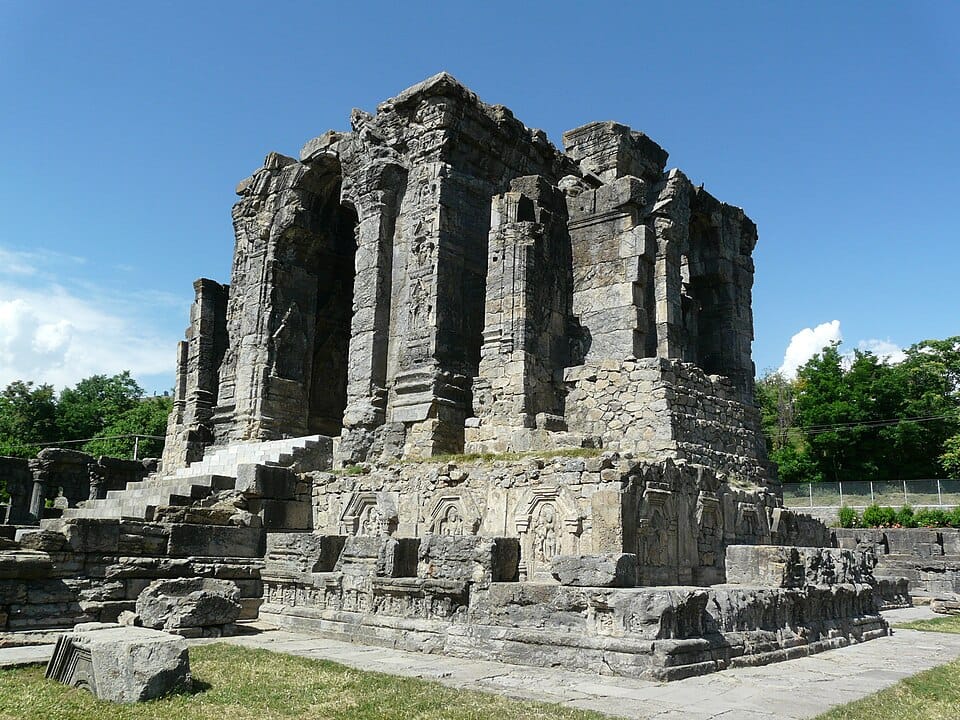
For a visitor, Mārtānda is the tangible link. The great sun temple of Lalitaditya, spared in the looting of the 1090s, is a ruin in the valley today. It is possible to stand inside it and read the verses that say it was one of the two shrines Harsha left alone.
Where the sites are
Mārtanda, the sun temple that Kalhana names as one of the two Hindu images Harsha spared, stands above the Kashmir valley and is managed as a protected monument. Parihasapura, where Kanaka saved the other Buddha, was already deserted and its temples in ruins by Kalhana's own time — one reason the chronicler's knowledge of that neighbourhood reads as local.
Method, and what was left out
Every historical statement on this page is traceable to one of the sources in the bibliography at the foot of the page, and the bibliography records what each source was used for. Where two translations of the same verse differ — over the rendering of the office held by Udayaraja, over the sense of VII.1089 — both are given and the difference is named rather than resolved by preference.
Several things were deliberately not written. No dialogue, scene or private conversation has been invented: where the chronicle puts words into someone's mouth, the verse is cited so that the reader can see it is reported speech. No number of temples, images or valuables is given, because none is given in the source. Harsha is never described as a Muslim, because no source consulted here says he was, and the contested epithet is discussed rather than resolved.
Sources that could not be verified during research are named rather than cited. Chitralekha Zutshi's 2011 article on the translating of the Rājatarangini is listed in the bibliography through its DOI, which resolves to the publisher record; the full text sits behind a paywall and was not read, so nothing on this page is attributed to it.
Questions this guide answers
Who was King Harsha of Kashmir?
Harsha, also written Harsa or Harsadeva, ruled Kashmir from 1089 to 1101 CE. He belonged to the Lohara family, took the throne after the brief twenty-two-day reign of his half-brother Utkarsa, and is the central figure of the seventh book of Kalhana's Rājatarangini. He was about forty-two when he was killed in 1101 during the rebellion of Uccala and Sussala. His reign is remembered above all for the confiscation of temple wealth and sacred images described in verses VII.1073 to VII.1107 of the chronicle.
Why did Harsha loot the temples?
Kalhana's account gives a financial reason and attaches it directly to the policy. 1089 says the king, addicted to extravagant expenditure on the various corps of his army, turned his mind to robbing the properties of the gods. 1080-1087), which showed him how much must be held in other shrines. His counsellor Lostadhara is named as the adviser who proposed the looting.
Modern writers have added two further readings - an ascetic, iconoclast influence and an external religious one - but the motive stated by the chronicle itself is money.
Which temples did Harsha spare?
Two Hindu images and two Buddhist ones. Kalhana names the illustrious Ranasvamin in Srinagar and the god of Martanda among the towns (VII.1096), then two colossal statues of Buddha - one at Parihasapura, saved by the singer Kanaka, and one in Srinagar, saved by the shramana Kusalasri (VII.1097-1098). All four were saved by personal petition at a moment when the king was dispensing favours, which is why the exceptions matter: they show that the spoliation was selective, negotiated and reversible, not a blanket demolition.
Did Harsha destroy the temples themselves, or take the images?
The passage in question describes the seizure of temple endowments, then temple treasuries, then the metal images themselves - carried off, defiled and, in Basham's reading, melted for their gold, silver and other metals. The one proposal to demolish a shrine for building material - using the stones of the Kalasekhara temple to build a bridge over the Vitasta - is reported as having been stopped by the counsellor Prayaga (VII.1075-1079). Nothing in this passage of the chronicle describes the tearing down of temple structures, and this page does not claim otherwise.
Was Harsha a Muslim king?
No source consulted for this page reports that he was. 1095, and Aurel Stein glossed the word as 'Muhammadan' while asking whether the epithet indicated Islamic leanings. A. L.
Basham examined the same two verses and called them inconclusive: the first, he argued, is used metaphorically by a writer who had the memory of Mahmud's pillage still fresh, and the second records that Harsha went on eating pork despite his Turkish mercenary captains. The label is evidence about how the chronicler framed him, not a record of his religion.
What does Turushka mean in the Rājatarangini?
Turushka is the Sanskrit form used in the chronicle for Turks, and in later usage it could carry the sense of Muslim. Two verses are relevant. 1095 Kalhana says that not one temple in village, town or Srinagar was left despoiled of its images 'by that Turushka, king Harsha'. 1149 he says the king continually supported Turushka captains of hundreds with money and yet, until his death, ate domesticated pigs.
Read together they have been taken both as proof of Islamic influence and as proof that the king was personally unaffected by Islam; the verse and the scholarship are set out in section 09 of this page.
How do we know any of this happened - is there an inscription?
The account is literary. It rests on one chronicle, Kalhana's Rājatarangini, composed around 1148-50 CE, roughly fifty years after the events. None of the sources consulted for this page points to an inscription, coin or excavation that records the confiscations.
That does not make the account doubtful in its essentials - Kalhana's father Campaka served as an official under Harsha, and the chronicler cites living witnesses for events of the 1090s - but it does mean that everything here should be read as what a named source reports rather than as what an independent record confirms.
What happened to Harsha in the end?
He lost the throne to a rebellion of his own Damaras and relatives. Uccala and Sussala rose against him, he fled Srinagar in the autumn of 1100, and he was killed fighting on the fifth day of the bright half of Bhadrapada, 1101 CE, at the age of forty-two, together with his loyal attendant Prayaga. His head was cut off and burned on Uccala's orders, and his body was cremated by a wood-dealer.
Kalhana closes by noting that the fashion of cutting off a king's head began in this land just as the destruction of the divine images had begun in Harsha's reign.
Keep reading
Jammu & Kashmir
Vaishno Devi, Amarnath, the Martand sun temple and the Shankaracharya shrine, with the valley's own chronology.
Open the guide Research & GuidesSomnath 1025–26
The other side of the same question: an eleventh-century attack on a temple, and the two reconstructions that followed it.
Read the guide Research & GuidesBack to all research
Every long-form guide, from temple chronology to architectural classification.
All guidesReviewed 11 October 2026 against Kalhana's Rājatarangini as translated by Stein and by Pandit, Basham's 1948 article and 1951 study, and the modern literature on the chronicle.
Verse numbers follow Book VII of the chronicle; where a translation differs, both readings are named at the point they are used.
Corrections are welcome via the contact page; sources that could not be verified are named rather than cited.