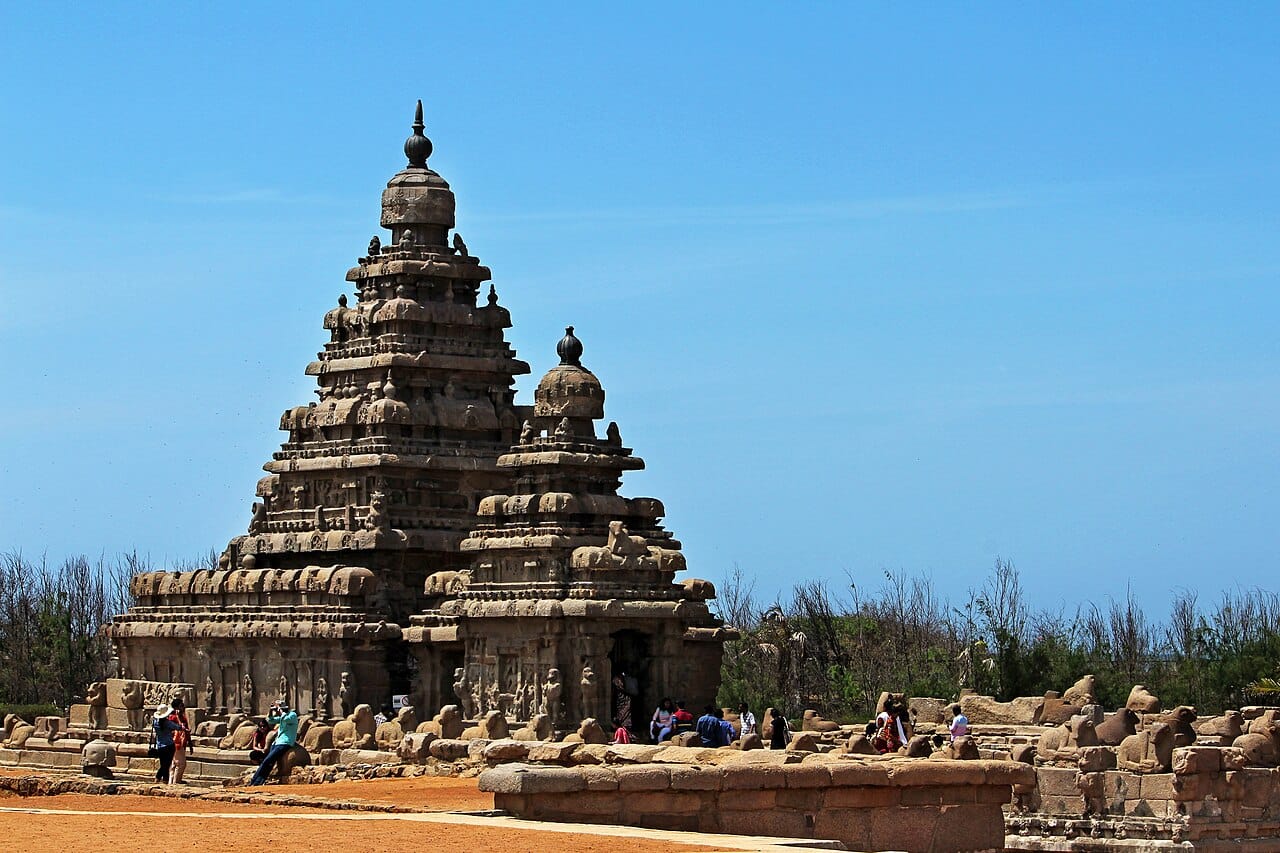
Official sources describe Pallava architecture in phases. UNESCO and ASI divide the monument programme at Mahabalipuram into five categories — mandapas (rock-cut caves), rathas (monolithic), rock reliefs, structural temples and excavated remains — and ASI credits the structural architecture to Rajasimha "on a grand scale," culminating in the Shore Temple.
Note one honest wrinkle: UNESCO's dossier attributes the cave tradition at Mahabalipuram to Mamalla, while ASI assigns the Adiranchanda caves to the Mahendra period — the two official pages draw the Mahendra/Mamalla boundary differently.
The cave phase. Rock-cut pillared halls excavated into rock faces replace perishable construction; Mahendravarman I is the patron Britannica associates with this innovation, and examples cluster around Kanchi and the Coromandel coast.
** At Mamallapuram, ASI records nine monolithic temples cut from living boulders, of which the best known are the Five Rathas, "known after the famous five Pandava brothers" — a local naming convention, not a Pallava inscription. ASI's plans: Dharmaraja, Arjuna and Draupadi are square; Bhima (and Ganesa) rectangular; Nakula-Sahadeva apsidal, a shape ASI says "indicate[s] the experimental tendency of the architect." Each is "hewn out of a huge boulder."
The open-air bas-reliefs belong to the same phase: UNESCO dates the four reliefs at Mamallapuram to Mamalla's reign, and the Ministry of Tourism measures the Descent of the Ganges / Arjuna's Penance at about 100 feet long and 43 feet high, with over 100 sculptures readable either as Arjuna's penance or Bhagiratha's descent of the Ganges.
** UNESCO: "King Rajasimha introduced structural architecture on a grand scale," the earliest and most modest being the Mukundanayananar temple, "followed by the Olakkanesvara temple … culminating in … the Shore temple." ASI documents the Shore Temple as a complex of three shrines — Rajasimhesvara, Kṣatrīyasiṁheśvara, and the Vaishnava NṛpatiSiṁha-Pallava-Viṣṇugṛha with its reclining Vishnu — enclosed by two prākāra walls.
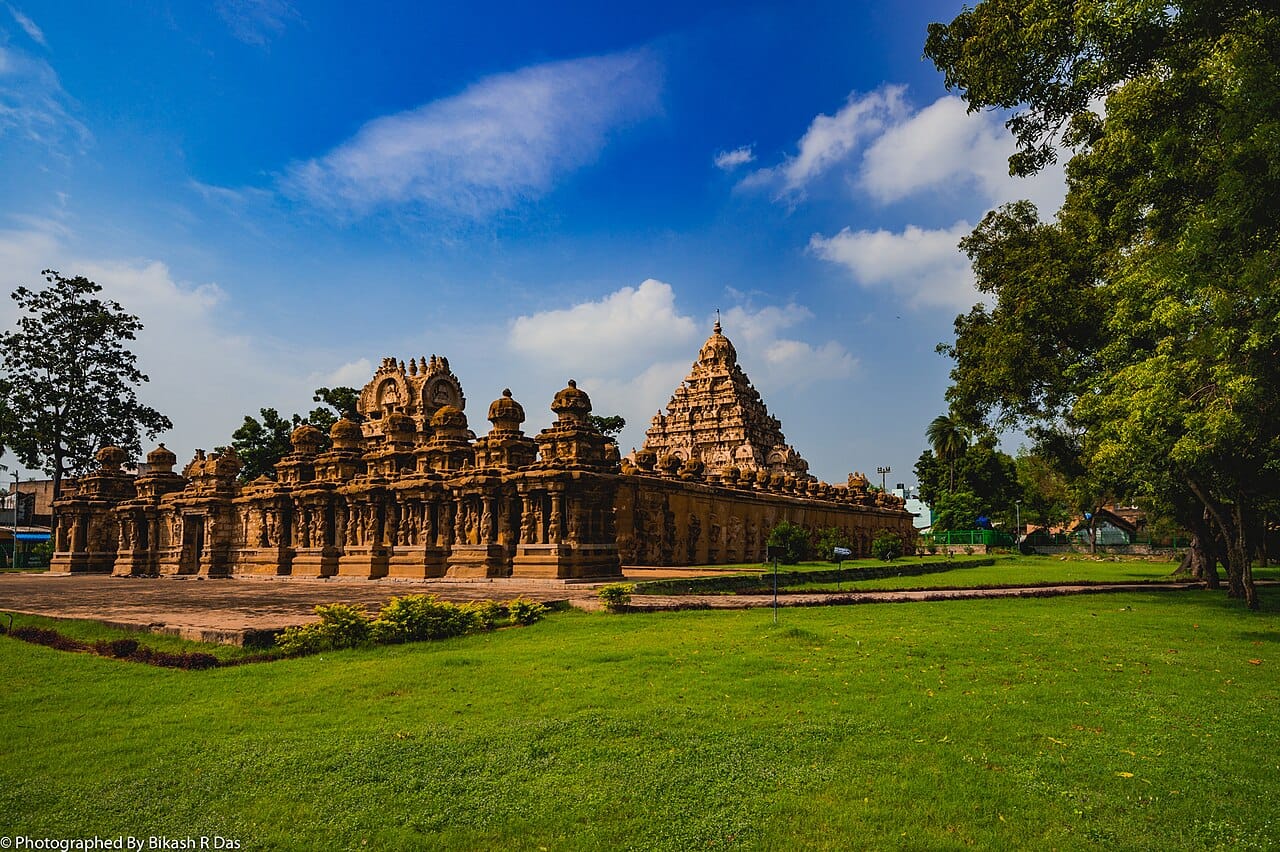
At Kanchi, Tamil Nadu Tourism dates the Kailasanathar to "around 700 CE by Narasimhavarman II": sandstone on granite foundations, a four-storey vimana, 58 small perimeter shrines, a 16-sided black-granite linga, and "some of the first mural art works in Tamil Nadu."
** UNESCO's criterion (ii) wording is the careful formulation to remember: "The influence of the sculptures of Mahabalipuram, characterized by the softness and suppleness of their modelling, spread afar to places such as Cambodia, Annam and Java." Britannica adds that Pallava rule was "marked by commercial enterprise and a limited amount of colonization in Southeast Asia."
What no source opened for this page supports is a claim that Pallava scripts directly generated the Khmer, Cham or Javanese writing systems — the documented link is artistic and commercial, as UNESCO and Britannica state it.