UNESCO 1992CambodiaVishnu
Angkor Wat
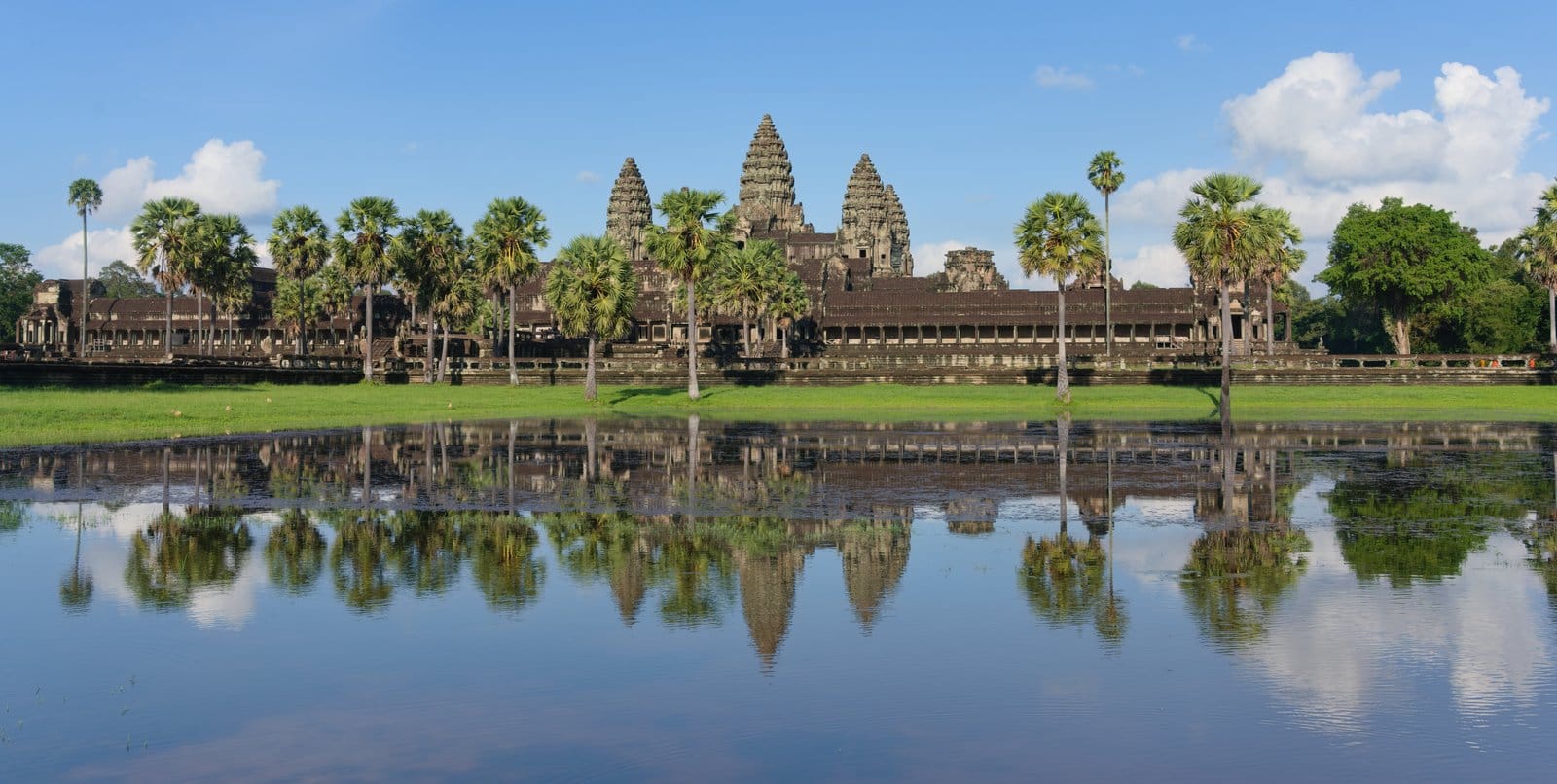
The largest religious monument in the world, Angkor Wat is a 12th-century Khmer temple complex in Cambodia originally dedicated to Vishnu and now a UNESCO World Heritage Site.
Siem Reap, Cambodia Vishnu Built: 1113–1150 CE
Share
Overview
Angkor Wat is the largest religious monument on earth, a temple complex spanning 162.6 hectares (402 acres) that stands as the supreme achievement of Khmer architecture and the enduring symbol of Cambodia. Built in the early 12th century during the reign of King Suryavarman II, Angkor Wat was originally constructed as a Hindu temple dedicated to Vishnu, the preserver god in the Hindu trinity. The temple's name translates from Khmer as 'City of Temples' or 'City of Pagodas.'
The temple is a microcosm of the Hindu universe in stone. Its central five towers represent the five peaks of Mount Meru, the mythical home of the gods in Hindu cosmology. The vast moat represents the cosmic ocean, and the concentric walls represent the mountain ranges that surround Meru. Every architectural detail, from the bas-reliefs to the tower proportions, follows a precise cosmic symbolism that transforms the temple into a three-dimensional representation of the Hindu cosmos.
Angkor Wat is unique among Angkor's temples for its westward orientation. While most Khmer temples face east, Angkor Wat faces west, aligning with Vishnu's association with the western direction. This orientation has led scholars to suggest that the temple may have also served as Suryavarman II's funerary temple. The monument's perfect symmetry, harmonious proportions, and exquisite bas-reliefs have made it among the most celebrated architectural achievements in human history.
Quick Facts
Deity
Vishnu
Location
Siem Reap, Cambodia
Built
1113–1150 CE
Built By
King Suryavarman II
UNESCO
1992
Coordinates
13.41, 103.87
Timings
5:00 AM – 5:30 PM daily (sunrise entry from 5:00 AM, temple closes at 5:30 PM)
Entry Fee
1-day pass: USD 37, 3-day pass: USD 62, 7-day pass: USD 72
History
Angkor Wat was constructed under the patronage of King Suryavarman II (reigned 1113-1150 CE), among the most powerful monarchs of the Khmer Empire. Suryavarman II reunified Cambodia after a period of civil war and expanded Khmer territory into what is now Thailand, Laos, and southern Vietnam. He was a devout Vaishnavite, one of the few Khmer kings to elevate Vishnu above Shiva, and Angkor Wat was his greatest legacy.
Construction is estimated to have taken approximately 30 years, requiring the labor of thousands of workers, artisans, and engineers.
Following Suryavarman II's death, Angkor Wat gradually transitioned from a Hindu temple to a Buddhist one. In the late 13th century, it was converted into a Theravada Buddhist monastery, and it has remained a Buddhist place of worship to the present day. Unlike many other Angkor temples that were abandoned to the jungle, Angkor Wat was never completely deserted. It was maintained by Buddhist monks who continued to inhabit the complex, which explains its relatively excellent state of preservation.
The temple was 'rediscovered' by the Western world through the writings of Portuguese traveler António da Madalena in 1586 and later through the detailed accounts of French naturalist Henri Mouhot in 1860. However, the temple had never been truly 'lost' — it was continuously known to Khmer and Thai peoples. The site became a focus of French colonial archaeology in the early 20th century, with major restoration efforts undertaken by the École Française d'Extrême-Orient (EFEO).
Angkor Wat was declared a UNESCO World Heritage Site in 1992.
Historical Timeline
1113 CE
Construction Begins
King Suryavarman II ascends the throne and commissions the construction of Angkor Wat as his state temple and funerary temple.
1150 CE
Temple Completion
After approximately 30 years of construction, Angkor Wat is completed, becoming the largest religious monument in the world.
Late 13th Century
Conversion to Buddhism
Angkor Wat gradually transitions from a Hindu temple dedicated to Vishnu to a Theravada Buddhist monastery.
1992
UNESCO World Heritage Site
Angkor Wat is declared a UNESCO World Heritage Site, recognizing its outstanding universal value and ensuring international protection.
Architecture
Angkor Wat's architecture represents the pinnacle of the classical Khmer style (Angkor Wat style), characterized by balanced proportions, refined ornamentation, and harmonious integration of structure and decoration. The temple complex covers 162.6 hectares within a rectangular outer wall measuring 1,024 meters by 802 meters. A 190-meter-wide moat surrounds the outer wall, creating an island-like setting for the temple proper.
The temple is organized as a three-tiered pyramid, with each tier representing a progressively higher level of cosmic existence. The lowest tier is the outer enclosure, featuring a galleried cloister with bas-reliefs. The second tier rises above with additional galleries and corner pavilions. The third and highest tier supports the five central towers arranged in a quincunx pattern — one central tower surrounded by four smaller ones at the corners.
The central tower rises 65 meters (213 feet) above the ground level.
The bas-reliefs of Angkor Wat are among its greatest treasures. The gallery walls on the first level are covered with over 1,200 square meters of carved stone panels depicting scenes from Hindu mythology and Khmer history. The most famous panel is the Churning of the Ocean of Milk (Samudra Manthan), a massive relief showing 88 asuras (demons) and 92 devas (gods) churning the cosmic ocean using serpent Vasuki as a rope.
Other panels depict the Battle of Kurukshetra from the Mahabharata, the battle between Rama and Ravana from the Ramayana, and historical processions of Suryavarman II's army.
Main Deity
Vishnu
Religious Significance
Angkor Wat's significance is multilayered — religious, historical, national, and architectural. As a Hindu temple, it ranks among the most elaborate and detailed architectural expressions of Vaishnavite cosmology ever created. The temple's bas-reliefs, spanning over 1,200 square meters, depict scenes from the Ramayana, the Mahabharata, and the Puranas, making it one of the world's greatest repositories of Hindu narrative art. For Hindus today, Angkor Wat is a sacred site of pilgrimage, and the temple still hosts Hindu ceremonies.
For Cambodia, Angkor Wat is the ultimate national symbol. It appears on the Cambodian national flag — the only flag in the world to feature a temple as its central emblem. The temple is a source of profound national pride, representing the greatness of the Khmer civilization and the country's cultural heritage. The silhouette of Angkor Wat's five towers is instantly recognizable to every Cambodian and serves as a unifying symbol for the nation.
The temple's significance extends to world heritage. As the largest religious monument ever built, Angkor Wat is an architectural wonder that joins the ranks of the Great Pyramid of Giza, the Great Wall of China, and the Taj Mahal as among humanity's most ambitious construction projects. Its sophisticated engineering, precise stonework, and artistic richness continue to inspire architects, scholars, and visitors from around the world.
Temple Legends
The most prominent legend of Angkor Wat involves its construction. According to Khmer tradition, the temple was built not by human labor but by the divine architect Vishvakarma at the request of Indra, the king of gods. Indra needed a palace for his son, and Vishvakarma built Angkor Wat in a single night.
The legend adds that the temple was so beautiful that Indra decided to keep it on earth as a gift to humanity rather than taking it to heaven.
Another legend tells of a Khmer king who built Angkor Wat to fulfill a prophecy. According to this tradition, a hermit predicted that a great civilization would arise in Cambodia if a temple was built whose reflection in the water would show the heavenly realm. The king ordered the construction of Angkor Wat with its vast moat, ensuring that the temple's reflection would indeed mirror the heavens, fulfilling the prophecy.
A third narrative connects Angkor Wat to the Hindu concept of the age of the gods. The temple is said to have been built at the exact center of the universe, calculated through ancient astronomical knowledge. The alignment of the central tower with the equinox sunrise and the precise dimensions of the temple's components are believed to encode the measurements of the cosmic ages (yugas), making the temple a giant calendar in stone.
Festivals & Celebrations
The most important festival at Angkor Wat is Angkor Sankranta, a three-day celebration held annually in January to mark the new year in the Khmer calendar. The festival transforms the temple grounds into a vibrant cultural venue featuring traditional Khmer dance performances, music, games, and food stalls. The highlight is a spectacular light and sound show projected onto the temple walls, narrating the history and legends of Angkor.
Khmer New Year (Chaul Chnam Thmey) in April sees thousands of Cambodians visiting Angkor Wat for prayer and offerings. Buddhist monks chant blessings, and families picnic on the temple grounds. The Pchum Ben festival (Ancestors' Day) in September-October brings devotees to the temple to make offerings to deceased relatives.
The temple hosts daily prayer sessions at the Buddhist shrines within the complex. Full moon days (Purnima) and new moon days (Amavasya) are considered particularly auspicious for worship. The Visakha Bochea festival in May commemorates the birth, enlightenment, and death of the Buddha and is observed with candlelight processions around the temple.
Daily Rituals
Daily worship at Angkor Wat begins before sunrise, when Buddhist monks from the active monastery within the complex conduct morning chanting sessions. Devotees and visitors gather at the eastern entrance to witness the first rays of sunlight illuminating the five central towers. The resident monks perform pujas at the Buddhist shrines located in the northern and southern sections of the temple's third enclosure.
The midday hours are reserved for private meditation and offerings by local Cambodian families who visit the temple to make merit. Incense sticks are lit at the various shrines, and flower garlands are offered at the Buddha images. Devotees circumambulate the central sanctuary in a clockwise direction, pausing to pray at each of the four cardinal points.
Evening aarti takes place at sunset at the active Buddhist shrine within the temple. Monks chant protective sutras while devotees wave oil lamps before the Buddha images. The ceremony concludes with blessings, where monks sprinkle holy water on attendees and tie sacred threads around their wrists. Visitors are welcome to observe these rituals respectfully from designated areas.
Visitor Information
Timings
5:00 AM – 5:30 PM daily (sunrise entry from 5:00 AM, temple closes at 5:30 PM)
Entry Fee
1-day pass: USD 37, 3-day pass: USD 62, 7-day pass: USD 72
Dress Code
Modest clothing covering shoulders and knees required; footwear must be removed before entering all temple sanctuaries
Photography
Photography allowed; tripods and drones require special permits; flash photography discouraged inside bas-relief galleries
Accessibility
Angkor Wat has paved pathways throughout the ground level, making the outer enclosure and bas-relief galleries accessible to wheelchair users and elderly visitors. However, the steep steps to the upper tiers and central tower are not wheelchair accessible, and visitors with mobility concerns should plan to explore the ground level only.
Best Time to Visit
The best time to visit Angkor Wat is during the dry season from November to March, when temperatures are cooler (25-30°C / 77-86°F) and rainfall is minimal. Sunrise viewing of the temple from the reflecting pool in front of the western causeway is a quintessential experience, drawing hundreds of visitors daily. The lotus-bud towers silhouetted against the dawn sky create among the world's most photographed scenes.
April is the hottest month, with temperatures exceeding 38°C (100°F), though the Khmer New Year celebrations offer cultural rewards. The rainy season (May-October) brings afternoon downpours and high humidity, but the temple is less crowded, the surrounding moat and vegetation are lush, and the skies are dramatic for photography. Early morning visits are recommended year-round to avoid heat and crowds.
The temple is busiest between 9:00 AM and 11:00 AM, when tour groups arrive. Visiting in the late afternoon (2:00 PM – 4:00 PM) offers softer light for photography and smaller crowds. The temple's relative position in the Angkor Archaeological Park means that sunset viewing is at Phnom Bakheng or Pre Rup rather than Angkor Wat itself.
How to Reach
Angkor Wat is located 5.5 kilometers north of Siem Reap city center in northwestern Cambodia. Siem Reap International Airport (REP) receives direct flights from Bangkok, Singapore, Kuala Lumpur, Ho Chi Minh City, Hanoi, and Phnom Penh. From the airport, hotels in Siem Reap are 15-20 minutes away, and the temple is an additional 10-15 minutes from the city.
From Siem Reap, Angkor Wat is accessible by taxi (USD 10-15 per day), tuk-tuk (USD 15-20 per day), bicycle rental (USD 2-5 per day), or organized tour. Many hotels offer complimentary shuttle services to the temple ticketing office. The Angkor Enterprise ticketing office, located 4 kilometers west of Siem Reap on the road to Angkor Wat, is where visitors purchase their park passes.
From Phnom Penh, Angkor Wat is 314 kilometers away. Express buses take 5-6 hours (USD 10-15), flights take 50 minutes (USD 50-100), and private taxis take 5-6 hours (USD 80-100). Boat services on the Tonle Sap Lake from Phnom Penh to Siem Reap are also available during the wet season (June-February), taking 5-6 hours.
Nearby Attractions
Angkor Thom, the last great capital of the Khmer Empire, is 1.5 kilometers north of Angkor Wat. Its central temple, Bayon, is famous for its 216 massive stone faces of Avalokiteshvara (Lokeshvara). The Terrace of the Elephants, Terrace of the Leper King, and the Baphuon temple are within the Angkor Thom complex. Ta Prohm, known for its atmospheric integration with jungle vegetation and giant strangler fig trees, is 3 kilometers east of Angkor Wat.
Other essential temples in the Angkor Archaeological Park include: Banteay Srei (25 kilometers northeast), known for its exquisite pink sandstone carvings; Preah Khan (4 kilometers northeast), a sprawling monastic complex; Neak Pean (5 kilometers northeast), a tiny temple on an artificial island; and Srah Srang (4 kilometers east), a large royal bathing pool.
Beyond the temples, Siem Reap offers the Angkor National Museum, the Cambodian Cultural Village, the Old Market (Phsar Chas) for shopping and dining, the floating villages on Tonle Sap Lake (the largest freshwater lake in Southeast Asia), and the Phnom Kulen National Park (50 kilometers north) with its riverbed carvings and waterfalls.
Nearby Hotels
Tara Angkor Hotel
3 km from Angkor WatA mid-range hotel with Khmer-style architecture, a large swimming pool, and complimentary shuttle service to Angkor Wat.
Saem Siemreap Hotel
4 km from Angkor WatAn upscale colonial-style hotel with spacious rooms, a spa, and landscaped gardens, located near the Old Market area.
Lotus Blanc Resort
4.5 km from Angkor WatA luxury resort with traditional Khmer design, multiple dining options, and a full-service spa, ideal for a relaxing stay.
Nearby Vegetarian Restaurants
Viroth's Restaurant
5 km from Angkor WatA popular vegetarian-friendly restaurant serving traditional Khmer cuisine in a serene garden setting.
Peace Cafe Siem Reap
5.5 km from Angkor WatA fully vegetarian and vegan cafe offering organic Khmer and Western dishes, with yoga classes available.
Chanrey Tree
5 km from Angkor WatA highly-rated riverside restaurant known for its vegetarian Khmer dishes and elegant riverside ambiance.
Nearby Temples
Angkor Thom
1.5 km northThe last great capital of the Khmer Empire, featuring the iconic Bayon temple with 216 stone faces.
Ta Prohm
3 km eastA hauntingly beautiful temple left in its natural state with giant strangler fig trees growing through the ruins.
Banteay Kdei
4 km eastA sprawling Buddhist monastery complex with intricate carvings and a peaceful atmosphere.
Interesting Facts
- Angkor Wat is the largest religious monument in the world, covering 162.6 hectares (402 acres) — larger than Vatican City.
- It is the only temple in the world to appear on a national flag; Cambodia's flag features Angkor Wat's five-tower silhouette as its central design.
- The temple's sandstone blocks weigh an average of 1.5 tons each, with some weighing up to 10 tons. Over 5 million blocks were used, transported from the Kulen Mountains 50 kilometers away via canal and river.
- Angkor Wat faces west instead of east (the standard orientation for Khmer temples), suggesting it may have served as Suryavarman II's funerary temple as well as his state temple.
- The temple's bas-reliefs are over 800 meters long if laid end to end, making the gallery one of the longest continuous stone carvings in the world.
- The central tower aligns precisely with the spring equinox sunrise on March 21, demonstrating the Khmer builders' sophisticated astronomical knowledge.
Image Gallery

1 / 4
Sunrise reflection of Angkor Wat
Frequently Asked Questions
Was Angkor Wat originally a Hindu or Buddhist temple?
Angkor Wat was originally built as a Hindu temple dedicated to Vishnu in the 12th century. It was gradually converted to a Buddhist temple from the 13th century onward, and today it functions as a Theravada Buddhist temple while retaining its original Hindu iconography.
How much time should I spend at Angkor Wat?
A thorough visit to Angkor Wat takes 3-4 hours. A full exploration of the Angkor Archaeological Park requires at least 3 days to visit the major temples. Many visitors purchase the 3-day pass and hire a guide for the most enriching experience.
Is Angkor Wat the oldest Khmer temple?
No, Angkor Wat is not the oldest Khmer temple. Bakong Temple (881 CE), Preah Ko (879 CE), and Phnom Bakheng (889-910 CE) all predate Angkor Wat. Angkor Wat represents the architectural peak of the classical Khmer period (12th century).
Can I climb Angkor Wat's central tower?
The central tower (the uppermost level) is sometimes accessible to visitors but has been periodically closed for conservation. When open, access involves climbing extremely steep stairs (over 70 degrees). A staircase with handrails was installed by a German conservation team in recent years.
How do I buy Angkor Wat tickets?
Tickets are purchased at the Angkor Enterprise ticketing office, located 4 kilometers west of Siem Reap on the road to Angkor Wat. Tickets can also be purchased online through the official Angkor Enterprise website. Cash and credit cards are accepted.
Sources & References
- [1]UNESCO World Heritage Centre website
- [2]APSARA Authority – Angkor Wat Official Guide government
- [3]The Khmers by Ian Mabbett and David Chandlerbook
— every record linked above was re-requested for this release, so the link still resolves and the publisher still serves the document. It is a link check, not a re-verification of every sentence on this page.
More Temples in Cambodia
Explore other Hindu temples in Cambodia.

Cambodia
Banteay Srei
A 10th-century Khmer temple renowned for its exquisite pink sandstone carvings, considered the finest and most refined of all Angkorian art.
Explore Temple

UNESCO 2008
Cambodia
Preah Vihear Temple
A spectacular Khmer temple perched on a 525-meter cliff in the Dangrek Mountains, a UNESCO World Heritage Site with a dramatic history and panoramic views.
Explore Temple
Cambodia
Bakong
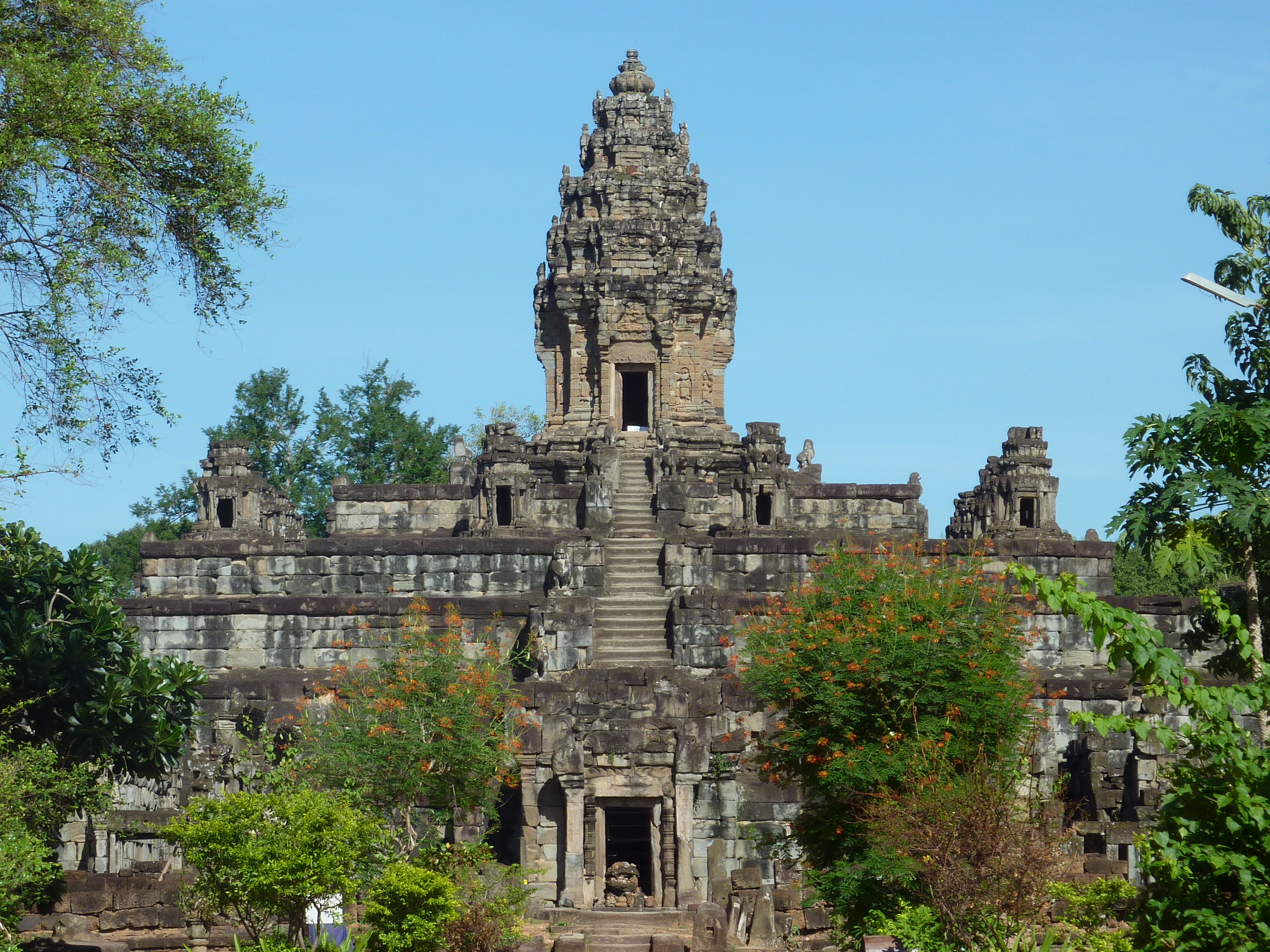
The first temple-mountain of the Khmer Empire, built in 881 CE by King Indravarman I, representing the prototype for all later Khmer pyramid temples including Angkor Wat.
Explore Temple