
CambodiaShiva
Banteay Srei
A 10th-century Khmer temple renowned for its exquisite pink sandstone carvings, considered the finest and most refined of all Angkorian art.
Siem Reap, Cambodia Shiva Built: 967 CE
Share
Overview
Banteay Srei, meaning 'Citadel of Women' in Khmer, is a 10th-century Hindu temple located 25 kilometers northeast of the main Angkor complex. Widely regarded as the 'jewel of Khmer art,' this temple is celebrated for its exquisite pink sandstone carvings, the finest and most intricate of any Angkorian monument. Unlike the massive scale of Angkor Wat or Bayon, Banteay Srei is small and intimate, designed on a scale that brings the viewer face to face with its extraordinary workmanship.
The temple was built in 967 CE, during the reign of King Rajendravarman (944-968 CE), but it was not commissioned by a king. Instead, Banteay Srei was built by Yajnavaraha, a Brahmin counselor and scholar who served as a tutor to the future King Jayavarman V. This unique non-royal patronage gave the temple a different character from most Angkorian monuments, with an emphasis on aesthetic refinement rather than the display of royal power.
The temple's distinctive red and pink sandstone has weathered to a warm rose color that glows in the early morning and late afternoon light. The carving is exceptionally three-dimensional, with figures seeming to emerge from the stone. Every surface is covered with intricate floral motifs, deities, and scenes from Hindu mythology. The temple's lintels, pediments, and false doors are considered the masterpieces of Khmer stone carving.
Quick Facts
Deity
Shiva
Location
Siem Reap, Cambodia
Built
967 CE
Built By
Yajnavaraha (Brahmin counselor of King Rajendravarman)
Coordinates
13.60, 103.96
Timings
7:30 AM – 5:30 PM daily (same operating hours as Angkor Archaeological Park)
Entry Fee
Included in Angkor pass (1-day: USD 37, 3-day: USD 62, 7-day: USD 72)
History
Banteay Srei was consecrated in 967 CE, with a dedication stele discovered at the site providing detailed information about its founding. The stele, now housed in the National Museum of Phnom Penh, records that the temple was built by Yajnavaraha, a Brahmin of the Gotama gotra (lineage), who was a royal tutor and advisor. The central shrine was dedicated to Shiva, with subsidiary shrines dedicated to Vishnu and the goddess Uma, Parvati's aspect.
The temple flourished through the 11th and 12th centuries but was eventually abandoned when the Khmer capital moved southward. Unlike the larger Angkor temples, Banteay Srei was not converted to Buddhism and remained primarily a Hindu site. By the 14th century, it was covered by jungle, and its location was largely forgotten.
Banteay Srei was rediscovered in 1914 by French archaeologists, who were astonished by the exceptional quality of its carvings. The site became the subject of intensive study and was chosen as the first major test of anastylosis — a restoration method involving the careful dismantling, cataloging, and reconstruction of collapsed structures — by the EFEO in the 1930s. The restoration, led by Henri Marchal and later by Maurice Glaize, became a model for heritage conservation across Southeast Asia.
The temple was opened to the public after restoration and has been a highlight of the Angkor circuit ever since.
Historical Timeline
967 CE
Temple Consecration
Banteay Srei is consecrated, built by Brahmin counselor Yajnavaraha under King Rajendravarman, with the central shrine dedicated to Shiva.
14th Century
Abandonment
The temple is abandoned as the Khmer capital moves southward, and it becomes covered by jungle vegetation.
1914
Rediscovery
French archaeologists rediscover Banteay Srei and are astonished by the exceptional quality of its pink sandstone carvings.
1930s
Anastylosis Restoration
The EFEO conducts the first major anastylosis restoration in Cambodia at Banteay Srei, setting the standard for heritage conservation in Southeast Asia.
Architecture
Banteay Srei is constructed primarily from red and pink sandstone, a medium-grained stone that allows for extremely fine carving. The sandstone was quarried from the Phnom Dei hill, approximately 10 kilometers from the temple. The temple's plan is relatively simple: three concentric enclosures leading to a central sanctuary, all oriented to the east. Three towers rise at the center, with the central and tallest tower reaching 12 meters.
The temple's most remarkable architectural features are its pediments and lintels — the carved panels above doorways and the decorative beams spanning openings. The pediments of Banteay Srei are unique among Angkorian temples because they are deeply carved in high relief, with figures that project several inches from the background. Scenes depicted include the battle between the monkey kings Vali and Sugriva from the Ramayana, the burning of Khandava forest from the Mahabharata, and the demon Ravana shaking Mount Kailasa.
The false doors of the central sanctuary are masterpieces of carving. Each is carved to represent a richly decorated door, complete with panels, bolts, and frames, all rendered in stone with extraordinary precision. The door guardians (dvarapalas) carved on the walls are depicted with elaborate headdresses, jewelry, and garments, their expressions serene and majestic. The entire temple was once painted and gilded, traces of which can still be seen in protected areas.
Main Deity
Shiva
Religious Significance
Banteay Srei is considered the pinnacle of Khmer decorative art, with carvings that surpass all other Angkorian temples in their precision, depth, and artistic quality. The temple's significance lies in demonstrating that the Khmer Empire could achieve architectural excellence at a smaller, more human scale. Where Angkor Wat impresses through sheer size, Banteay Srei dazzles through detail.
The temple is a testament to the skill of Khmer stone carvers, whose work here is often described as 'woodcarving in stone' due to its remarkable delicacy.
For art historians and archaeologists, Banteay Srei is invaluable because its foundation stele provides precise dating and detailed information about its builders — an uncommon degree of documentation for Angkorian temples. The stele names the architect, the patron, and even specifies the exact date of consecration, allowing scholars to place the temple within the broader context of Khmer artistic development.
The temple's association with the feminine — both in its name ('Citadel of Women') and in the legend that its carvings were too fine to have been made by men — has made it especially popular with visitors. While the legend is not historical, it reflects the temple's perceived delicacy and grace. The pink sandstone glows warmly in sunlight, giving the temple a romantic aura that contrasts with the gray stone of most Angkor temples.
Temple Legends
The most famous legend of Banteay Srei explains its name, 'Citadel of Women.' According to Cambodian folklore, the temple was built by women because the carvings were so delicate and intricate that only women's hands could have produced them. The legend says that the temple was constructed by a community of women artists who devoted their lives to creating a perfect offering to the gods.
While historically inaccurate — the temple was built by male craftsmen under Yajnavaraha's patronage — the legend persists because the carvings truly are exceptionally fine.
Another legend involves the temple's original patron, Yajnavaraha. According to tradition, he was a sage of such spiritual power that the gods themselves took notice. When Yajnavaraha prayed for a temple that would surpass all others in beauty, Vishnu instructed Vishvakarma, the divine architect, to guide the human craftsmen. The result was Banteay Srei, whose beauty was so sublime that even the gods descended from heaven to admire it.
A third narrative tells of a magical serpent (naga) that once guarded the temple's treasures. The naga was said to have its lair beneath the central tower, and its presence protected the temple from invaders. When the French archaeologists began their restoration work, local workers reportedly made offerings to the naga spirit before moving any stones, a practice that continues among Cambodian workers at the site to this day.
Festivals & Celebrations
Banteay Srei does not host large-scale festivals like Angkor Wat, but it is incorporated into the broader Angkor festival calendar. During the Angkor Sankranta festival in January, Banteay Srei is sometimes the venue for traditional Apsara dance performances, with dancers performing against the backdrop of the temple's exquisite carvings — a visual pairing that delights visitors.
The temple sees increased visitation during Khmer New Year (April) when Cambodian families visit to make offerings and pray. The temple is also a popular site for wedding photography among Cambodian couples, who believe that the temple's beauty and its association with women bring blessings for a harmonious marriage.
Throughout the year, Banteay Srei's remote location (25 kilometers from Siem Reap) means it is quieter than the main Angkor temples. Daily Buddhist prayers are conducted at the small active shrine within the complex by local monks who maintain the site. The temple is considered a power spot for blessing ceremonies, and local monks occasionally lead small groups in meditation within the temple grounds.
Daily Rituals
Daily worship at Banteay Srei is conducted by the resident monks who maintain the small active shrine within the temple complex. Morning prayers begin at dawn, with monks chanting Pali sutras and offering incense at the central sanctuary. Local Cambodian families visit throughout the morning to make offerings of flowers, fruit, and rice at the temple's shrines.
Unlike larger Angkor temples, Banteay Srei does not have elaborate daily aarti ceremonies, but the temple is considered a powerful spiritual site for blessing ceremonies. Local monks occasionally perform private blessings for visitors who request them, involving chanting, holy water sprinkling, and the tying of protective threads around the wrist.
The temple's serene atmosphere and relatively quiet setting make it a favored location for meditation. Visitors are welcome to sit quietly in the temple grounds, though active participation in Buddhist rituals is reserved for Cambodian devotees. The temple is at its most peaceful in the early morning before tour groups arrive.
Visitor Information
Timings
7:30 AM – 5:30 PM daily (same operating hours as Angkor Archaeological Park)
Entry Fee
Included in Angkor pass (1-day: USD 37, 3-day: USD 62, 7-day: USD 72)
Dress Code
Modest clothing covering shoulders and knees required
Photography
Photography allowed; tripods discouraged without special permit
Accessibility
Banteay Srei is located on relatively flat ground with paved walkways through the temple complex, making the ground level accessible to wheelchair users. However, the central sanctuary has steps that are not wheelchair accessible. The temple is 25 kilometers from Siem Reap, and visitors with mobility concerns should arrange private transport for comfort.
Best Time to Visit
The best time to visit Banteay Srei is early morning (7:30 AM – 9:00 AM) or late afternoon (3:00 PM – 5:00 PM), when the low-angle sunlight strikes the pink sandstone at an angle that makes the carvings appear to glow with a warm rose color.
The temple is 25 kilometers from Siem Reap, so it requires dedicated transport — most visitors combine Banteay Srei with a visit to the Banteay Samre temple and the Roluos group or the Kulen Mountains.
The dry season (November-March) is ideal, with clear skies and moderate temperatures. The temple's open layout means there is little shade, so the hot season (April-May) can be uncomfortable at midday. The rainy season brings lush vegetation to the surrounding countryside, and the pink stone contrasts beautifully with the green of the rice paddies.
Banteay Srei is significantly less crowded than Angkor Wat, Bayon, or Ta Prohm, making it a peaceful experience at any time of day. However, it is a popular stop for tour groups, who typically arrive between 9:30 AM and 11:00 AM. Visiting early or late allows for a more contemplative experience.
How to Reach
Banteay Srei is located approximately 25 kilometers northeast of Siem Reap city center. Most visitors reach the temple by hiring a car, minivan, or tuk-tuk from Siem Reap for a half-day trip. The journey takes 40-50 minutes via a paved road that passes through rural Cambodian villages and rice fields. The drive itself is scenic, offering glimpses of traditional Cambodian rural life.
The temple is included in the extended Angkor Archaeological Park circuit (the Grand Circuit or Outer Circuit). Most tour operators offer a half-day tour combining Banteay Srei with Banteay Samre, Preah Khan, and either Phnom Kulen or the Roluos group. Bicycling to Banteay Srei is possible for experienced cyclists but requires a significant time commitment (2-3 hours each way from Siem Reap).
For those combining Banteay Srei with Phnom Kulen National Park, the temple is on the route to the mountain, making it a logical stop. The road from Banteay Srei to the main Angkor complex (Angkor Wat) follows a different route than the way out, so visitors can make a loop without backtracking.
Nearby Attractions
Banteay Samre, a 12th-century temple built in the same architectural style as Angkor Wat, is just 10 kilometers south of Banteay Srei and makes an excellent complementary visit. The Roluos group of temples (Bakong, Preah Ko, Lolei), which predate Angkor Wat by 200 years, are 15 kilometers southeast. Phnom Kulen National Park, with its massive riverbed carving of Vishnu and the 1,000 Linga River, is 20 kilometers further north.
The Landmine Museum and the War Museum Cambodia, both located between Siem Reap and Banteay Srei, offer sobering insights into Cambodia's recent history. The Angkor Centre for Conservation of Biodiversity near Banteay Srei focuses on Southeast Asian wildlife conservation. The Cambodian Cultural Village in Siem Reap showcases traditional Khmer architecture, dance, and rural life.
The villages along the road to Banteay Srei offer opportunities to see traditional Cambodian crafts, including stone carving workshops where artisans produce reproductions of Angkorian statues. The Banteay Srei Butterfly Centre, adjacent to the temple, is a pleasant stop for families.
Nearby Hotels
Koulen Hotel
24 km from Banteay Srei (Siem Reap)A boutique hotel with Khmer-inspired decor, a rooftop pool, and easy access to both Banteay Srei and the main Angkor complex.
Angkor Village Hotel
25 km from Banteay Srei (Siem Reap)A charming hotel with traditional wooden architecture, tropical gardens, and a relaxing spa.
Shinta Mani Shack
25 km from Banteay Srei (Siem Reap)A stylish boutique hotel offering modern comfort with traditional design elements, located near the Old Market area.
Nearby Vegetarian Restaurants
Sugar Palm Restaurant
24 km from Banteay Srei (Siem Reap)A family-run restaurant serving authentic Khmer vegetarian dishes in a traditional wooden house setting.
Temple Coffee n' Bakery
24 km from Banteay Srei (Siem Reap)A vegetarian-friendly cafe offering fresh pastries, salads, and Khmer specialties in a relaxed atmosphere.
Malis Restaurant
25 km from Banteay Srei (Siem Reap)An elegant restaurant serving refined Cambodian cuisine with plenty of vegetarian options, set in a beautiful garden.
Nearby Temples
Banteay Samre
10 km southA 12th-century temple built in the Angkor Wat style with well-preserved carvings and a peaceful setting.
Bakong
15 km southeastThe first temple-mountain of the Khmer Empire, a five-tiered pyramid built in 881 CE.
Preah Ko
14 km southeastA 9th-century temple dedicated to the ancestors of King Indravarman I, featuring six brick towers.
Interesting Facts
- Banteay Srei was the first major Cambodian temple to be restored using the anastylosis method, where each stone was dismantled, numbered, and reassembled, becoming a model for conservation across Southeast Asia.
- The temple's foundation stele provides the most detailed historical record of any Angkorian temple, including the exact consecration date (967 CE) and the names of the architect and patron.
- The pink sandstone used for Banteay Srei is unique among Angkor temples — no other major temple uses this material as its primary building stone.
- The temple was originally called Tribhuvanamahesvara, meaning 'Great Lord of the Three Worlds,' in honor of Shiva. The name 'Banteay Srei' is a much later nickname meaning 'Citadel of Women.'
- The French author and archaeologist André Malraux famously tried to steal four statues from Banteay Srei in 1923, was arrested in Phnom Penh, and the incident became an international scandal that raised the temple's profile worldwide.
- The temple's carving is so three-dimensional that some figures are completely detached from the background stone, a technique not found anywhere else in Angkorian art.
Image Gallery
1 / 4
Exquisite carvings of Banteay Srei
Frequently Asked Questions
Is Banteay Srei included in the standard Angkor Wat ticket?
Yes, Banteay Srei is included in the Angkor Archaeological Park pass. There is no additional fee beyond the standard 1-day, 3-day, or 7-day pass.
Why is Banteay Srei called 'Citadel of Women'?
The name comes from a Cambodian legend that the temple's carvings were too fine and delicate to have been created by men, so they must have been carved by women. Historically, the name is a later nickname and not the temple's original name.
How far is Banteay Srei from Angkor Wat?
Banteay Srei is located 25 kilometers northeast of Angkor Wat and the main Angkor temple complex. The drive takes approximately 40-50 minutes from Siem Reap.
Which is the best-preserved Khmer temple?
Banteay Srei is often described as the best-preserved Khmer temple due to its excellent condition, the detailed restoration work, and the protection provided by its hard, finely-grained pink sandstone.
Can I combine Banteay Srei with other temples in a single day?
Yes, Banteay Srei is typically visited as part of a half-day or full-day 'Outer Circuit' tour that also includes Banteay Samre, Preah Khan, and sometimes Phnom Kulen or the Roluos group temples.
Sources & References
- [1]APSARA Authority – Banteay Srei Guide government
- [2]The Civilization of Angkor by Charles Highambook
- [3]UNESCO – Angkor World Heritage Site website
— every record linked above was re-requested for this release, so the link still resolves and the publisher still serves the document. It is a link check, not a re-verification of every sentence on this page.
More Temples in Cambodia
Explore other Hindu temples in Cambodia.
UNESCO 1992
Cambodia
Angkor Wat
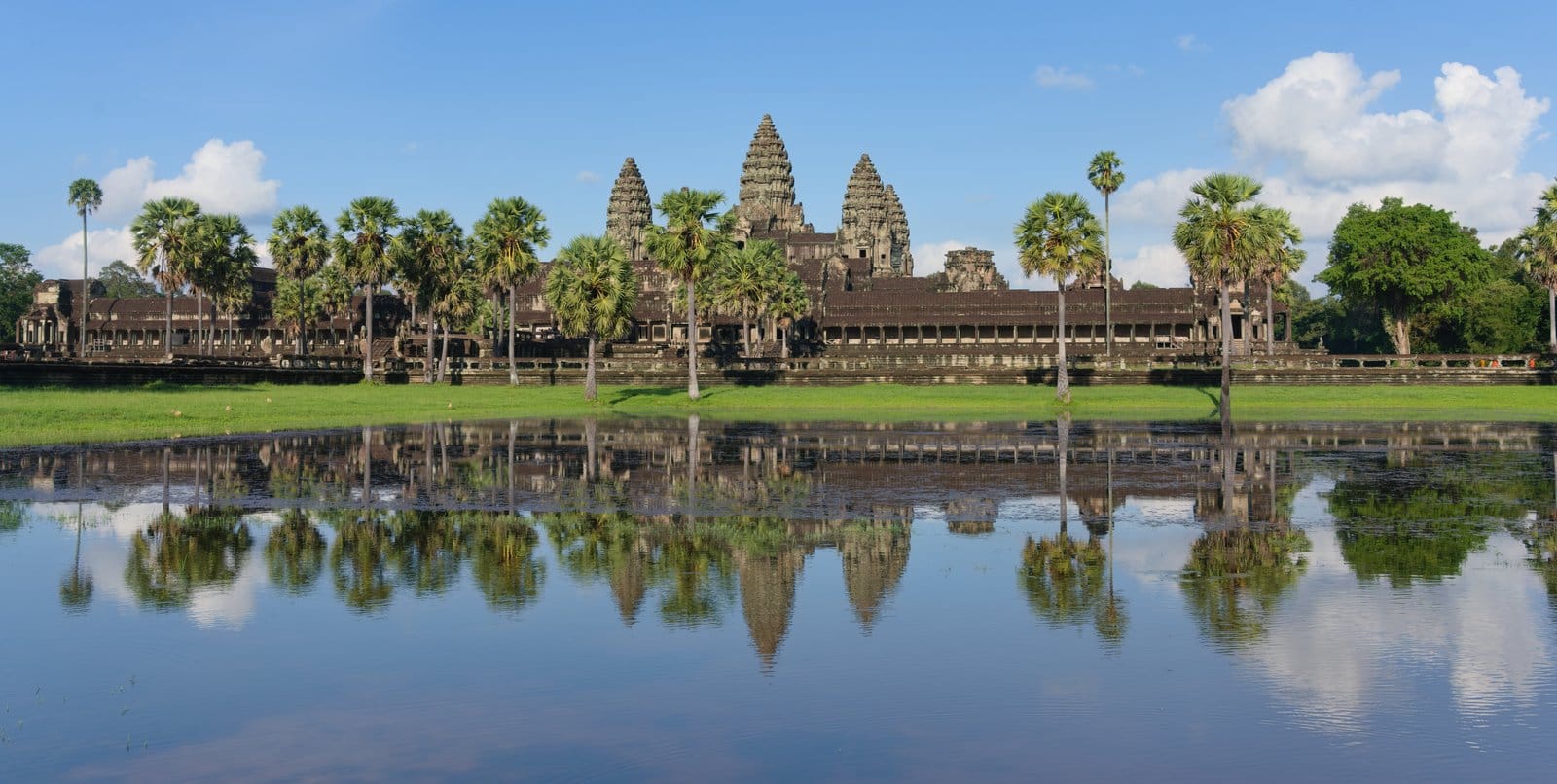
The largest religious monument in the world, Angkor Wat is a 12th-century Khmer temple complex in Cambodia originally dedicated to Vishnu and now a UNESCO World Heritage Site.
Explore Temple

UNESCO 2008
Cambodia
Preah Vihear Temple
A spectacular Khmer temple perched on a 525-meter cliff in the Dangrek Mountains, a UNESCO World Heritage Site with a dramatic history and panoramic views.
Explore Temple
Cambodia
Bakong
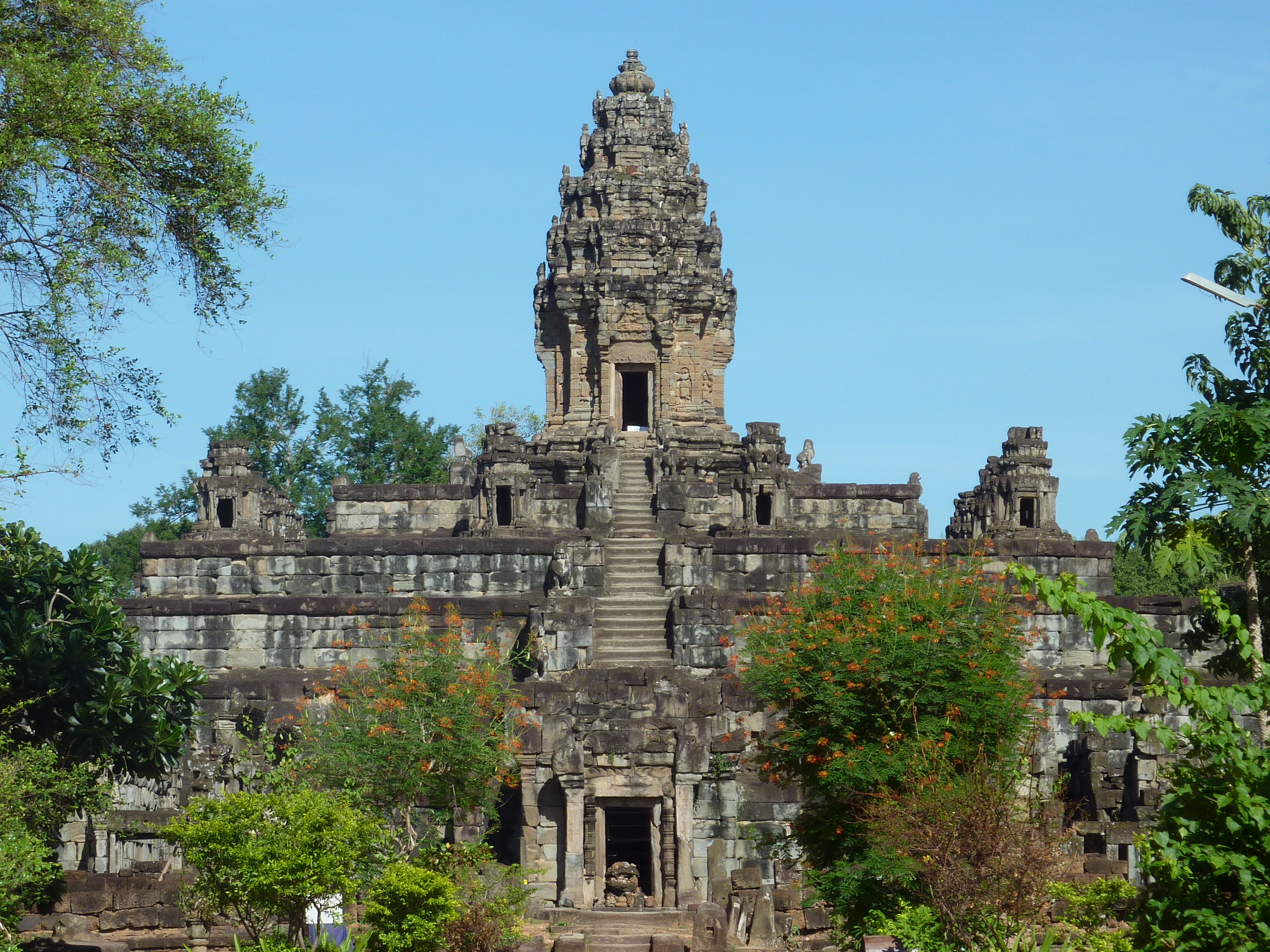
The first temple-mountain of the Khmer Empire, built in 881 CE by King Indravarman I, representing the prototype for all later Khmer pyramid temples including Angkor Wat.
Explore Temple