
CambodiaShiva
Phnom Bakheng
The first temple-mountain built in the Angkor region (889-910 CE), serving as the state temple of the original Khmer capital at Yasodharapura and the most famous sunset viewpoint.
Siem Reap, Cambodia Shiva Built: 889–910 CE
Share
Overview
Phnom Bakheng is a hilltop Hindu temple built between 889 and 910 CE by King Yasovarman I, marking the founding of the first capital in the Angkor region. The temple was constructed on a natural hill (phnom in Khmer) that rises 67 meters above the surrounding plain, making it the tallest structure in the area at the time of its construction.
Phnom Bakheng served as the state temple of Yasodharapura, the first Khmer capital in what would become the Angkor region.
The temple is famous today as the premier sunset viewpoint in the Angkor Archaeological Park. From its summit, visitors enjoy a panoramic view that includes the towers of Angkor Wat rising from the forest 1.5 kilometers to the south, the western baray (reservoir) gleaming in the distance, and the endless green expanse of the Cambodian countryside stretching toward the horizon. The scene of the sun setting behind Angkor Wat's iconic towers is among the most photographed images in Southeast Asia.
Beyond its scenic appeal, Phnom Bakheng is historically and architecturally significant as the first temple-mountain of the Angkor region, establishing the urban and religious plan that all subsequent Khmer kings would follow. The temple's design, with its five-tiered pyramid base and 108 surrounding towers, encodes sophisticated Hindu cosmological symbolism that reveals the deep mathematical and astronomical knowledge of its builders.
Quick Facts
Deity
Shiva
Location
Siem Reap, Cambodia
Built
889–910 CE
Built By
King Yasovarman I
Coordinates
13.42, 103.86
Timings
5:00 AM – 7:00 PM daily (sunset viewing strictly limited to 300 visitors)
Entry Fee
Included in Angkor pass (1-day: USD 37, 3-day: USD 62, 7-day: USD 72)
History
Phnom Bakheng was built between 889 and 910 CE by King Yasovarman I (reigned 889-910 CE), the son of Indravarman I (builder of Bakong). Yasovarman moved the Khmer capital from Hariharalaya (Roluos) to the Angkor region, establishing a new city called Yasodharapura.
The selection of Phnom Bakheng as the site for the new state temple was strategic: the natural hill provided a defensible position and a prominent landmark that could be seen from miles around, asserting the king's presence over the landscape.
The temple's construction marked the beginning of the Angkor period, the golden age of Khmer civilization that would last for over 500 years. Yasovarman's urban plan included not only Phnom Bakheng but also the construction of a massive water reservoir (the Eastern Baray, measuring 7.1 km by 1.7 km) and the founding of hundreds of temple-shrines. The city of Yasodharapura was the first of several Angkor capitals, each centered around a different temple-mountain.
After the Khmer capital shifted to the Angkor Thom area under King Jayavarman VII in the late 12th century, Phnom Bakheng lost its position as the central state temple. However, it remained an important religious site through the centuries. The temple underwent restoration by the World Monuments Fund and the APSARA Authority in the early 2000s to address structural instability caused by the huge numbers of tourists climbing to the summit for sunset views.
Historical Timeline
889–910 CE
Construction of Phnom Bakheng
King Yasovarman I builds Phnom Bakheng as the state temple of Yasodharapura, the first Khmer capital in the Angkor region.
Late 12th Century
Capital Relocation
The Khmer capital shifts to Angkor Thom under King Jayavarman VII, and Phnom Bakheng loses its status as the central state temple.
Early 2000s
Restoration and Conservation
The World Monuments Fund and APSARA Authority undertake structural restoration of Phnom Bakheng to address damage from mass tourism.
2004
World Monuments Watch
Phnom Bakheng becomes the first Cambodian monument on the World Monuments Watch List, leading to visitor management reforms including the 300-person sunset limit.
Architecture
Phnom Bakheng is a temple-mountain built on a natural hill, combining human construction with the existing topography. The temple proper consists of a five-tiered pyramid of laterite and sandstone built on the summit of the 67-meter hill.
The base of the pyramid measures approximately 76 meters on each side, and the total height from the ground to the top of the central sanctuary is about 25 meters, bringing the effective height of the entire structure to over 90 meters above the surrounding plain.
The five tiers of the pyramid are accessed by steep stairways on each of the four cardinal directions. The stairs, like those of most Khmer temple-mountains, are extremely steep (over 70 degrees), symbolizing the difficulty of ascending to the realm of the gods. Each tier was originally lined with small sandstone towers, of which approximately 44 survive out of the original 108.
The towers are arranged with 6 on each side of each tier (totaling 24 per tier across 4 sides), plus a ring at the base and 4 around the central sanctuary, totaling 108.
The central sanctuary, now largely in ruins, originally housed a Shiva linga. The sanctuary is built of sandstone and features the typical Khmer corbelled dome construction. From the central platform, visitors have a 360-degree view of the Angkor plain. The western side of the summit offers the famous view of Angkor Wat, perfectly framed between the surviving towers of Phnom Bakheng.
Main Deity
Shiva
Religious Significance
Phnom Bakheng holds immense significance as the foundational temple of the Angkor period. It was the first major monument built in the Angkor region and established the urban paradigm — with a temple-mountain at the center, surrounded by a royal palace, residential quarters, and a vast water management system — that would define Khmer capital cities for centuries. Without Phnom Bakheng, Angkor Wat and the other great temples of Angkor might never have been built in this location.
The temple is also significant for its sophisticated cosmological design. The temple is composed of 108 small towers surrounding a central sanctuary, with 108 being a sacred number in Hindu and Buddhist cosmology (the number of names of the goddess, the number of beads in a mala, the number of stages in the spiritual path).
The five-tiered pyramid represents Mount Meru, and the seven levels of the hill itself (counting the natural hill plus the five tiers and the summit) represent the seven heavens of Hindu mythology.
For contemporary Cambodia, Phnom Bakheng is both a source of national pride and a challenge in heritage management. The temple's extreme popularity for sunset viewing has led to severe overcrowding and structural damage. The Cambodian authorities have implemented a daily visitor limit of 300 people for sunset, making it among the most restrictive and sought-after experiences in the Angkor Archaeological Park.
Temple Legends
The primary legend of Phnom Bakheng centers on its natural hill. According to Khmer tradition, the hill was not a natural formation but was built by the gods as a throne for the god Indra. When Indra descended to earth to establish the kingdom of Cambodia, he sat on this hill to survey the land.
The hill itself is therefore considered sacred, and King Yasovarman I built his temple-mountain on top of it to connect his earthly reign with Indra's divine authority.
Another legend involves the 108 towers of Phnom Bakheng. According to tradition, the temple was built to align with the 108 stars of the zodiac, with each tower corresponding to a specific star. On the night of the winter solstice, the moon rises in perfect alignment with the central sanctuary and the major towers, a phenomenon that still occurs annually. The temple was thus designed as a giant astronomical observatory as well as a place of worship.
A third narrative concerns the foundation of Yasodharapura itself. When King Yasovarman I decided to move his capital from Hariharalaya, he consulted his chief Brahmin, who instructed the king to release a sacred white elephant and follow it without stopping. The elephant walked for three days and finally stopped at the foot of Phnom Bakheng. The king took this as a divine sign and established his new capital city there, with Phnom Bakheng as its spiritual center.
Festivals & Celebrations
Phnom Bakheng is not a site of major festivals due to its role primarily as a state temple and ceremonial monument rather than an active religious center. However, it is incorporated into the broader Angkor festival calendar. During the Angkor Sankranta festival in January, special sunset ceremonies are sometimes held at Phnom Bakheng, with Apsara dance performances and traditional music.
The temple sees its highest attendance during the Khmer New Year (April) and the Bonn Pchum Ben (September-October), when visitors combine holy day observances with sunset viewing. The winter and summer solstices, which have special significance in the temple's astronomical design, attract informed visitors and astronomy enthusiasts.
While Phnom Bakheng itself has no regular religious ceremonies, the small Buddhist shrine at the base of the hill receives offerings from local villagers who consider the hill a sacred site. The modern Buddhist monastery near the foot of the hill conducts regular prayers and ceremonies that include the veneration of the ancient temple above.
Daily Rituals
Phnom Bakheng does not have regular daily rituals conducted on the summit due to its status as an archaeological monument with restricted access. However, the small Buddhist shrine and monastery at the base of the hill maintain daily worship activities. Monks from the nearby monastery conduct morning prayers at the base shrine, offering incense and chanting Pali sutras at dawn.
Local villagers visit the base shrine throughout the day to make offerings of flowers, incense, and food. The hill itself is considered sacred in local tradition, and many Cambodians make a brief prayer at the foot of the hill before beginning their ascent to the summit.
On full moon days and Buddhist holy days, larger gatherings of devotees assemble at the base monastery for special ceremonies. These include candlelight processions, extended chanting sessions, and communal offerings. The summit itself is occasionally used for special ceremonial events during the Angkor Sankranta festival, when traditional dance performances are held at sunset.
Visitor Information
Timings
5:00 AM – 7:00 PM daily (sunset viewing strictly limited to 300 visitors)
Entry Fee
Included in Angkor pass (1-day: USD 37, 3-day: USD 62, 7-day: USD 72)
Dress Code
Modest clothing required; shoulders and knees covered
Photography
Photography allowed; tripods discouraged due to limited space on the summit
Accessibility
Phnom Bakheng involves a steep 10-15 minute climb up a hillside path to reach the summit and is not wheelchair accessible. The temple's hilltop location and steep stairways make it unsuitable for visitors with severe mobility impairments. The 300-person sunset limit can also present challenges for elderly visitors who need to arrive early and wait.
Best Time to Visit
Sunset is the most popular time to visit Phnom Bakheng, and for good reason — the view of the sun setting behind Angkor Wat's towers from the temple's summit is unforgettable. However, the daily limit of 300 sunset visitors means arriving early is essential. Visitors should plan to be at the temple by 4:30 PM to secure a spot for the sunset (typically 5:30-6:15 PM depending on the season). The temple closes at 7:00 PM.
Sunrise is an alternative and less crowded time to visit. The temple offers spectacular views in the morning light, with the hillside vegetation alive with bird calls. Morning visits are also cooler and less crowded, providing a more contemplative experience.
The dry season (November-March) offers the most reliable sunset views, with clear skies. The wet season (June-October) brings dramatic cloud formations that can create spectacular sunsets, but there is also a higher chance of overcast skies. The temple is at its most beautiful during the rice harvest season (December-January), when the flooded paddies around Angkor reflect the sunset colors.
How to Reach
Phnom Bakheng is located within the Angkor Archaeological Park, approximately 1.5 kilometers north of Angkor Wat and 6 kilometers north of Siem Reap city center. Access is through the main Angkor park entrance, with the same ticket valid for Phnom Bakheng as for Angkor Wat and all other park temples. A paved road leads from the main Angkor park road to the base of Phnom Bakheng hill.
From Siem Reap, a taxi or tuk-tuk can reach the temple in 15-20 minutes. Most visitors combine Phnom Bakheng sunset with a day of temple visiting, arriving directly from Angkor Wat or Angkor Thom. A steep but well-maintained path climbs from the base of the hill to the temple summit. The climb takes 10-15 minutes of moderate exertion. Elephant rides to the summit were discontinued in recent years to protect the temple structure.
Visitors planning to see the sunset must be at the temple before 5:30 PM (the cut-off for admission to the summit). During peak season, the 300-slot limit fills quickly, and late arrivals are turned away. Secure a sunset spot the day before by purchasing an Angkor pass and confirming opening hours.
Nearby Attractions
Angkor Wat, the most famous temple in the complex, is just 1.5 kilometers south of Phnom Bakheng and clearly visible from the summit. Angkor Thom, the last great capital of the Khmer Empire, is 2 kilometers north, with the Bayon temple at its center. The Terrace of the Elephants and the Terrace of the Leper King are within Angkor Thom. The Baphuon temple, undergoing extensive restoration, is also nearby.
The Western Baray, a massive 8th-century reservoir measuring 8 kilometers by 2.1 kilometers, is 2.5 kilometers west of Phnom Bakheng. The West Mebon temple, located on an artificial island in the middle of the baray, is accessible by boat. The Preah Khan temple, 4 kilometers northeast, is another major attraction.
Siem Reap city center, with its restaurants, night markets, and cultural shows, is 6 kilometers south. The Angkor Night Market, Pub Street, and the Cambodian BBQ are popular evening destinations after a sunset at Phnom Bakheng. The Angkor National Museum offers climate-controlled exhibits on Khmer art and history, ideal for escaping the midday heat.
Interesting Facts
- Phnom Bakheng was the first major monument built in the Angkor region, marking the founding of Yasodharapura, the first Khmer capital in what would become the Angkor empire.
- The temple originally had 108 small sandstone towers surrounding the central sanctuary, of which approximately 44 survive. 108 is a sacred number in both Hinduism and Buddhism.
- Phnom Bakheng is the most popular sunset viewing spot in Cambodia, with a strict daily limit of 300 visitors enforced by the APSARA Authority to protect the structure.
- The natural hill of Phnom Bakheng, at 67 meters, was the tallest point in the Angkor region until the construction of the central tower of Angkor Wat (65 meters on flat ground).
- The temple's design incorporates astronomical alignments: the central sanctuary aligns with the cardinal directions, and certain towers align with solstice sunrise and sunset positions.
- Phnom Bakheng was the first monument in Cambodia to be placed on the World Monuments Watch List (2004) for conservation, leading to extensive restoration and visitor management reforms.
Image Gallery
1 / 4
Sunset over Angkor Wat from Phnom Bakheng
Frequently Asked Questions
How many people are allowed on Phnom Bakheng for sunset?
The APSARA Authority limits sunset viewing to 300 people per day. This number was implemented to prevent structural damage to the ancient temple and to preserve the quality of the visitor experience.
Do I need a separate ticket for Phnom Bakheng?
No, Phnom Bakheng is included in the standard Angkor Archaeological Park pass. No additional ticket is required, but the same pass rules apply (1-day, 3-day, or 7-day options).
Can I ride an elephant up Phnom Bakheng?
No. Elephant rides to the summit of Phnom Bakheng were discontinued in recent years due to concerns about the animals' welfare and the structural impact on the ancient stairways.
Is the view of Angkor Wat better from Phnom Bakheng or from within the temple?
The view from Phnom Bakheng is the only place where you can see Angkor Wat from above and in context with its surroundings. The sunset view from Phnom Bakheng, with Angkor Wat's towers silhouetted against the setting sun, is the most iconic image of Cambodia.
What is the best time to arrive for sunset at Phnom Bakheng?
Arrive by 4:30 PM during the dry season to secure a spot within the 300-person limit. The sunset itself occurs around 5:30-6:15 PM depending on the season. The climb takes 10-15 minutes, and the sunset crowd can make the final approach slow.
Sources & References
— every record linked above was re-requested for this release, so the link still resolves and the publisher still serves the document. It is a link check, not a re-verification of every sentence on this page.
More Temples in Cambodia
Explore other Hindu temples in Cambodia.
UNESCO 1992
Cambodia
Angkor Wat
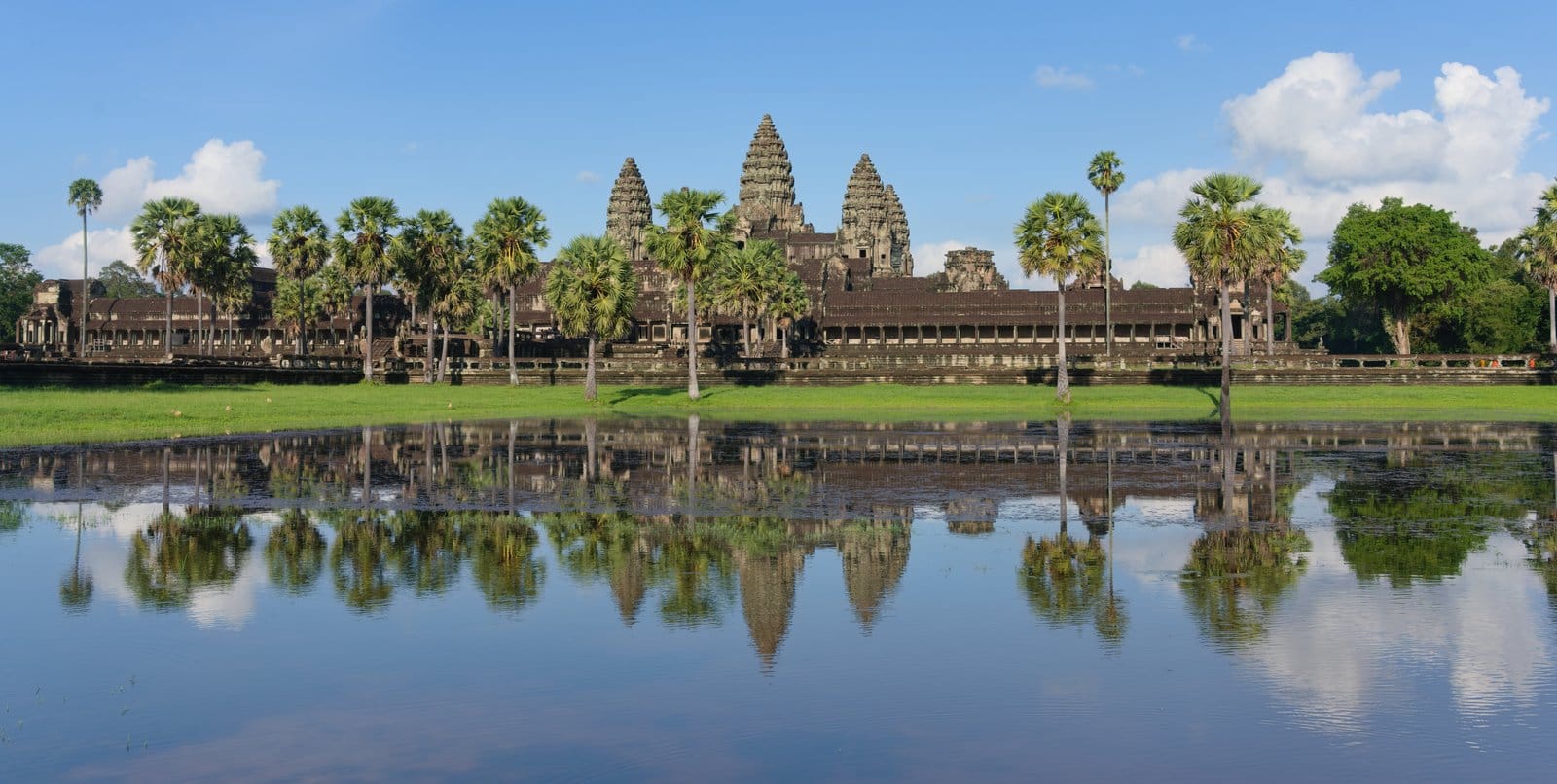
The largest religious monument in the world, Angkor Wat is a 12th-century Khmer temple complex in Cambodia originally dedicated to Vishnu and now a UNESCO World Heritage Site.
Explore Temple

Cambodia
Banteay Srei
A 10th-century Khmer temple renowned for its exquisite pink sandstone carvings, considered the finest and most refined of all Angkorian art.
Explore Temple

UNESCO 2008
Cambodia
Preah Vihear Temple
A spectacular Khmer temple perched on a 525-meter cliff in the Dangrek Mountains, a UNESCO World Heritage Site with a dramatic history and panoramic views.
Explore Temple