UNESCO 1991IndonesiaShiva Mahadeva
Prambanan Temple
Prambanan is the largest Hindu temple complex in Indonesia, a 9th-century UNESCO World Heritage Site dedicated to the Trimurti and located near Yogyakarta.
Yogyakarta, Indonesia Trimurti (Shiva, Vishnu, Brahma) Built: c. 850 CE
Share
Overview
Prambanan Temple, also known as Candi Prambanan or Candi Rara Jonggrang, constitutes the largest Hindu temple complex in Indonesia and among the most magnificent architectural achievements of Southeast Asian classical civilization. Situated approximately 17 kilometers northeast of Yogyakarta on the border between Central Java and the Special Region of Yogyakarta, this 9th-century compound was built as a grand dedication to the Trimurti—the three supreme deities of Hinduism: Shiva the Destroyer, Vishnu the Preserver, and Brahma the Creator.
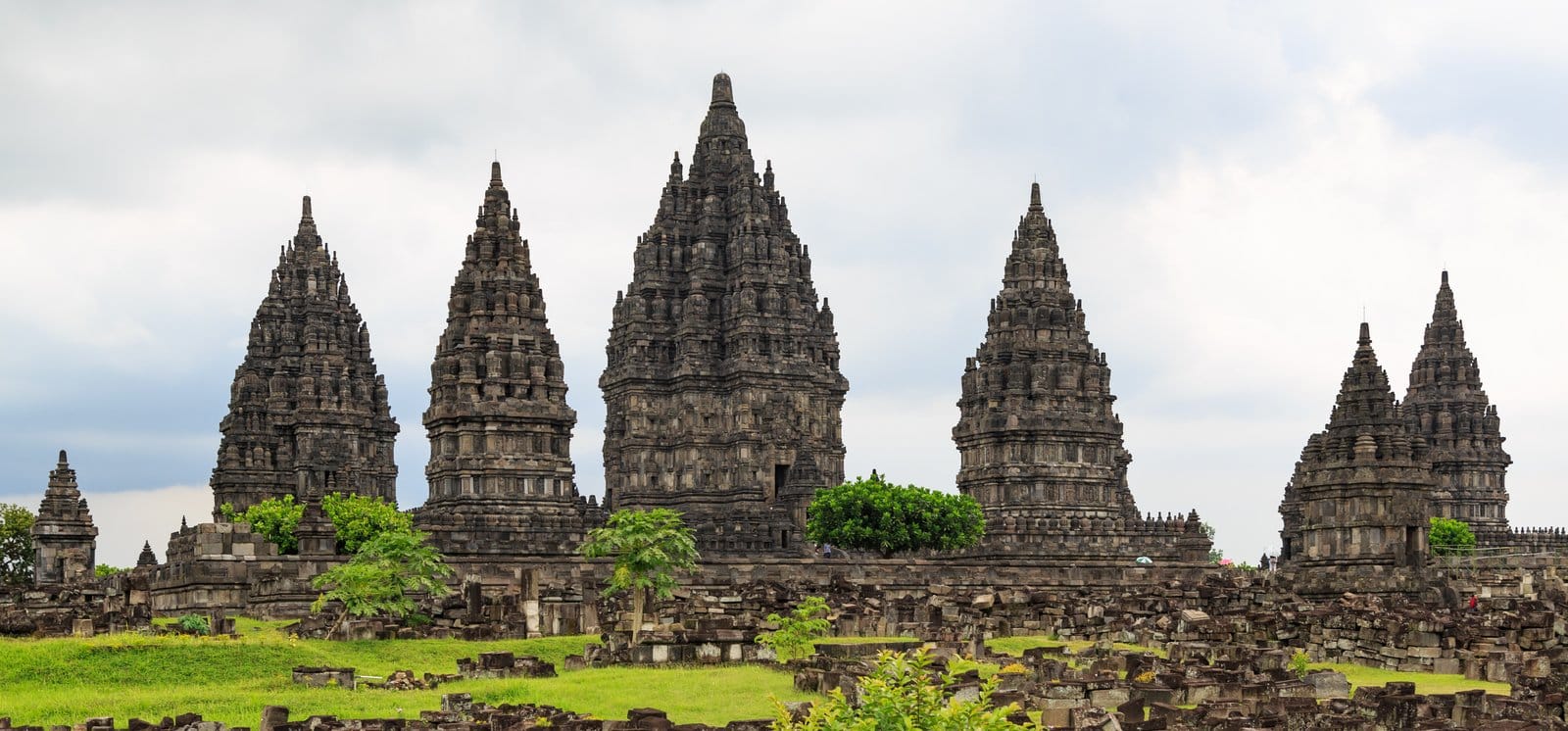
The complex originally comprised 240 temples of varying sizes, with the central courtyard housing three primary temples flanked by three smaller shrines dedicated to the vahana (celestial vehicles) of each god. The main Shiva temple rises to an imposing height of 47 meters, dominating the skyline with its towering spire and intricate stone carvings that narrate episodes from the Ramayana epic.
Quick Facts
Deity
Shiva Mahadeva
Location
Yogyakarta, Indonesia
Built
c. 850 CE
Built By
Rakai Pikatan of the Medang Mataram Kingdom
UNESCO
1991
Coordinates
-7.75, 110.49
Timings
6:00 AM – 6:00 PM daily
Entry Fee
IDR 50,000 (adults), IDR 25,000 (children); combined Prambanan-Borobudur tickets available
History
Construction of Prambanan began around 850 CE under the patronage of Rakai Pikatan of the Medang Mataram Kingdom and was substantially expanded by his successor, Rakai Balitung. The complex was conceived as a Hindu counterpart to the nearby Buddhist monument Borobudur, marking the return of Hindu dynastic power in Central Java after a period of Buddhist Sailendra dominance.
The temple complex was strategically positioned on the Prambanan Plain, an area that had been a contested religious landscape between Hindu and Buddhist kingdoms during the 8th and 9th centuries. Following the decline of the Medang Kingdom in the early 11th century, Prambanan was gradually abandoned as the political center shifted eastward to the Brantas River valley.
The temples lay buried under layers of volcanic ash from Mount Merapi eruptions for centuries until their rediscovery in 1733 by Dutch surveyor C. A. Lons. Systematic archaeological restoration began in 1918 under Dutch colonial administration and continued after Indonesian independence.
The most intensive reconstruction occurred between 1967 and 1991, culminating in the complex's designation as a UNESCO World Heritage Site in 1991. 4 Yogyakarta earthquake in May 2006 caused significant structural damage, including the collapse of the main Shiva temple's central spire, requiring years of additional restoration work.
Historical Timeline
c. 850 CE
Construction Begins
Prambanan is built under Rakai Pikatan of the Medang Mataram Kingdom as a grand Hindu temple complex dedicated to the Trimurti on the Prambanan Plain.
1733
Rediscovery
The temple complex is rediscovered by Dutch surveyor C. A. Lons after spending more than eight centuries buried under volcanic ash from Mount Merapi eruptions.
1991
UNESCO World Heritage Designation
Prambanan is inscribed as a UNESCO World Heritage Site, recognized as the largest Hindu temple complex in Indonesia and a masterpiece of classical Javanese architecture.
2006
Earthquake Devastation
A magnitude 6.4 earthquake strikes Yogyakarta, causing the central spire of the main Shiva temple to collapse and severely damaging several other structures.
Architecture
Prambanan's architectural design follows a hierarchical tripartite layout divided into three concentric zones: the outer zone (nista mandala), the intermediate zone (madya mandala), and the inner sanctum (utama mandala). The inner courtyard, elevated on a raised terrace, contains eight principal temples arranged in a precise geometric pattern.
The central Shiva temple (Candi Shiva Mahadeva) occupies the most sacred position, flanked by the Brahma temple to the south and the Vishnu temple to the north, with three smaller temples dedicated to their respective vahanas—Nandi the bull, Garuda the eagle, and Hamsa the swan—arranged directly opposite. The entire complex sits on a massive stone plinth measuring 110 meters on each side.
The Shiva temple rises through a series of diminishing terraces culminating in a 47-meter-high spire adorned with eight cells, including the main garbhagriha that houses a four-armed stone statue of Shiva Mahadeva. The temple walls exhibit an extensive program of narrative relief panels totaling over 2,000 square meters, depicting the Ramayana arranged in a clockwise sequence for ritual circumambulation.
All structures were constructed from dark andesite stone blocks fitted together with precise interlocking joinery without mortar, an engineering technique that has demonstrated remarkable resilience through centuries of tropical weathering and seismic activity.
Main Deity
Shiva Mahadeva
Trimurti (Shiva, Vishnu, Brahma)
Religious Significance
Prambanan stands as the definitive expression of classical Hindu architecture in the Indonesian archipelago and represents the profound synthesis of Indian religious concepts with distinctly Javanese artistic and cosmological traditions. The temple complex embodies the Hindu conception of the universe, with its concentric mandala layout and towering central spire symbolizing Mount Meru, the axis mundi of Hindu cosmology.
As a UNESCO World Heritage Site, Prambanan holds exceptional universal value as testimony to the sophisticated urban civilization of 9th-century Java and the extensive cultural exchange networks that connected Southeast Asia with the Indian subcontinent. Beyond its archaeological importance, Prambanan functions as a living cultural landmark that continues to shape Indonesian identity. The temple grounds host the internationally acclaimed Ramayana Ballet, a nightly open-air performance combining dance, drama, and gamelan music performed against the illuminated temple backdrop.
The site also remains an active place of worship for Hindus in the Yogyakarta region, particularly during Galungan and the Javanese New Year.
Temple Legends
The most enduring legend associated with Prambanan is the tale of Rara Jonggrang (Slender Maiden), which remains deeply embedded in Javanese folklore. According to the story, Prince Bandung Bondowoso, endowed with supernatural powers, fell deeply in love with Rara Jonggrang, the beautiful princess of the neighboring kingdom of Prambanan. When he proposed marriage, Rara Jonggrang, who did not wish to accept him, devised an impossible condition: Bandung Bondowoso must construct 1,000 temples in a single night before dawn.
The prince summoned demonic spirits and began building with astonishing supernatural speed, rapidly completing temple after temple. As the 999th temple neared completion with the first light of dawn approaching, Rara Jonggrang, consumed by desperation, commanded her maidservants to light fires in the eastern direction and pound rice mortars vigorously, creating the convincing illusion of sunrise. The demonic workers, believing daybreak had arrived, immediately fled and the task remained one temple short of completion.
When Bandung Bondowoso discovered the deception, he pronounced a curse, turning Rara Jonggrang into stone—the 1,000th and final temple. To this day, local tradition holds that the statue of Durga Mahisasuramardini within the northern cell of the Shiva temple is the petrified form of Rara Jonggrang, and the temple complex is still commonly referred to locally as Candi Rara Jonggrang.
Festivals & Celebrations
The most celebrated annual event at Prambanan is the Ramayana Ballet, a spectacular open-air performance staged on a purpose-built covered stage to the west of the main temples. Running from approximately May through October during the dry season, this grand dance-drama adapts Valmiki's Ramayana epic and features over 200 dancers and musicians performing traditional Javanese wayang wong and classical ballet styles.
The performance is presented in a cycle of four acts rotated across evenings, with narratives unfolding against the dramatically floodlit temple backdrop and incorporating gamelan orchestras, intricate costumes, and stylized choreography that follows conventions established by the Mangkunegaran court of Surakarta. The temple also hosts the annual Prambanan Jazz Festival, which juxtaposes contemporary music genres against the ancient stone architecture. During the Hindu festival of Galungan, Balinese and Javanese Hindu communities gather at Prambanan for communal prayers, offerings, and processions.
The temple receives particularly large congregations during Nyepi (the Balinese Day of Silence) and throughout the month of Suro, the Javanese New Year period, when special ceremonies and wayang kulit shadow-puppet performances are organized within the temple grounds.
Daily Rituals
Prambanan functions primarily as a historical monument and UNESCO World Heritage Site, but daily worship is maintained by Hindu caretakers at designated shrines within the complex. Morning prayers commence at sunrise with offerings of flowers, incense, and traditional Javanese cakes placed before the statues of Shiva, Vishnu, and Brahma in the main temples, accompanied by the chanting of Vedic mantras by appointed temple priests.
An evening aarti ceremony takes place near the Shiva temple at sunset, where devotees light oil lamps and offer prayers while the soft strains of gamelan music resonate through the temple courtyards.
Visitor Information
Timings
6:00 AM – 6:00 PM daily
Entry Fee
IDR 50,000 (adults), IDR 25,000 (children); combined Prambanan-Borobudur tickets available
Dress Code
Visitors are expected to dress modestly; sarongs can be rented at the entrance if needed
Photography
Photography is permitted for personal use; tripods require special permission; drone usage is strictly prohibited
Accessibility
Paved walkways connect the main areas of the complex and are navigable by wheelchair and stroller, though the inner sanctum areas around the central temples require ascending several stone steps. Wheelchair rental is not available on-site, and visitors with mobility concerns are advised to visit during off-peak hours for easier navigation.
Best Time to Visit
April to October (dry season), early morning at 6:00 AM or late afternoon after 3:00 PM to avoid heat and crowds
How to Reach
Prambanan is accessible by bus (TransJogja route 1A or 1B from Yogyakarta city center), taxi (approximately 30–40 minutes), or as part of organized tour packages from Yogyakarta. The temple is located on the main road between Yogyakarta and Solo, approximately 17 kilometers east of Yogyakarta.
Nearby Attractions
Borobudur Temple (40 km west), Sewu Temple (800 meters south), Plaosan Temple (3 km northeast), Ratu Boko Palace (2 km south), Yogyakarta city center museums and the Sultan's Kraton Palace
Nearby Hotels
Hotel Manohara Prambanan
500 metersA conveniently located hotel within walking distance of the Prambanan temple complex, offering comfortable rooms with traditional Javanese decor and a restaurant serving local cuisine.
The Alana Hotel & Convention Center
10 kmA modern four-star hotel located between Prambanan and Yogyakarta city center, featuring an outdoor pool, fitness center, and multi-cuisine dining options.
Omah Tamansari Guesthouse
2 kmA boutique guesthouse in a quiet neighborhood near Prambanan, offering cozy rooms with garden views and personalized hospitality.
Nearby Vegetarian Restaurants
Restoran Prambanan
300 metersA family-friendly restaurant near the temple entrance serving Indonesian classics including vegetarian nasi goreng, gado-gado, and fresh tropical juices.
Gardenia Restaurant
1 kmA peaceful garden restaurant offering a dedicated vegetarian menu with traditional Javanese dishes such as tempeh, tahu, and sayur lodeh.
Lesehan Prambanan
500 metersA casual open-air dining venue serving authentic local cuisine with vegetarian options, located along the main road opposite the temple complex.
Nearby Temples
Sewu Temple
800 meters southThe second-largest Buddhist temple complex in Central Java, dating from the 8th century and featuring a central main temple surrounded by 240 smaller stupas.
Plaosan Temple
3 km northeastA 9th-century Buddhist temple complex known for its distinctive twin main temples and beautiful carved reliefs, representing the coexistence of Buddhism and Hinduism.
Borobudur Temple
40 km westThe world's largest Buddhist temple, a 9th-century UNESCO World Heritage Site featuring nine stacked platforms and thousands of narrative relief panels.
Interesting Facts
- Prambanan was originally composed of 240 temples, but only 18 have been fully reconstructed; the remaining 222 exist as scattered rubble heaps.
- The main Shiva temple measures 47 meters, making it taller than Borobudur (35 meters) despite being built approximately half a century earlier.
- The temple complex lay buried under volcanic ash for over 800 years before its rediscovery in 1733.
- The 2006 Yogyakarta earthquake caused the main Shiva temple's 30-ton spire finial to collapse; restoration took over two years and cost millions of dollars.
- Prambanan is oriented to the east, but the main entrance faces north—an unusual deviation from standard Hindu temple alignment.
- Only one original stone statue remains in each of the three main temples; the others are modern replicas created during reconstruction.
Image Gallery

1 / 4
The towering 47-meter spire of the main Shiva temple at Prambanan
Frequently Asked Questions
Is Prambanan still an active place of worship?
Yes, while it primarily functions as a historical monument and tourist attraction, local Hindu communities conduct prayers and ceremonies at Prambanan during major festivals such as Galungan and Nyepi. A small shrine area is maintained for active worship.
Can I visit Prambanan and Borobudur in one day?
Yes, the two sites are approximately one hour apart by car. Many tour operators offer combined packages that include both temples, though visiting both in a single day requires an early start and can be physically demanding given the walking involved at each site.
What is the significance of the Rara Jonggrang statue?
The statue of Durga Mahisasuramardini in the northern cell of the Shiva temple is locally believed to be the petrified form of Rara Jonggrang from the folklore tale. Many visitors pay special attention to this particular shrine, which holds cultural significance beyond its religious importance.
Are there any height or dress restrictions for visitors?
There are no height restrictions, but modest dress is required. Sarongs are available for rental at the entrance for a small fee. Visitors wearing shorts or skirts above the knee will be asked to wear a sarong before entering the inner temple complex.
Sources & References
- [1]UNESCO World Heritage Centre government
- [2]Prambanan Temple Official Website temple
- [3]Indonesian Heritage Societywebsite
— every record linked above was re-requested for this release, so the link still resolves and the publisher still serves the document. It is a link check, not a re-verification of every sentence on this page.
More Temples in Indonesia
Explore other Hindu temples in Indonesia.

Indonesia
Pura Besakih
Pura Besakih is the Mother Temple of Bali, a sprawling complex of 23 temples on the slopes of Mount Agung and the holiest site in Balinese Hinduism.
Explore Temple
Indonesia
Tanah Lot
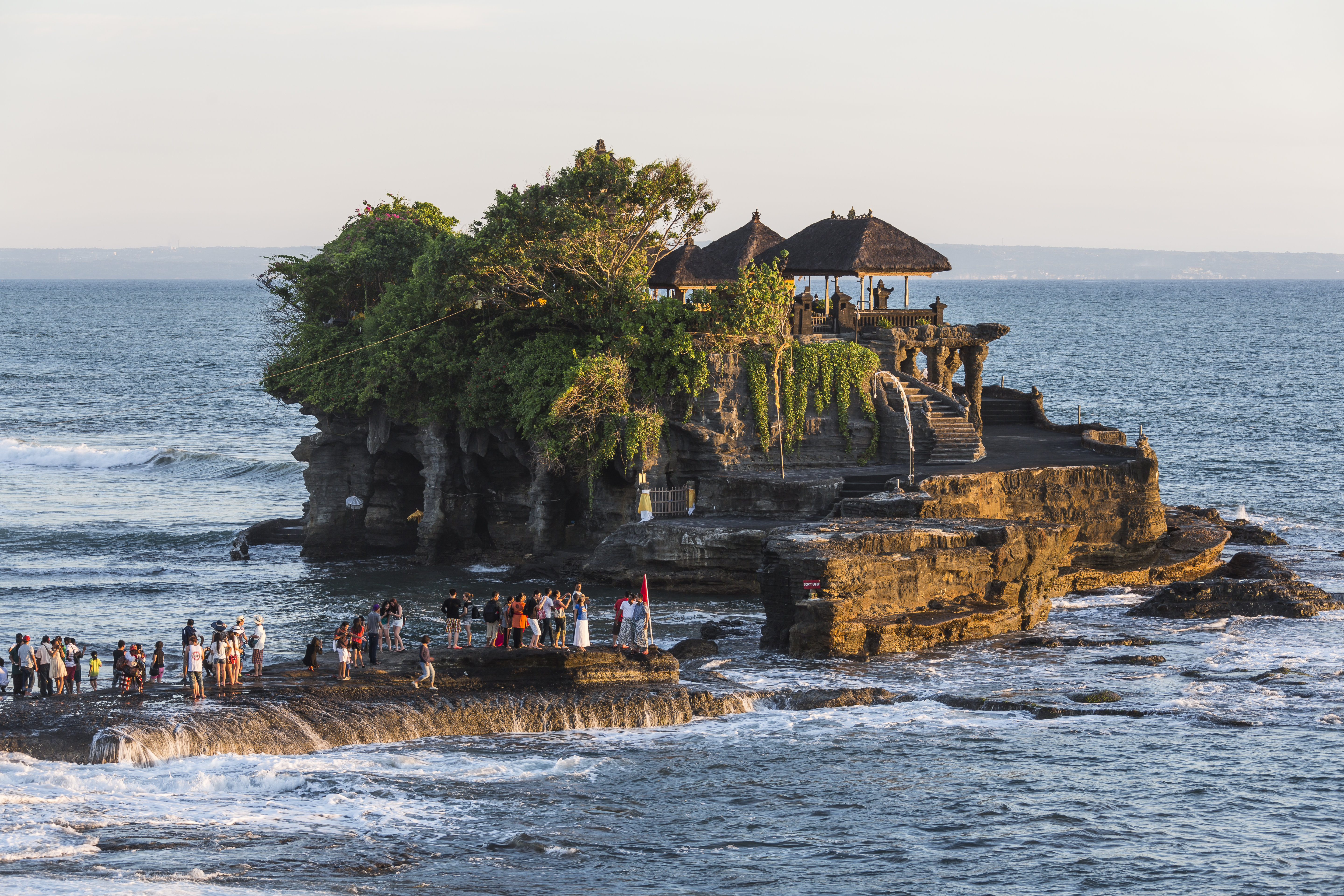
Tanah Lot is a spectacular Balinese sea temple perched on a rocky offshore outcrop, famous for its sunset views and sacred sea snakes.
Explore Temple

Indonesia
Uluwatu Temple
Uluwatu Temple is a spectacular Balinese sea temple perched on a 70-meter cliff edge at the southwestern tip of Bali, known for its Kecak fire dance performances and sunset views.
Explore Temple