UNESCO 1979NepalShiva
Pashupatinath Temple
Explore Pashupatinath Temple in Kathmandu, Nepal. Complete guide to the UNESCO World Heritage Shiva shrine, four-faced linga, Bagmati ghats, and timings.
Kathmandu, Nepal Shiva (Pashupatinath) Built: 5th century CE (original), 15th century (current structure)
Share
Overview
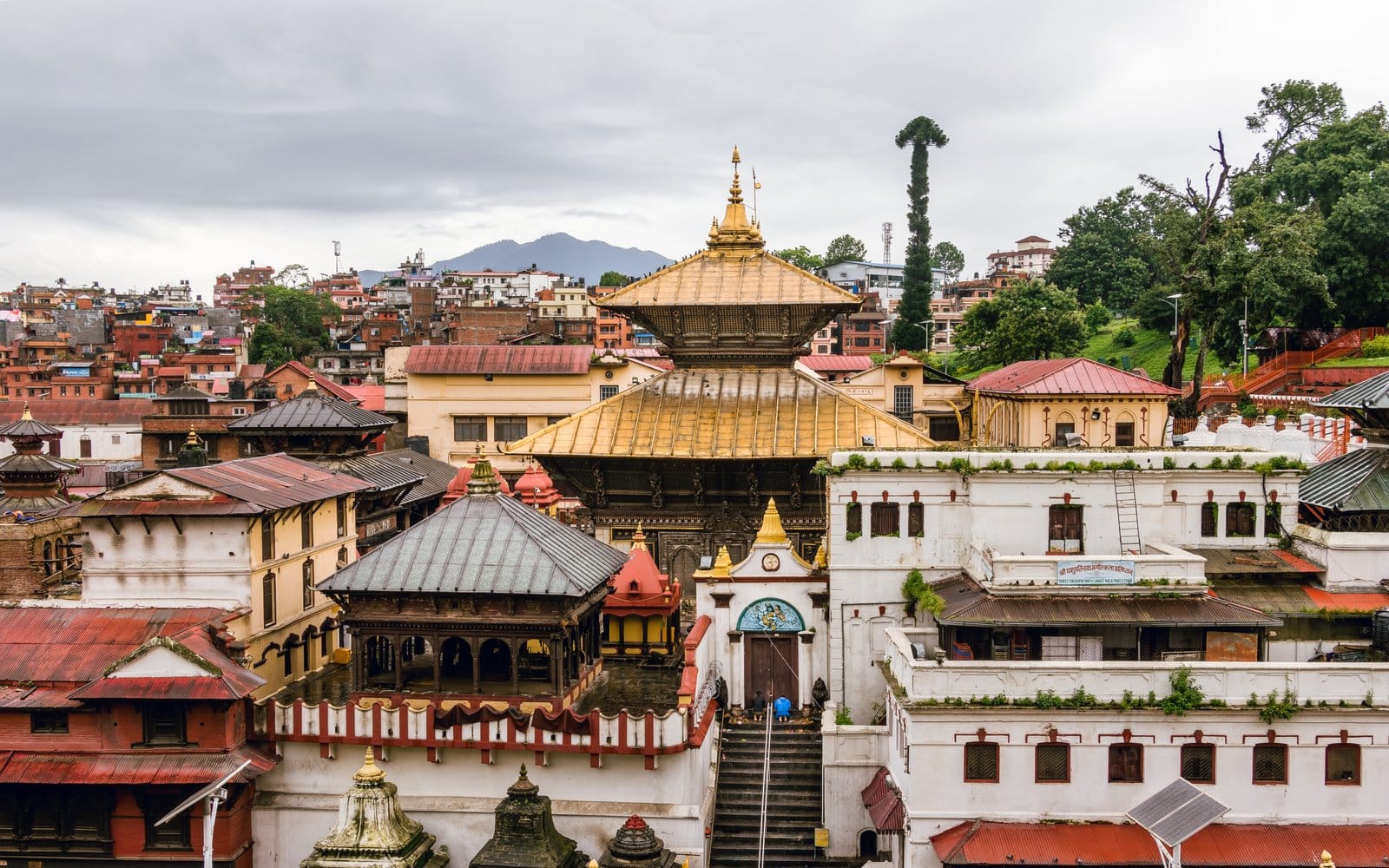
Pashupatinath Temple ranks among the holiest Hindu temples dedicated to Lord Shiva, located on the western bank of the Bagmati River in Kathmandu, Nepal. The temple is revered as one of the twelve Jyotirlingas, the sacred abodes of Shiva spread across the Indian subcontinent. For Shaivites worldwide, Pashupatinath represents the supreme manifestation of Shiva as the Lord of all beings (Pashu-pati).
The temple complex sprawls over 600 bighas of land and contains 516 smaller temples, shrines, and monastic buildings. The main temple, with its distinctive two-tiered pagoda roof covered in gold and silver doors, rises elegantly against the Kathmandu skyline. The Bagmati River, considered as sacred as the Ganges, flows beside the temple, and its banks host cremation ghats where Hindus bring their dead for final rites.
Pashupatinath is not merely a tourist attraction but a living, breathing center of Hindu spirituality. Every day, hundreds of sadhus, ascetics, and devotees perform rituals, chant mantras, and offer prayers. The temple grounds buzz with activity from dawn until dusk, making it among the most intensely spiritual sites in the world.
Quick Facts
Deity
Shiva
Location
Kathmandu, Nepal
Built
5th century CE (original), 15th century (current structure)
Built By
King Prachanda Dev (original), King Bhupalendra Malla (reconstruction)
UNESCO
1979
Coordinates
27.71, 85.35
Timings
Complex open 4:00 AM – 9:00 PM daily; inner sanctum darshan 5:00 AM – 12:00 PM and 5:00 PM – 7:00 PM (closed to non-Hindus)
Entry Fee
NPR 1,000 per entry for foreign visitors; free for Indian and Nepali citizens
History
The origins of Pashupatinath Temple are shrouded in both history and mythology. The earliest historical references to the temple date back to the Licchavi period, around the 5th century CE, when King Prachanda Dev is credited with establishing the original structure. However, Nepalese tradition holds that the temple has existed since the beginning of the Kali Yuga, over 300,000 years ago, when a linga spontaneously appeared at this location.
The current main temple building was constructed in the 15th century by King Bhupalendra Malla after the original structure was severely damaged by termites. The Malla kings of the Kathmandu Valley were great patrons of the temple, adding the golden roof, silver doors, and surrounding shrines. The Shah dynasty, which unified Nepal in 1768, continued this tradition of patronage.
A devastating earthquake in 1934 caused significant damage to the temple complex, but it was meticulously restored by the Nepalese government with support from devotees worldwide. In 1979, UNESCO designated Pashupatinath Temple as a World Heritage Site as part of the Kathmandu Valley UNESCO World Heritage listing. Today, the temple is managed by the Pashupatinath Area Development Trust under the Government of Nepal.
Architecture
Pashupatinath Temple is a masterpiece of Nepalese pagoda architecture, a distinctive style that later influenced temple construction across Tibet, China, and the Himalayas. The main temple building features a two-tiered roof constructed of copper covered in gold leaf, supported by intricately carved wooden struts depicting various Hindu deities and mythical beings. The roof beams are adorned with brass and copper ornaments that catch the sunlight.
The sanctum sanctorum houses the Chaturmukha (four-faced) linga of Shiva, a unique feature not found in most Shiva temples. Each face represents a different aspect of Shiva: Sadyojata (west), Vamadeva (north), Tatpurusha (east), and Aghora (south). The fifth face, Ishana, is conceptual and points upward. The linga is enclosed within a silver-plated mandapam (pavilion) decorated with intricate repoussé work.
The temple entrance is guarded by massive silver doors featuring embossed images of Bhairav, Shiva's fierce form, and other deities. Surrounding the main temple are 516 smaller shrines, including a large statue of Nandi, Shiva's bull mount, facing the sanctum. The outer walls of the complex feature chaityas, stupas, and temples representing both Hindu and Buddhist traditions, reflecting Nepal's syncretic religious culture.
Main Deity
Shiva
Shiva (Pashupatinath)
Religious Significance
Pashupatinath Temple holds unparalleled significance in the Hindu world as one of the twelve Jyotirlingas, the most sacred manifestations of Lord Shiva. According to the Shiva Purana, the Pashupatinath Jyotirlinga represents the aspect of Shiva as the protector of all living beings. The temple is particularly important for Shaivites from Nepal and India, who consider a pilgrimage to Pashupatinath essential for spiritual liberation.
The temple also occupies a central role in Nepalese national identity. As the tutelary deity of the Shah dynasty and the royal family, Pashupatinath was historically the most important state temple of the Kingdom of Nepal. Even today, the temple is the focal point of Nepal's Hindu-majority population and a powerful symbol of the country's religious heritage.
For Hindus, death at Pashupatinath is considered exceptionally auspicious. The cremation ghats along the Bagmati River are among the most sacred cremation sites in the world, and many elderly Hindus come to Kathmandu specifically to spend their final days near the temple. The belief is that those cremated here achieve moksha, liberation from the cycle of rebirth.
Temple Legends
The most famous legend of Pashupatinath involves the god Shiva himself. According to the Nepal Mahatmya, Shiva once disguised himself as a deer and wandered the forests of the Kathmandu Valley. The other gods, unable to find him, grew concerned. When they finally discovered him in the forest, Shiva bounded away into the sky, but his horn broke off and fell to the ground. The broken horn transformed into a linga, which became the original Pashupatinath.
Another legend tells of King Bhupalendra Malla, who rebuilt the temple in the 15th century. The story says that the king dreamed of a golden deer that led him to the exact spot where the original linga was buried. Upon excavating the site, he discovered the ancient linga and built the current temple over it. The king was so devoted to Shiva that he eventually renounced his throne and became a wandering ascetic.
A third narrative involves the great sage Veda Vyasa, who is said to have medicated at Pashupatinath. According to local tradition, Vyasa composed parts of the Puranas while seated on a rock beside the Bagmati River. The rock, known as Vyasa Gufa (Vyasa's Cave), remains a pilgrimage site within the temple complex.
Festivals & Celebrations
Maha Shivaratri is the grandest festival at Pashupatinath Temple, drawing over one million pilgrims from across Nepal, India, and the world. The celebration lasts for three days and nights, with all-night chanting of Vedic hymns, offerings of bhang and milk to the linga, and processions of naked sadhus (Naga Babas) who converge on the temple from remote Himalayan caves. The atmosphere is electric with devotion, smoke from countless dhuni (sacred fires), and the ringing of temple bells.
Other major festivals include Teej, a women's festival devoted to Parvati, where women dressed in red saris fast and pray for marital bliss. Bala Chaturdashi is a unique Pashupatinath festival where devotees light butter lamps and scatter seven types of grain seeds to honor the dead. The festival of Shivaratri is celebrated monthly on the 14th day of the dark fortnight, but the annual Maha Shivaratri in February-March is the most important.
The temple also observes the Bada Dashain festival with special ceremonies. During the months of Shravan (July-August) and Kartik (October-November), the temple sees a significant increase in pilgrims who believe that offerings made during these months bring multiplied blessings.
Visitor Information
Timings
Complex open 4:00 AM – 9:00 PM daily; inner sanctum darshan 5:00 AM – 12:00 PM and 5:00 PM – 7:00 PM (closed to non-Hindus)
Entry Fee
NPR 1,000 per entry for foreign visitors; free for Indian and Nepali citizens
Dress Code
Modest clothing covering shoulders and knees required
Photography
Photography allowed in outer courtyard, prohibited inside the main temple
Best Time to Visit
The best time to visit Pashupatinath Temple is between October and March, when Kathmandu's weather is cool and dry. The skies are clear, offering excellent views of the temple's golden roof and the surrounding valley. This period also coincides with the peak festival season, including Maha Shivaratri in February-March, which offers the most spectacular experience of the temple's spiritual vitality.
Visiting during the early morning hours (5:00 AM – 8:00 AM) is recommended to witness the morning aarti and the temple at its most serene. The sunset aarti at the Bagmati ghats, held daily at around 6:00 PM, is a powerful ritual where priests offer lamps to the river accompanied by chanting and drumming.
The monsoon season (June-September) brings heavy rainfall and increased humidity, but the temple remains open and less crowded. Shravan (July-August) is a particularly important month for Shiva worship despite the rain.
How to Reach
Pashupatinath Temple is located approximately 5 kilometers northeast of Kathmandu's city center. Tribhuvan International Airport is the primary entry point, about 3 kilometers from the temple. From the airport, taxis and ride-sharing services can reach the temple in 15-20 minutes depending on traffic.
From central Kathmandu (Thamel, Durbar Square area), the temple is accessible by taxi (15-30 minutes), local bus (routes to Chabahil or Gaushala), or bicycle. A scenic walk along the Bagmati River is also possible for those staying nearby. The temple is well-connected by the ring road, and parking is available for private vehicles.
For pilgrims coming from India, there are direct flights from Delhi, Varanasi, Mumbai, and Kolkata to Kathmandu. Overland routes exist through the Sunauli-Bhairahawa and Raxaul-Birgunj border crossings, followed by bus or domestic flights to Kathmandu.
Nearby Attractions
The Guhyeshwari Temple, one of the 51 Shakti Peethas, is located just 500 meters from Pashupatinath and is often visited as part of the same pilgrimage. The Boudhanath Stupa, one of the largest Buddhist stupas in the world, lies about 2 kilometers to the east. Kathmandu Durbar Square, a UNESCO World Heritage Site, is 4 kilometers southwest.
The Bodhisattva Garden, the Pashupatinath Museum, and the Deopatan neighborhood with its old Newari houses are within walking distance. The site of the 2015 earthquake memorial garden is also nearby, offering a place for reflection. The Swoyambhunath Stupa (Monkey Temple), on a hilltop west of the city, provides panoramic views of Kathmandu Valley and is about 6 kilometers away.
Interesting Facts
- Pashupatinath is one of the very few temples in the world where the linga has four faces (Chaturmukha), each representing a different aspect of Shiva.
- The temple's gold roof was donated by King Bhupalendra Malla in the 15th century and uses approximately 20 kg of pure gold.
- Despite being a Hindu temple, Pashupatinath's main gate faces east while its secondary entrance faces west, a rare orientation that aligns with both Vastu and local geographical features.
- The temple is one of the few places where the ancient tradition of Kapalika ascetics can still be observed; these sadhus carry skull-topped staffs and practice Tantric rites.
- An estimated 7,000 cremations are performed annually on the banks of the nearby Bagmati River ghats.
- The temple complex includes a Panchadeval complex, believed to have been built in the 16th century by Queen Gangamati, a former queen who renounced her throne.
Frequently Asked Questions
Can non-Hindus enter Pashupatinath Temple?
Non-Hindus are permitted in the outer courtyard and can view the main temple from the eastern bank of the Bagmati River, but they are not allowed inside the inner sanctum or the main temple building. Special viewing platforms provide excellent views of the temple and rituals.
What is the dress code for visiting Pashupatinath?
Modest clothing that covers shoulders and knees is required. Shorts, sleeveless tops, and revealing clothing are not permitted. Men wear a kurta or shirt with trousers, and women wear saris, salwar kameez, or long skirts.
Is Pashupatinath one of the 12 Jyotirlingas?
Yes, Pashupatinath is universally recognized as one of the 12 Jyotirlingas, the most sacred Shiva shrines in Hinduism. It is the only Jyotirlinga located outside India, making it especially significant for Nepalese Hindus.
What is the best day to visit Pashupatinath?
Mondays are considered the most auspicious day for Shiva worship and see the highest number of devotees. The Monday closest to the full moon (Somavati Amavasya) is particularly sacred.
Are there any accommodation options near the temple?
Yes, there are numerous hotels and guesthouses in the Pashupatinath area, ranging from budget lodges to mid-range hotels. Many pilgrim hostels (dharamshalas) offer free or low-cost accommodation for genuine pilgrims.
Sources & References
— every record linked above was re-requested for this release, so the link still resolves and the publisher still serves the document. It is a link check, not a re-verification of every sentence on this page.
More Temples in Nepal
Explore other Hindu temples in Nepal.
Nepal
Muktinath Temple
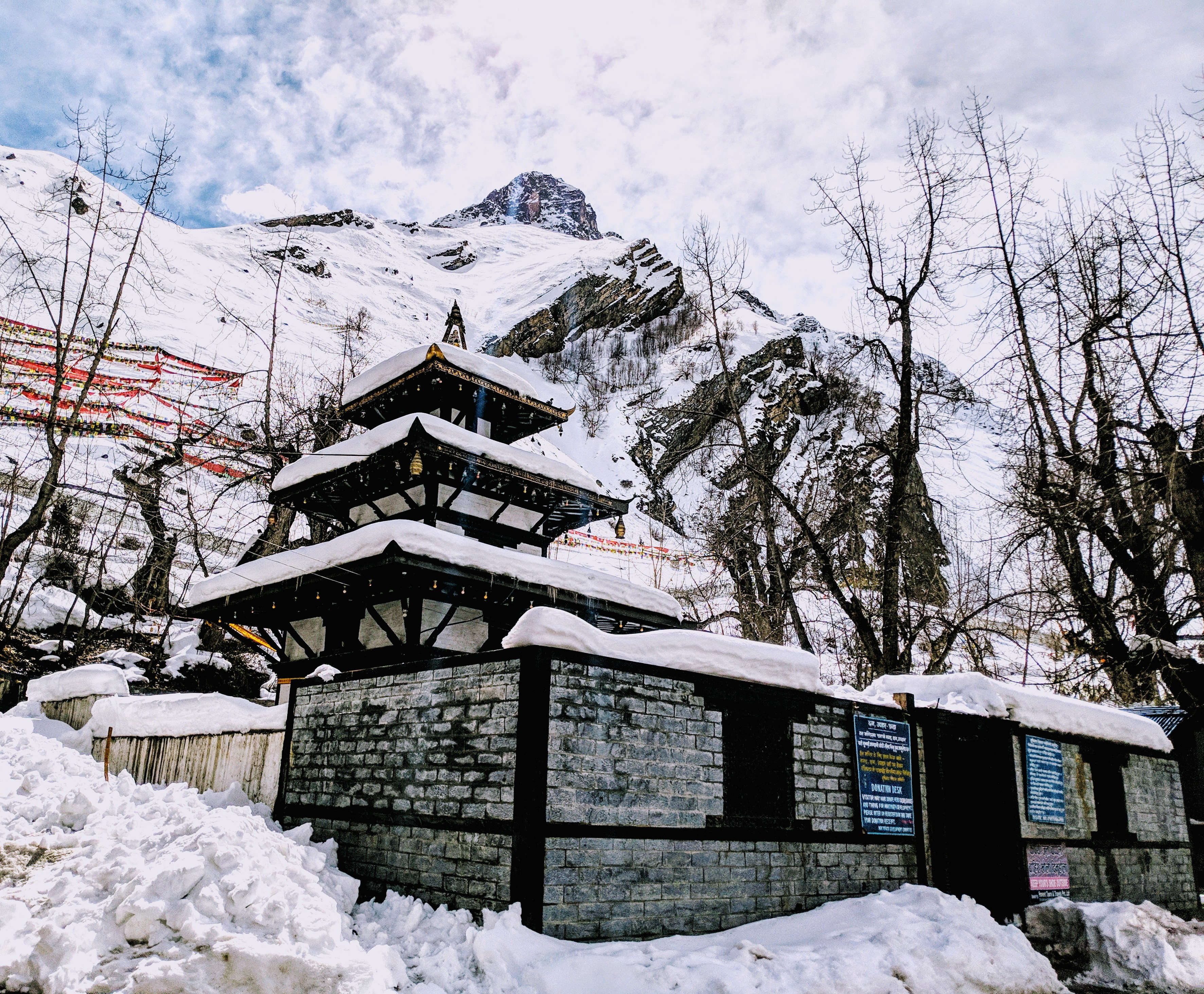
Situated at 3,710 meters in the Mustang district, Muktinath Temple is sacred to both Hindus and Buddhists, known for its 108 water spouts and eternal flame.
Explore Temple

Nepal
Manakamana Temple
Perched at 1,300 meters in the Gorkha district, Manakamana Temple is dedicated to the goddess Bhagwati and is renowned as a wish-fulfilling shrine accessible by cable car.
Explore Temple

Nepal
Guhyeshwari Temple
Located near Pashupatinath in Kathmandu, Guhyeshwari Temple is one of the 51 Shakti Peethas, representing the most secret and powerful manifestation of the goddess.
Explore Temple