
🇦🇪
Hindu Temples in the UAE
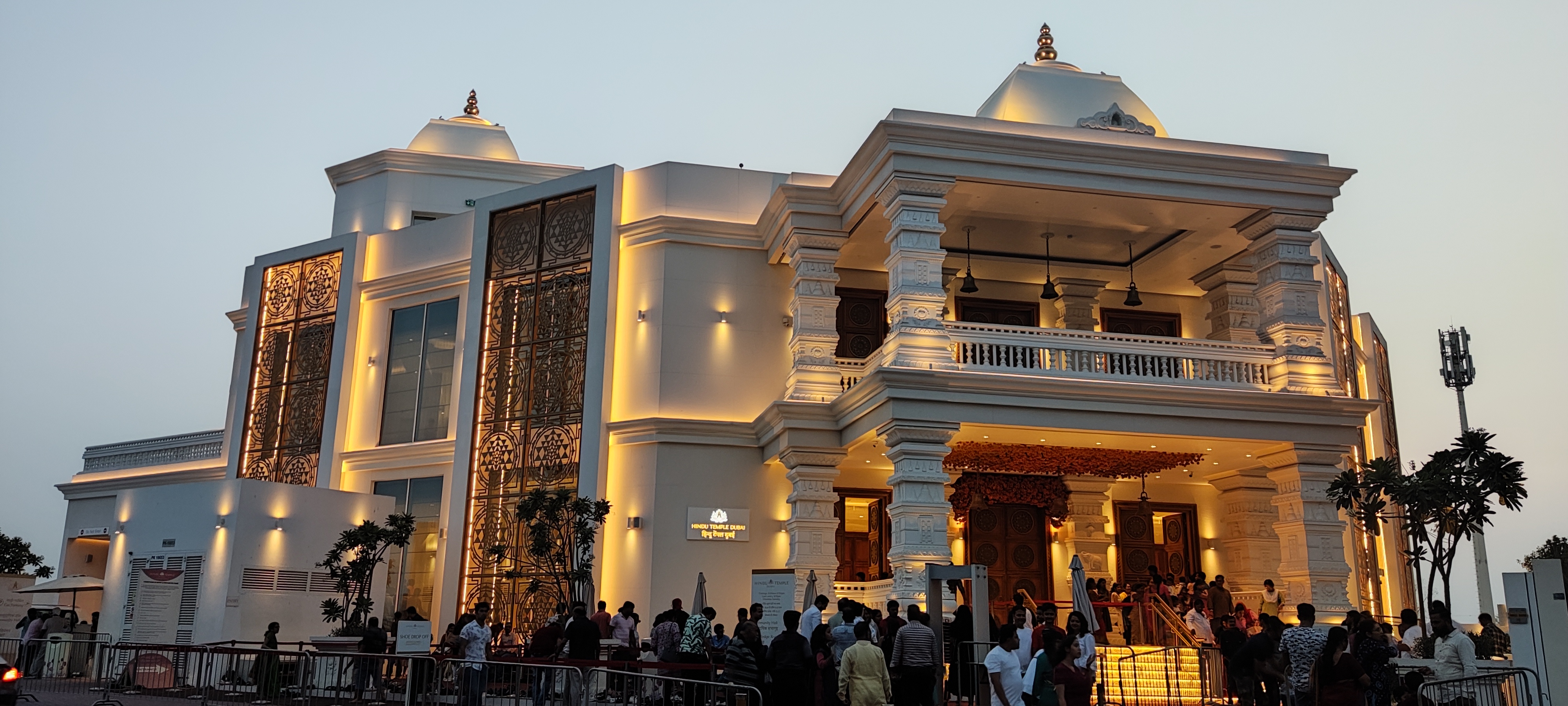
The UAE is home to three actively functioning permanent consecrated Hindu temple complexes: the landmark 2024 BAPS Hindu Mandir in Abu Dhabi, the 2022 Hindu Temple Dubai in Jebel Ali, and the historic 1958 Shri Krishna Haveli in Bur Dubai (with worship from the historic Bur Dubai Shiva Mandir relocated to Jebel Ali in Jan 2024).
4 Temples Profiled Middle East Abu Dhabi
Direct Answer
How Many Hindu Temples Are in the UAE?
The United Arab Emirates has three actively functioning permanent consecrated Hindu temple complexes open for public worship: the hand-carved stone BAPS Hindu Mandir in Abu Dhabi, the modern multi-faith Hindu Temple Dubai in Jebel Ali, and the historic Shri Krishna Haveli in Bur Dubai. A fourth historic site—the Bur Dubai Shiva Mandir—had its worship operations relocated to Jebel Ali in January 2024.
Actively Functioning Consecrated Complexes
3 Active Today
BAPS Hindu Mandir (Abu Dhabi, 2024), Hindu Temple Dubai (Jebel Ali, 2022), and Shri Krishna Haveli (Bur Dubai, 1958).
Relocated Historic Site
1 Relocated Site
Historic Bur Dubai Shiva Mandir (1958), whose daily worship operations were formally shifted to Jebel Ali on 3 January 2024 to relieve congestion.
Estimated Hindu Population
~660,000+
Indian expatriates and diaspora residents worshipping across the licensed complexes.
Sacred Places India Directory
4 Documented Sites
Our database profiles all 4 historic and active complexes (3 active and 1 relocated) with verified architecture, darshan rules, and travel guides.
How Temple Numbers Are Counted
Unlike nations with informal storefront shrines, the UAE strictly regulates all non-Muslim places of worship through formal government licensing and official land grants. Religious institutions are administered by the Department of Community Development (DCD) in Abu Dhabi and the Community Development Authority (CDA) in Dubai. Only permanent, consecrated institutions holding official state authorization are recognized as temples.
Sacred Places India Database Scope
Because religious construction in the UAE is governed strictly by royal decrees and municipal licensing, the complexes documented on Sacred Places India represent the complete set of recognized Hindu temple complexes in the UAE.
Introduction
The United Arab Emirates preserves a distinct Hindu heritage rooted in Indian Ocean trade and expanded through modern diaspora migration. With over 660,000 Hindu residents, the nation accommodates worship through dedicated religious quarters. The opening of the hand-carved stone BAPS Hindu Mandir in Abu Dhabi (2024) and the interfaith worship complex in Jebel Ali, Dubai (2022) represent formal institutional recognition of Hindu worship in the Arabian Peninsula.
4
Profiled Temples
Middle East
Region
Abu Dhabi
Capital
Arabic
Language
Major Hindu Communities
The community includes long-established mercantile families from Gujarat and Sindh, alongside professionals and workers from Kerala, Tamil Nadu, Andhra Pradesh, and Maharashtra. Worship reflects Pushtimarg Vaishnavism, Shaivism, and the Swaminarayan tradition.
Regional Temple Distribution
Places of worship are located in two primary hubs: Dubai (historic Bur Dubai and the Jebel Ali Worship Complex) and Abu Dhabi (the standalone Abu Mureikha campus). Other northern emirates do not currently maintain permanent independent Hindu temple buildings.
History of Hinduism in the UAE
Hindu mercantile presence along the Trucial Coast dates to the late 19th and early 20th centuries, when Bhatia, Sindhi, and Gujarati traders operated along Dubai Creek. In 1958, Sheikh Rashid bin Saeed Al Maktoum granted permission for a shrine complex in Bur Dubai's historic Al Fahidi quarter, housed in a traditional wind-tower structure. Following UAE unification in 1971 and rapid economic expansion, the Indian expatriate population grew substantially. In 2015, the UAE government allocated land in Abu Dhabi for a traditional stone temple, leading to the consecration of the BAPS Mandir in February 2024. In January 2024, services from the historic Bur Dubai Shiva Mandir were formally shifted to the new Jebel Ali complex to provide expanded facilities.
Pilgrimage & Cultural Significance
The BAPS Hindu Mandir in Abu Dhabi functions as the primary regional pilgrimage and cultural destination for Hindus across the Middle East. Together with the historic Bur Dubai Krishna Haveli and the modern multi-faith temple in Jebel Ali, these complexes support daily worship, major festival observances like Diwali and Janmashtami, and community welfare programs.
Architecture Overview
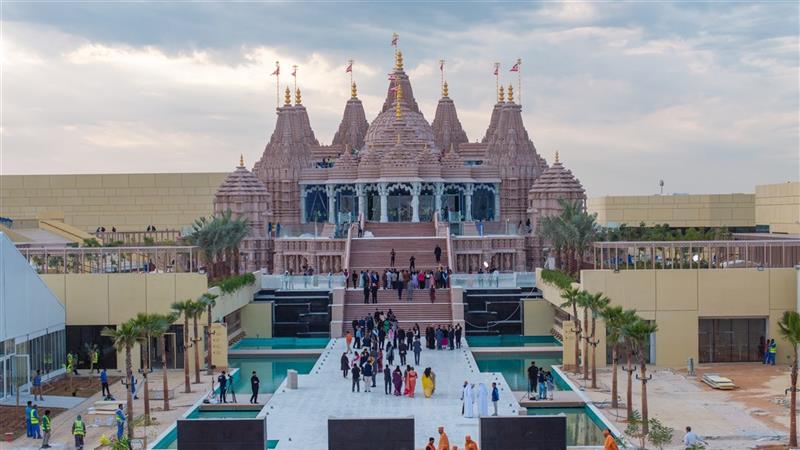
The BAPS Hindu Mandir Abu Dhabi follows traditional Rajasthani and Gujarati Shilpa Shastra stone architecture, constructed from pink sandstone from Rajasthan and Italian Carrara marble without structural steel or reinforced concrete. Its seven shikharas (spires) represent the seven emirates of the UAE. In contrast, the historic Krishna shrine in Bur Dubai occupies adapted premises, while the Jebel Ali Hindu Temple presents a contemporary blend of Indian temple motifs with modern Arabian architectural lines.
Temple Directory
Explore documented Hindu temples in the UAE.
UAE
BAPS Hindu Mandir Abu Dhabi
The first traditional hand-carved Hindu stone temple in the Middle East, inaugurated in 2024 on 13.5 acres in Abu Dhabi, symbolizing interfaith harmony.
Explore Temple
UAE
Shiva and Krishna Temple
The oldest Hindu temple in Dubai, established in 1958 in the historic Al Fahidi neighborhood, serving the South Indian expatriate community with dual shrines to Shiva and Krishna.
Explore Temple

UAE
Shree Krishna Haveli
A historic Krishna temple established in 1972 in Bur Dubai, serving the Sindhi and North Indian Hindu communities with vibrant festivals and devotional services.
Explore Temple

UAE
Sindhi Guru Darbar Temple
A vibrant temple serving Dubai's Sindhi Hindu community with inclusive worship, regular satsangs, and one of the largest community kitchens in the UAE.
Explore Temple
Documentation Methodology & Scope
Research & Selection Criteria
Documentation is based on official temple trust disclosures, municipal registration records, and verified site visits. Only permanent, consecrated Hindu places of worship with public access are catalogued.
Scope Boundaries & Limitations
Temporary festival halls, residential prayer rooms, and informal gatherings are excluded from this directory, which tracks only permanent, recognized temple structures.
Travel Information
Temples are easily reached from Abu Dhabi International Airport and Dubai International Airport. The Abu Dhabi Mandir is situated in Abu Mureikha along the E11 highway connecting Abu Dhabi and Dubai, accessible by private vehicle or taxi. In Dubai, the historic Bur Dubai Krishna shrine is reachable via Al Fahidi Metro Station, while the Jebel Ali temple is located in the Religious Village near Energy Metro Station.
Best Time to Visit
November to March offers pleasant temperatures (20–28°C / 68–82°F) suitable for outdoor exploration. Summer months (June to September) experience extreme heat exceeding 42°C (108°F), requiring temple visits during early morning or evening hours. Major festival days attract substantial crowds requiring advance registration.
Verified Sources & References
Documentation for the UAE draws on official census statistics, heritage authorities, and registered temple trust archives.
- BAPS Swaminarayan Sanstha — Abu Dhabi Mandir Architecture & Opening Archives (2024)temple
- Dubai Community Development Authority (CDA) — Religious Institutions Directorygovernment
- Archaeological and Historical Records of Indian Ocean Trade — Dr. Roxani Margaritiacademic
- Khaleej Times Historical Archives — Bur Dubai Temple Establishment (1958–2024)news
Ministry of Culture and Youth, UAE
UAE heritage register and cultural sites directory
Official heritage designation, site management and visitor information for the monuments described on this page.
Open source (opens in a new tab)UNESCO World Heritage Centre
UNESCO World Heritage List — India
World Heritage inscription records for the internationally listed monuments named on this page.
Open source (opens in a new tab)INTACH
Indian National Trust for Art and Cultural Heritage
Architectural classification and conservation context for the temple traditions described on this page.
Open source (opens in a new tab)— every record linked above was re-requested for this release, so the link still resolves and the publisher still serves the document. It is a link check, not a re-verification of every sentence on this page.
Frequently Asked Questions
How many Hindu temples are there in the UAE?
The UAE currently has three active permanent consecrated Hindu temple complexes open for daily public worship: the hand-carved stone BAPS Hindu Mandir in Abu Dhabi (consecrated February 2024), the Hindu Temple Dubai in Jebel Ali (opened October 2022), and the historic Shri Krishna Haveli in Bur Dubai (founded 1958). Worship services from the historic Bur Dubai Shiva Mandir were officially relocated to the larger Jebel Ali complex in January 2024 to alleviate overcrowding, bringing the total number of profiled historic and active sites in our directory to four.
Is BAPS Hindu Mandir Abu Dhabi open to all visitors?
Yes, the BAPS Hindu Mandir Abu Dhabi welcomes visitors of all nationalities and faiths. Modest dress covering shoulders and knees is mandatory, and advance booking via the official temple portal is recommended on weekends and festival days.
What is the largest Hindu temple in the Middle East?
The BAPS Hindu Mandir in Abu Dhabi is the largest traditional hand-carved Hindu stone temple in the Middle East, situated on a 13.5-acre site (with an additional 13.5 acres for parking and facilities) in Abu Mureikha.