UAESwaminarayan
BAPS Hindu Mandir Abu Dhabi
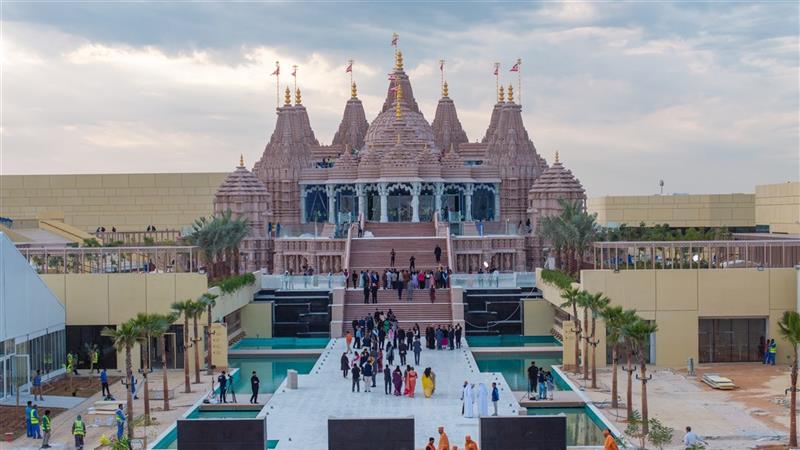
The first traditional hand-carved Hindu stone temple in the Middle East, inaugurated in 2024 on 13.5 acres in Abu Dhabi, symbolizing interfaith harmony.
Abu Dhabi, UAE Various (Swaminarayan) Built: 2024
Share
Overview
The BAPS Hindu Mandir in Abu Dhabi is the first traditional hand-carved stone Hindu temple built in the Middle East. Inaugurated on February 14, 2024, by Prime Minister Narendra Modi of India, the temple represents a notable chapter in Hindu presence in the Arabian Peninsula. The temple is constructed on 13.5 acres of land granted by the UAE government in Abu Mureikha.
The mandir follows the ancient Shikarbaddha style of temple architecture, entirely hand-carved from pink sandstone from Rajasthan and white marble from Italy. Over 3,000 artisans and 700 engineers worked on the project over several years, with the stone carving done in India before being shipped to Abu Dhabi for assembly. The temple's seven shikharas (spires) represent the seven emirates of the UAE, symbolically uniting Indian craftsmanship with local architectural planning.
More than a place of worship, the BAPS Hindu Mandir serves as a cultural center and exhibition space. Its walls display traditional Hindu iconography alongside narrative panels depicting civilizations from across the ancient world, including Egypt, Mesopotamia, and the Americas.
Quick Facts
Deity
Swaminarayan
Location
Abu Dhabi, UAE
Built
2024
Built By
BAPS Swaminarayan Sanstha
Coordinates
24.42, 54.61
Timings
9:00 AM – 8:00 PM daily (closed Mondays for maintenance)
Entry Fee
Free entry
History
The concept of building a traditional Hindu stone temple in Abu Dhabi was conceived in 2015, when the UAE government offered land to the BAPS Swaminarayan Sanstha for the construction of a mandir. The offer came during a visit by Crown Prince Sheikh Mohammed bin Zayed to India, reflecting the strong diplomatic and cultural ties between the two nations. The foundation stone was laid in 2019, and construction proceeded through the COVID-19 pandemic.
The project was executed under the direct supervision of Pujya Ishwarcharan Swami and the BAPS organization, which has built several other iconic temples globally, including Akshardham in Delhi (2005) and Neasden Temple in London (1995). The Abu Dhabi mandir, however, presented unique challenges: strict humidity control was required for the marble, the foundation had to withstand desert soil conditions, and the design had to comply with UAE building regulations while maintaining traditional temple proportions.
The temple was completed and consecrated in early 2024, with the opening ceremony attended by heads of state, religious leaders from multiple faiths, and thousands of devotees. The UAE declared February 14, 2024, as the official opening date, and the temple opened to the public shortly thereafter. Within its first month, over 500,000 visitors from around the world had passed through its gates.
Architecture
The BAPS Hindu Mandir Abu Dhabi is a masterpiece of traditional Shikarbaddha architecture, a style characterized by intricately carved spires (shikharas) and domed mandapams (pillared halls). The temple measures 262 feet in length and 180 feet in width, with seven shikharas rising to varying heights, the tallest reaching 108 feet. The spires represent the seven emirates and also symbolize the seven major continents of the world.
The temple is constructed entirely from hand-carved stone without any steel or reinforced concrete, following the ancient principle that sacred space should be created from natural materials. The pink sandstone comes from the Bansi Paharpur region of Rajasthan, while the white marble was sourced from Carrara, Italy. Each stone block was carved by artisans in Rajasthan and Gujarat, numbered, disassembled, shipped to Abu Dhabi, and reassembled on-site like a giant three-dimensional puzzle.
Over 600 pillars support the temple, each uniquely carved with depictions of deities, sages, flora, fauna, and dance postures. The temple features over 60 major murtis (sacred images) representing the Swaminarayan tradition as well as Shiva, Vishnu, Durga, Ganesh, Hanuman, and other Hindu deities. The external walls include carvings of the Egyptian Sphinx, Mesopotamian lamassu (winged bulls), Mayan temples, and even a representation of the Burj Khalifa, symbolizing the temple's embrace of world cultures.
Main Deity
Swaminarayan
Various (Swaminarayan)
Religious Significance
The BAPS Hindu Mandir Abu Dhabi holds profound significance for Hindus worldwide, particularly for those living in the Middle East. For decades, Hindu communities in the Gulf region worshipped in converted buildings, warehouses, and community centers. This temple represents the first legitimate, monumental Hindu religious structure in the Arabian Peninsula, giving the Hindu diaspora a permanent and dignified spiritual home.
Beyond the Hindu community, the temple is a powerful symbol of the UAE's model of religious tolerance. The UAE constitution guarantees religious freedom, and the government has consistently promoted interfaith dialogue. The land grant and support for the mandir demonstrate that this policy extends to supporting visible, monumental places of worship for minority faiths. The temple has been visited by Muslim, Christian, Jewish, Sikh, and Buddhist leaders who have praised its message of universal harmony.
The temple also represents a significant milestone in India-UAE relations. The two nations have grown increasingly close in trade, defense, and cultural cooperation. The mandir serves as a physical monument to this partnership, built with Indian craftsmanship on Emirati land, funded by devotees from both countries and around the world.
Temple Legends
Although the BAPS Hindu Mandir is a modern construction, the Swaminarayan tradition has its own foundational narratives that animate the temple's spiritual energy. The tradition traces its roots to Sahajanand Swami (1781-1830), also known as Bhagwan Swaminarayan, who is considered by followers as the supreme manifestation of God. According to BAPS teachings, the murtis installed in the temple are not merely representations but are consecrated as living embodiments of the divine, capable of receiving devotees' prayers and blessings.
A legend specific to the Abu Dhabi mandir involves the selection of the land itself. According to temple tradition, when the BAPS leadership first visited the site, they observed a natural sand dune formation that resembled the sacred syllable 'Om' when viewed from above. This was interpreted as a divine sign that the location was blessed and that the mandir would serve as a center for spreading the message of universal peace.
Another narrative recounts that during the construction, a severe sandstorm struck Abu Dhabi that halted all construction across the city. However, the area around the temple site reportedly remained calm, with workers continuing their work uninterrupted. Local devotees see this as evidence of divine protection over the project.
Festivals & Celebrations
The BAPS Hindu Mandir Abu Dhabi celebrates all major Hindu festivals with great enthusiasm, often drawing thousands of attendees from the UAE's diverse expatriate community. Diwali, the festival of lights, is celebrated with the temple illuminated by thousands of lamps and oil lights, with special ceremonies and cultural programs. The festival attracts visitors from all faiths and is one of the temple's most spectacular events.
Janmashtami, the birthday of Lord Krishna, features midnight celebrations with bhajans, dance performances, and a special abhishek (ritual bathing) ceremony. Navaratri is celebrated over nine nights with garba and dandiya raas performances, particularly popular among the Gujarati community that forms a significant part of the UAE's Hindu population. Holi, the festival of colors, is celebrated with dry colors and flowers in the temple courtyard.
The temple also observes Swaminarayan-specific festivals including the births of Bhagwan Swaminarayan and the lineage of gurus, as well as Maha Shivaratri, Ram Navami, and Hanuman Jayanti. Weekly Sunday satsang assemblies feature spiritual discourses, devotional singing, and community gatherings.
Visitor Information
Timings
9:00 AM – 8:00 PM daily (closed Mondays for maintenance)
Entry Fee
Free entry
Dress Code
Modest clothing covering shoulders and knees required; removal of footwear before entering the temple
Photography
Photography allowed in most areas; check for restrictions inside the inner sanctum
Best Time to Visit
The best time to visit the BAPS Hindu Mandir Abu Dhabi is between November and March, when the UAE enjoys its mild winter weather with daytime temperatures between 20°C and 30°C (68°F-86°F). The temple's open courtyards and walkways are most pleasant during these months. Evening visits are particularly recommended as the temple is beautifully illuminated after sunset, with the white marble glowing against the night sky.
Weekday mornings (9:00 AM – 12:00 PM) offer the most peaceful experience with smaller crowds. The temple hosts guided tours that provide detailed explanations of the architecture, symbolism, and the consecration rituals. The aarti ceremony at 12:00 PM and 7:30 PM is a highlight not to be missed.
Summer months (June-September) are extremely hot in Abu Dhabi, with temperatures often exceeding 45°C (113°F). However, the temple's marble interiors remain cool, and the management provides shaded walkways and water stations. Diwali (October-November) and the annual celebration of the temple's founding (February) are the most vibrant times to visit.
How to Reach
The BAPS Hindu Mandir is located in the Al Rahba area of Abu Dhabi, approximately 40 kilometers from Abu Dhabi city center and 120 kilometers from Dubai. The temple is easily accessible by car via the E11 (Abu Dhabi-Dubai highway), taking exit toward Al Rahba. The journey from Abu Dhabi takes 30-40 minutes, while from Dubai it takes approximately 1.5 hours.
Abu Dhabi International Airport (AUH) is about 25 kilometers from the temple, and Dubai International Airport (DXB) is about 110 kilometers away. Taxis and ride-sharing services (Uber, Careem) are available from both airports. For public transport, Abu Dhabi city buses serve the Al Rahba area, with a stop within walking distance of the temple.
The temple provides extensive parking for cars and buses. Many tour operators in both Abu Dhabi and Dubai offer half-day trips to the mandir, often combined with other cultural attractions. The dedicated access road from the highway is well-signposted with bilingual directions.
Nearby Attractions
The Sheikh Zayed Grand Mosque, one of the world's largest mosques, is about 30 kilometers from the temple and makes an excellent complement to a visit, showcasing the UAE's other major religious monument. The Louvre Abu Dhabi, a stunning museum of cross-cultural art, is 35 kilometers away on Saadiyat Island. Yas Island, with Ferrari World, Warner Bros. World, and Yas Waterworld, is approximately 40 kilometers from the temple.
Al Rahba itself is a developing residential area with several shopping centers and restaurants. The Abu Dhabi Desert Safari departure points are accessible from this area. The Dubai Expo City site, home to the Expo 2020 legacy pavilions, is about 100 kilometers toward Dubai but offers a fascinating cultural detour.
For those interested in architectural contrasts, the Qasr Al Watan (Presidential Palace) and the Etihad Towers in downtown Abu Dhabi showcase the evolution of Emirati architecture. The dates market near Al Rahba is worth a stop for traditional sweets and souvenirs.
Interesting Facts
- The BAPS Hindu Mandir Abu Dhabi is the first traditional Hindu stone temple in the entire Middle East, built without any steel or reinforced concrete.
- Each of the temple's seven shikharas represents one of the seven emirates of the UAE, symbolically unifying the country's diverse regions.
- The temple walls feature carvings of Egyptian pharaohs, Mesopotamian winged bulls, Mayan calendar symbols, and Native American dreamcatchers, alongside traditional Hindu motifs.
- Over 3,000 artisans from Rajasthan and Gujarat hand-carved the stone blocks in India before they were shipped to Abu Dhabi in more than 2,000 shipping containers.
- The murtis (sacred images) were consecrated through elaborate rituals involving fire ceremonies, Vedic chants, and offerings that spanned 30 days.
- The UAE government specifically allocated land for the temple as a gift of goodwill, estimated to be worth over USD 100 million.
Frequently Asked Questions
Is the BAPS Hindu Mandir Abu Dhabi open to non-Hindus?
Yes, the temple is open to people of all faiths and nationalities. Visitors are expected to dress modestly, remove footwear before entering, and respect the sanctity of the worship areas.
How much does it cost to visit the BAPS Mandir?
Entry is completely free. Donations are welcome but not required. Guided tours are also free of charge and provide excellent insight into the temple's architecture and spiritual significance.
What is the largest Hindu temple in the Middle East?
The BAPS Hindu Mandir Abu Dhabi is the largest traditional Hindu stone temple in the Middle East. It was built at a cost of approximately USD 200 million on 13.5 acres of land.
Are there vegetarian dining options near the temple?
Yes, the temple complex includes a vegetarian food court serving Indian cuisine. There are also several Indian restaurants in the nearby Al Rahba area.
Can I attend aarti at the temple?
Yes, the temple holds aarti ceremonies at 12:00 PM and 7:30 PM daily. Visitors are welcome to attend and participate. The evening aarti, with the temple illuminated against the night sky, is particularly moving.
Sources & References
— every record linked above was re-requested for this release, so the link still resolves and the publisher still serves the document. It is a link check, not a re-verification of every sentence on this page.
More Temples in UAE
Explore other Hindu temples in UAE.
UAE
Shiva and Krishna Temple
The oldest Hindu temple in Dubai, established in 1958 in the historic Al Fahidi neighborhood, serving the South Indian expatriate community with dual shrines to Shiva and Krishna.
Explore Temple

UAE
Shree Krishna Haveli
A historic Krishna temple established in 1972 in Bur Dubai, serving the Sindhi and North Indian Hindu communities with vibrant festivals and devotional services.
Explore Temple

UAE
Sindhi Guru Darbar Temple
A vibrant temple serving Dubai's Sindhi Hindu community with inclusive worship, regular satsangs, and one of the largest community kitchens in the UAE.
Explore Temple