
UAE
Sindhi Guru Darbar Temple
A vibrant temple serving Dubai's Sindhi Hindu community with inclusive worship, regular satsangs, and one of the largest community kitchens in the UAE.
Dubai, UAE Various Built: 1990s
Share
Overview
The historic Bur Dubai complex of the Sindhi Guru Darbar Temple — which housed Dubai's first Hindu temple, the 1958 Shiva Mandir, alongside its Gurudwara — closed for worship on 3 January 2024, when the congregation relocated to the new Hindu Temple Dubai complex in Jebel Ali (opened in October 2022). The temple's community life, Guru Ka Langar, and Sindhi devotional traditions continue at the Jebel Ali site, while the separate Krishna shrine remains at Bur Dubai.
In its original form, the Sindhi Guru Darbar Temple in Bur Dubai was a vibrant and inclusive Hindu temple that served as the spiritual and cultural heart of Dubai's Sindhi community. Established to serve the needs of the Sindhi Hindu diaspora — whose ancestors migrated from the Sindh region of present-day Pakistan during the 1947 Partition — the temple grew from a small prayer space into among the most active community temples in the UAE.
The temple's name reflects its dual nature: 'Guru Darbar' evokes the court of a spiritual teacher, emphasizing the temple's role in both worship and learning.
The temple has long distinguished itself through its exceptionally inclusive approach. While it primarily serves the Sindhi community, it welcomes all Hindus and people of other faiths to its programs and meals. The temple's hallmark has been its Guru Ka Langar, a free community kitchen inspired by the Sikh tradition of langar that grew into one of the UAE's largest, serving free vegetarian meals regardless of religion, nationality, or economic status.
This practice made the temple beloved across Dubai's diverse expatriate population.
the Sindhi Guru Darbar Temple is more than a place of worship; it is a community center, a cultural preservation society, and a food relief organization rolled into one. The temple organizes Sindhi language classes, devotional music workshops, and cultural events that keep the unique Sindhi Hindu heritage alive in the diaspora. Its open-door policy and commitment to service embody the Sindhi community's renowned resilience and generosity.
Quick Facts
Deity
Various
Location
Dubai, UAE
Built
1990s
Coordinates
25.26, 55.30
Timings
Note: the original Bur Dubai complex closed to worshippers on 3 January 2024. Worship continues at the Hindu Temple Dubai complex in Jebel Ali, open daily approximately 6:00 AM – 8:30 PM (evening aarti around 7:30 PM)
Entry Fee
Free entry
History
The Sindhi Guru Darbar Temple was established in the early 1990s in response to the growing needs of Dubai's Sindhi Hindu population. While the older Shiva and Krishna Temple (1958) and Shree Krishna Haveli (1972) served the broader Hindu community, the Sindhi community felt the need for a dedicated space where their unique cultural and religious traditions — combining Hindu devotion with Sindhi language, music, and customs — could be preserved and practiced.
The temple began in a modest villa in Bur Dubai before moving to a larger purpose-built facility. The expansion was funded entirely by donations from the Sindhi business community, which has been exceptionally successful in Dubai's trading, gold, and real estate sectors. The temple's growth paralleled the expansion of Dubai itself in the 1990s and 2000s.
The temple management committee established strong relationships with the Dubai government and other religious organizations. The temple was officially registered with the Dubai Community Development Authority and has participated in numerous interfaith initiatives. In recent years, the temple has become a destination for visiting dignitaries and international delegations interested in understanding the UAE's model of religious coexistence.
Architecture
The Sindhi Guru Darbar Temple occupies a modern multi-story building designed to serve both worship and community functions. The building's architecture blends contemporary Middle Eastern construction with traditional Indian temple elements. The entrance features a colorful torana (archway) with images of Hindu deities, floral motifs, and the Om symbol. The exterior walls are decorated with murals depicting scenes from Sindhi devotional poetry and the life of Guru Nanak, reflecting the temple's inclusive approach.
The main prayer hall on the ground floor is a spacious, column-free room that can accommodate up to 500 people for congregational worship. The sanctum houses multiple deities, with Krishna and Radha at the center, flanked by images of Shiva, Hanuman, Durga, and the Sikh Gurus (reflecting the Sindhi tradition of revering both Hindu deities and Sikh Gurus). The murtis are adorned with traditional Sindhi embroidered textiles.
The upper floors house the Guru Ka Langar (community kitchen), a large dining hall capable of seating 300 people, a library, classrooms for language instruction, and an auditorium for cultural events. The building's roof features a small temple tower (shikhara) that rises above the surrounding buildings, making the temple visible from a distance. The tower is illuminated at night, serving as a beacon for the community.
Main Deity
Various
Religious Significance
For the Sindhi Hindu diaspora in the UAE, the Guru Darbar Temple is nothing less than a cultural lifeline. The Sindhi community, which lost its ancestral homeland in Sindh during the 1947 Partition, has been exceptionally successful in preserving its identity through religion, language, and cuisine. The temple is the primary institution through which Sindhi culture is transmitted to younger generations born and raised in the UAE.
Children attend Sindhi language classes at the temple, learn traditional Sindhi bhajans, and participate in festivals that maintain continuity with pre-Partition Sindhi traditions.
The temple's community kitchen (Guru Ka Langar) is its most significant contribution to Dubai's social fabric. The free meal service, which operates daily, serves thousands of people regardless of their religion, nationality, or economic status. The kitchen has become a symbol of the Sindhi community's commitment to seva (selfless service) and has inspired similar initiatives at other temples in the UAE.
The temple also plays a significant role in interfaith relations in Dubai. Its open-door policy and community kitchen attract visitors from all backgrounds, fostering understanding and friendship across religious boundaries. The temple regularly hosts school groups, university students, and international visitors who want to learn about Hinduism and Sindhi culture in the context of multicultural Dubai.
Temple Legends
The Sindhi Guru Darbar Temple is founded on the spiritual legacy of the Sindhi Sant (saint) tradition. The most revered figure in this tradition is Sadhu Belo (1840-1910), a Sindhi saint who established a famous temple on an island in the Indus River near Sukkur, Sindh. The Guru Darbar Temple in Dubai considers itself a spiritual successor to the Belo Temple, carrying forward the saint's teachings of devotion, service, and interfaith harmony.
Another influential figure is Jhulelal, the patron saint of the Sindhi community. Jhulelal is revered as an incarnation of the river god Varuna and is associated with the victory of good over evil. The temple celebrates Jhulelal Jayanti with great fervor, and the saint's image holds a prominent place in the sanctum. According to tradition, Jhulelal protects Sindhi people wherever they may be, making the Dubai temple a particular focus of his blessings for the diaspora community.
The temple's community kitchen has its own origin story. According to temple history, during the construction of the building, food was served to all the workers without distinction of religion or caste. This practice was so well-received that the temple decided to continue it permanently. The founders reportedly saw a vision of Sadhu Belo himself serving food to the hungry, which they took as a divine instruction to feed all who came to the temple.
Festivals & Celebrations
The Sindhi Guru Darbar Temple celebrates the full Hindu festival calendar with distinctive Sindhi cultural additions. Jhulelal Jayanti, the birthday of the Sindhi community's patron saint, is the most uniquely Sindhi celebration at the temple. The event features the procession of Jhulelal's image, Sindhi devotional songs, and distribution of special prasad including Sindhi specialities like sai bhaji and chawrani.
Cheti Chand, the Sindhi New Year, is celebrated with great enthusiasm. The temple organizes a grand procession with music, dancing, and decorated floats that winds through the streets of Bur Dubai, with participation from the entire Sindhi community. The festival marks the beginning of the Sindhi calendar year and is observed with prayers for prosperity.
Other major festivals include Diwali (with thousands of lamps and the distribution of traditional Sindhi sweets like sekar parfi and koki), Holi, Janmashtami, and Navaratri. The temple also celebrates Guru Nanak Gurpurab with special programs, reflecting the Sindhi tradition of reverence for the Sikh Gurus. The temple's unique contribution to the festival calendar is the celebration of the birthdays of prominent Sindhi saints and poets.
Visitor Information
Timings
Note: the original Bur Dubai complex closed to worshippers on 3 January 2024. Worship continues at the Hindu Temple Dubai complex in Jebel Ali, open daily approximately 6:00 AM – 8:30 PM (evening aarti around 7:30 PM)
Entry Fee
Free entry
Dress Code
Modest dress required; head coverings recommended in the prayer hall
Photography
Photography allowed with permission; avoid photographing devotees without consent
Best Time to Visit
The best time to visit the Hindu Temple Dubai complex at Jebel Ali is during the cooler months from November to March, when Dubai's weather is pleasant and daytime temperatures are comfortable. The Aarti service in the late afternoon or the evening aarti (around 7:30 PM) is the ideal moment to experience the temple's devotional atmosphere.
The temple is particularly vibrant during Cheti Chand (the Sindhi New Year, in March-April) and Jhulelal Jayanti (July-August), when the Sindhi community's distinctive celebrations are on full display. Diwali (October-November) sees the complex beautifully lit with traditional lamps.
Weekday mornings are the most peaceful time to visit for darshan and personal prayer. Weekends and major festivals such as Diwali and Maha Shivaratri draw large crowds, so arrive early; the temple management often runs an online registration system for festival visits.
How to Reach
Worship for the Sindhi Guru Darbar congregation now takes place at the Hindu Temple Dubai complex in Worship Village, Jebel Ali Village, roughly 35 kilometers southwest of Dubai's city center off Sheikh Zayed Road (E11). The complex sits beside the Guru Nanak Darbar Sikh Gurudwara and several churches within a designated multi-faith precinct. From anywhere in Dubai, taxis or ride-hailing (Uber, Careem) are the most direct option, taking around 35-45 minutes from central Dubai depending on traffic.
By metro, take the Red Line towards Expo 2020 and alight at Ibn Battuta or Energy Station, then complete the final leg by bus (route F44 stops close to the temple) or a short taxi ride (approx. AED 12-20). The Krishna Temple in Bur Dubai, which remains open, can be reached by continuing to Al Fahidi area stops.
It is worth checking the RTA apps or official temple site before a festival visit, as crowds are large around Diwali and Maha Shivaratri.
Nearby Attractions
At the Jebel Ali complex, the Guru Nanak Darbar Sikh Gurudwara, several churches, and other faith centres sit side by side in the multi-faith Worship Village, making it easy to combine visits. Ibn Battuta Mall, one of Dubai's largest shopping destinations, is nearby, and Expo City Dubai is within easy reach.
The historic temple district of Bur Dubai still retains the Krishna Temple only — the Shiva Mandir and Gurudwara that once stood there relocated to Jebel Ali in January 2024. The Al Fahidi Historical Neighbourhood, Dubai Museum, Dubai Creek abras, and the Textile and Gold Souks remain popular landmarks in Bur Dubai, on the other side of the city.
For a taste of Sindhi heritage, nearby restaurants in Jebel Ali and Bur Dubai serve specialties such as sai bhaji, dal pakwan, and papad.
Interesting Facts
- The Sindhi Guru Darbar Temple runs one of the largest free community kitchens in the UAE, serving over 2,000 free meals daily to people of all faiths.
- The temple is named 'Guru Darbar' to honor both Hindu saints and Sikh Gurus, reflecting the Sindhi tradition of revering spiritual teachers from multiple traditions.
- The temple's library holds one of the largest collections of Sindhi literature outside India and Pakistan, including rare books from pre-Partition Sindh.
- During Ramadan, the temple coordinates with local mosques to provide iftar meals for workers, exemplifying interfaith cooperation in Dubai.
- The temple has a dedicated women's committee that organizes monthly Satsang programs specifically focused on women's spiritual and social issues.
- The temple's Sindhi language classes are among the few places in the UAE where the Perso-Arabic script of Sindhi (used in Pakistan) is taught alongside the Devanagari script (used in India).
Frequently Asked Questions
What makes the Sindhi Guru Darbar Temple different from other Dubai temples?
The temple uniquely serves the Sindhi Hindu community and combines Hindu worship with reverence for Sikh Gurus. It is best known for its daily free community kitchen (Guru Ka Langar) that serves thousands of meals regardless of religion or background.
Is the community kitchen really free?
Yes, the Guru Ka Langar serves completely free vegetarian meals daily. The kitchen is funded entirely by donations from the community, and anyone is welcome to eat without any obligation.
What language are the temple services conducted in?
Services are conducted primarily in Sindhi and Hindi, with some segments in English. The temple offers translation services during major events to accommodate non-Sindhi visitors.
Can I volunteer at the community kitchen?
Yes, the temple welcomes volunteers for the community kitchen. Volunteers typically help with food preparation, serving, and cleaning. Contact the temple management in advance to arrange volunteer opportunities.
What is the significance of Jhulelal at this temple?
Jhulelal is the patron saint of the Sindhi community, revered as an incarnation of Varuna (the god of water). The temple celebrates Jhulelal Jayanti as its most important festival, and the saint's image holds a central place in the sanctum.
Sources & References
— every record linked above was re-requested for this release, so the link still resolves and the publisher still serves the document. It is a link check, not a re-verification of every sentence on this page.
More Temples in UAE
Explore other Hindu temples in UAE.
UAE
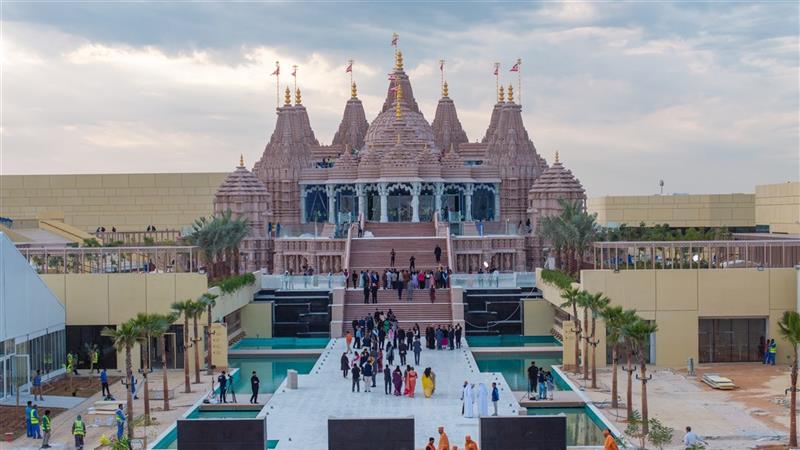
BAPS Hindu Mandir Abu Dhabi
The first traditional hand-carved Hindu stone temple in the Middle East, inaugurated in 2024 on 13.5 acres in Abu Dhabi, symbolizing interfaith harmony.
Explore Temple
UAE
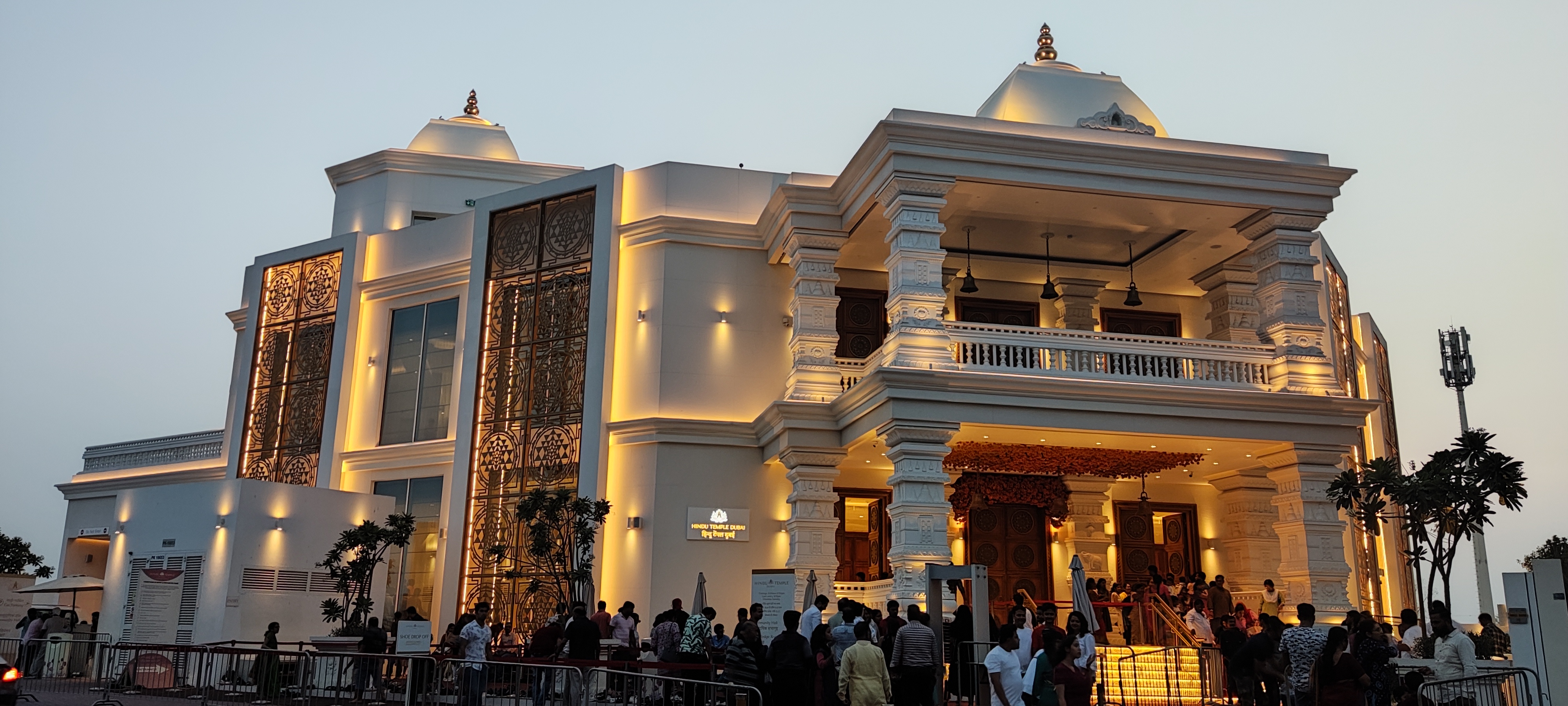
Shiva and Krishna Temple
The oldest Hindu temple in Dubai, established in 1958 in the historic Al Fahidi neighborhood, serving the South Indian expatriate community with dual shrines to Shiva and Krishna.
Explore Temple

UAE
Shree Krishna Haveli
A historic Krishna temple established in 1972 in Bur Dubai, serving the Sindhi and North Indian Hindu communities with vibrant festivals and devotional services.
Explore Temple