From ancient rock-cut marvels to towering imperial shrines, discover the architectural soul of Bharat through our verified digital archive.
Explore More Temples
Main Deity
Lord Venkateswara (Balaji / Srinivasa)
Style
Dravidian (Vijayanagara influence)
Location
Tirumala, Tirupati district
State
Andhra Pradesh
Significance
Richest temple, Swayambhu deity, 108 Divya Desams
Season
September to March
Daily Footfall
60,000–100,000 pilgrims
Management
Tirumala Tirupati Devasthanams (TTD)
Dynasty
Pallava, Chola, Vijayanagara
Main Vimana
Ananda Nilayam (gold-gilded)
Prasadam
Tirupati Laddu (GI tag 2009)
Darshan
24 hours; Sarva Darshan 3:30 AM – 1:00 AM
The temple's central sanctum houses a standing eight-foot-tall black stone deity of Lord Venkateswara, adorned with elaborate ornaments and holding a conch and discus. This inner shrine is topped by the Ananda Nilayam, a historic three-story vimana completely gilded in gold. The surrounding complex includes multiple concentric courtyards (prakaras) and administrative facilities designed for crowd circulation.
The word Swayambhu means self-manifested — a deity believed to have appeared on its own rather than being created by human hands. At Tirumala, the main deity of Lord Venkateswara is considered Swayambhu, and so it is never moved from its position in the sanctum.
The deity is a standing eight-foot (2.4-meter) black stone figure of Lord Venkateswara, also called Balaji, Srinivasa, or Govinda. In its upper hands it holds the Panchajanya conch and the Sudarshana Chakra, while the lower right hand is extended in the Abhaya Hasta (blessing posture) and the lower left rests on the waist. The image wears a crown studded with precious gems, diamond earrings, and a gold breastplate, and is ritually covered with sandalwood paste, turmeric, and kumkum applied daily during the Thomala ritual.
Because the main deity never leaves the sanctum, the temple uses a separate bronze processional image, Malayappa Swamy, which accompanies the utsava murtis of Sridevi and Bhudevi (Vishnu's consorts). It is Malayappa that is carried out on the festival vahanas during Brahmotsavam, Vaikunta Ekadasi, Rathasapthami, and other outdoor celebrations.
As one of the 108 Divya Desams, the holiest Vaishnava shrines enumerated by the Alvar saints between the 5th and 9th centuries CE, the sanctum at Tirumala stands at the heart of Vaishnava worship in South India.
The most famous legend of Tirumala explains why a hill temple receives offerings of money and gold from millions of devotees each year. According to Vaishnava tradition, the Venkateswara form is a composite deity that emerged when Vishnu descended to Earth in response to the prayers of the sage Bhrigu. The Puranas describe Venkateswara as the Lord of the Kali Yuga, the deity to be worshipped in the present age.
The most prominent legend concerns Venkateswara's marriage to Padmavati, an incarnation of Lakshmi. To fund the wedding, Venkateswara took a loan from Kubera, the god of wealth, and agreed to remain on Venkatadri Hill until the loan is repaid. This is why, tradition holds, he continues to reside at Tirumala to this day.
The legend also explains the defining spiritual economy of the shrine. Devotees who place money and gold in the temple hundi are understood to be helping to repay Venkateswara's debt to Kubera. Every offering is seen as a contribution toward settling the loan that financed the divine wedding, which is why giving at Tirumala carries such a poignant devotional meaning.
The seven hills of Tirumala are identified with Adishesha, the serpent of Vishnu, who manifested as a mountain range to protect the deity. Each hill has a specific name and significance: Venkatadri, Vrishabhadri, Garudadri, Seshadri, Narayanadri, Neeladri, and Anjanadri.
This perpetual offering makes Tirumala the richest temple in the world, a theme explored in the next section. For another great Andhra shrine, compare the Srisailam Mallikarjuna Temple on the Nallamala hills.
Tirumala is regularly described as the richest temple in the world, a title earned not by a single benefactor but by the sustained devotion of millions. TTD, the temple trust, reported an annual income of approximately 3,500 crore rupees for the financial year 2023-24, with hundi (offering box) collections alone averaging about 2.5 crore rupees per day.
The shrine draws an average of 60,000–100,000 pilgrims every day. Devotees offer cash, gold, and silver in the hundi, either as a repayment of the Kubera loan or as thanksgiving. Revenue also flows from the sale of Tirupati Laddu prasadams, special darshan tickets, accommodation, land leases, and interest on deposits.
3,500 Crore Annual Income
TTD reported approximately 3,500 crore rupees of income for FY 2023-24 across hundi, prasadam sales, special darshan, accommodation and property.
Faith in the Hundi
Donations of gold, silver and cash arrive daily, deeply tied to the Kubera repayment legend.
4 Lakh Laddus a Day
More than 4 lakh Tirupati Laddus are produced and distributed daily, a prasadam that holds its own GI tag.
Pilgrim Infrastructure
Special darshan tickets, sevas, boarding and lodging add steady revenue from the hill's daily pilgrim flow.
The gold-plated dome over the sanctum, the Ananda Nilayam, is the most visible symbol of this wealth. It was first gilded under the Vijayanagara rulers in the 14th century and restored in the 1960s with 5,250 kilograms of gold at a cost of 5.82 crore rupees.
The temple's vast resources are concentrated around three flows: the daily hundi collections averaging about 2.5 crore rupees; the more than 4 lakh laddus sold each day; and the revenue from special darshan, sevas, and accommodation. Together they fund one of the largest temple administrations in India, employing roughly 17,000 staff.
What began as a divine lending contract has matured into a global institution of giving. Its Dravidian architecture, shaped under Vijayanagara influence, and its daily flow of pilgrims make it a landmark of both faith and engineering. See also the wider list of India's most opulent temples.
The earliest epigraphic records of the Tirumala temple date to the Pallava dynasty in the 9th century CE. These early inscriptions provide a foundation for tracing the shrine's slow growth from a hill shrine into a major Vaishnava centre.
In the centuries that followed, the Chola kings made significant endowments to the shrine, expanding its income base across the temple networks of South India.
The shrine attained its greatest architectural expansion and financial support under the Vijayanagara Empire. During the reign of Emperor Krishnadevaraya in the early 16th century, the temple received gold vessels and monolithic copper statues of the emperor and his queens. The Bangaru Vakili was also donated in this era.
In 1933, the TTD was formally constituted under a trust act, bringing the administration of the temple under a statutory board and creating a stable framework for governance and accounts.
Major modernisation of pilgrim facilities began in the 1970s and continues under current TTD management. Today the temple employs approximately 17,000 staff to manage its daily operations.
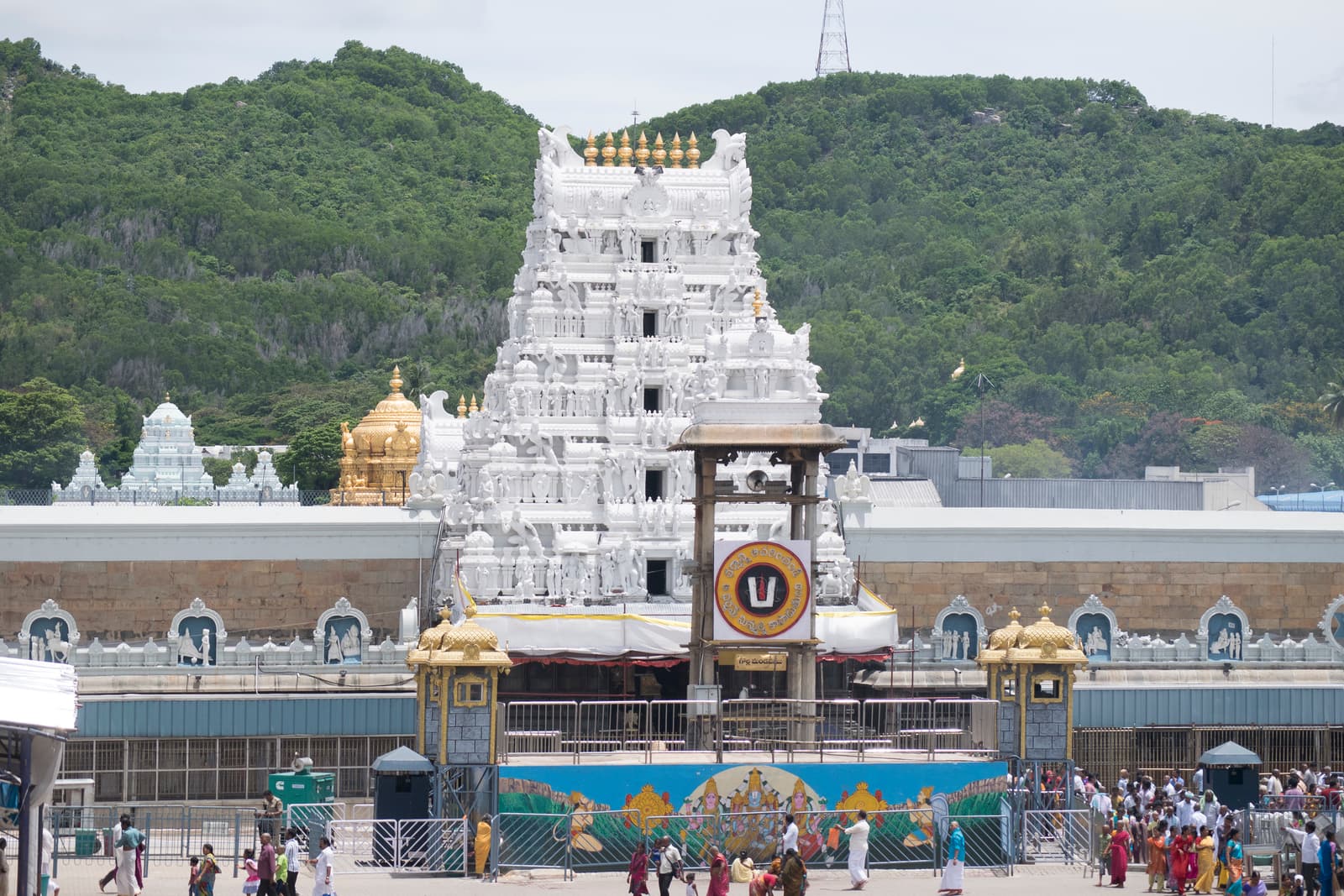
The temple complex covers approximately 16 acres (6.5 hectares), enclosed within three concentric prakaras (courtyards). The main gopuram at the entrance rises seven storeys. The inner sanctum houses the deity beneath the Ananda Nilayam, a three-tiered vimana covered in gold leaf.
The Ananda Nilayam, a three-tiered vimana sheathed in gold leaf, crowns the sanctum. It was first gilded in the 14th century under the Vijayanagara rulers and restored in the 1960s with 5,250 kg of gold at a cost of 5.82 crore rupees. The Bangaru Vakili (golden threshold) at the entrance to the inner courtyard is made of copper alloy and was donated by Krishnadevaraya in the 16th century.
In the second prakara stands the Dhvajastambha, the flagstaff carved from a single monolith. The complex also includes the Ammani Mandapam (a pillared hall), the Vimana Prakara (inner corridor with 16 pillars), and the Tirumamani Mandapam.
Around the concentric courtyards operates an administration engineered for enormous visitor numbers. Approximately 17,000 staff manage daily operations, from the queue systems of Sarva Darshan to the automated kitchen that produces more than 4 lakh laddus a day.
The liturgies are exclusively governed by the ancient Vaikhanasa Agama tradition, a priestly lineage that manages all inner sanctum rituals. Unlike many other major Vaishnava temples in South India, the main deity is considered Swayambhu (self-manifested) and is never moved from its position, with processional deities used for outdoor festivals instead. The temple is one of the 108 Divya Desams, the holiest Vaishnava shrines as enumerated by the Alvar saints between the 5th and 9th centuries CE. It is also one of the richest temples by assets, with an annual cash budget exceeding several hundred crore rupees.
The annual Brahmotsavam, a nine-day grand celebration in September, is the most important festival, attracting millions of devotees. It features daily processions of the processional deity Malayappa Swamy on different vahanas (Garuda, Hamsa, Simha, etc.). Other major festivals include Vaikunta Ekadasi (December-January), when the Vaikunta Dwaram (gate to heaven) is opened, and Rathasapthami (February), when the deity's procession covers the four mada streets around the temple. Annual gross revenue of TTD from hundi (offering box) collections exceeds 1,000 crore rupees.
Recognized as the richest temple in the world by assets and donations, with an annual cash budget exceeding several hundred crore rupees.
The Swayambhu (self-manifested) deity of Lord Venkateswara stands 8 feet tall and is never moved; the bronze Malayappa Swamy is used for processions.
Receives an average daily footfall of 60,000–100,000 pilgrims.
Distributes more than 4 lakh laddu prasadams daily; the Tirupati Laddu holds a GI tag awarded in 2009.
The temple follows the Vaikhanasa Agama tradition; Suprabhatam awakens the Lord at 2:30 AM.
The Ananda Nilayam vimana was re-plated in the 1960s with 5,250 kg of gold at a cost of 5.82 crore rupees.
One of the 108 Divya Desams enumerated by the Alvar saints between the 5th and 9th centuries CE.
The temple employs approximately 17,000 staff to manage daily operations.
September to March offers the most pleasant weather on the Tirumala hills. In summer (April-June), daytime temperatures on the hill can reach 38°C. The Brahmotsavam season (September) sees massive crowds exceeding 1 lakh per day. Vaikunta Ekadasi (December-January) lines stretch for 24+ hours. For shorter queues, book darshan online at least 2 weeks in advance. The best darshan slots are early morning (5-7 AM) or late night (9-11 PM), when footfall is lower.
Open 24 hours daily for various sevas. Free Sarva Darshan runs from 3:30 AM to 1:00 AM. VIP darshan (Rs. 300) has shorter waiting times. Separate queues for women and senior citizens. Special darshan tickets can be booked online through the TTD website. The temple closes for 30 minutes during maintenance shifts, around noon and midnight.
5 km from the hills. The temple of Venkateswara's consort Padmavati, closely connected to the Kubera loan legend and the divine wedding tradition.
A 12th-century Shiva temple at the foot of the hills, and the starting point for the Srivari Mettu trekking path to Tirumala.
A natural spring and waterfall on the Tirumala hills, roughly 8 km away, considered sacred in the temple's water traditions.
At 49 km, the highest waterfall in Andhra Pradesh at 82 meters, set within the Seshachalam forest.
24 km away, a dedicated conservation area for the flora and fauna of the Seshachalam Biosphere Reserve.
September
1 festival
Tirumala Venkateswara Temple
The grandest annual celebration, drawing millions of devotees. Daily processions of Malayappa Swamy on different vahanas including Garuda, Hamsa, and Simha. Crowds can exceed one lakh pilgrims per day.
/ti-ru-ma-la/
Sacred hill
/ven-ka-tesh-wa-ra/
Lord of Venkata Hill
/sva-yam-bhoo/
Self-manifested or self-born
/dar-shan/
Sacred viewing of the deity
/vi-ma-na/
Tower rising above the sanctum
/div-ya deh-sam/
Sacred abode of Vishnu
/sree-va-ri/
Of Lord Venkateswara
/lad-doo/
Sweet prasadam ball
/vai-kha-na-sa/
Agama tradition governing the temple rituals
/pra-ka-ra/
Enclosing courtyard wall
/hoon-dee/
Offering box for donations
/brahm-ot-sa-vam/
Grand annual festival
Click the speaker icon to hear pronunciation. Browser text-to-speech may vary.
World's Richest Temple
Tirumala is recognized as one of the richest temples in the world by assets and donations. TTD reported an annual income of approximately 3,500 crore rupees for FY 2023-24, with hundi (offering box) collections averaging about 2.5 crore rupees per day.
Swayambhu Deity
The main deity, Lord Venkateswara, is considered Swayambhu (self-manifested) and is never moved from the sanctum. A separate bronze processional image, Malayappa Swamy, accompanies the utsava murtis of Sridevi and Bhudevi for all outdoor festivals.
Vaikhanasa Agama
All inner-sanctum rituals are governed exclusively by the ancient Vaikhanasa Agama tradition, a priestly lineage that manages the temple's daily liturgies.
One of the 108 Divya Desams
Tirumala is enumerated among the 108 Divya Desams, the holiest Vaishnava shrines as sung by the Alvar saints between the 5th and 9th centuries CE.
Tirupati Laddu GI Tag
The Tirupati Laddu, distributed at more than 4 lakh pieces daily, received a Geographical Indication (GI) tag in 2009, reserving that name exclusively for TTD.
A. The traditional trekking path (Alipiri Mettu) has 3,550 steps covering a distance of 11 km from Tirupati to Tirumala. A second path (Srivari Mettu) from the Kapileswara Temple has 2,385 steps. Both paths are free to use with rest shelters and drinking water at regular intervals. The climb takes 3-5 hours depending on fitness level.
A. The Tirupati Laddu is the official prasadam of the temple, made with Bengal gram flour, sugar, ghee, cashew nuts, and cardamom. It received a Geographical Indication (GI) tag in 2009, meaning only TTD can produce laddus under that name. TTD produces approximately 4 lakh laddus daily in its automated kitchen, each weighing approximately 100 grams. The GI tag was challenged in 2010 by an Andhra Pradesh confectioner but upheld by the Chennai GI Registry.
A. TTD reported an annual income of approximately 3,500 crore rupees for the financial year 2023-24. The largest portion comes from the hundi (donation box) collections, which averaged about 2.5 crore rupees per day. Other revenue sources include sale of laddu prasadams, special darshan tickets, accommodation, land leases, and interest on deposits in various banks.
A. Swayambhu means 'self-manifested' — the deity is believed to have appeared naturally without being created by human hands. At Tirumala, the main deity is considered Swayambhu, which is why it is never moved from its position. Processional images (Malayappa Swamy) are used for all outdoor festivals and processions.
A. Traditional Indian attire is mandatory for all visitors. Men must wear dhoti, pajama, or pants with a shirt. Women must wear saree, half-saree, or salwar kameez. Western attire including shorts, sleeveless tops, miniskirts, and ripped jeans is not allowed. The TTD provides free dhotis at the entrance.
A. The Tirumala Venkateswara Temple is open to all visitors regardless of religion. However, visitors must follow the temple's dress code and behavioral guidelines. Photography and videography are prohibited inside the sanctum. Mobile phones must be switched off or deposited at the cloakroom.
A. Online booking is recommended and opens roughly 90 days ahead on the official TTD website (ttdsevaonline.com). You can reserve Sarva Darshan, VIP darshan (Rs. 300 with shorter waiting times), special sevas, and accommodation from the same portal.
A. Sarva Darshan is the free general darshan queue that runs from 3:30 AM to 1:00 AM. It is the most economical option but waiting times can be long. Separate queues exist for women and senior citizens. The temple closes for 30 minutes during maintenance shifts, around noon and midnight.
A. No. The permanent main deity is Swayambhu (self-manifested) and is never moved from the sanctum. Malayappa Swamy is a separate bronze processional image used only for outdoor festivals, accompanying the utsava murtis of Sridevi and Bhudevi (Vishnu's consorts).
A. Sevas such as Suprabhatam, Thomala Seva, Koluvu, Archana, and Naivedyam are booked online on the official TTD website, which opens bookings 90 days ahead. Seats are limited, so early booking is advised, especially in festival seasons.
A. September to March offers the most pleasant weather on the Tirumala hills. Summer (April-June) can reach about 38°C and the Brahmotsavam season (September) is the busiest. Vaikunta Ekadasi (December-January) queues stretch for 24+ hours. The best darshan slots are early morning (5-7 AM) or late night (9-11 PM), when footfall is lower.
A. Tirupati railway station connects to all major Indian cities, and the nearest airport is Tirupati Airport (14 km) with flights from Delhi, Mumbai, Hyderabad, Chennai, and Bangalore. Buses and ghat roads provide direct road connections to the hill. TTD provides free accommodation and meals on a first-come basis.
Tirumala Tirupati Devasthanams (TTD)
Sarva darshan, seva booking and temple information
View sourceTirupati District, Government of Andhra Pradesh
District tourism and pilgrimage heritage
Archaeological Survey of India (ASI)
Epigraphic record of the Tirumala shrine
Srisailam Mallikarjuna Swamy Temple
One of the twelve Jyotirlingas and the southernmost among them, Mallikarjuna Temple at Srisailam is uniquely also a Shakti Peetha where the goddess Bhramaramba is worshipped alongside Shiva. Located on a hilltop above the Krishna River, it is the only temple in India that houses both a Jyotirlinga and a Shakti Peetha.
Simhachalam Temple
Simhachalam Temple, also known as Sri Varaha Lakshmi Narasimha Temple, is a historic Hindu temple dedicated to Lord Narasimha, the half-man half-lion avatar of Vishnu. Located on a hill about 300 metres above sea level on the outskirts of Visakhapatnam, it is a foremost Vaishnava pilgrimage site in Andhra Pradesh. The temple's distinguishing feature is that the main deity remains covered in sandalwood paste (chandanam) throughout the year and is revealed in its original form only once a year on Akshaya Tritiya.
Kanaka Durga Temple
Kanaka Durga Temple, situated on the Indrakeeladri Hill on the banks of the Krishna River in Vijayawada, is a popular Shakti temple in South India. The temple is believed to be a Shakti Peetha where the goddess is worshipped as Kanaka Durga (the bestower of gold and prosperity). The temple overlooks the Prakasam Barrage and the Krishna River, offering a panoramic view of Vijayawada city.
Veerabhadra Temple
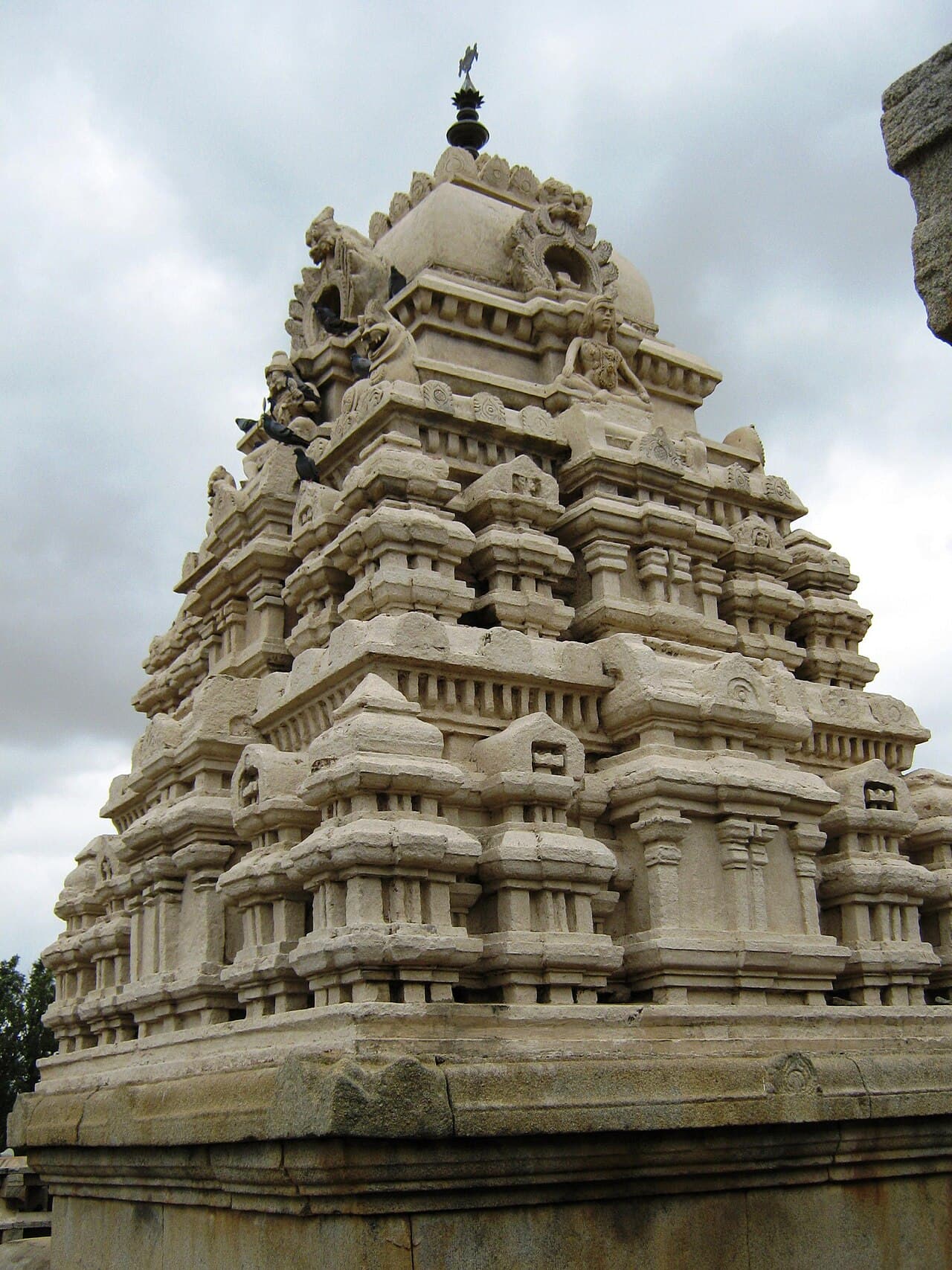
Veerabhadra Temple at Lepakshi is a 16th-century Vijayanagara masterpiece, renowned for its hanging pillar, monolithic Nandi, and exquisite ceiling murals. The temple is dedicated to Veerabhadra, a fierce form of Shiva.
Ahobilam Narasimha Temple
Ahobilam, situated in the dense Nallamala forest of Kurnool district, is the sacred landscape where Lord Narasimha — the half-man, half-lion avatar of Vishnu — is believed to have manifested to slay the demon Hiranyakashipu and protect his devotee Prahlada. The site comprises nine Narasimha shrines (Nava Narasimha Kshetras) distributed across the forested hills, each representing a different aspect of the deity.
Amaralingeswara Temple
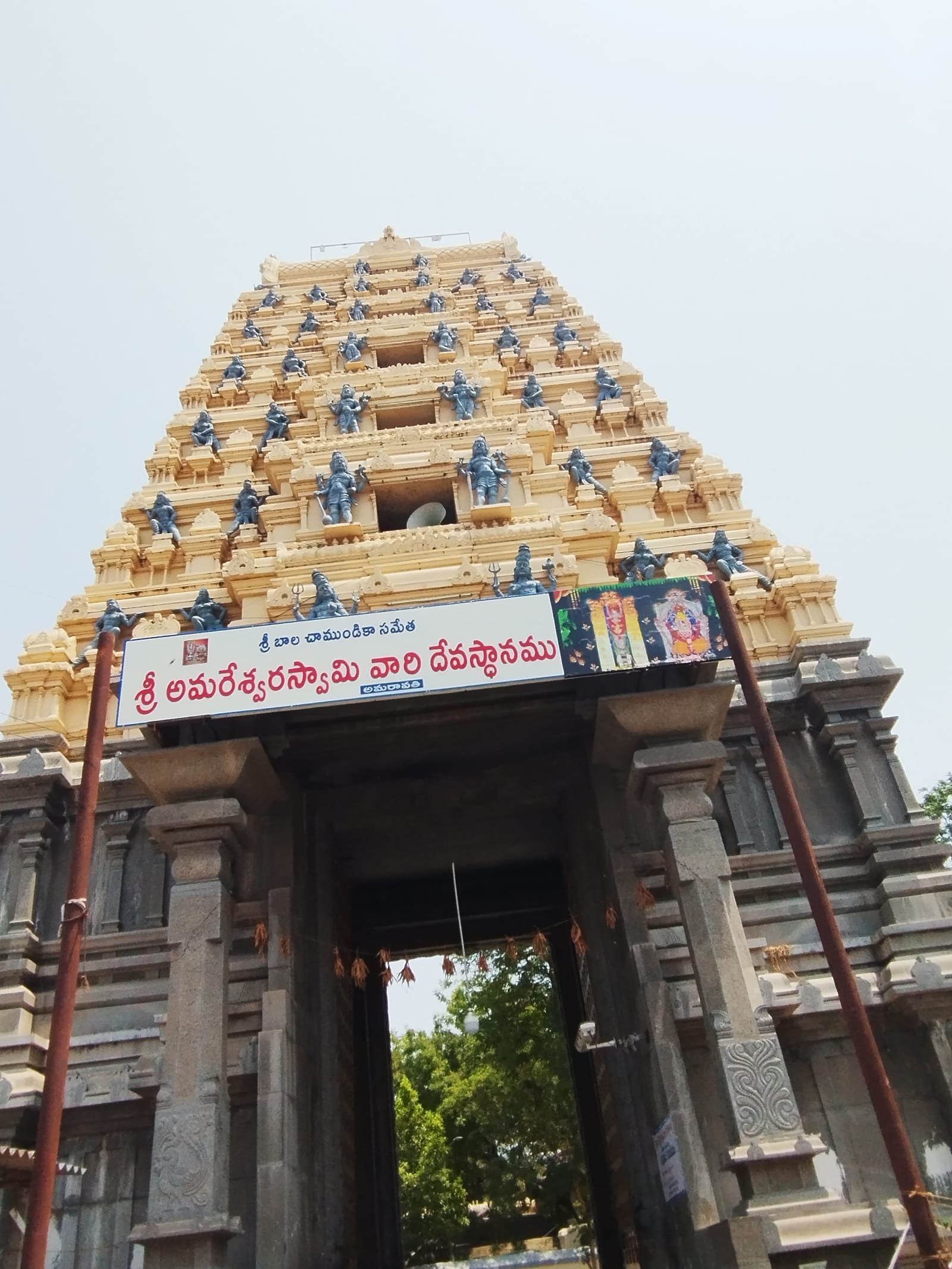
Amaralingeswara Temple, located in Amaravati on the southern bank of the Krishna River, is the foremost of the Pancharama Kshetras — the five ancient Shiva temples of coastal Andhra Pradesh. The temple shares its sacred landscape with the historic Amaravati Mahachaitya, a major Buddhist stupa from the Satavahana period.
Rasmancha Bishnupur
The oldest 17th-century brick structure in Bishnupur, unique for its massive pyramidal roof and arched galleries.
Jor-Bangla Temple Bishnupur
Known for its 'twin hut' design and incredibly detailed terracotta panels depicting the Ramayana and Mahabharata.
Shyam Rai Temple Bishnupur
A five-towered terracotta temple famous for its circular friezes showing the Rasa-lila of Lord Krishna.
Dashavatara Temple
Dating to around 500 CE, this is the earliest known North Indian temple with a shikhara (curvilinear tower). The temple is famous for its carved panels depicting the ten incarnations (Dashavatara) of Vishnu on the sanctum walls.
Shri Ram Janmabhoomi Mandir
A grand and historic temple marking the birthplace of Lord Rama, the seventh avatar of Vishnu, representing the pinnacle of Nagara architecture.
Prem Mandir
A stunning modern white-marbled complex in Vrindavan dedicated to Divine Love, known for its life-like tableaus of Krishna's pastimes.
India's temples are living traditions — not museums. Every temple has its own customs. This guide helps first-time visitors prepare with confidence and respect.
Foreign visitor information is being researched
Please verify with the official temple authority before planning your visit.
Foreign Visitors
Verify Before VisitingVisitor Information
Entry policies vary between temples. Most temples welcome visitors, while some may restrict access to specific areas, rituals, or the inner sanctum. Always verify the latest entry guidelines with the official temple authorities before your visit.
Modest clothing is expected at every Indian temple — a sign of respect, not a restriction. Think of it as dressing for a formal ceremony.
A scarf is always useful — it covers shoulders, works as a head covering, and can double as a makeshift face cover if needed.
Outdoor photography is generally permitted. Indoor photography is often restricted. Always look for signage or ask a priest before taking photos inside.
September to March offers the most pleasant weather on the Tirumala hills. In summer (April-June), daytime temperatures on the hill can reach 38°C. The Brahmotsavam season (September) sees massive crowds exceeding 1 lakh per day. Vaikunta Ekadasi (December-January) lines stretch for 24+ hours. For shorter queues, book darshan online at least 2 weeks in advance. The best darshan slots are early morning (5-7 AM) or late night (9-11 PM), when footfall is lower.
April — June
July — September
English is widely understood at major tourist temples. In smaller local temples, Hindi and the regional language are more common. A smile and simple hand gestures go a long way. Learning a few words of the local language is always appreciated.
Cash (Indian Rupees) is the most reliable option, especially for temple offerings, small shops, and local transport.
UPI digital payments (Google Pay, PhonePe, Paytm) are widely accepted across India — even at roadside stalls. Download one before you arrive.
International credit/debit cards work at most ATMs, hotels, and larger establishments. Smaller vendors may only accept cash or UPI.
Carry small denominations (₹10, ₹20, ₹50, ₹100 notes) for offerings and temple donations. Large notes (₹500, ₹2000) can be hard to break at smaller counters.
Many historic temples have uneven stone floors, multiple steps, and narrow passages. Wheelchair access is limited at older sites — contact the temple in advance.
Basic restroom facilities and drinking water are available at most major temples. Some charge a small fee (₹5–₹10).
Stay hydrated — carry a reusable water bottle, especially in hot climates.
Keep valuables secure — use hotel lockers for passports and excess cash.
Wear comfortable, sturdy footwear — temple floors can be hot, wet, or uneven.
Beware of unofficial guides or touts near temple entrances. Only use authorised services.
Carry a photocopy of your passport and visa. Leave originals in your hotel safe.
Download offline maps — mobile networks can be unreliable near remote temple sites.
These short explanations help make sense of what you see and experience.
Darshan means 'seeing' — but in a temple it means being seen by the deity. It is a sacred moment of connection, not just a viewing.
Removing footwear is a sign of humility. It also keeps the temple floor clean, since devotees sit and pray on the ground.
Food offered to the deity and then distributed to devotees. It is considered blessed. Accept it with both hands and do not discard it.
The bell creates a focused acoustic atmosphere, wards off distractions, and announces your presence before entering the inner sanctum.
Circumambulation (pradakshina) is done clockwise, keeping the sanctum on your right — an auspicious direction aligned with the sun's path.
Flowers symbolise devotion, coconuts represent the ego being broken, incense purifies the air, and lamps represent the victory of light over darkness.
Sacred viewing of the deity; the central act of temple worship.
Clockwise circumambulation of the sanctum.
Blessed food offered to the deity and distributed to devotees.
The innermost sanctum where the main deity resides.
The towering spire above the sanctum, a defining feature of temple architecture.
A pillared hall or pavilion within the temple complex.
The Indian Rupee (?, INR) is the local currency. ATMs are widely available in cities and towns. For temple offerings, keep small notes (₹10, ₹20, ₹50). Most temples accept donations in cash only — digital payments are uncommon at the offering counter itself.
Offerings (dakshina) are given with the right hand. Place cash in the donation box (hundi) or give it directly to the priest. There is no fixed amount — give what feels appropriate. Some temples have fixed fees for special entry or puja participation.
Shoes and sandals are removed before entering the temple building. Most temples have a designated shoe counter (free or a small fee of ₹5–₹20). Socks are generally allowed. In monsoon, carry a plastic bag for wet shoes.
Darshan queues can take 30 minutes to 3 hours at popular temples. Many offer paid VIP darshan (₹100–₹500) for faster entry. Special queues for women, elderly, and disabled visitors exist at some temples. No line jumping.
Major festivals draw enormous crowds — sometimes hundreds of thousands. Book accommodation months in advance. Expect road closures, restricted vehicle access, and limited phone network. Arrive early (before dawn) to avoid the worst congestion.
Always look for signage before taking photos. When in doubt, ask a priest. Never take photos of devotees in prayer without permission. Selfie sticks are banned at most temples. Silently switch your phone to silent mode.
Police / Ambulance / Fire: 112 (National Emergency Number)
Tourist Helpline: 1800-111-363 (Multi-lingual, Ministry of Tourism)
Women's Helpline: 1091
Temple-specific visitor information is continuously researched and updated from official sources. Where specific data is unavailable, general India travel guidance is provided. Always verify current policies with the temple authority before your visit.
Information last verified July 2026. Temple-specific data coming soon.
Continue your journey through the spiritual and architectural wonders of India.

Srikalahasti Temple, situated on the banks of the Swarnamukhi River at the foot of Srikalahasti hill in Tirupati district, is dedicated to Lord Shiva as Srikalahasteeswara. The temple represents the Vayu (wind) element among the southern Pancha Bhoota Sthalas (five element temples of Shiva). Its name is traditionally derived from three animal devotees — a spider (Sri), a serpent (Kala), and an elephant (Hasti) — who attained salvation here. The self-manifested (swayambhu) lingam remains untouched by human hands, and a lamp in the draft-free sanctum continuously flickers, physically symbolising the presence of the air element.

Simhachalam Temple, also known as Sri Varaha Lakshmi Narasimha Temple, is a historic Hindu temple dedicated to Lord Narasimha, the half-man half-lion avatar of Vishnu. Located on a hill about 300 metres above sea level on the outskirts of Visakhapatnam, it is a foremost Vaishnava pilgrimage site in Andhra Pradesh. The temple's distinguishing feature is that the main deity remains covered in sandalwood paste (chandanam) throughout the year and is revealed in its original form only once a year on Akshaya Tritiya.

Ahobilam, situated in the dense Nallamala forest of Kurnool district, is the sacred landscape where Lord Narasimha — the half-man, half-lion avatar of Vishnu — is believed to have manifested to slay the demon Hiranyakashipu and protect his devotee Prahlada. The site comprises nine Narasimha shrines (Nava Narasimha Kshetras) distributed across the forested hills, each representing a different aspect of the deity.

One of the twelve Jyotirlingas and the southernmost among them, Mallikarjuna Temple at Srisailam is uniquely also a Shakti Peetha where the goddess Bhramaramba is worshipped alongside Shiva. Located on a hilltop above the Krishna River, it is the only temple in India that houses both a Jyotirlinga and a Shakti Peetha.

Kanaka Durga Temple, situated on the Indrakeeladri Hill on the banks of the Krishna River in Vijayawada, is a popular Shakti temple in South India. The temple is believed to be a Shakti Peetha where the goddess is worshipped as Kanaka Durga (the bestower of gold and prosperity). The temple overlooks the Prakasam Barrage and the Krishna River, offering a panoramic view of Vijayawada city.

Veerabhadra Temple at Lepakshi is a 16th-century Vijayanagara masterpiece, renowned for its hanging pillar, monolithic Nandi, and exquisite ceiling murals. The temple is dedicated to Veerabhadra, a fierce form of Shiva.

Amaralingeswara Temple, located in Amaravati on the southern bank of the Krishna River, is the foremost of the Pancharama Kshetras — the five ancient Shiva temples of coastal Andhra Pradesh. The temple shares its sacred landscape with the historic Amaravati Mahachaitya, a major Buddhist stupa from the Satavahana period.
"UNESCO was founded in 1945 to promote world peace and security through international cooperation."