From ancient rock-cut marvels to towering imperial shrines, discover the architectural soul of Bharat through our verified digital archive.
Explore More Temples
Location
Belur
Presiding Deity
Lord Vishnu
Architecture
Hoysala
Dynasty
Hoysala, 12th century
Timings
The Chennakesava Temple is open daily from 7:00 AM to 8:00 PM, with a break from 12:30 PM to 4:00 PM when the temple is closed for the midday rituals. The temple is busiest between 10:00 AM and 12:00 PM and again from 5:00 PM to 7:00 PM. The best time for a peaceful visit is immediately after opening at 7:00 AM or after 4:00 PM. The temple remains open on all public holidays. There is no entry fee for darshan, but there is a nominal fee of INR 100 for the camera (still photography) and INR 500 for video cameras.
Entry Fee
Free
Best Time
The ideal time to visit the Chennakesava Temple is from October to March, when Karnataka's Malnad region enjoys pleasant weather with temperatures between 15 and 28 degrees Celsius. The post-monsoon months of October and November are particularly beautiful as the surrounding landscape is lush and green, and the Yagachi River flows full. The winter months of December and January are comfortable for exploring the extensive sculptural details of the temple. The Vaikuntha Ekadasi festival in December-January is a special time to visit, though the temple is extremely crowded. The summer months of March to May can be warm, with temperatures reaching 35 degrees Celsius, though the temple's stone construction remains cool inside. The monsoon months of June to September bring heavy rainfall to the Belur region, which can make the temple precincts slippery and reduce visibility for appreciating the architectural details, though the rain-washed stone creates a unique aesthetic. For photographers, the golden hours just after sunrise (6:30-8:00 AM) provide the best light for the star-shaped platform and the exterior friezes.
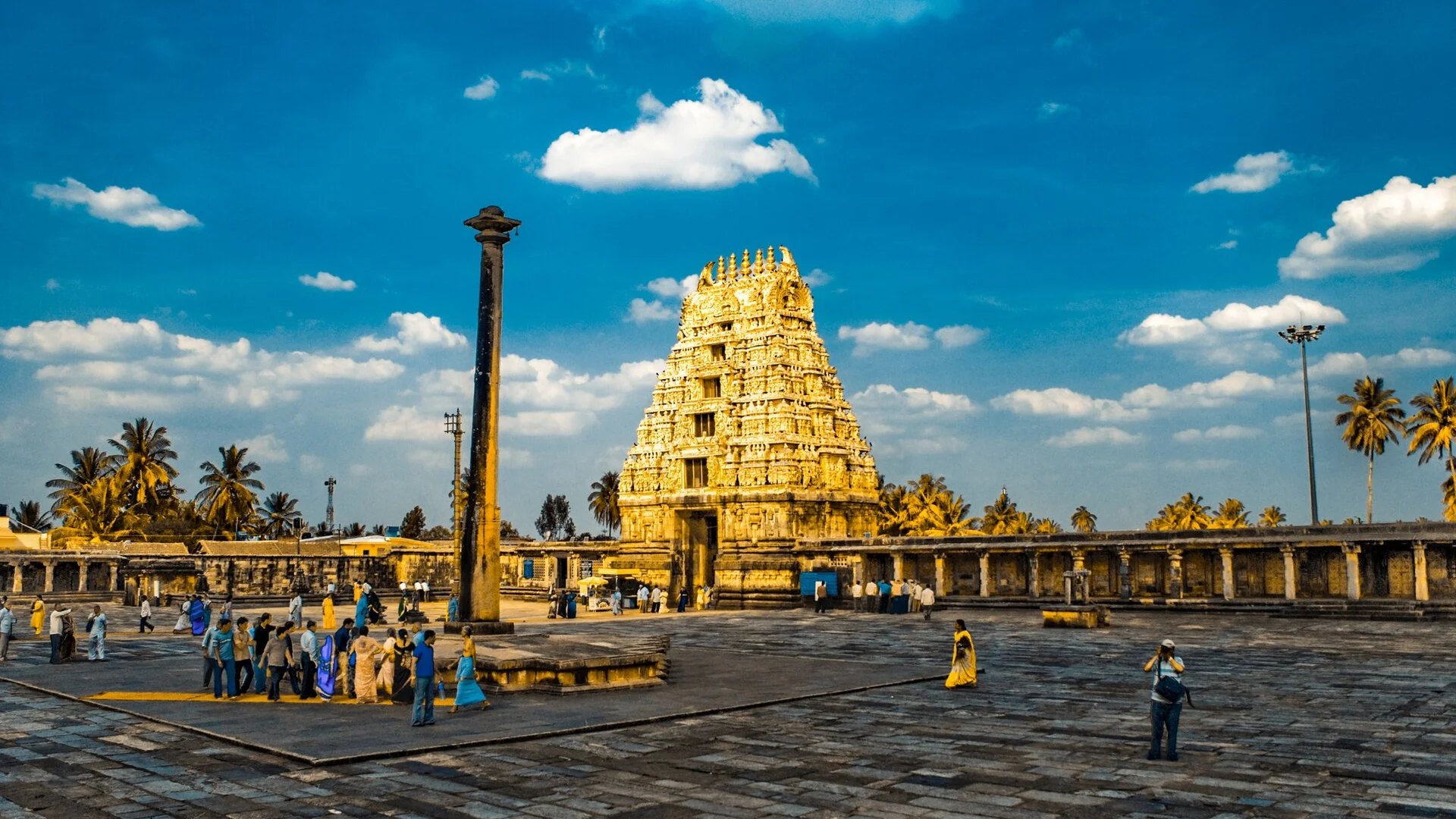
The Chennakesava Temple in Belur, Karnataka, is the finest example of Hoysala architecture, dedicated to Lord Vishnu as Chennakesava, built in the 12th century.
The Chennakesava Temple was built by King Vishnuvardhana (1108-1152 CE), the most renowned ruler of the Hoysala Empire. Vishnuvardhana began his reign as a Jain (his dynasty had been Jain for generations) but converted to Vaishnavism under the influence of the philosopher-saint Ramanujacharya, who visited the Hoysala court in 1117 CE. The Chennakesava Temple was built as both a celebration of Vishnuvardhana's newfound Vaishnava faith and a political monument commemorating his victory over the Cholas at the Battle of Talakkad in 1116 CE, which pushed the Hoysala frontier southward into the Kaveri River valley. The construction of the temple began in 1117 CE under the direction of the chief architect Jakanachari (also known as Keshava), a legendary figure in Kannada folklore who is credited with establishing the Hoysala architectural tradition. The temple's main structure was completed in 103 years, spanning three generations — Vishnuvardhana himself, his son Narasimha I, and his grandson Ballala II. The temple's main garbhagriha was consecrated in 1117 CE, while the completed temple was consecrated in 1220 CE, as recorded in the Belur inscription. The temple witnessed continuous patronage under subsequent Hoysala rulers, with additions such as the small Garuda shrine, the Kappe Chennigaraya shrine (added by Vishnuvardhana's queen Shantala Devi in 1120 CE), and various mandapas. After the decline of the Hoysala Empire in the 14th century, the temple came under the control of the Vijayanagara Empire, whose rulers made further additions, including the smaller gopuram at the entrance and several subsidiary shrines. The temple survived the destruction that many Hoysala temples faced during the Muslim invasions of the 14th century — Halebidu (30 km away) was sacked, but Belur was apparently spared, possibly because of its remote location in the forested Malnad hills. During the 18th and 19th centuries, the temple was maintained by local Maratha and Mysore rulers. The Archaeological Survey of India took over conservation in the early 20th century, undertaking major restoration work from the 1970s onward. In September 2024, the Chennakesava Temple, together with the Hoysaleswara Temple and the Keshava Temple, was inscribed as a UNESCO World Heritage Site under the title 'Sacred Ensembles of the Hoysala Period.'
“The Chennakesava Temple is deeply connected to Vaishnava mythology, particularly the Krishna legend. The name 'Chennakesava' translates to 'Beautiful Keshava' — Keshava being one of the primary names of Vishnu, referring to him as the 'slayer of the Keshi demon.' According to the Bhagavata Purana, the demon Keshi, sent by Kamsa to kill the infant Krishna, appeared in the form of a wild horse. Krishna slew the demon by thrusting his arm into Keshi's mouth and expanding it until the horse demon's head was split. This victory is commemorated in Vishnu's epithet 'Keshava' (he who killed Keshi), and the Belur temple is dedicated to this particular manifestation of the divine. The temple's association with Vishnuvardhana's conversion to Vaishnavism also ties it to Ramanujacharya, who according to tradition visited the Hoysala court and persuaded the king to abandon Jainism and embrace Sri Vaishnavism. The conversion was reportedly confirmed when Ramanujacharya identified a particular stone in the Yagachi River as containing an image of Vishnu that would be consecrated in the new temple. This stone, when carved, is said to have yielded the beautiful image of Chennakesava that now occupies the main sanctum. The local folklore of the Belur region includes the legend of Jakanachari, the master architect. According to the tale, Jakanachari was so confident of his architectural perfection that he built the temple's pillars without leaving space for the daily cleaning of the garbhagriha. When a rival architect pointed out this oversight, Jakanachari realized his error and cut off his right hand in shame, earning the temple the local name 'Mugadakattu' (the temple of the mutilated hand). The bracket figures of Belur are central to another legend — it is said that Jakanachari's son, Dankachari, carved these figures to prove his skill when his father could not work due to his self-inflicted injury.”
The Chennakesava Temple is the definitive expression of Hoysala architecture, a style that emerged in the 11th-14th centuries in the Karnataka region and represents one of the most sophisticated developments in Indian temple building. The temple is constructed entirely of chloritic schist (soapstone), a relatively soft stone that hardens upon exposure to air, allowing the Hoysala carvers to achieve a level of detail impossible in harder granites. The temple plan is based on a stellate (star-shaped) design with 16 points, creating a complex geometric figure that alternates between projecting and recessed angles. This star plan multiplies the number of exterior wall surfaces, providing more area for sculptural decoration and creating dramatic patterns of light and shadow throughout the day. The temple stands on a raised platform (jagati), approximately 4 feet high, which serves as a circumambulatory path that brings the devotee face-to-face with the exterior friezes at eye level — a uniquely Hoysala innovation. The platform follows the star-shaped plan of the temple, creating a series of angled walkways around the structure. The exterior walls are organized into six horizontal registers: at the base, a band of 650 elephants (each carved differently), symbolizing strength and stability; above them, a band of lions with riders, representing royal power; a continuous band of intricate scrollwork; a band of horses ridden by warriors; a band of scenes from the Ramayana and Mahabharata; and finally, at the top, a band of makaras (mythical crocodile-elephant creatures) and other mythical figures. Above these friezes, the wall surfaces are adorned with large sculptural panels depicting deities — Vishnu in various forms, Lakshmi, Saraswati, Garuda, and others — each framed by ornate pilasters and toranas (archways). The interior of the temple is equally remarkable. The navaranga (central hall) is a large pillared space supported by 46 columns arranged in a grid, each column carved from a single piece of soapstone and turned on a lathe to create different profiles. The pillars are decorated with bracket figures (the famous Madanikas) that project outward from the pillar capital, supporting the ceiling. The ceiling panels are carved with concentric circles of lotus petals, geometric patterns, and scenes from Vaishnava mythology, with the central panel featuring a pendant lotus bud that appears to hang from the ceiling. The garbhagriha (sanctum) is a small, dark chamber that originally held the main deity; it is surrounded by a narrow circumambulatory path with carved windows that filter light into the inner space. The shikhara (tower) above the sanctum was originally present but collapsed or was dismantled in later centuries — the temple currently has a flat roof over the main hall, though the small shrine of Kappe Chennigaraya retains its original pyramidal roof.
The Chennakesava Temple holds unparalleled significance in the history of Indian architecture. As the most complete and best-preserved Hoysala temple, it represents the mature phase of the Hoysala architectural style, which evolved from earlier Western Chalukya traditions but developed a distinctive aesthetic all its own. The temple's star-shaped plan represents a geometric sophistication that anticipates European Renaissance star forts by three centuries, demonstrating the Hoysala architects' mastery of complex geometry and volumetric design. The temple's stone carving is considered the finest of any period in southern India — the soapstone (chloritic schist) material allowed Hoysala carvers to achieve an unprecedented level of detail, with the bracket figures exhibiting a naturalism and sensuous grace that rivals the best of any Indian sculptural tradition. Religiously, the temple is one of the most important Vaishnava pilgrimage sites in Karnataka, associated with Ramanujacharya's propagation of Sri Vaishnavism in the Hoysala kingdom. The temple's inscriptions, particularly the Belur inscription of 1117 CE and subsequent records, are primary historical sources for Hoysala history, documenting royal genealogies, land grants, and the administrative organization of the empire. The temple's designation as a UNESCO World Heritage Site in 2024 has elevated its global profile, recognizing the Sacred Ensembles of the Hoysala Period as a cultural tradition of outstanding universal value. Architecturally, the temple is a university of Vaishnava iconography — every surface of the temple tells a story from Hindu mythology, creating a comprehensive visual encyclopedia of the Puranic narratives and the Vaishnava theological universe.
The Chennakesava Temple follows the Pancharatra Agama tradition of temple worship, with daily rituals conducted by a dedicated group of priests. The day begins at 6:00 AM with the Suprabhata (awakening ceremony), when the deity is roused from sleep with the chanting of Vishnu Sahasranama and the ringing of bells. This is followed by the Abhishekam at 7:00 AM, where the deity is bathed with panchamrita (a mixture of milk, curd, honey, ghee, and sugar), turmeric water, sandalwood paste, and rose water. The Alankara (dressing) ceremony at 8:00 AM is a visual spectacle, with the temple priest adorning the Chennakesava icon with fresh flower garlands, silk garments, and the royal jewelry of the temple — including a diamond-studded crown that is over 300 years old. The morning aarti at 8:30 AM is open to all devotees. The midday puja at 12:00 PM includes the offering of naivedya (sacred food), which typically includes rice, payasam (sweet pudding), and local Karnataka preparations. The temple closes between 12:30 PM and 4:00 PM for the deity's midday rest. The evening rituals begin at 4:00 PM with the Sayankala Aarti, and the final ritual of the day, the Shej Aarti, is performed at 8:30 PM. On Thursdays, which are particularly auspicious for Vishnu worship, special abhishekams are performed using 108 pots of sacred water. The temple celebrates Ekadasi (the 11th day of the lunar fortnight) with fasting and special prayers, and Vaikuntha Ekadasi (in December-January) is the most important day of the year, when the main doorway to the garbhagriha is opened, symbolizing the entrance to Vaikuntha (Vishnu's heaven).
The Chennakesava Temple celebrates a vibrant festival calendar dominated by Vaishnava observances. The most important festival is the Chennakesava Rathotsava (chariot festival), held annually in March-April (Chaitra month). The deity is taken in a grand wooden chariot around the temple, pulled by hundreds of devotees accompanied by traditional Karnataka music, dance performances, and fireworks. The chariot, built of jackfruit wood and weighing over 20 tons, was built in the 18th century and is one of the oldest surviving temple chariots in Karnataka. The Vaikuntha Ekadasi festival (December-January) draws over 50,000 devotees, who queue from midnight to pass through the 'Vaikuntha Dwaram' (the gate of heaven) into the garbhagriha. During the annual Brahmotsavam (September-October), the temple conducts nine days of processions where the utsava murti (processional deity) is taken to various parts of Belur town, recreating the sacred geography of the temple's domain. The Karthika Deepotsava (November-December) sees the entire temple complex illuminated with thousands of oil lamps, creating a spectacular display reflected in the temple's polished stone surfaces. The temple also participates in the 'Hoysala Legacy Festival,' organized jointly by the Karnataka Tourism Department and the Archaeological Survey of India, held in January-February to celebrate the inscription of the Hoysala temples as a UNESCO World Heritage Site. This festival features classical dance performances in the temple's open courtyard, guided heritage walks, and exhibitions on Hoysala art and culture. The Krishna Janmashtami (August-September) is celebrated with special fervor, with the deity dressed as the infant Krishna and offered butter, curd, and milk-based sweets.
Being the masterpiece of Hoysala architecture, its star-shaped platform, lathe-turned chloritic schist pillars, the exquisite bracket figures of dancers (Madanikas), and its declaration as a UNESCO World Heritage Site in 2024.
The ideal time to visit the Chennakesava Temple is from October to March, when Karnataka's Malnad region enjoys pleasant weather with temperatures between 15 and 28 degrees Celsius. The post-monsoon months of October and November are particularly beautiful as the surrounding landscape is lush and green, and the Yagachi River flows full. The winter months of December and January are comfortable for exploring the extensive sculptural details of the temple. The Vaikuntha Ekadasi festival in December-January is a special time to visit, though the temple is extremely crowded. The summer months of March to May can be warm, with temperatures reaching 35 degrees Celsius, though the temple's stone construction remains cool inside. The monsoon months of June to September bring heavy rainfall to the Belur region, which can make the temple precincts slippery and reduce visibility for appreciating the architectural details, though the rain-washed stone creates a unique aesthetic. For photographers, the golden hours just after sunrise (6:30-8:00 AM) provide the best light for the star-shaped platform and the exterior friezes.
The Chennakesava Temple is open daily from 7:00 AM to 8:00 PM, with a break from 12:30 PM to 4:00 PM when the temple is closed for the midday rituals. The temple is busiest between 10:00 AM and 12:00 PM and again from 5:00 PM to 7:00 PM. The best time for a peaceful visit is immediately after opening at 7:00 AM or after 4:00 PM. The temple remains open on all public holidays. There is no entry fee for darshan, but there is a nominal fee of INR 100 for the camera (still photography) and INR 500 for video cameras.
How to Reach: The Chennakesava Temple is in Belur, approximately 220 km from Bangalore. The nearest airport is Mangalore International Airport (140 km), with flights from Bangalore, Mumbai, and Dubai. The nearest railway station is Hassan Junction (30 km), connected to Bangalore by passenger and express trains (3 hours). From Hassan, KSRTC buses operate every 15 minutes to Belur (45 minutes). By road from Bangalore, take NH-75 through Nelamangala, Hirisave, and Channarayapatna to Hassan, then SH-57 to Belur (4-5 hours). Tips: Combine your visit with Halebidu (30 km) and Shravanabelagola (40 km) to make a full-day Hoysala circuit from Bangalore or Mangalore. Hire a local guide at the temple entrance (approximately 1,000-1,500 rupees for a 1.5-hour tour) to understand the complex iconography of the friezes and bracket figures. Visit the archaeological museum within the temple complex, which houses sculptures from the Hoysala period, including several original Madanika bracket figures removed for conservation. The best views of the star-shaped platform are from the northeast corner of the outer courtyard. Carry binoculars to appreciate the intricate carvings on the upper registers. Photography is permitted but flash photography is restricted inside the garbhagriha. The temple is wheelchair-accessible through the main entrance, though some areas may require assistance.
The Chennakesava Temple is part of a rich circuit of Hoysala heritage in Karnataka's Hassan district. The most important nearby site is the Hoysaleswara Temple in Halebidu (30 km), dedicated to Lord Shiva and known for its larger size and equally intricate carvings, featuring a Nandi mandapa with a monolithic bull and walls covered with an encyclopedia of Hindu mythology. The Keshava Temple in Somanathapura (90 km), the third of the UNESCO-listed Hoysala temples, is the most perfectly preserved example of the Hoysala star-shaped design. The town of Belur itself has several smaller Hoysala temples worth visiting, including the Veeranarayana Temple and the Channigaraya Temple within the Chennakesava complex. The Shravanabelagola (40 km) is one of the most important Jain pilgrimage sites in India, housing the 57-foot Gommateshwara monolith. The Sakleshpur hill station (50 km) offers scenic trekking routes through the Western Ghats, including the Manjarabad Fort and the Bisle Ghat. The coffee plantations of Chikmagalur (30 km) offer plantation tours, homestays, and the chance to trek to Mullayanagiri, Karnataka's highest peak. The Hassan town (30 km) has the Gorur Dam and the Shettihalli Church (a neo-gothic church that submerges underwater during the monsoon). For a complete Hoysala circuit, visitors can plan a 3-day itinerary covering Belur, Halebidu, Somanathapura, and Shravanabelagola.
A. The Chennakesava Temple was built by Hoysala King Vishnuvardhana in 1117 CE to celebrate his victory over the Cholas at Talakkad. The temple took 103 years to complete, spanning three generations of the Hoysala dynasty. It was designed by the master architect Jakanachari and represents the pinnacle of Hoysala architectural achievement. The temple was declared a UNESCO World Heritage Site in 2024 as part of the Sacred Ensembles of the Hoysala Period.
A. The temple is built in the Hoysala architectural style, which is characterized by a star-shaped platform (jagati), the use of chloritic schist (soapstone) that allows for extremely fine carving, multiple horizontal friezes around the exterior depicting elephants, lions, scrollwork, horses, and epic scenes, and the famous bracket figures of dancing women (Madanikas) that project from the pillars. The temple's 46 interior pillars are all carved differently and polished to a mirror finish.
A. The temple is open from 7:00 AM to 8:00 PM, with a midday closure from 12:30 PM to 4:00 PM for rituals. The best time for a peaceful darshan is early morning (7:00 AM onwards) or late afternoon (after 4:00 PM). Entry is free, but there are nominal fees for still cameras (INR 100) and video cameras (INR 500).
A. The temple was built by King Vishnuvardhana of the Hoysala Empire, who ruled from 1108 to 1152 CE. The chief architect was Jakanachari (also spelled Jakanacharya), who is celebrated in Kannada folklore as a master sculptor. Vishnuvardhana was a Jain who converted to Vaishnavism under the influence of Ramanujacharya, and the temple was an expression of his new faith as well as a victory monument.
A. The Madanikas are the most celebrated features of the Chennakesava Temple. These are 38 bracket figures of women carved in three-dimensional detail, showing them in various poses — dancing, playing musical instruments, applying makeup, and carrying items. Each figure is approximately 3 feet tall and sculpted from soapstone with extraordinary naturalism. The most famous is the 'Darpana Sundari' (the lady with a mirror), considered one of the finest sculptures in Indian art. These figures represent the highest achievement of Hoysala stone carving.
A. Yes, the Chennakesava Temple was inscribed as a UNESCO World Heritage Site in September 2024 as part of the 'Sacred Ensembles of the Hoysala Period,' along with the Hoysaleswara Temple in Halebidu and the Keshava Temple in Somanathapura. The UNESCO designation recognizes the Hoysala temples as outstanding examples of Indian temple architecture, characterized by their distinctive star-shaped plans, intricate soapstone carvings, and the comprehensive narrative programs of their sculptural decoration.
A. Belur is approximately 220 kilometers from Bangalore, a 4-5 hour drive via NH-75 and SH-57. The route passes through Hassan (30 km before Belur), which serves as the main transportation hub for the region. Regular KSRTC buses run from Bangalore's Kempegowda Bus Station to Belur (6:00 AM to 10:00 PM, buses every 30 minutes). By train, Hassan Junction (30 km from Belur) is the nearest railhead with trains from Bangalore.
A. Ramanujacharya (1017-1137 CE) was the foremost philosopher and theologian of Sri Vaishnavism, a tradition that worships Vishnu as the supreme deity with Lakshmi as his consort. He visited the Hoysala court in 1117 CE and converted King Vishnuvardhana from Jainism to Vaishnavism. The Chennakesava Temple was built as a direct outcome of this conversion, and the temple's Vaishnava iconography reflects Ramanuja's theological teachings. The temple is considered an enduring monument to Ramanuja's influence in Karnataka.
A. The must-see carvings include: (1) the Darpana Sundari bracket figure (lady with a mirror), (2) the 12 Madanika bracket figures on the exterior of the main hall, (3) the horizontal friezes depicting elephants, lions, and the Ramayana story, (4) the 46 unique interior pillars with different carvings, (5) the ceiling panels with lotus and geometric patterns, (6) the Garuda shrine with its detailed carvings, and (7) the main Chennakesava deity in black granite, standing 4 feet tall with four arms holding the Vishnu attributes. Guided tours cover these highlights in approximately 1.5 hours.
A. Belur and Halebidu are 30 kilometers apart, approximately a 40-minute drive. The two towns are always visited together as they represent the twin capitals of the Hoysala Empire–Belur was the early capital and Halebidu (originally Dwarasamudra) was the later capital. The Hoysaleswara Temple in Halebidu is the Shaiva counterpart to the Vaishnava Chennakesava Temple in Belur, and both were built during the same period of Hoysala architectural excellence.
A. The main festival is the Chennakesava Rathotsava (chariot festival) in March-April, featuring a grand procession of the deity on a 20-ton wooden chariot. Vaikuntha Ekadasi in December-January is the most important religious day, drawing over 50,000 devotees. The Brahmotsavam in September-October includes nine days of processions. Karthika Deepotsavam in November-December sees the temple illuminated with oil lamps. The Hoysala Legacy Festival in January-February celebrates the temple's UNESCO status with cultural performances.
A. Jakanachari is the legendary master architect of the Hoysala period, credited with building the Chennakesava Temple. According to folklore, he was so proud of his creation that he boasted no flaws existed. A rival architect pointed out that a stone would be needed for cleaning the sanctum floor. Realizing his oversight and feeling dishonored, Jakanachari cut off his right hand. His son, Dankachari, is believed to have carved the famous Madanika bracket figures. The temple's local name 'Mugadakattu' means 'the temple of the mutilated hand.'
A. There is no entry fee for darshan (worship) at the Chennakesava Temple. For tourists, there is a nominal fee of INR 100 for still camera usage and INR 500 for video cameras. The ASI archaeological museum within the complex (which houses the original Madanika figures removed for conservation) charges a separate entry fee of INR 25 for Indian citizens and INR 300 for foreign nationals. Parking for vehicles is free near the temple compound.
A. The temple is dedicated to Lord Vishnu in his form as Chennakesava, which translates to 'Beautiful Keshava' — Keshava being one of the 1,000 names of Vishnu. The main deity is a standing image of Vishnu carved from black granite (not soapstone), standing approximately 4 feet tall with four arms holding a conch (shankha), discus (chakra), mace (gada), and lotus (padma). The image is placed within a richly carved silver and brass frame (torana) and is always adorned with flower garlands.
Dashavatara Temple
Dating to around 500 CE, this is the earliest known North Indian temple with a shikhara (curvilinear tower). The temple is famous for its carved panels depicting the ten incarnations (Dashavatara) of Vishnu on the sanctum walls.
Vaikuntha Perumal Temple
Built by the Pallava king Nandivarman II in the 8th century (circa 770 CE), the Vaikuntha Perumal Temple in Kanchipuram is a key monument of Pallava architecture featuring three tiers of sanctums one above the other, a unique architectural design representing the three aspects of Vishnu — seated (bhoga), standing (sthita), and reclining (sayana).
Badrinath Temple
Badrinath Temple, dedicated to Lord Vishnu, is a principal Char Dham site and one of the most sacred Vaishnava temples in India, located in the Garhwal Himalayas of Uttarakhand.
Virupaksha Temple
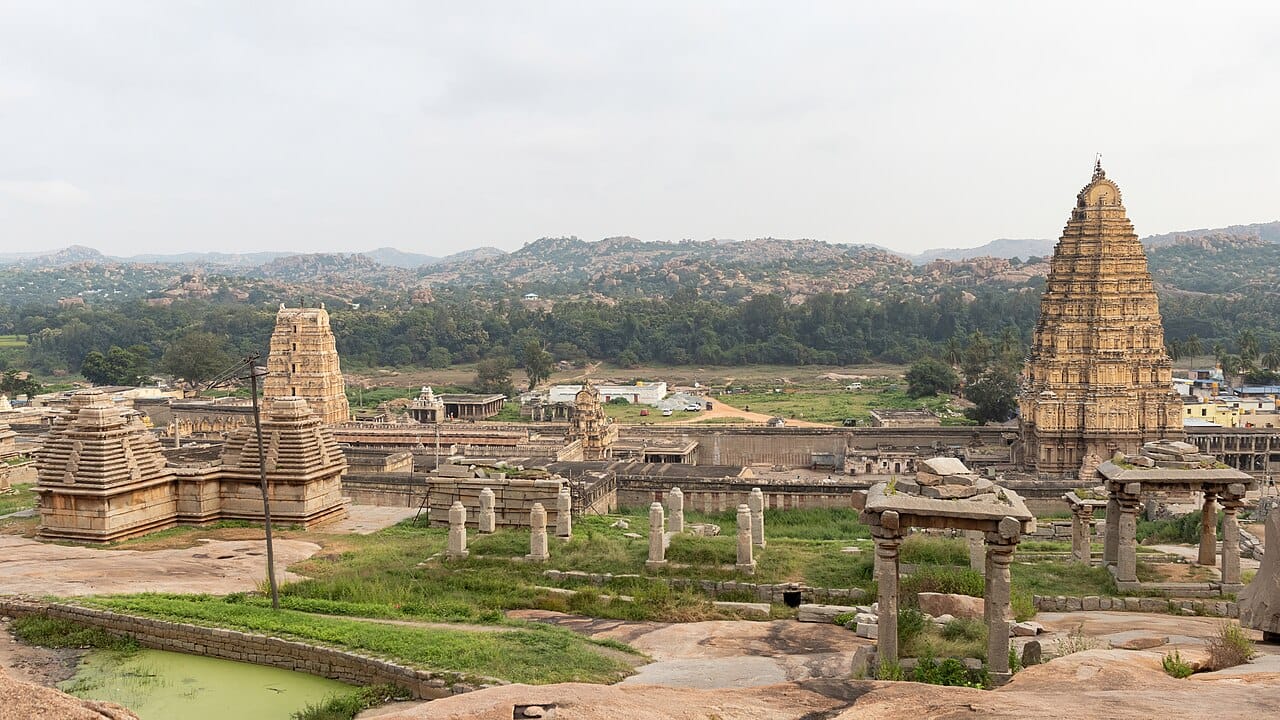
The Virupaksha Temple in Hampi, Karnataka, is a UNESCO World Heritage Site and the oldest functioning temple in India, dedicated to Lord Shiva as Virupaksha.
Chamundeshwari Temple
Perched atop Chamundi Hills at 3,489 feet, the Chamundeshwari Temple is the tutelary shrine of the Wodeyar dynasty of Mysore. The goddess Chamundeshwari, an eight-armed form of Durga who defeated the demon Mahishasura, is the state deity (Naada Devi) of Karnataka. The temple is accessed by 1,000 stone steps built in 1664.
Badami Cave Temples
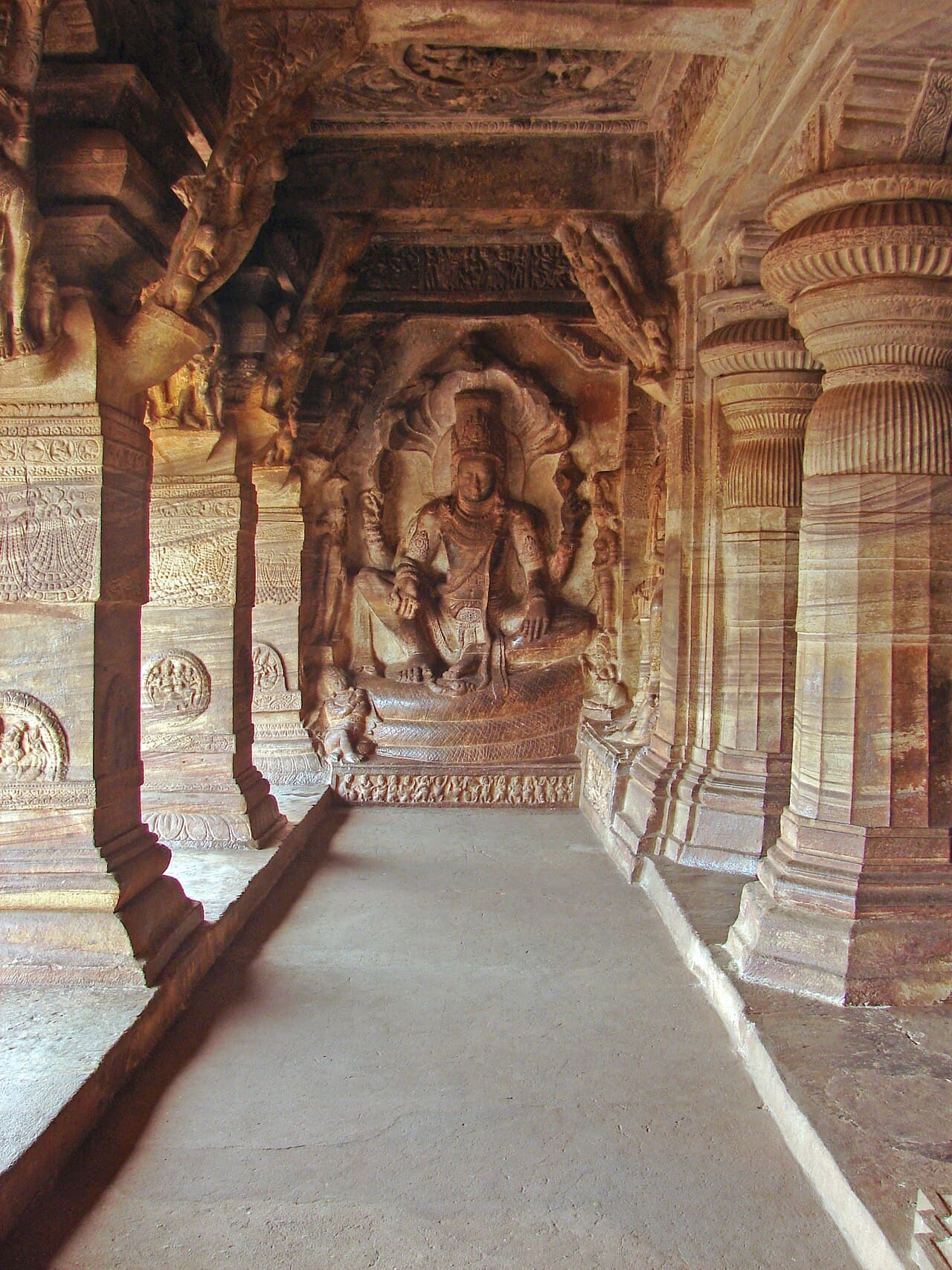
The Badami Cave Temples are a complex of four rock-cut cave temples carved into the soft sandstone cliffs of Badami, the capital of the Early Chalukya dynasty. Dating from the 6th-7th century CE, these caves represent the earliest known examples of South Indian temple architecture in rock-cut form and are considered the birthplace of Chalukya art. The site is on UNESCO's tentative list of World Heritage Sites.
Durga Temple
The Durga Temple at Aihole, built in the 7th-8th century CE, is a distinctive architectural experiment of the Early Chalukya period. Featuring a unique apsidal (horseshoe-shaped) plan modelled after a Buddhist chaitya hall, a raised gallery with carved stone pillars, and a massive Dravidian-style shikhara, it represents the creative fusion of architectural traditions that Characterises Aihole as the 'cradle of Indian temple architecture.'
Lad Khan Temple
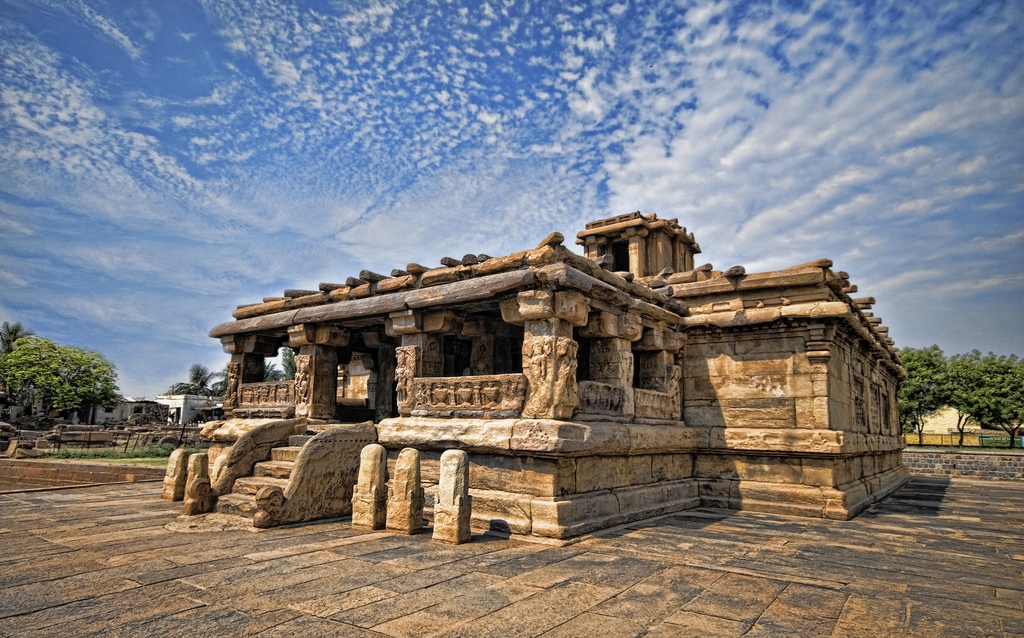
The Lad Khan Temple at Aihole is one of the oldest surviving stone temples in India, dating to the 5th century CE. Built by the Early Chalukya dynasty, the temple is a key monument in the evolution of Hindu temple architecture, representing an early experimental phase when temple builders were adapting earlier wooden and brick construction methods into permanent stone forms. The temple features a flat-roofed mandapa with 16 carved stone pillars and a small ground-level sanctum.
Meguti Temple
The Meguti Temple atop the Aihole hill is a Jain temple built in 634 CE by Ravikirti, the court poet of the Chalukya emperor Pulakeshin II. The temple is historically paramount for its inscription — the Aihole Prashasti — which provides the earliest known securely dated reference in Chalukya history and records the military campaigns of Pulakeshin II, including his victory over the Pallava king Mahendravarman I.
Rasmancha Bishnupur
The oldest 17th-century brick structure in Bishnupur, unique for its massive pyramidal roof and arched galleries.
Jor-Bangla Temple Bishnupur
Known for its 'twin hut' design and incredibly detailed terracotta panels depicting the Ramayana and Mahabharata.
Shyam Rai Temple Bishnupur
A five-towered terracotta temple famous for its circular friezes showing the Rasa-lila of Lord Krishna.
Dashavatara Temple
Dating to around 500 CE, this is the earliest known North Indian temple with a shikhara (curvilinear tower). The temple is famous for its carved panels depicting the ten incarnations (Dashavatara) of Vishnu on the sanctum walls.
Shri Ram Janmabhoomi Mandir
A grand and historic temple marking the birthplace of Lord Rama, the seventh avatar of Vishnu, representing the pinnacle of Nagara architecture.
Prem Mandir
A stunning modern white-marbled complex in Vrindavan dedicated to Divine Love, known for its life-like tableaus of Krishna's pastimes.
India's temples are living traditions — not museums. Every temple has its own customs. This guide helps first-time visitors prepare with confidence and respect.
Foreign visitor information is being researched
Please verify with the official temple authority before planning your visit.
Foreign Visitors
Verify Before VisitingVisitor Information
Entry policies vary between temples. Most temples welcome visitors, while some may restrict access to specific areas, rituals, or the inner sanctum. Always verify the latest entry guidelines with the official temple authorities before your visit.
Modest clothing is expected at every Indian temple — a sign of respect, not a restriction. Think of it as dressing for a formal ceremony.
A scarf is always useful — it covers shoulders, works as a head covering, and can double as a makeshift face cover if needed.
Outdoor photography is generally permitted. Indoor photography is often restricted. Always look for signage or ask a priest before taking photos inside.
The ideal time to visit the Chennakesava Temple is from October to March, when Karnataka's Malnad region enjoys pleasant weather with temperatures between 15 and 28 degrees Celsius. The post-monsoon months of October and November are particularly beautiful as the surrounding landscape is lush and green, and the Yagachi River flows full. The winter months of December and January are comfortable for exploring the extensive sculptural details of the temple. The Vaikuntha Ekadasi festival in December-January is a special time to visit, though the temple is extremely crowded. The summer months of March to May can be warm, with temperatures reaching 35 degrees Celsius, though the temple's stone construction remains cool inside. The monsoon months of June to September bring heavy rainfall to the Belur region, which can make the temple precincts slippery and reduce visibility for appreciating the architectural details, though the rain-washed stone creates a unique aesthetic. For photographers, the golden hours just after sunrise (6:30-8:00 AM) provide the best light for the star-shaped platform and the exterior friezes.
April — June
July — September
English is widely understood at major tourist temples. In smaller local temples, Hindi and the regional language are more common. A smile and simple hand gestures go a long way. Learning a few words of the local language is always appreciated.
Cash (Indian Rupees) is the most reliable option, especially for temple offerings, small shops, and local transport.
UPI digital payments (Google Pay, PhonePe, Paytm) are widely accepted across India — even at roadside stalls. Download one before you arrive.
International credit/debit cards work at most ATMs, hotels, and larger establishments. Smaller vendors may only accept cash or UPI.
Carry small denominations (₹10, ₹20, ₹50, ₹100 notes) for offerings and temple donations. Large notes (₹500, ₹2000) can be hard to break at smaller counters.
Many historic temples have uneven stone floors, multiple steps, and narrow passages. Wheelchair access is limited at older sites — contact the temple in advance.
Basic restroom facilities and drinking water are available at most major temples. Some charge a small fee (₹5–₹10).
Stay hydrated — carry a reusable water bottle, especially in hot climates.
Keep valuables secure — use hotel lockers for passports and excess cash.
Wear comfortable, sturdy footwear — temple floors can be hot, wet, or uneven.
Beware of unofficial guides or touts near temple entrances. Only use authorised services.
Carry a photocopy of your passport and visa. Leave originals in your hotel safe.
Download offline maps — mobile networks can be unreliable near remote temple sites.
These short explanations help make sense of what you see and experience.
Darshan means 'seeing' — but in a temple it means being seen by the deity. It is a sacred moment of connection, not just a viewing.
Removing footwear is a sign of humility. It also keeps the temple floor clean, since devotees sit and pray on the ground.
Food offered to the deity and then distributed to devotees. It is considered blessed. Accept it with both hands and do not discard it.
The bell creates a focused acoustic atmosphere, wards off distractions, and announces your presence before entering the inner sanctum.
Circumambulation (pradakshina) is done clockwise, keeping the sanctum on your right — an auspicious direction aligned with the sun's path.
Flowers symbolise devotion, coconuts represent the ego being broken, incense purifies the air, and lamps represent the victory of light over darkness.
Sacred viewing of the deity; the central act of temple worship.
Clockwise circumambulation of the sanctum.
Blessed food offered to the deity and distributed to devotees.
The innermost sanctum where the main deity resides.
The towering spire above the sanctum, a defining feature of temple architecture.
A pillared hall or pavilion within the temple complex.
The Indian Rupee (?, INR) is the local currency. ATMs are widely available in cities and towns. For temple offerings, keep small notes (₹10, ₹20, ₹50). Most temples accept donations in cash only — digital payments are uncommon at the offering counter itself.
Offerings (dakshina) are given with the right hand. Place cash in the donation box (hundi) or give it directly to the priest. There is no fixed amount — give what feels appropriate. Some temples have fixed fees for special entry or puja participation.
Shoes and sandals are removed before entering the temple building. Most temples have a designated shoe counter (free or a small fee of ₹5–₹20). Socks are generally allowed. In monsoon, carry a plastic bag for wet shoes.
Darshan queues can take 30 minutes to 3 hours at popular temples. Many offer paid VIP darshan (₹100–₹500) for faster entry. Special queues for women, elderly, and disabled visitors exist at some temples. No line jumping.
Major festivals draw enormous crowds — sometimes hundreds of thousands. Book accommodation months in advance. Expect road closures, restricted vehicle access, and limited phone network. Arrive early (before dawn) to avoid the worst congestion.
Always look for signage before taking photos. When in doubt, ask a priest. Never take photos of devotees in prayer without permission. Selfie sticks are banned at most temples. Silently switch your phone to silent mode.
Police / Ambulance / Fire: 112 (National Emergency Number)
Tourist Helpline: 1800-111-363 (Multi-lingual, Ministry of Tourism)
Women's Helpline: 1091
Temple-specific visitor information is continuously researched and updated from official sources. Where specific data is unavailable, general India travel guidance is provided. Always verify current policies with the temple authority before your visit.
Information last verified July 2026. Temple-specific data coming soon.
Continue your journey through the spiritual and architectural wonders of India.

The Virupaksha Temple in Hampi, Karnataka, is a UNESCO World Heritage Site and the oldest functioning temple in India, dedicated to Lord Shiva as Virupaksha.

Perched atop Chamundi Hills at 3,489 feet, the Chamundeshwari Temple is the tutelary shrine of the Wodeyar dynasty of Mysore. The goddess Chamundeshwari, an eight-armed form of Durga who defeated the demon Mahishasura, is the state deity (Naada Devi) of Karnataka. The temple is accessed by 1,000 stone steps built in 1664.

The Badami Cave Temples are a complex of four rock-cut cave temples carved into the soft sandstone cliffs of Badami, the capital of the Early Chalukya dynasty. Dating from the 6th-7th century CE, these caves represent the earliest known examples of South Indian temple architecture in rock-cut form and are considered the birthplace of Chalukya art. The site is on UNESCO's tentative list of World Heritage Sites.

The Durga Temple at Aihole, built in the 7th-8th century CE, is a distinctive architectural experiment of the Early Chalukya period. Featuring a unique apsidal (horseshoe-shaped) plan modelled after a Buddhist chaitya hall, a raised gallery with carved stone pillars, and a massive Dravidian-style shikhara, it represents the creative fusion of architectural traditions that Characterises Aihole as the 'cradle of Indian temple architecture.'

The Lad Khan Temple at Aihole is one of the oldest surviving stone temples in India, dating to the 5th century CE. Built by the Early Chalukya dynasty, the temple is a key monument in the evolution of Hindu temple architecture, representing an early experimental phase when temple builders were adapting earlier wooden and brick construction methods into permanent stone forms. The temple features a flat-roofed mandapa with 16 carved stone pillars and a small ground-level sanctum.

The Meguti Temple atop the Aihole hill is a Jain temple built in 634 CE by Ravikirti, the court poet of the Chalukya emperor Pulakeshin II. The temple is historically paramount for its inscription — the Aihole Prashasti — which provides the earliest known securely dated reference in Chalukya history and records the military campaigns of Pulakeshin II, including his victory over the Pallava king Mahendravarman I.

The Hoysaleswara Temple in Halebidu, built circa 1121-1160 CE, is the largest Shiva temple built by the Hoysalas. Inscribed as a UNESCO World Heritage Site in 2023 as part of the Sacred Ensembles of the Hoysalas, it is celebrated for its hyper-realistic soapstone sculptures covering every surface of the structure.

The Kedareshwara Temple at Halebidu, built in 1319 CE by the Hoysala king Veera Ballala III, is a Hoysala-era temple dedicated to Lord Shiva. It features the characteristic Hoysala star-shaped platform (jagati), intricately carved soapstone pillars, and elaborate sculptural friezes. The temple is a protected monument under the Archaeological Survey of India.
"Pattadakal represents the high point of an eclectic art which, in the 7th and 8th centuries, achieved a harmonious blend of architectural forms from northern and southern India."